
FILM-320 · Lesson 11 of 12 · 26 min
Directing in post-production
Many filmmakers say that a film is written three times: once on the page, once on set and once in the cutting room. The director's work in post-production is the third writing. Scenes are shortened, reordered or removed; performances are reshaped by choosing different takes and reactions; the story's emphasis shifts; and sound, music and colour are added. The film the audience sees may be quite different from the one planned in prep. Directors who treat post-production as a technical finishing stage miss one of their greatest creative opportunities.
FILM-220 covers editing from the editor's side, FILM-310 covers sound post-production, and CINE-310 covers colour grading. This lesson covers the director's role: the stages and versions of a cut, working with the editor, shaping performance and structure, the director's cut and guild protections, test screenings and notes, and locking the picture and finishing the film.
The stages of post-production
Post-production usually begins during the shoot. The editor receives dailies each day and starts assembling scenes, so that by the end of shooting there is a complete or nearly complete editor's assembly. The director typically takes a short break after the shoot, then begins working with the editor toward the director's cut. After that come producers' and financiers' notes, further cuts, test screenings where appropriate, picture lock, and then the finishing stages of sound editing and mixing, music, visual effects, colour grading and delivery.
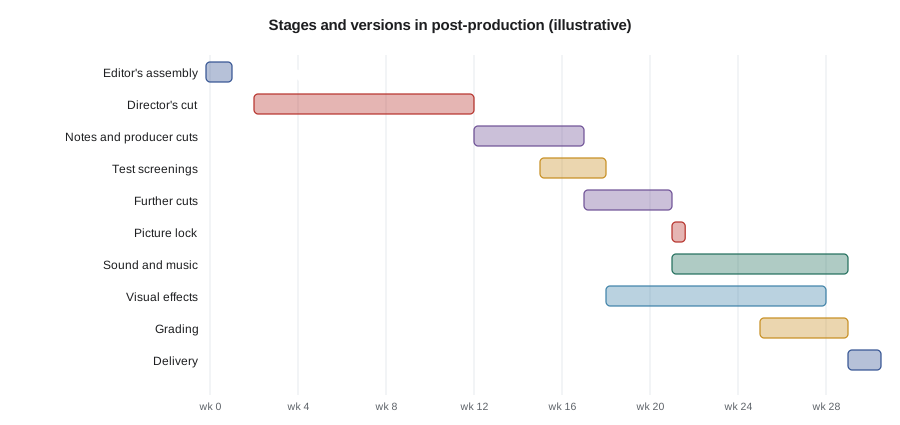
| Version | Prepared by | Purpose |
|---|---|---|
| Editor's assembly | Editor, during and just after the shoot | All scenes in script order, usually long, to see what was shot |
| Director's cut | Director with the editor | The director's version of the film, protected under guild agreements |
| Producer's cut | Producers with the editor and director | Responds to producers' and financiers' notes |
| Test-screening cuts | Director and editor | Versions shown to audiences to gauge response |
| Locked cut | Director and producers | Final picture edit, handed to sound, music, effects and colour |
Watching the assembly
The first viewing of the editor's assembly is often painful. It is long, sometimes much longer than the intended running time, scenes play at their full scripted length and the pace may feel slow. Experienced directors expect this and watch with a clear purpose: to see what material exists, which scenes work, which do not and where the story's energy lies. It helps to take notes immediately after a single uninterrupted viewing, as with the first reading of a script described in lesson 2.
The assembly is also the first chance to see the film as an audience might, rather than as a series of shooting days. Directors often discover that scenes they fought to shoot are unnecessary, while small moments they barely noticed on set are the heart of the film. Staying open to these discoveries is essential.
Working with the editor
The director and editor are partners. A good editor brings fresh eyes: they were not on set, have no memory of how hard a shot was to get, and see only what is on screen. Directors should value this perspective, especially when an editor suggests cutting something the director loves. The relationship works best when the director explains intentions and the editor proposes solutions, mirroring the director's partnership with the cinematographer.
Practical habits help. Many directors let the editor work alone on a scene first, then review and give notes, rather than sitting beside them for every cut. Notes should focus on the purpose of a scene or moment rather than on specific frames, at least at first. Directors should watch the whole film regularly, not only individual scenes, because rhythm and structure can only be judged across the whole. Taking breaks and returning with fresh eyes is valuable for both.
Shaping performance in the edit
Editing can transform performances. By choosing among takes, the director and editor can make a character warmer or colder, more confident or more fragile. Reaction shots can change the meaning of a line: the same line followed by a smile or a flinch tells two different stories. Pauses can be lengthened or shortened, and lines can be removed altogether. Sometimes a line from one take is combined with a reaction from another, or dialogue is replaced with automated dialogue replacement, as FILM-310 lesson 7 describes.
These tools carry responsibility. Editing can improve a performance; it can also distort it in ways the actor did not intend. Most actors accept that the edit will shape their work, but a director should avoid assembling a performance that misrepresents the actor's choices in ways that would embarrass them, and should be particularly careful in documentary and with non-actors, where editing can change what people appear to have said or meant.
Worked problem
Shaping the end of the kitchen scene in the edit
In the cut of the kitchen scene, the final push of the box plays in the two-shot, followed by a close-up of Dana, then a cut to the next scene. Test viewers say the ending feels abrupt and they are unsure what the sisters feel. What options does the director have?
Show solution
- Look for a reaction from Maya after the box comes back; holding on her face may show the hurt and acceptance the audience is missing.
- Try extending the silence by holding the two-shot longer before the cut, letting the stalemate register.
- Consider using the take in which Dana's hand rests on the box for a moment before she pushes it, adding hesitation.
- Check whether a sound transition, such as the kitchen tap dripping over the cut, could carry the emotion into the next scene.
- Test two versions with the editor and watch them in the context of the whole film, not in isolation.
Answer: Small changes in reaction, timing and sound can clarify the ending without new shooting. The best choice is the one that serves the scene's purpose, an unresolved stalemate, within the film's rhythm.
Shaping structure
The edit can also change the film's structure. Scenes can be moved, combined, cut or reordered. A slow opening can be tightened or replaced; a subplot that distracts from the spine can be removed; a flashback can be repositioned to change when the audience learns information. Many celebrated films found their final shape in the cutting room after their original structure did not work.
Structural changes should be measured against the spine. If the film is about a woman learning that she cannot reclaim her childhood by holding on to a place, every scene should contribute to that journey. Scenes that do not, however beautiful, may need to go. Directors sometimes keep a list of cut scenes and moments, both to revisit later and to remind themselves that cutting is a creative choice rather than a loss.
| Problem | Possible solutions in the edit |
|---|---|
| Slow opening | Start later in the first scene; move a hook earlier; cut exposition |
| Confusing timeline | Add clearer transitions; reorder scenes; use sound or titles to orient |
| Saggy middle | Cut repetitive scenes; intercut storylines; tighten within scenes |
| Unclear protagonist journey | Strengthen key turning points; cut subplots that compete |
| Ending lacks impact | Trim the build-up; hold the final moment longer; reconsider the last image |
The director's cut and guild protections
Guild agreements protect the director's right to prepare a cut of the film before producers make their own changes. Under the DGA Basic Agreement in the United States, the director of a theatrical feature is generally entitled to a director's cut period of ten weeks, or one day of editing for each two days of scheduled photography, whichever is longer, with different periods for television and low-budget films. The agreement also gives the director the right to be consulted throughout post-production and, for theatrical films, to request a preview of the director's cut before an audience.
In Canada, DGC agreements with producers include creative rights provisions for directors, including rights relating to the director's cut and consultation in post-production. The details depend on the agreement and the production, so directors should read the relevant agreement and their own contract carefully. On productions without a guild agreement, the director's rights in post-production depend entirely on the contract.
Final cut, the right to decide the final version of the film, is a separate matter. Most directors do not have it; it usually rests with the producers, studio or financier. Final cut is normally reserved for established directors with significant leverage. A director without final cut must persuade rather than decide, which makes the quality of the director's cut and the director's relationships with producers all the more important.
Notes and test screenings
After the director's cut, producers, financiers, distributors and sometimes broadcasters or streamers give notes. Notes can be frustrating, but they often identify real problems even when the suggested solutions are wrong. A useful approach is to look for the problem behind the note: a producer who says "cut the kitchen scene" may really be saying that the middle of the film drags, which might be solved in another way.
Test screenings show the film to recruited audiences who are not involved in its production. Afterward, viewers usually complete questionnaires rating the film and individual elements, and a smaller group may join a moderated discussion. Test screenings are common on studio films and less common on independent films, where informal screenings for trusted friends and colleagues serve a similar purpose. The results should be interpreted with care: audiences are good at telling you where they were confused, bored or moved, and less reliable at telling you how to fix it.
import random, statistics
random.seed(11)
n = 120
# simulated ratings: 1 = poor, 5 = excellent
overall = [min(5, max(1, round(random.gauss(3.7, 0.9)))) for _ in range(n)]
recommend = sum(1 for r in overall if r >= 4) / n
print(f"Viewers: {n}")
print(f"Mean overall rating: {statistics.mean(overall):.2f}")
print(f"Share rating 4 or 5: {recommend:.0%}")
# scenes flagged as confusing or slow
flags = {"Opening funeral": 0.18, "Kitchen scene": 0.06, "Lawyer's office": 0.41,
         "Garden at dusk": 0.09, "Bus station ending": 0.27}
for scene, share in sorted(flags.items(), key=lambda kv: -kv[1]):
    marker = "  <- look at this" if share > 0.25 else ""
print(f"{scene:20s} flagged by {share:.0%}{marker}")Viewers: 120 Mean overall rating: 3.87 Share rating 4 or 5: 69% Lawyer's office flagged by 41% <- look at this Bus station ending flagged by 27% <- look at this Opening funeral flagged by 18% Garden at dusk flagged by 9% Kitchen scene flagged by 6%
Numbers like these help directors and producers find patterns, such as a scene that many viewers found slow or confusing. They do not replace judgement. A scene that unsettles audiences may be doing exactly what it should, and a film designed only to please test audiences can lose what made it distinctive. The director's job is to listen to the evidence, weigh it against the film's intentions and argue for the choices that matter.
Picture lock and finishing
Picture lock is the point at which the edit is finalized and handed to the finishing departments. Locking matters because sound editors, composers, visual effects artists and colourists all work to the exact timing of the cut; changes after lock create extra work and cost. Directors should resist locking before they are ready but recognize that endless tinkering rarely improves a film.
After lock, the director supervises finishing. In spotting sessions with the sound team and composer, the director explains what each scene needs, as FILM-310 describes. In the grading suite, the director works with the colourist and cinematographer on the look, as CINE-310 describes. The director reviews visual effects, approves the final mix and checks the deliverables. Each of these stages can change the film's effect significantly, and directors who stay engaged through them usually see their intentions realized more fully.
Directing documentary in post-production
In documentary, post-production often carries even more of the directing than in fiction. The structure may be found almost entirely in the edit, from many hours of observational footage and interviews. This gives the director great freedom and great responsibility, because editing choices determine how real people and events are represented. CINE-320 and FILM-220 lesson 8 cover documentary practice. The ethical principle from lesson 9 applies strongly here: the film must not make people appear to say or mean what they did not.
Common mistakes
MistakeWatching the assembly and despairing at its length
InsteadExpect a long assembly and watch it to learn what material exists.
MistakeDictating frame-by-frame changes to the editor from the start
InsteadExplain the purpose of scenes and let the editor propose solutions.
MistakeKeeping scenes because they were hard to shoot
InsteadMeasure every scene against the spine and cut what does not serve it.
MistakeDismissing producers' notes outright
InsteadLook for the real problem behind each note before deciding how to respond.
MistakeTreating test-screening scores as instructions
InsteadUse them to find where audiences were confused or bored, then decide solutions yourself.
Summary and key terms
- Post-production is the third writing of a film; scenes, performances and structure can all change.
- The editor's assembly, director's cut, producer's cuts and locked cut each have a purpose.
- The editor's fresh eyes are valuable; share intentions and let the editor propose.
- Choosing takes and reactions can reshape performances, with a responsibility not to misrepresent.
- Guild agreements protect a director's cut period and consultation; final cut usually rests elsewhere.
- Notes and test screenings reveal problems; the director decides how to solve them.
- After picture lock, the director supervises sound, music, effects and colour to realize the film's intentions.
- Editor's assembly
- The editor's first complete version of the film, usually in script order.
- Director's cut
- The director's version of the film, protected under guild agreements.
- Final cut
- The right to decide the final version of the film.
- Picture lock
- The point at which the edit is finalized for finishing.
- Test screening
- A showing of a cut to a recruited audience to gauge response.
- Notes
- Feedback on a cut from producers, financiers or others.
- Reaction shot
- A shot of a character responding to something.
- Spotting session
- A meeting to decide where sound and music will be used.
- Finishing
- The post-production stages after picture lock: sound, music, effects, colour and delivery.
- Pickup
- A shot filmed after principal photography to fill a gap found in the edit.
Practice problems
Work each problem on paper first, then reveal the answer to check.
Why do some filmmakers say a film is written three times?
Show answer
It is shaped on the page, on set and in the cutting room.
Why is the editor's assembly often long and slow?
Show answer
It includes all scenes at full scripted length in script order.
Why is the editor's fresh perspective valuable?
Show answer
They see only what is on screen, without memories of how hard shots were.
How can a reaction shot change the meaning of a line?
Show answer
A smile or a flinch after the line tells different stories.
Under the DGA Basic Agreement, how long is the director's cut period for a theatrical feature?
Show answer
Ten weeks, or one day per two days of scheduled photography, whichever is longer.
Who usually holds final cut?
Show answer
Producers, the studio or the financier; only established directors usually have it.
What should a director look for behind a note?
Show answer
The real problem the note points to, which may have other solutions.
What are audiences in test screenings most reliable at telling you?
Show answer
Where they were confused, bored or moved.
Why does picture lock matter to other departments?
Show answer
Sound, music, effects and colour all work to the exact timing of the cut.
Why is editing especially sensitive in documentary?
Show answer
It determines how real people and events are represented.
Lesson quiz · 5 questions
Score 60% or more to complete this lesson.
Create a free account to save your progress, take quizzes and earn a certificate.