
FILM-420 · Lesson 1 of 12 · 28 min
How media law protects and constrains image makers
Every photograph, film, video and podcast is surrounded by law. The image maker owns rights in the work they create, and those rights let them control copying and earn money from licensing. At the same time, the work almost always contains other people's property and other people's faces: a song playing in a café, a painting on a wall, a logo on a T-shirt, a stranger on a bus, a building, a quotation from a book, a clip from a news broadcast. Each of those can carry its own rights. Media law is the set of rules that decides who controls what, who must give permission, and what happens when someone uses material without it.
This course is written for working photographers, filmmakers, editors, producers and content creators. It explains how the law works so that you can spot problems early, ask the right questions, paper your projects properly and know when to call a lawyer. Laws differ between countries, provinces and states, they change, and the outcome of any real dispute depends on its facts. When a project carries real money or real risk, a lawyer who practises entertainment or media law should review the specific situation.
This version of the course follows Canadian law: the federal Copyright Act and Trademarks Act, the Civil Code of Québec, provincial privacy statutes and common law, the Criminal Code and the Canadian rules on defamation. Where American law matters to Canadian producers, for example because a project is sold to a United States streamer or uses American music, the lessons say so.
The figures and dates in this course were checked in October 2026. Fees, damages ranges, platform policies and new laws on artificial intelligence change quickly, so check current sources before relying on any number.
Five bodies of law every image maker meets
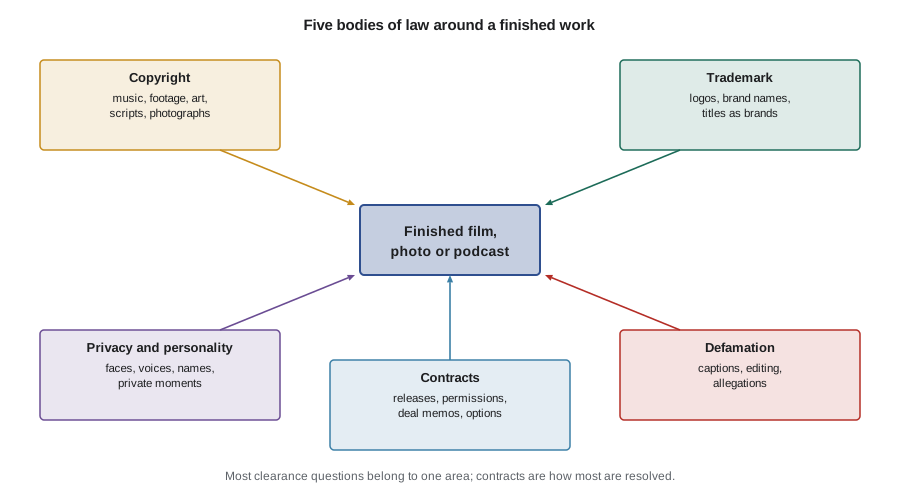
Most legal questions on a shoot or in an edit suite fall into one of five areas. Knowing which area a question belongs to tells you which rules apply and who has the right to say yes or no.
- Copyright protects original creative works, such as photographs, films, music, scripts, paintings, choreography and software. It controls copying, distribution, adaptation and public performance, and it belongs to the author or whoever the author has transferred it to.
- Trademark law protects names, logos and other signs that identify the source of goods and services. It stops confusing or misleading uses, not every appearance of a brand.
- Privacy and personality rights protect people against intrusion, the exposure of private facts and the unauthorized commercial use of their name, image or voice.
- Defamation law protects reputation against false statements of fact that harm it, including statements made through images, captions and editing.
- Contract law binds people to the promises they make in releases, licences, deal memos, option agreements and distribution contracts. Much of practical media law is contract law, because most rights are cleared by agreement.
Several other areas also touch image makers: criminal law (for example, voyeurism and recording offences), regulatory rules for drones, broadcasting and advertising, consumer protection, employment and labour law, and the rules on content credentials and synthetic media covered in PHOT-420. BUS-210 introduces contract and tort law in general; this course applies them to media work.
Rights in, rights out
Producers and photographers think about rights in two directions. Rights in are the permissions you need from others to make and exploit the work: the script, the music, the archive footage, the location, the people on camera. Rights out are the permissions you grant to others: a client's licence to use a photograph, a distributor's right to release a film, a broadcaster's licence for three years in one territory.
The two must match. You cannot grant more than you hold. If your music licence covers festivals only, you cannot sell a worldwide streaming licence for the film without going back to the music publisher and the record label. If a model release covers editorial use only, you cannot license the photograph for an advertising campaign. Many expensive problems come from a mismatch between rights in and rights out, often discovered only when a buyer or insurer asks for paperwork.
| Item | Rights in (what you need) | Rights out (what you grant) |
|---|---|---|
| Interviews | Appearance releases from each participant | Distributor may use the interviews in the film and its marketing |
| Score | Composer agreement assigning or licensing music | Worldwide licence to the distributor for the film |
| Archive clip | Footage licence for named media, territory and term | Cannot exceed the footage licence |
| Location | Location agreement allowing filming and depiction | Location may appear in the film and trailers |
| Photographs used on screen | Licence from each photographer | Same scope as the photograph licences |
Why the law treats images differently
Images raise legal questions that text often does not. A photograph can identify a person instantly, record a private moment, reproduce another artist's work in full or imply a story that is not true. Editing can change meaning: two shots placed side by side can suggest a connection between people who never met. Captions and titles can turn a neutral picture into a defamatory statement. Because images are copied so easily, a single upload can spread a work around the world in hours.
Courts and legislators have responded with doctrines that treat images with particular care. Privacy law pays attention to whether a person is identifiable and whether they are the subject of the image or part of a crowd. Copyright law asks whether a work appears incidentally in the background or is featured. Defamation law reads images and captions together, as an ordinary viewer would. These distinctions recur throughout the course.
Commercial, editorial and artistic uses
The purpose of a use changes the legal analysis more than almost anything else. Three broad categories help.
- Commercial use promotes a product, service, brand or cause, as in advertising, packaging, sponsored content and corporate marketing. It carries the highest legal risk and usually requires releases from every identifiable person and permission for every trademark, artwork and property featured.
- Editorial use informs or comments, as in news, documentary, journalism, education and criticism. It enjoys more legal protection, including stronger free expression protections and broader exceptions to copyright, but it is not unlimited.
- Artistic or expressive use includes fiction films, fine art photography, exhibitions and books. It sits between the two: often protected as expression, but subject to privacy, publicity and copyright rules that vary by place.
In Canada, the line between these uses matters especially in Quebec, where the Civil Code protects a person's image and the Supreme Court has held that publishing an identifiable photograph of a person without consent can be a fault even in an artistic magazine (Lesson 7). Outside Quebec, provincial privacy statutes and common law torts also look closely at commercial exploitation of a person's name or likeness.
A single image can change category. A photograph taken for a news story is editorial; the same photograph used in an advertisement for a newspaper subscription can become commercial. Always ask how each use is presented and what it is selling.
Who enforces media law
Most media law is enforced privately. The person whose rights are affected decides whether to complain, send a demand letter, issue a takedown notice, negotiate a licence fee or sue. Courts decide disputes that are not settled. Some areas also have public enforcement: criminal offences such as voyeurism or illegal interception of communications, broadcasting regulators, privacy commissioners and advertising standards bodies.
In Canada, copyright and privacy disputes go to the provincial superior courts or, for copyright and trademarks, the Federal Court. Small claims courts handle lower-value claims; limits vary by province, from 35,000 dollars at the British Columbia Provincial Court to 50,000 dollars in Ontario and 100,000 dollars in Alberta (as of 2026). The Copyright Board sets tariffs for collective societies. Privacy commissioners oversee personal information laws, and Ad Standards administers the advertising code.
In practice, the gatekeepers who check rights most rigorously are often not courts but buyers, insurers and platforms. A broadcaster's legal department, a streamer's delivery requirements, an errors and omissions insurer's application form or a platform's content-identification system will ask for proof of rights long before anyone sues. Learning to satisfy them is a core professional skill.
Risk, not certainty
Media law rarely gives a yes or no answer in advance. More often it asks how likely a claim is, how much it would cost, and whether the use is worth the risk. Lawyers and insurers think in terms of risk: the probability of a complaint, the likely damages, the cost of defending a claim even if you win, and the reputational cost. Risk depends on the use, the audience, the territory, the deep pockets of the parties and the attitude of the rights holder.
Worked problem
Rating clearance risk on three shots
A short film includes (a) a famous painting clearly visible behind the lead actor for a full scene, (b) a soft drink logo on a can in the background of a street shot for two seconds, and (c) a recognizable stranger crossing the frame in a crowd. Rank the shots by legal risk and suggest a fix for each.
Show solution
- The painting is featured, recognizable and on screen for a long time, so copyright risk is high unless the work is in the public domain or licensed. Fix: obtain a licence, replace it with cleared or original art, or reframe.
- The logo is incidental and brief, and it is shown accurately, so trademark risk is low; the main concern would be a negative or misleading association. Fix: usually none needed, though some broadcasters ask for brands to be blurred or replaced.
- The stranger is identifiable but not featured. Risk depends on the jurisdiction and the use (Lesson 7). Fix: post crowd notices, get a release if the person is prominent, or blur if the use is commercial or the location is sensitive.
Answer: Highest risk: the featured painting. Medium: the identifiable stranger, depending on place and use. Lowest: the passing logo. The producer should log each item and record the decision.
Throughout the course, worked examples rate risks in this way. The goal is not to eliminate every risk, which is impossible, but to identify the serious ones, clear what must be cleared, document decisions and buy insurance for the rest.
Where the rules come from
Media law draws on several sources: statutes passed by legislatures, regulations made under them, court decisions that interpret statutes and develop the common law, international treaties, and private rules set by contracts, collective agreements, industry codes and platform terms.
Canadian copyright and trademark law are federal. Privacy, defamation, property and most contract law are provincial, so the rules differ between provinces, and Quebec follows a civil law tradition based on the Civil Code rather than the common law used in the other provinces and territories. Canada belongs to the Berne Convention, the WIPO Internet Treaties and the Canada–United States–Mexico Agreement, which shaped the 2022 extension of the copyright term.
International treaties matter because media travels. Under the Berne Convention, a work created in one member country is protected in all others under each country's own law, without registration formalities. That is why a Canadian photograph is protected in the United States and vice versa, but also why the length of protection and the exceptions available can differ when the same work is used in different places.
How this course is organized
Lessons 2 to 6 cover copyright: what it protects, who owns it, how infringement is enforced, the exceptions that allow some uses without permission, and how to clear music, art, trademarks and footage. Lessons 7 to 9 cover people and places: privacy and personality rights, defamation and filming in public, and releases. Lesson 10 covers contracts and licences. Lesson 11 looks at artificial intelligence, digital replicas and platforms. Lesson 12 brings everything together in a clearance and contracting plan for a documentary project.
Several other courses connect to this one. PHOT-410 covers copyright and contracts as business assets for photographers, including pricing usage. FILM-410 covers producing, including the chain of title and errors and omissions insurance from the producer's side. FILM-320 covers working with performers, including children. CRE courses cover disclosure rules for sponsored content. PHOT-420 covers content credentials and laws on synthetic images. This course concentrates on the legal rules themselves.
Habits that prevent most problems
Experienced producers and photographers share a few habits that prevent most legal trouble. They are simple, but they need discipline on busy shoots.
- Get it in writing. Oral permissions are hard to prove and often do not satisfy the law's requirements for transferring rights.
- Clear early. The cost of clearing a song or a location rises sharply once the scene is shot and the cut is locked.
- Keep a clearance log from the first day, listing every third-party element, its rights holder, the permission obtained and where the document is filed.
- Match rights in to rights out. Before signing a distribution deal, check that every licence covers the media, territories and term you are granting.
- Ask when unsure. A short consultation with a media lawyer costs far less than a claim, a recall or a reshoot.
The rest of the course explains the legal reasons behind these habits and shows how to apply them to real projects.
Common mistakes
MistakeAssuming that anything visible in public can be used freely
InsteadCheck copyright, trademark and personality rights for anything featured, even in public places.
MistakeTreating media law as one national set of rules
InsteadIdentify the jurisdiction: provinces and states differ on privacy, publicity and defamation.
MistakeGranting a distributor more rights than your licences cover
InsteadMatch rights out to rights in for media, territory and term before signing.
MistakeRelying on oral permission for important rights
InsteadGet signed, written releases and licences and file them in a clearance log.
MistakeTreating legal questions as yes or no
InsteadAssess risk, document decisions, clear what must be cleared and insure the rest.
Summary and key terms
- Media law covers copyright, trademarks, privacy and personality rights, defamation and contracts.
- Rights in are permissions you need; rights out are permissions you grant, and the two must match.
- Commercial uses carry the highest risk; editorial and expressive uses enjoy more protection but not unlimited protection.
- Most media law is enforced privately, and buyers, insurers and platforms often check rights before any court does.
- Media law is usually a matter of risk assessment rather than certainty.
- Laws differ between countries and between provinces or states, and international treaties protect works across borders.
- Written permissions, early clearance and a clearance log prevent most problems.
- Copyright
- The exclusive right to copy, distribute, adapt and publicly perform an original work.
- Trademark
- A sign that identifies the source of goods or services, protected against confusing uses.
- Personality right
- A person's right to control commercial use of their name, image or voice.
- Defamation
- A false statement of fact that harms a person's reputation.
- Rights in
- The permissions a producer needs from others to make and exploit a work.
- Rights out
- The permissions a producer grants to others, such as distributors or clients.
- Clearance
- The process of identifying third-party rights in a work and obtaining permission or confirming that none is needed.
- Clearance log
- A record of every third-party element in a work, its rights holder and the permission obtained.
- Editorial use
- Use that informs or comments, such as news, documentary and education.
- Commercial use
- Use that promotes a product, service, brand or cause.
Practice problems
Work each problem on paper first, then reveal the answer to check.
Name the five main bodies of law around a finished film.
Show answer
Copyright, trademark, privacy and personality rights, defamation and contracts.
What is the difference between rights in and rights out?
Show answer
Rights in are permissions you obtain; rights out are permissions you grant to others.
Why can a music licence for festivals only cause problems later?
Show answer
You cannot grant streaming or broadcast rights in the film beyond what the music licence covers.
Which kind of use usually carries the highest legal risk?
Show answer
Commercial use, such as advertising.
Who often checks rights before any court does?
Show answer
Buyers, broadcasters, insurers and platforms.
Why does the same photograph sometimes need different permissions?
Show answer
The purpose of each use, such as editorial or commercial, changes the legal analysis.
What does the Berne Convention do for image makers?
Show answer
It protects works from one member country in all other members without registration formalities.
Give two habits that prevent most legal problems.
Show answer
For example, get permissions in writing and keep a clearance log from day one.
Rank a featured painting, a passing logo and a crowd member by typical risk.
Show answer
Featured painting highest, crowd member middle, passing logo lowest.
When should an image maker consult a media lawyer?
Show answer
When a project carries real money or risk, or when the answer is unclear.
Lesson quiz · 5 questions
Score 60% or more to complete this lesson.
Create a free account to save your progress, take quizzes and earn a certificate.