
FILM-420 · Lesson 9 of 12 · 25 min
Model, property and location releases
A release is a written permission from a person or property owner that allows an image maker to capture and use their image, voice, property or location in defined ways. Releases are the everyday tool for clearing the privacy, personality and property issues covered in Lessons 7 and 8, and they are among the first documents that buyers, stock agencies, broadcasters and insurers ask for. This lesson explains when releases are needed, what they should contain, and how to manage them on shoots of every size.
PHOT-410 lesson 5 covers model and property releases briefly as part of a photographer's document flow, and PHOT-499 covers releases and community consent for a capstone project. This lesson goes deeper into the law and practice of releases for both photography and film.
What a release does
A release is a contract. The person signing it, the releasor, gives permission and usually promises not to sue for the uses described; the person receiving it, the releasee, often gives something in return, such as a fee, a copy of the work or simply the opportunity to appear. Because it is a contract, its scope is defined by its words: a release for editorial use does not cover advertising, and a release for one film does not cover a sequel unless it says so.
A release does not transfer copyright. A model who signs a release does not become an owner of the photograph, and the photographer does not gain ownership of anything belonging to the model. A release only removes the model's ability to object to the uses it describes. Similarly, a property release does not give a photographer rights in a sculpture on the property; that needs a copyright licence from the sculptor.
When a release is needed
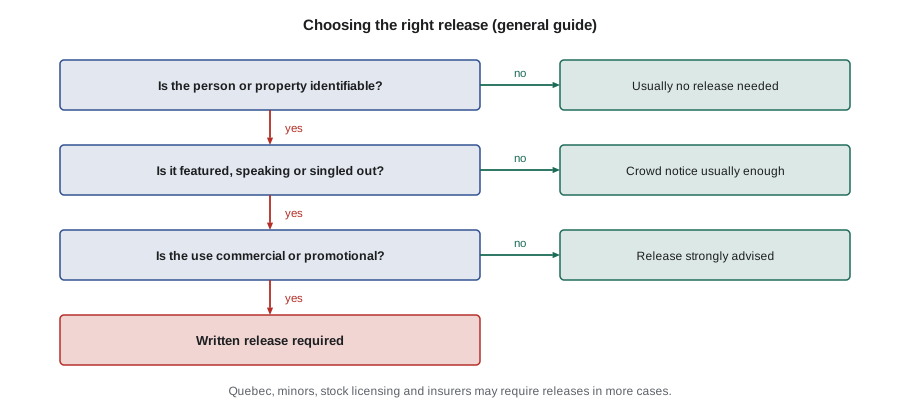
Whether a release is legally required depends on the jurisdiction, the setting and, above all, the use. Even where the law does not require one, buyers and insurers often do.
| Use | Identifiable featured person | Person in a crowd | Recognizable private property |
|---|---|---|---|
| Advertising or promotion | Required | Usually required | Usually required if featured |
| Stock licensed for any use | Required for commercial licensing | Often required | Often required |
| Documentary or news | Strongly advised; insurers expect it | Crowd notice usually enough | Location agreement if filmed on site |
| Fiction film | Required for performers and extras | Background release or notice | Location agreement |
| Fine art exhibition | Depends on jurisdiction | Usually not required | Usually not required from public view |
In Quebec, because of the right to one's image (Lesson 7), producers and photographers obtain releases more routinely than elsewhere, including for editorial and artistic uses of featured people. In the other provinces, releases are legally essential for commercial uses and strongly advisable for documentaries, while crowd notices are commonly used for people in the background.
Model and appearance releases
A model release, called an appearance release or personal release in film and television, should identify the parties, describe the work and the uses, and state the consideration. Good releases are clear, specific where it matters and broad enough to cover future uses that the producer can foresee.
- Parties: the full name and contact details of the person, and the name of the producer or photographer and any company that will exploit the work.
- The work: the project, shoot or event, with a date and location.
- The rights: permission to photograph, film and record the person, and to use their name, likeness, voice and biographical information in the work and in its advertising and promotion.
- Media, territory and term: for maximum flexibility, all media now known or later devised, worldwide, in perpetuity; for narrower deals, the specific uses agreed.
- Editing and context: permission to edit, and an acknowledgement that the person may be portrayed in a way they do not like, without approval rights unless agreed.
- Waivers: a promise not to sue for privacy, publicity, defamation and similar claims arising from the authorized uses, and, in Canada, a waiver of moral rights in any contribution the person makes, such as a performance.
- Consideration: what the person receives, even if nominal.
- Signature and date, with a witness where helpful, and a parent's or guardian's signature for a minor.
Quebec's Civil Code allows a person to consent to use of their image, and courts interpret consent according to its terms and the circumstances. Releases used in Quebec should be available in French: the Charter of the French Language requires contracts of adhesion, such as standard-form releases, to be presented in French first, with an English version allowed only if the person expressly chooses it after seeing the French version. Producers working in Quebec should check current requirements, which were strengthened in 2022.
Releases for minors and vulnerable adults
A minor cannot be bound by most contracts in the same way as an adult, and may be able to disaffirm a contract made while a minor. Releases for minors are therefore signed by a parent or legal guardian, often together with the minor. For significant payments or long-term rights, some jurisdictions require court approval of a minor's entertainment contract so that the minor cannot later disaffirm it.
In Canada, rules on minors' contracts are provincial. British Columbia's Infants Act makes contracts with minors generally unenforceable against them unless specific conditions are met, such as court approval or confirmation after the age of majority. Ontario's Protecting Child Performers Act, 2015, regulates working conditions for child performers and requires a portion of their earnings to be held in trust in some cases. FILM-320 covers directing children.
For adults who may lack capacity to consent, such as some people with cognitive impairments, consent should come from a person with legal authority to give it, and productions should consider whether filming is appropriate at all. Ethical standards for documentary go beyond the law here, and PHOT-499 discusses community consent and Indigenous protocols.
Property releases and location agreements
Buildings, private property and recognizable possessions raise different issues from people. Owning property generally does not give the owner a right to stop others from photographing it from a public place, but the owner controls access to the property, and some property contains protected works such as sculptures or murals.
- A property release gives permission to photograph and use images of private property, such as the interior of a home, a distinctive car or a pet, and is commonly required by stock agencies for commercial licensing.
- A location agreement gives a production permission to enter and film on property for a set period, and sets out fees, access, use of utilities, parking, insurance, restoration of the property, indemnity and the right to depict the property in the film and its promotion, with or without its real name.
- Separate permission is needed for protected works on the property, such as murals, art and trademarks, which the property owner may not own.
The Canadian Copyright Act allows photographing and filming an architectural work, and sculptures and works of artistic craftsmanship permanently situated in a public place or building, without infringing. This covers exteriors seen from the street and public sculptures, but not paintings inside a building or temporary installations.
Crowds, events and notices
It is impractical to get individual releases from everyone who appears in a crowd at a concert, sports event or street scene. Productions instead use crowd notices or signs at entrances and around the filming area, stating that filming is taking place and that people who enter may appear in the work. Some events include filming consent in ticket terms. Posted notices are weaker than signed releases, because a court may find that a person did not see the sign or did not consent to the use made, so productions get signed releases from anyone who is featured: speaking, singled out by the camera, shown in close-up or portrayed in a sensitive way.
Worked problem
Planning releases for a concert documentary
A crew is filming a documentary about a local band, including a concert in a club, interviews with band members, backstage scenes, shots of fans in the audience and an interview with a fan who travelled from another city. What releases and notices are needed?
Show solution
- Band members: signed appearance releases, plus performer consent for recording their performances and agreements covering their music (synchronization and master rights, Lesson 6).
- Club: a location agreement covering filming, depiction of the venue and the event, and any house rules.
- Audience: crowd notices at the entrance and inside, plus filming consent in the ticket terms if the club agrees.
- Featured fan: a signed appearance release, because the fan is interviewed and identifiable.
- Backstage: releases from anyone featured, such as crew or guests, and care with private spaces.
Answer: Individual releases for the band, the featured fan and anyone singled out; a location agreement with the club; and crowd notices for the audience, documented with photographs of the posted signs.
Getting and keeping releases
Releases are only useful if they are signed, legible, matched to the footage and kept. Many productions use digital release apps that capture a signature, a photograph of the person and the time and location, which makes matching easier. Paper releases should be photographed or scanned at the end of each day.
- Get the release before or at the time of filming, not weeks later, when people may have changed their minds.
- Photograph the person with their signed release or record a short verbal confirmation on camera, so the release can be matched to the footage.
- Use plain language and explain the release; a person who understood what they signed is less likely to dispute it.
- Log every release in the clearance log with its scope, so editors know which people can appear in which uses.
- Respect withdrawals where possible. A release usually cannot be revoked once relied on, but editorial and ethical judgment may favour honouring a request, especially for vulnerable people.
releases = {"R-001": "Ana Silva", "R-002": "Ben Okafor", "R-003": "Club manager"}
tagged = ["Ana Silva", "Ben Okafor", "Fan in red jacket", "Club manager", "Drummer"]
signed = set(releases.values())
missing = [p for p in tagged if p not in signed]
print("People needing a release or a decision:", missing)People needing a release or a decision: ['Fan in red jacket', 'Drummer']
In the example, two people in the edit have no release. The producer must get releases, cut or blur them, or record a reasoned decision that no release is needed, for example because the drummer's performance is covered by a band agreement.
Common mistakes
MistakeUsing an editorial release for an advertising campaign
InsteadMatch the release to the use, and get a new release for commercial uses.
MistakeAssuming a release transfers copyright
InsteadA release only gives permission; copyright needs a licence or assignment.
MistakeHaving a minor sign their own release
InsteadHave a parent or guardian sign and follow local rules on minors' contracts.
MistakeRelying on crowd notices for featured people
InsteadGet individual releases from anyone speaking, singled out or shown in close-up.
MistakeCollecting releases weeks after filming
InsteadGet releases at the time of filming and match them to the footage.
Summary and key terms
- A release is a contract giving permission to capture and use a person's image, voice or property for defined uses.
- Releases are essential for commercial uses and strongly advised for documentaries and stock.
- Good releases describe the parties, work, rights, media, territory, term, editing and consideration.
- Minors' releases are signed by a parent or guardian, and some contracts need court approval.
- Property releases and location agreements cover access and depiction; protected works on the property need separate permission.
- Crowd notices cover background crowds, but featured people need individual releases.
- Releases must be collected promptly, matched to footage and logged.
- Release
- Written permission to capture and use a person's image or a property in defined ways.
- Appearance release
- A release signed by a person who appears in a film or television production.
- Property release
- A release from the owner of private property allowing images of it to be used.
- Location agreement
- A contract allowing a production to film on property, with fees and conditions.
- Crowd notice
- A posted sign telling people that filming is taking place and they may appear.
- Consideration
- Something of value given in exchange for a promise, such as a fee.
- Disaffirm
- To cancel a contract made while a minor.
- Court approval
- Approval by a court of a minor's contract so that it cannot later be disaffirmed.
- Coogan account
- A blocked trust account holding part of a child performer's earnings.
- Contract of adhesion
- A standard-form contract offered without negotiation.
Practice problems
Work each problem on paper first, then reveal the answer to check.
Does a model release transfer copyright in the photograph?
Show answer
No, it only gives permission for the uses described.
Which use most clearly requires a model release?
Show answer
Advertising or other commercial use.
Name four things a good appearance release should include.
Show answer
For example, parties, work, rights and media, territory and term.
Who signs a release for a minor?
Show answer
A parent or legal guardian.
What does a location agreement cover that a property release usually does not?
Show answer
Access, fees, insurance, restoration and conditions for filming on site.
Does permission from a building owner clear a mural painted on the building?
Show answer
Not necessarily; the mural's artist may hold copyright.
When is a crowd notice not enough?
Show answer
When a person is featured, speaking, singled out or portrayed sensitively.
Why should a production photograph signed releases or the people who signed them?
Show answer
To match each release to the footage.
What should an editor do with a person in the edit who has no release?
Show answer
Get a release, cut or blur, or record a reasoned decision.
Why might a production honour a request to withdraw even if the release is binding?
Show answer
Ethical and editorial judgment, especially for vulnerable people.
Lesson quiz · 5 questions
Score 60% or more to complete this lesson.
Create a free account to save your progress, take quizzes and earn a certificate.