
FILM-420 · Lesson 5 of 12 · 27 min
Fair dealing and moral rights
Copyright is not absolute. The law recognizes that some uses of a work without permission serve important public purposes, such as criticism, news, education, parody and research, and that requiring permission for every quotation or clip would choke expression. Each country builds these limits differently. Image makers rely on them every day, for example when a documentary shows a clip to discuss it, or a review reproduces a frame. But exceptions are narrower and less predictable than many people assume, and relying on them requires judgment and documentation.
This lesson covers the Canadian exceptions, especially fair dealing, and the moral rights that protect an author's name and the integrity of the work. Moral rights are particularly important to image makers, because they apply even after the copyright has been sold.
Why exceptions exist
Exceptions balance the rights of creators against the interests of users and the public. Courts in both countries describe exceptions as an integral part of copyright law rather than loopholes. That does not make them easy to apply. Most exceptions turn on factors such as the purpose of the use, how much was taken and whether the use harms the market for the original, and reasonable people can disagree about how those factors apply to a given clip.
For a producer, an exception is a legal argument that the use is permitted. Insurers, broadcasters and distributors will want to know that the argument is a good one, usually through an opinion letter from a lawyer who has reviewed the use in context. A use that clearly falls within an exception can save money and make some films possible at all, especially documentaries about media, history and public figures.
How the test works
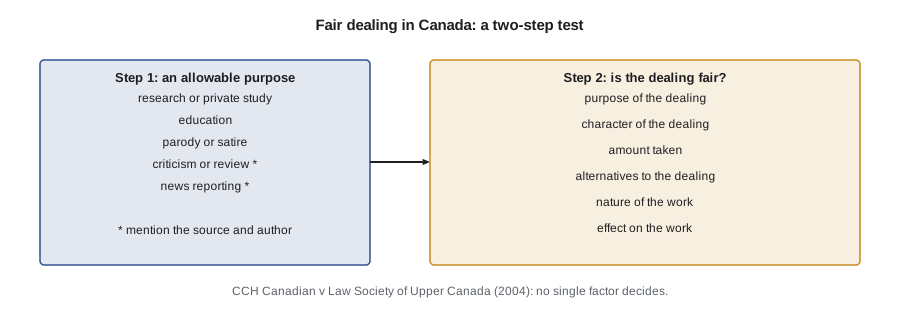
Canadian fair dealing is a two-step test. First, the dealing must be for one of the purposes listed in the Copyright Act: research, private study, education, parody, satire, criticism or review, or news reporting. For criticism, review and news reporting, the user must also mention the source and, if given in the source, the name of the author, performer, maker or broadcaster. Purposes are interpreted generously.
Second, the dealing must be fair. In CCH Canadian v Law Society of Upper Canada (2004), the Supreme Court set out six factors: the purpose of the dealing, its character (for example, how many copies and how widely distributed), the amount taken, alternatives to the dealing, the nature of the work, and the effect of the dealing on the work. No factor is decisive, and later decisions, including SOCAN v Bell (2012) and York University v Access Copyright (2021), confirm that fair dealing is a user's right to be given a large and liberal interpretation.
Applying the test to film and photography
Documentaries often rely on criticism, review and news reporting. A film that shows a short clip of a television advertisement in order to analyse its messaging is dealing for criticism, and if the clip is no longer than needed and the source is identified on screen or in the credits, the dealing is likely fair. A film that uses the same advertisement as background mood, without commenting on it, is harder to justify.
Parody and satire became purposes in 2012. A parody imitates a work to comment on it or on something else, usually with humour; satire uses humour or exaggeration to criticize. Courts have not developed a large body of Canadian case law on parody, so producers should treat it carefully and avoid taking more than needed to evoke the original.
Education covers teaching and learning, including in online courses. Research and private study cover individual study and investigation, including research by creators preparing a work, but they do not automatically cover publishing the result.
Worked problem
Rating three clips
A documentary about online celebrity uses (a) 12 seconds of a famous influencer's video, discussed on screen by critics; (b) a full three-minute music video playing under an interview as atmosphere; and (c) a news photograph of a protest shown while the narrator describes the protest. Which uses are most likely permitted without a licence?
Show solution
- Clip (a) is used for criticism, is short and is the subject of discussion. It is the strongest case, provided the source is identified.
- Clip (b) is used in full, as background, without commentary. It is unlikely to be permitted and the music needs licensing.
- Clip (c) illustrates the narration of a real event. It may be permitted for news reporting or historical commentary, but news photographs are licensed commercially, so using them without a licence harms an existing market. It is a closer call and many producers license it.
Answer: Clip (a) is likely permitted; clip (b) needs a licence; clip (c) is uncertain and is usually licensed or replaced.
Other exceptions image makers use
Canadian law includes several specific exceptions. Incidental and not deliberate inclusion of a work in another work does not infringe, so a poster that happens to be visible in a street scene is usually fine, but a work deliberately placed or featured is not covered. Making a photograph, film or drawing of an architectural work, or of a sculpture or artistic craftsmanship permanently situated in a public place, does not infringe. The non-commercial user-generated content exception allows individuals to use existing works in new non-commercial works, such as remixes, under conditions including mentioning the source and not substantially harming the market.
| Situation | Typical position | What makes it stronger |
|---|---|---|
| Clip shown and discussed in a documentary | Often permitted | Short excerpt, clear commentary, source identified |
| Background music under a scene | Usually needs a licence | Use cleared or original music |
| Poster visible by chance in a street scene | Often permitted | Brief, not featured, not deliberately placed |
| Artwork featured on set | Usually needs permission | Use original or cleared art |
| Building photographed from the street | Usually permitted | Shoot from a public place; check murals or sculptures |
| Parody of a well-known song | Uncertain | Comment on the original, take only what is needed |
Moral rights
Moral rights protect the personal connection between authors and their works. They are separate from the economic rights of copyright, and in some countries they stay with the author even after the copyright is sold.
Canadian authors have moral rights in their works: the right to the integrity of the work, the right to be associated with it as its author by name or pseudonym, or to remain anonymous, and the right to prevent the work being used in association with a product, service, cause or institution in a way that harms their honour or reputation. Performers have similar rights in their live and recorded performances.
The integrity right is infringed when the work is distorted, mutilated or otherwise modified, to the prejudice of the author's honour or reputation. For paintings, sculptures and engravings, prejudice is presumed. In Snow v Eaton Centre (1982), a sculptor successfully objected when a shopping centre tied ribbons around the necks of his sculpture of flying geese for Christmas. Changing the location of a work or the physical way it is displayed does not by itself distort it.
Moral rights cannot be assigned, but they can be waived in whole or in part, and a waiver can benefit a buyer and its licensees. Because an author who has sold the copyright can still object to edits, crops, colourization or association with a product, Canadian production and licensing contracts routinely include moral rights waivers. Moral rights last as long as the copyright.
When no exception applies: licensing
Most uses of other people's work in commercial projects need a licence. Licensing is a negotiation, but it follows predictable patterns: identify the owner, describe the use precisely, agree on a fee and get the terms in writing.
- Identify the use: the medium (film, broadcast, streaming, social media, advertising), the territory, the term, the duration on screen and whether the work is featured or in the background.
- Identify the owner: a creator, an agency, a publisher, a record label, a stock library, an archive or an estate. Ownership may differ by country.
- Ask for the right scope: festival-only licences are cheap but must be upgraded before distribution, while all-media worldwide licences in perpetuity cost more.
- Get it in writing, including credit requirements, approvals and any restrictions.
Collective societies administer many licences in Canada. SOCAN licenses the public performance of music, Re:Sound collects for performers and record labels, CMRRA licenses reproduction of musical works, Access Copyright licenses copying of published works in Canada outside Quebec and Copibec in Quebec, and CARCC licenses visual art. Synchronization licences for film and television are usually negotiated directly with music publishers and record labels (Lesson 6).
Worked problem
Choosing between relying on an exception and licensing
An independent filmmaker making a feature documentary about a 1990s music scene wants to use 20 seconds of a concert film to discuss a famous performance. A licence would cost 4,000. The distributor's errors and omissions insurer will cover the use if a media lawyer writes an opinion letter. What should the filmmaker consider?
Show solution
- Purpose: the clip is discussed as part of the film's argument, which supports criticism or commentary.
- Amount: 20 seconds of a long concert film is modest, if the film uses only what it needs.
- Market: a licence market exists for concert clips, which weighs against the use, but the commentary purpose differs from the original.
- Cost: an opinion letter may cost less than the licence and also covers other clips in the film; but if the clip were used as entertainment rather than discussed, licensing would be the safer path.
Answer: The filmmaker can reasonably rely on the exception, with a lawyer's opinion and the insurer's acceptance, provided the clip is genuinely discussed and identified. If either is missing, license the clip or cut it.
Documenting the decision
Whether you rely on an exception or obtain a licence, document the reasons. For exceptions, the clearance log should record the purpose, the amount used, why less would not work, how the source is identified and who reviewed the decision. For licences, file the signed licence with the log entry. Buyers and insurers ask for this documentation, and if a claim arrives years later, it shows that the decision was careful and made in good faith.
Common mistakes
MistakeAssuming any educational or non-profit use is automatically permitted
InsteadApply the full test; purpose helps, but amount and market effect also matter.
MistakeThinking that a short clip is always allowed
InsteadThere is no fixed number of seconds; the whole test applies to every use.
MistakeTreating altered or filtered images as automatically transformative
InsteadCourts look at whether the use serves a different purpose, not just whether it looks different.
MistakeForgetting to identify the source when relying on an exception
InsteadCredit the source and author where the law or best practice requires it.
MistakeRelying on an exception without legal review on a funded project
InsteadGet an opinion letter that the insurer and distributor accept.
Summary and key terms
- Exceptions let some uses proceed without permission, but they depend on purpose, amount and market effect.
- Canadian fair dealing requires an allowable purpose and a fair dealing under the CCH factors.
- American fair use weighs four factors, and Warhol narrowed what counts as transformative.
- Specific exceptions cover incidental inclusion, public buildings and some other situations.
- Moral rights protect attribution and integrity; they are broad in Canada and limited in the United States.
- Most commercial uses still need licences negotiated for a defined media, territory and term.
- Every reliance on an exception should be documented and, for funded projects, reviewed by a lawyer.
- Fair dealing
- The Canadian exception allowing dealing with a work for listed purposes if the dealing is fair.
- Fair use
- The American doctrine allowing some uses without permission, judged by four factors.
- Transformative use
- A use that adds a new purpose or character rather than substituting for the original.
- Parody
- A work that imitates another to comment on it or on something else, often with humour.
- Incidental inclusion
- The unplanned, non-deliberate appearance of a work within another work.
- De minimis
- A use too trivial to count as infringement.
- Moral rights
- The rights of attribution and integrity that protect an author's personal connection to a work.
- Waiver
- A written agreement not to exercise a right, such as a moral right.
- Opinion letter
- A lawyer's written analysis that a use is likely permitted, relied on by insurers.
- Collective society
- An organization that licenses works on behalf of many rights holders.
Practice problems
Work each problem on paper first, then reveal the answer to check.
Name two purposes that can support using a clip without permission.
Show answer
For example, criticism and news reporting.
Is there a fixed number of seconds that is always allowed?
Show answer
No, the full test applies to every use.
What did the Warhol decision change in the United States?
Show answer
It narrowed transformative use when the new use shares the original's purpose.
Why might a poster visible by chance in a street scene be acceptable?
Show answer
It is incidental and not featured or deliberately placed.
Why do Canadian contracts often include moral rights waivers?
Show answer
Moral rights cannot be assigned, so buyers need waivers to edit and use the work freely.
Do American filmmakers usually have statutory moral rights in their films?
Show answer
No, films are excluded from VARA.
What should a clearance log record when relying on an exception?
Show answer
Purpose, amount, why less would not work, source identification and who reviewed it.
Name one collective organization that licenses music performance.
Show answer
For example, SOCAN in Canada or ASCAP in the United States.
Why might a news photograph be riskier to use without a licence than a short advertising clip being criticized?
Show answer
News photographs are licensed commercially, so the use may harm an existing market.
What does an errors and omissions insurer usually want before covering a use under an exception?
Show answer
An opinion letter from a qualified lawyer.
Lesson quiz · 5 questions
Score 60% or more to complete this lesson.
Create a free account to save your progress, take quizzes and earn a certificate.