
FILM-420 · Lesson 7 of 12 · 26 min
Privacy and personality rights
Copyright protects works. Privacy and personality rights protect people. They matter every time an image maker photographs or films a person, records their voice, uses their name, or tells a story about their life. These rights differ more between and within countries than almost any other area of media law, and they are evolving quickly, especially as digital replicas make it possible to imitate a person's face and voice convincingly.
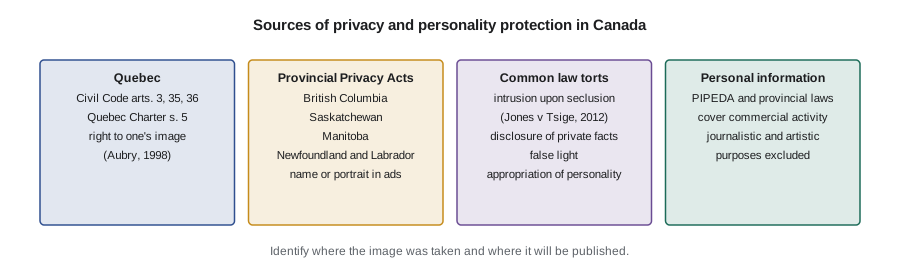
Canadian law protects privacy and personality through a patchwork: the Civil Code of Québec and the Quebec Charter of human rights and freedoms, privacy statutes in four common law provinces, common law torts developed by the courts in Ontario and elsewhere, and personal information laws. Quebec gives the strongest protection to a person's image.
Two kinds of interest
It helps to separate two interests that the law protects. The first is dignity and seclusion: the interest in being left alone, in keeping private matters private and in not being portrayed falsely. The second is control over the commercial value of one's identity: the interest in deciding whether one's name, face or voice is used to sell something, and in being paid for it. Celebrities care most about the second; private individuals usually care most about the first. The law addresses both, but through different rules.
The sources of protection
Quebec. Article 3 of the Civil Code says every person has a right to the respect of their reputation and privacy, and article 36 lists invasions of privacy, including intentionally intercepting or using private communications, capturing or using a person's image or voice while they are in private premises, keeping their private life under observation, and using their name, image, likeness or voice for any purpose other than the legitimate information of the public. Section 5 of the Quebec Charter protects respect for private life. These provisions apply to filmmakers and photographers working in Quebec and to images of people in Quebec published elsewhere in some cases.
Common law provinces. British Columbia, Saskatchewan, Manitoba and Newfoundland and Labrador have Privacy Acts that make it a tort to violate another person's privacy wilfully and without claim of right; several also make it a tort to use a person's name or portrait for advertising or trade without consent. In Ontario, the Court of Appeal recognized the tort of intrusion upon seclusion in Jones v Tsige (2012), and later Ontario decisions have recognized public disclosure of private facts and placing a person in a false light. Courts in several provinces also recognize the tort of appropriation of personality, which protects against the unauthorized commercial use of a person's identity.
Personal information laws. The federal Personal Information Protection and Electronic Documents Act and provincial private-sector laws regulate how organizations collect, use and disclose personal information in commercial activity, including images. They generally do not apply to the collection, use or disclosure of personal information for journalistic, artistic or literary purposes, so most documentary and artistic work falls outside them, but a production company's handling of cast and crew data, or a commercial photographer's client records, does not.
Photographing people in public
Outside private premises, people generally have a reduced expectation of privacy, and taking photographs or video in public streets, parks and events is usually lawful. But taking an image and publishing it are different acts, and publication raises its own questions.
The leading Canadian case is Aubry v Éditions Vice-Versa (1998). A photographer took a picture of a 17-year-old sitting on a doorstep on a Montréal street, and an arts magazine published it without her consent. The Supreme Court of Canada held that, under Quebec law, the right to one's image is part of the right to privacy, and publishing an identifiable image of a person without consent infringes it unless the public interest outweighs the right, for example where the person plays a role in a public event or appears incidentally in a crowd or a public place. The magazine was liable for modest damages. Outside Quebec, courts have not adopted Aubry as such, but privacy statutes and torts can still apply when images expose private moments or are used commercially.
| Situation | Editorial or artistic use | Commercial use |
|---|---|---|
| Person in a crowd at a public event | Usually acceptable | Release advisable or required |
| Identifiable person featured on a public street | Depends on jurisdiction; Quebec is strict | Release required |
| Person in a private home or medical setting | Consent required | Release required |
| Public figure performing public role | Usually acceptable | Release required for endorsement-style uses |
| Child or vulnerable person | Extra care; consent of guardian advisable | Guardian's release required |
Public figures and newsworthiness
Public figures, such as politicians, celebrities and people involved in public controversies, have less protection against images and stories about their public roles. News, documentary, biography and commentary about them are generally protected. But public figures keep their right to control commercial uses of their identity, and their private lives, such as health or family matters unrelated to their public role, are not fair game simply because they are famous.
Canadian courts weigh the public interest in information against the privacy interest. In Aubry, the Supreme Court said that people who become involved in public events, or who are public figures, may be photographed in that context. The Supreme Court's decisions on publication of private information also distinguish between matters of genuine public interest and matters that merely interest the public.
Commercial use of identity
Using a person's name, image, likeness or voice to promote a product, service or cause without consent is the clearest violation of personality or publicity rights in both countries. This includes look-alikes and sound-alikes: an advertisement that uses an impersonator to suggest a celebrity's endorsement can violate the celebrity's rights even though the celebrity never appeared.
Canadian courts recognized the tort of appropriation of personality in Krouse v Chrysler Canada (1973) and Athans v Canadian Adventure Camps (1977), where a famous water-skier's image was used in a brochure. The Privacy Acts of British Columbia, Saskatchewan, Manitoba and Newfoundland and Labrador also make unauthorized use of name or portrait for advertising or trade an actionable violation. In Quebec, using a person's image or voice for a purpose other than the legitimate information of the public is an invasion of privacy under article 36.
Worked problem
Assessing a stock photograph of a stranger
A photographer in Montréal captures a striking portrait of a stranger on a busy street and wants to (a) exhibit it in a gallery, (b) publish it in an arts magazine and (c) license it as stock for advertising. She has no release. What are the risks?
Show solution
- (a) Exhibition: under Quebec law, publishing or exhibiting an identifiable image of a person who is the main subject may infringe the right to one's image unless the public interest outweighs it, which is unlikely for a portrait of a private person.
- (b) Magazine: Aubry involved exactly this situation, and the magazine was liable. The risk is real, although damages may be modest.
- (c) Stock for advertising: a release is required in all provinces for commercial use.
Answer: Without a release, all three uses carry risk in Quebec, and advertising use carries risk everywhere. She should seek a release or keep the image for private portfolio use.
Children and vulnerable people
Images of children and vulnerable adults require extra care in every jurisdiction. Children cannot give binding consent, so releases are signed by a parent or guardian, and some laws give children additional protection against publication of identifying information, such as youth justice laws that prohibit identifying young offenders and victims. Filming in schools, hospitals, care homes and shelters raises institutional rules as well as legal ones. FILM-320 lesson 9 covers directing children, including employment rules for child performers.
Canada's Youth Criminal Justice Act prohibits publishing information that would identify a young person dealt with under the Act, with narrow exceptions, and courts can issue publication bans protecting victims and witnesses. In Quebec, the right to one's image applies to children, and parental consent is expected for featured images.
Personal information in productions
Productions collect a lot of personal information: cast and crew contact details, identity documents, banking and tax information, medical information for insurance and accommodation, and footage of participants. Even where journalism or art exemptions protect the content of a film, the production company's business records are subject to personal information laws. Keep personal data secure, collect only what you need, delete what you no longer need and be careful when sharing call sheets and casting materials.
Images of people in sensitive situations
Some situations call for particular care regardless of whether a release is strictly required. People photographed at accidents, in hospitals, at funerals, in courtrooms, during police arrests or in moments of grief may later object strongly to publication, and the law, broadcasters' codes and journalistic ethics all pay attention to them.
- Courtrooms: rules on photography and recording in courts differ by jurisdiction and court; many courts prohibit cameras without permission, and publication bans can prohibit identifying parties or witnesses.
- Health information: images that reveal a person's medical condition, disability or treatment are among the most sensitive kinds of private information.
- Victims and survivors: people who have experienced violence, abuse or trauma may be identifiable through images, voices, locations or details; blurring faces may not be enough if voices, tattoos or surroundings identify them.
- Arrests and accusations: showing a person under arrest can imply guilt; careful captions and accurate reporting reduce defamation and privacy risk.
Canadian courts and statutes add specific protections. Publication bans under the Criminal Code protect complainants in sexual offence cases and can be ordered for witnesses, and courts restrict photography in and around courtrooms. Provincial health information laws apply to custodians such as hospitals and clinics, which will set conditions on any filming in their facilities.
Anonymizing participants
When a person's identity must be protected, producers use techniques such as blurring or pixelating faces, altering voices, filming in silhouette, avoiding identifying locations and changing names. Each technique should be tested: modern tools can sometimes reverse weak blurring, and a combination of details can identify a person even if their face is hidden. Promises of anonymity are also promises that the producer must keep, including in raw footage, transcripts and promotional material, so secure storage and careful handling of unedited material matter as much as the final edit.
Consent as an ongoing conversation
Good practice treats consent as more than a signature. Participants should understand what the project is about, how they will be portrayed, where the work will appear and for how long, and whether they can change their minds before publication. Explaining these points in plain language, and checking understanding with people who are young, unwell, grieving or speaking a second language, reduces later disputes and respects the people who make documentary work possible. Some filmmakers show participants a cut of their scenes before release, without giving them approval rights, to catch factual errors and identify safety concerns, such as a location that could reveal where a person in danger lives.
Common mistakes
MistakeAssuming that anything photographed in public can be published anywhere
InsteadConsider the jurisdiction and the use; Quebec and commercial uses require more.
MistakeTreating public figures as having no rights at all
InsteadPublic roles are open to comment, but commercial use and unrelated private matters still need care.
MistakeUsing a look-alike or sound-alike in advertising to avoid paying a celebrity
InsteadImitations that suggest endorsement can violate personality and publicity rights.
MistakeGetting consent from a child rather than a parent or guardian
InsteadHave a parent or guardian sign, and follow youth publication restrictions.
MistakeIgnoring privacy laws for cast and crew data
InsteadSecure and minimize personal data even when the film itself is exempt.
Summary and key terms
- Privacy and personality rights protect dignity and seclusion as well as control over commercial use of identity.
- The rules differ by province or state, so identify where the image was taken and where it will be published.
- Photographing people in public is generally lawful, but publication and commercial use raise further questions.
- Quebec gives strong protection to a person's image, as shown in Aubry.
- Public figures have less protection for their public roles but keep control over commercial uses.
- Look-alikes and sound-alikes used in advertising can violate personality and publicity rights.
- Children and vulnerable people require extra care and guardian consent.
- Intrusion upon seclusion
- A tort for intruding into a person's private affairs in a highly offensive way.
- Public disclosure of private facts
- A tort for publicizing private information not of legitimate public concern.
- False light
- A tort for portraying a person falsely in a highly offensive way.
- Appropriation of personality
- Unauthorized commercial use of a person's identity.
- Right of publicity
- A person's right to control commercial use of their name, likeness and voice.
- Right to one's image
- In Quebec law, a person's right to control the capture and publication of their image.
- Newsworthiness
- The public interest in information that can outweigh privacy.
- Sound-alike
- An imitation of a person's voice, sometimes used in advertising.
- Post-mortem right
- A right of publicity that continues after a person's death.
- Journalistic exemption
- A provision excluding journalism and similar purposes from personal information laws.
Practice problems
Work each problem on paper first, then reveal the answer to check.
What two interests do privacy and personality rights protect?
Show answer
Dignity and seclusion, and control over commercial use of identity.
What did the Supreme Court of Canada decide in Aubry?
Show answer
Publishing an identifiable image of a person without consent can infringe the right to one's image in Quebec.
Which kind of use most clearly needs a release everywhere?
Show answer
Commercial use, such as advertising.
Do public figures have any protection against commercial use of their image?
Show answer
Yes, they keep control over commercial uses.
Why can a sound-alike in an advertisement create liability?
Show answer
It can suggest endorsement and exploit the person's identity.
Who signs a release for a child?
Show answer
A parent or legal guardian.
Name one law that restricts identifying young people in criminal matters.
Show answer
For example, Canada's Youth Criminal Justice Act.
Why do personal information laws still matter to productions with a journalism exemption?
Show answer
The company's records about cast, crew and participants are still covered.
What should a photographer do before licensing a street portrait for advertising?
Show answer
Obtain a signed model release.
Why must you identify where an image was taken and where it will be published?
Show answer
Privacy and publicity rules differ by province, state and country.
Lesson quiz · 5 questions
Score 60% or more to complete this lesson.
Create a free account to save your progress, take quizzes and earn a certificate.