
FILM-430 · Lesson 1 of 12 · 27 min
What film theory is for
Film theory asks big questions about cinema: what a film is, how it produces meaning and feeling, what it does to the people who watch it, and how it connects to power, history and identity. Criticism asks a narrower question: what this particular film is doing, and whether it does it well. This course moves between the two. It surveys the major theories of the last hundred years and then shows how to use them to write criticism that is sharper, better argued and more interesting than an opinion.
FILM-101 taught you the vocabulary of film form, from mise-en-scène to sound, and FILM-120 traced the history of cinema from the earliest moving pictures to streaming. This course assumes both. When a lesson mentions continuity editing, neorealism or the French New Wave, it builds on those courses rather than repeating them, and it points back to the relevant lesson where that helps.
Theory, criticism, history and analysis
Students often use these four words loosely, so it helps to separate them before going further. Each is a different activity with a different goal, and most good writing about film combines more than one.
| Activity | Main question | Typical output | Example |
|---|---|---|---|
| Film theory | What is cinema, and how does it work in general? | Essay or book proposing concepts that apply across many films | An argument that the long take preserves the ambiguity of reality |
| Film criticism | What is this film doing, and is it valuable? | Review, critical essay, programme notes | A review arguing that a new thriller wastes its premise |
| Film history | What happened, when, why and with what consequences? | Archival research, industry studies | A study of how sound changed studio labour in the 1930s |
| Film analysis | How exactly does this film or scene produce its effects? | Close reading of shots, sound and structure | A shot-by-shot account of a chase sequence |
The boundaries are porous. A theorist builds an argument from examples, so theory always contains analysis. A critic who calls a film's ending manipulative is making a theoretical assumption about how spectators respond. A historian who explains why a genre became popular is drawing on theories of audiences and industry. Learning theory does not mean abandoning taste; it means becoming aware of the assumptions behind taste and testing them.
Why theory matters for people who make and study films
Theory can sound remote from the practical work of making films, but almost every craft decision rests on a theory, whether or not the filmmaker names it. A director who prefers long takes because they let actors breathe is close to the realist position of André Bazin, covered in Lesson 3. An editor who cuts two unrelated images together to produce a new idea is using a principle that Sergei Eisenstein theorized in the 1920s, covered in Lesson 2. A producer who worries that a protagonist is unlikeable is thinking about identification and spectatorship, the subject of Lesson 8.
Theory also gives you a language for disagreement. When two viewers argue about whether a film is sexist, they are often using different theories of representation without realizing it. One may be thinking about how many women speak on screen, another about whose point of view the camera adopts, and a third about whether the film invites the audience to question what it shows. Naming the framework turns a shouting match into a debate that can be settled, or at least clarified, with evidence.
- Theory helps you see more: it directs attention to features you might otherwise miss, such as who controls the look in a scene or how a genre's conventions shape an ending.
- Theory helps you explain: it moves you from describing what you felt to explaining how the film produced that feeling.
- Theory helps you argue: it supplies concepts, precedents and counterarguments that make a critical claim more persuasive.
- Theory helps you make: filmmakers who understand theories of montage, realism or genre can choose techniques deliberately instead of by habit.
Three big questions that organize the field
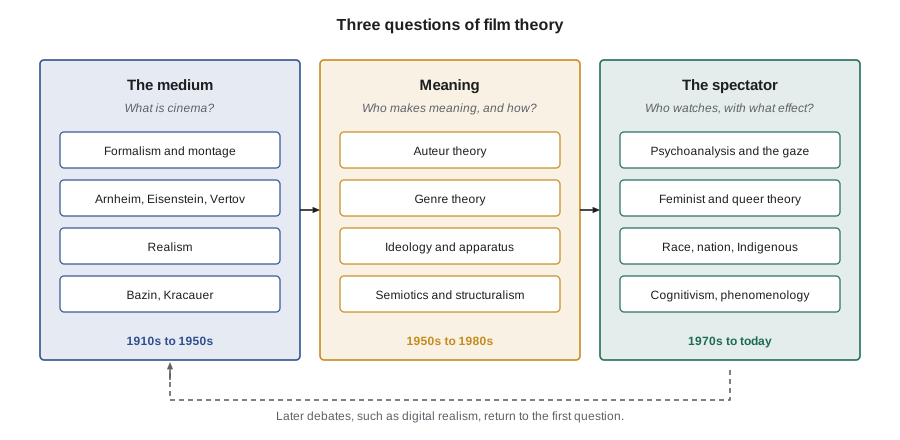
Most film theories can be sorted by which of three questions they put first. Classical theory, from the 1910s to the 1950s, asked mainly about the medium: what makes film different from painting, theatre or literature, and what it can do that they cannot. From the late 1960s, theory turned to meaning and ideology: how films produce meaning, and whose interests those meanings serve. From the 1980s onward, many theorists turned to the spectator: how real viewers perceive, understand and feel films, and how identity shapes viewing.
| Question | Period of greatest influence | Theories in this course | Lessons |
|---|---|---|---|
| What is the medium? | 1910s to 1950s | Formalism, montage theory, realism | 2 and 3 |
| Who makes meaning, and how? | 1950s to 1980s | Auteur theory, genre theory, ideology and apparatus theory, semiotics | 4 to 7 |
| Who is watching, and with what effect? | 1970s to the present | Psychoanalysis, feminist and queer theory, race and postcolonial theory, cognitivism, phenomenology | 8 to 11 |
These periods overlap and the questions never disappear. Debates about whether digital images can still be realist, discussed in Lesson 11, return to the classical question of the medium. Debates about streaming algorithms return to questions of ideology and audiences. Treat the table as a map, not a chronology that ended.
Grand theory and middle-level research
In the 1990s, the American scholars David Bordwell and Noël Carroll criticized what they called Grand Theory: large frameworks, often drawn from psychoanalysis and Marxism, that explained all films in advance and treated individual films as illustrations of the theory. They argued instead for piecemeal or middle-level research that asks specific, answerable questions, such as how Hollywood staging changed after widescreen arrived, and answers them with evidence. Their critics replied that no research is free of large assumptions, and that refusing big questions about power and pleasure simply hides one's own theory.
You do not have to choose a side permanently, but the debate teaches a useful habit. Whenever you use a theory, ask what kind of evidence would support or weaken your claim. A psychoanalytic reading of a horror film may be illuminating, but it should still be grounded in what is on screen: the framing, the editing, the sound, the structure. A statistical claim about shot lengths, by contrast, may be precise but say little about meaning unless you connect it to an interpretation.
How to read film theory
Film theory is often difficult to read. Many classic texts were written in French, Russian, German or Italian, were translated decades later, and assume readers already know the debates they join. Some deliberately use unfamiliar vocabulary to break habits of thought. The following approach makes the reading manageable.
- Find the question: before reading closely, identify the question the author is trying to answer and the position they are arguing against.
- Track the key terms: list each technical term the first time it appears, with the author's definition in your own words.
- Note the examples: theorists usually rely on a small set of films; watching even one of them clarifies the argument enormously.
- Summarize in three sentences: what the author claims, why, and what follows if they are right.
- Test the claim: apply it to a film the author never discussed, and note where it fits and where it breaks.
Throughout this course, theorists are summarized in plain language and their arguments are paraphrased rather than quoted at length. When you write your own essays, follow the same practice: paraphrase carefully, cite the source, and quote only short phrases when the exact wording matters.
Worked problem
Applying three questions to one film
Choose a well-known film, such as Alfred Hitchcock's Rear Window (1954), in which a photographer confined to his apartment watches his neighbours across a courtyard and comes to believe one of them has committed murder. Show how each of the three big questions leads to a different line of inquiry.
Show solution
- Medium: ask what the film does that only cinema can do. Almost everything is shown from inside the apartment, and the film uses framing, focal length and editing to make the courtyard windows work like small screens. A medium-focused essay would explore how the film reflects on cinema itself.
- Meaning and authorship: ask how the film fits Hitchcock's recurring concerns with guilt, looking and suspense, and how it uses the conventions of the thriller. An auteur or genre essay would compare it with his other films and with other mysteries of the 1950s.
- Spectator: ask how the film positions the audience. We share the hero's view, and the film implicates us in his voyeurism. A spectatorship essay, drawing on Laura Mulvey (Lesson 8), would ask whose look the film organizes and how the female lead both disrupts and supports that look.
- Combine: a strong critical essay might start from the spectator question and support it with analysis of the medium and comparisons with the director's other work.
Answer: The same film supports at least three distinct essays. Choosing the question first makes the essay focused instead of a list of observations.
Measurement and interpretation
Some film scholarship is quantitative. The historian Barry Salt began measuring shot lengths in the 1970s and showed how editing pace changed across decades and countries. The online Cinemetrics project, founded by Yuri Tsivian, lets researchers log the duration of every shot in a film. Other scholars count speaking roles by gender or race, track how often films pass simple tests such as the Bechdel test, or analyse the vocabulary of reviews. These methods do not replace interpretation; they give it a firmer footing and sometimes overturn assumptions.
Here is a small example of the simplest measure, average shot length, which is the running time divided by the number of shots. The durations below are invented for illustration, but the calculation is the one Salt and Cinemetrics use.
import statistics
shots = [4.2, 3.1, 2.8, 6.5, 1.9, 2.2, 14.0, 3.3, 2.7, 2.5, 3.8, 22.5, 2.1, 2.9, 3.0]
asl = sum(shots) / len(shots)
msl = statistics.median(shots)
print(f"Shots: {len(shots)}, running time: {sum(shots):.1f} s")
print(f"Average shot length (ASL): {asl:.2f} s")
print(f"Median shot length (MSL): {msl:.2f} s")
print("Two long takes pull the average above the median.")Shots: 15, running time: 77.5 s Average shot length (ASL): 5.17 s Median shot length (MSL): 3.00 s Two long takes pull the average above the median.
The output shows why many researchers report the median as well as the average. Shot lengths are skewed: a few long takes raise the average, while the median describes a typical shot. Lesson 11 returns to these measures and to what they can and cannot tell us about style.
How this course is organized
Lessons 2 and 3 cover classical theory: formalism and montage, then realism. Lessons 4 to 7 cover the theories that dominated film studies as it became a university discipline: auteur theory, genre theory, ideology and apparatus theory, and semiotics. Lessons 8 to 10 cover theories of the spectator and of identity: psychoanalysis, feminist and queer theory, and theories of race, colonialism and national cinema. Lesson 11 covers cognitive and phenomenological approaches and the challenges of digital and streaming culture. Lesson 12 turns to criticism as a practice and guides you through a capstone critical essay.
Each lesson ends with practical exercises. By the end of the course you should be able to choose a theory that suits a question, apply it to a film with careful evidence, and anticipate the objections other theories would raise.
Common mistakes
MistakeTreating theory as jargon to decorate an opinion
InsteadUse theory to ask a precise question and to explain how the film produces its effects.
MistakeAssuming theory and practice are separate worlds
InsteadRecognize that craft choices such as long takes, montage and point of view embody theories of cinema.
MistakeApplying a theory without checking the evidence on screen
InsteadGround every theoretical claim in specific shots, sounds and structures.
MistakeQuoting long passages from theorists instead of explaining them
InsteadParaphrase the argument in your own words, cite it, and quote only short essential phrases.
MistakeThinking older theories are obsolete because newer ones exist
InsteadTreat theories as tools; classical questions about the medium return in debates about digital cinema.
Summary and key terms
- Film theory asks general questions about what cinema is and does; criticism asks what a particular film does and whether it succeeds.
- Theory, criticism, history and analysis are distinct activities that good writing usually combines.
- Most theories put one of three questions first: the nature of the medium, the production of meaning, or the experience of the spectator.
- The debate over Grand Theory versus middle-level research reminds us to ask what evidence supports a theoretical claim.
- Classic theory texts are easier to read when you identify the question, track key terms, watch the examples and test the claims.
- Quantitative measures such as average and median shot length can support interpretation but do not replace it.
- The course moves from classical theory through meaning and ideology to spectatorship, identity, new approaches and criticism.
- Film theory
- General explanation of what cinema is, how it works and what it does to viewers and societies.
- Film criticism
- Evaluation and interpretation of particular films, in reviews, essays and programme notes.
- Film analysis
- Close examination of how a film's techniques produce its meanings and effects.
- Classical film theory
- Theories from the 1910s to the 1950s that focused on the nature and potential of the medium.
- Grand Theory
- Label used by Bordwell and Carroll for broad frameworks that explain all films in advance.
- Middle-level research
- Research that asks specific, answerable questions about films and answers them with evidence.
- Average shot length
- Running time divided by number of shots, a basic measure of editing pace.
- Median shot length
- The middle value of all shot durations, less affected by a few very long takes.
- Cinemetrics
- An online project and method for measuring and sharing shot-length data.
- Spectatorship
- The study of how viewers perceive, understand and respond to films.
Practice problems
Work each problem on paper first, then reveal the answer to check.
Explain the difference between film theory and film criticism using one sentence for each.
Show answer
Theory explains how cinema works in general; criticism interprets and evaluates a particular film.
Name the three organizing questions of film theory and one theory linked to each.
Show answer
Medium (realism), meaning (semiotics), spectator (feminist theory or cognitivism).
A director says she uses long takes so the audience can decide where to look. Which theory does this echo?
Show answer
Bazin's realism, which values the long take for preserving ambiguity.
Why might a researcher report median shot length as well as average shot length?
Show answer
Shot lengths are skewed by long takes, so the median better describes a typical shot.
What was Bordwell and Carroll's criticism of Grand Theory?
Show answer
That it explained films in advance with broad frameworks instead of answering specific questions with evidence.
List three steps for reading a difficult theory text.
Show answer
Identify the question, track key terms, watch the examples, summarize and test the claim.
Give one way theory helps a filmmaker.
Show answer
It lets them choose techniques such as montage or long takes deliberately, knowing their likely effects.
Two viewers disagree about whether a film is sexist. How can naming theories help?
Show answer
It shows they may be using different measures, such as speaking roles versus point of view, so the debate can be clarified.
Calculate the ASL of a 90-minute film with 1,350 shots.
Show answer
5,400 seconds divided by 1,350 shots is 4.0 seconds.
Why should a theoretical claim be grounded in on-screen evidence?
Show answer
Without it the theory simply restates itself; evidence shows the claim fits this film.
Lesson quiz · 5 questions
Score 60% or more to complete this lesson.
Create a free account to save your progress, take quizzes and earn a certificate.