
FILM-430 · Lesson 10 of 12 · 25 min
Race, postcolonial, Indigenous and national cinemas
Cinema has never been a neutral window onto the world. From its earliest years, it has been used to represent racial and colonized peoples, often through the eyes of those who held power over them, and to build ideas of nationhood. This lesson covers theories that analyse race and colonialism on screen, the movements in which filmmakers from colonized and marginalized communities created their own cinemas, the idea of Indigenous screen sovereignty, and the debate over what makes a national cinema.
FILM-120 traced many of these filmmakers historically, and Lessons 6, 8 and 9 introduced ideology, the oppositional gaze and intersectionality. Here we bring those threads together around race, colonialism and nation.
Stereotypes and the history of representation
Early criticism of race on screen documented stereotypes. D. W. Griffith's The Birth of a Nation (1915), a technically influential film that glorified the Ku Klux Klan and depicted Black people through vicious caricature, became the defining example of how cinematic innovation could serve racism. In Toms, Coons, Mulattoes, Mammies, and Bucks (1973), the American historian Donald Bogle traced five stereotypes of Black people that persisted in Hollywood for decades, and showed how Black performers found ways to bring dignity and complexity to limited roles.
Similar histories have been written about the depiction of Indigenous peoples as savage enemies or vanishing noble figures in westerns, of Asian characters through exoticism and threat, and of Latin American and Arab characters through recurring villain types. These studies are valuable, but critics such as Ella Shohat and Robert Stam, in Unthinking Eurocentrism (1994), argued that counting stereotypes is not enough. A positive image can still serve a Eurocentric narrative, and representation must be analysed in terms of who speaks, whose perspective organizes the film, and who controls production.
Postcolonial theory
Postcolonial theory examines the cultural legacies of colonialism. The psychiatrist Frantz Fanon, born in Martinique and active in the Algerian independence struggle, described in Black Skin, White Masks (1952) how colonized people internalize the colonizer's view of them. The literary scholar Edward Said, in Orientalism (1978), argued that Western scholarship, art and media constructed the East as exotic, irrational and inferior, a representation that justified domination. Film critics have applied these ideas to colonial adventure films, ethnographic documentaries and contemporary blockbusters that set American heroes against foreign landscapes and peoples.
Postcolonial theory also emphasizes the agency of colonized people: their resistance, their own image-making and the hybrid cultures that emerge from colonial encounters. Hamid Naficy's concept of accented cinema (2001) describes films by exiled and diasporic filmmakers, whose style, often marked by fragmentation, multilingualism and themes of journey and home, reflects displacement.
Third Cinema
In 1969, the Argentine filmmakers Fernando Solanas and Octavio Getino, who had made the militant documentary The Hour of the Furnaces (1968), published a manifesto called Towards a Third Cinema. They distinguished three cinemas. First cinema is Hollywood: commercial entertainment that spreads the values of consumer capitalism and positions viewers as consumers. Second cinema is the European auteur film, artistically independent but still individualist and limited to elite audiences. Third cinema is a cinema of liberation, made collectively, often clandestinely, in support of anti-colonial and revolutionary struggles, and designed to turn viewers into participants in discussion and action.
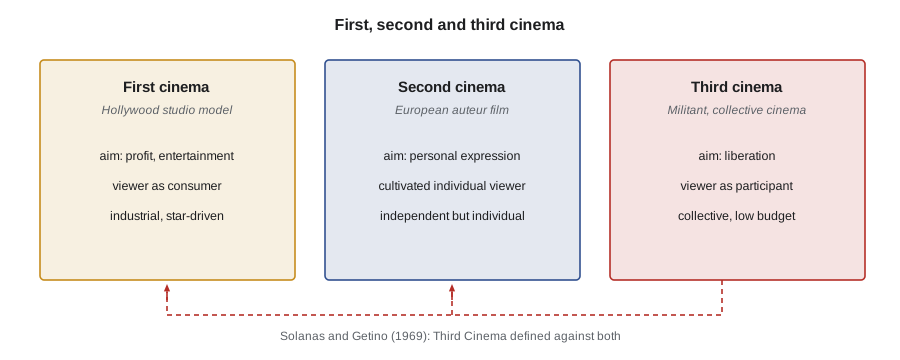
Related manifestos came from across Latin America. The Brazilian director Glauber Rocha's Aesthetic of Hunger (1965) argued that the violence and poverty of the underdeveloped world should shape a rough, confrontational style rather than imitate polished foreign models. The Cuban filmmaker Julio García Espinosa called for an imperfect cinema that rejected technical perfection as a value of privileged industries. These ideas influenced filmmakers in Africa, Asia and among diasporic and minority communities in North America and Europe.
| Feature | First cinema | Second cinema | Third cinema |
|---|---|---|---|
| Model | Hollywood studio and its imitators | European auteur cinema | Militant, collective, anti-colonial cinema |
| Aim | Profit and entertainment | Personal artistic expression | Liberation and political awareness |
| Viewer | Consumer | Cultivated individual spectator | Active participant in discussion and action |
| Production | Industrial, star-driven | Independent but individual | Collective, low-budget, often clandestine |
| Example | A studio blockbuster | A French New Wave film | The Hour of the Furnaces (1968) |
Black cinema and the LA Rebellion
In the United States, Black filmmakers built traditions outside and against Hollywood. Oscar Micheaux produced and directed dozens of films for Black audiences from 1919 into the 1940s, including Within Our Gates (1920), a response to The Birth of a Nation. In the late 1960s and 1970s, a group of Black students at the University of California, Los Angeles, later called the LA Rebellion, made independent films influenced by Third Cinema and Italian neorealism. Charles Burnett's Killer of Sheep (1978), a quiet portrait of a slaughterhouse worker and his family in Watts, Haile Gerima's Bush Mama (1975) and Julie Dash's later Daughters of the Dust (1991) offered Black perspectives and styles in deliberate contrast to Hollywood and to commercial Blaxploitation films.
Contemporary Black cinema includes Spike Lee, Barry Jenkins, Ava DuVernay, Ryan Coogler and Jordan Peele, whose Get Out (2017) uses horror conventions to dramatize racism in liberal white society. Critics have used the film to discuss how genre (Lesson 5) can carry social critique and how audiences of different backgrounds read the same scenes differently, recalling Hall's decoding positions in Lesson 6.
Worked problem
Reading Get Out through theory
In Get Out, a young Black photographer visits his white girlfriend's family, who appear welcoming but plan to transplant white consciousness into Black bodies. Show how two theories from this course illuminate the film.
Show solution
- Genre theory: the film combines horror syntax, an isolated victim gradually discovering a monstrous threat, with the semantic elements of a social comedy of manners, which lets it expose racism hidden beneath politeness.
- Theories of the gaze: the protagonist is a photographer, and the film stages scenes in which white characters inspect and admire his body, reversing the usual structure of who looks and who is looked at; his camera flash ultimately helps free another captive.
- The sunken place, where the protagonist is paralysed and watches his life as if on a distant screen, can be read as an image of spectatorship itself: a Black viewer forced to watch without power, which echoes bell hooks's account of exclusion and the oppositional gaze.
- Evidence and caution: support each claim with specific scenes and avoid claiming a single correct reading; audiences of different backgrounds responded differently, which is itself part of the film's meaning.
Answer: Genre theory explains how the film's structure carries critique, and theories of the gaze explain how it reverses and dramatizes racialized looking.
Indigenous cinema and screen sovereignty
Indigenous filmmakers have long contested their representation by others and asserted control over their own stories, languages and images. Scholars use terms such as visual sovereignty, proposed by Michelle Raheja, to describe how Indigenous filmmakers reclaim the screen, sometimes by revisiting and reworking stereotypes, and to emphasize community protocols about who may tell which stories. Indigenous cinema often centres collective authorship, oral tradition, land and language revitalization.
Canada has an influential Indigenous screen sector. Alanis Obomsawin's documentaries at the National Film Board (Lesson 4) and the Inuit production company Isuma, whose Atanarjuat: The Fast Runner (2001), directed by Zacharias Kunuk and made in Inuktitut, won the Caméra d'or at Cannes, transformed perceptions of Indigenous filmmaking. Directors such as Jeff Barnaby, Tracey Deer and Danis Goulet have brought Indigenous perspectives to genre and drama. The Indigenous Screen Office, announced by the federal government in 2017 and established in 2018, supports Indigenous storytellers and was given ongoing federal funding in the 2024 budget. The guide On-Screen Protocols and Pathways, published in 2019 by the imagineNATIVE festival, sets out how productions should work respectfully with Indigenous communities and their stories.
What is a national cinema?
Film studies once organized cinema history by nation: German Expressionism, Italian neorealism, the French New Wave. But what makes a film national? The British scholar Andrew Higson, in a 1989 essay, distinguished several ways of defining national cinema: by production, such as where films are made and who funds them; by consumption, such as what national audiences actually watch, which is often Hollywood; by text, such as recurring themes and styles; and by criticism, such as which films critics and institutions promote as representative. Drawing on Benedict Anderson's idea that nations are imagined communities, Higson and others argued that national cinemas help imagine the nation rather than simply reflect it.
Scholars now emphasize transnational cinema: co-productions, global streaming, diasporic filmmakers and stories that cross borders. A film may be financed in several countries, shot in another and watched worldwide on a platform. National labels remain important for funding, regulation and identity, but they describe only part of how films are made and seen.
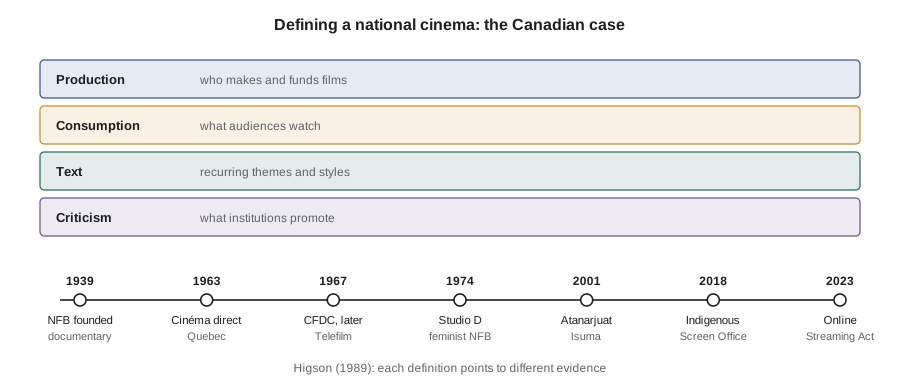
Canadian critics have debated for decades what Canadian cinema is. Some identified recurring themes, such as survival, failure, ambivalence and landscapes that dwarf people, sometimes linked to Margaret Atwood's literary study Survival (1972). Others emphasized the documentary tradition of the National Film Board as Canada's distinctive contribution, or Quebec cinema as a national cinema in its own right, with a strong domestic audience and a cinema of language and identity. Because Hollywood dominates Canadian screens and many Hollywood films are shot in Canadian cities standing in for American ones, Canada is a key case for Higson's distinction between production and consumption.
Measuring who makes films
Representation studies also track who directs, writes and produces. The calculation below converts percentages from the USC Annenberg study of the top 100 films of 2025, which counted 111 directors, into approximate numbers of people, showing how small some groups are in absolute terms.
directors = 111
shares = {"Underrepresented racial or ethnic groups": 24.3, "Women from racialized groups": 5.4, "White women": 2.7}
for group, pct in shares.items():
print(f"{group}: {pct}% of {directors} is about {round(directors * pct / 100)} directors")Underrepresented racial or ethnic groups: 24.3% of 111 is about 27 directors Women from racialized groups: 5.4% of 111 is about 6 directors White women: 2.7% of 111 is about 3 directors
Percentages can make progress or decline look abstract; head counts show that a handful of hiring decisions can move the figures dramatically from one year to the next, which is why researchers emphasize long-term trends.
Writing about race, colonialism and nation responsibly
Writing about films from communities other than your own calls for particular care. Research the historical and cultural context, read critics and scholars from the community the film represents, and avoid presenting a single film as the voice of an entire people. Pay attention to language, including how communities name themselves, and to protocols about stories, images and ceremonies. When a film was made by outsiders, ask how it was produced, whether communities were consulted, and who benefits from its circulation. These questions do not replace formal analysis; they place it within the relationships of power that the theories in this lesson describe.
Common mistakes
MistakeThinking that positive images alone solve problems of representation
InsteadAsk whose perspective organizes the film and who controls production, as Shohat and Stam argued.
MistakeTreating Third Cinema as any film from the Global South
InsteadThird Cinema is a specific militant, collective model defined against first and second cinema.
MistakeAssuming national cinema means only films made in a country
InsteadConsider production, consumption, text and criticism, as Higson proposed.
MistakeSpeaking for Indigenous communities without attention to protocols
InsteadFollow community protocols and centre Indigenous voices and authority over stories.
MistakeReading a film about race in only one way
InsteadConsider how audiences of different backgrounds decode the same scenes differently.
Summary and key terms
- Early criticism documented racial stereotypes, from The Birth of a Nation to Bogle's five types.
- Shohat and Stam argued that representation depends on perspective and control, not only positive images.
- Fanon and Said shaped postcolonial theory, and Naficy described the accented cinema of exile and diaspora.
- Solanas and Getino's Third Cinema defined a militant, collective cinema against Hollywood and the auteur film.
- Black independent cinema, from Micheaux to the LA Rebellion and Get Out, offered alternative perspectives and styles.
- Indigenous filmmakers assert visual sovereignty, supported in Canada by the Indigenous Screen Office and protocols.
- Higson defined national cinema by production, consumption, text and criticism, and transnational cinema complicates national labels.
- Stereotype
- A simplified, recurring representation of a group.
- Eurocentrism
- A worldview that treats European and Western perspectives as the universal norm.
- Orientalism
- Said's term for Western representations of the East as exotic and inferior.
- Accented cinema
- Naficy's term for films by exiled and diasporic filmmakers marked by displacement.
- Third Cinema
- A militant, collective cinema of liberation defined against Hollywood and auteur cinema.
- Imperfect cinema
- García Espinosa's call to reject technical perfection as a value.
- LA Rebellion
- Black filmmakers trained at UCLA who made independent films from the late 1960s.
- Visual sovereignty
- Indigenous control over representation and the reclaiming of the screen.
- National cinema
- Films understood as belonging to a nation, defined in several competing ways.
- Transnational cinema
- Films made, financed, circulated or watched across national borders.
Practice problems
Work each problem on paper first, then reveal the answer to check.
Why is The Birth of a Nation central to the history of race on screen?
Show answer
It combined technical innovation with racist caricature and glorification of the Klan.
What did Shohat and Stam add to stereotype criticism?
Show answer
That perspective and control of production matter, not only positive or negative images.
Define Orientalism.
Show answer
Western representations constructing the East as exotic, irrational and inferior.
Distinguish first, second and third cinema.
Show answer
Hollywood entertainment, European auteur film, and militant collective cinema of liberation.
Name a film of the LA Rebellion.
Show answer
Killer of Sheep, Bush Mama or Daughters of the Dust.
What is visual sovereignty?
Show answer
Indigenous control over representation and the reclaiming of the screen.
What award did Atanarjuat: The Fast Runner win at Cannes?
Show answer
The Caméra d'or.
List Higson's four ways of defining national cinema.
Show answer
Production, consumption, text and criticism.
Why is Canada a useful case for national cinema theory?
Show answer
Canadians mostly watch Hollywood films, and Hollywood often films in Canada, separating production from consumption.
About how many of 111 directors does 24.3 per cent represent?
Show answer
About 27 directors.
Lesson quiz · 5 questions
Score 60% or more to complete this lesson.
Create a free account to save your progress, take quizzes and earn a certificate.