
FILM-430 · Lesson 6 of 12 · 25 min
Ideology, apparatus and counter-cinema
In the late 1960s and 1970s, film theory became openly political. Influenced by Marxism, the protests of May 1968 and new theories of language and the mind, critics argued that mainstream films are not innocent entertainment. They carry ideology: systems of beliefs and values that make a particular social order seem natural. Some theorists went further and argued that the cinematic apparatus itself, the camera, projector and screen, shapes viewers into particular kinds of subjects. This lesson explains these ideas, the counter-cinema they inspired, and the audience research that challenged them.
The previous lesson introduced the ideological view of genre. Here we look at ideological criticism as a general method, and at the specific theories of the apparatus that dominated British and French film theory in the 1970s.
What ideology means
In everyday speech, ideology means a set of political opinions. In Marxist theory, it means something deeper: the ideas and values through which people experience their place in society as natural and inevitable. Karl Marx argued that the ruling ideas of an age tend to be the ideas of its ruling class. Later Marxists asked how ideology works in modern societies where people are not simply forced to obey but appear to consent freely.
In 1944, the German philosophers Theodor Adorno and Max Horkheimer described what they called the culture industry. Writing in exile in California, they argued that films, radio and popular music were produced like factory goods: standardized, predictable and designed to keep audiences passive and distracted. Their pessimism was influential but criticized for dismissing popular culture and its audiences wholesale.
In 1970, the French philosopher Louis Althusser offered a more flexible account. He argued that ideology works through institutions he called ideological state apparatuses, such as schools, families, churches and media, which shape people's identities. Ideology interpellates, or hails, individuals as subjects: it addresses us as particular kinds of people, and we recognize ourselves in that address. For film theorists, cinema became a powerful apparatus of this kind, addressing viewers and inviting them to take up a position.
Cahiers du cinéma after 1968
After May 1968, Cahiers du cinéma turned from auteurism to political theory. In an influential 1969 editorial, Jean-Louis Comolli and Jean Narboni argued that every film is political, because every film is shaped by the ideology of the system that produces it. They sorted films into categories by how they related to ideology in both content and form. Most films, they said, simply reproduce dominant ideology. A few attack it in both subject matter and form. Others have political subjects but conventional, transparent form, which, they argued, undermines their politics.
Their most fertile category described films that seem to belong to dominant ideology but contain internal tensions, gaps or excesses that crack it open from within. A critic attentive to these cracks can read a mainstream film against the grain. In 1970, the Cahiers editors published a collective reading of John Ford's Young Mr. Lincoln (1939), arguing that the film's attempt to present Lincoln as a natural embodiment of law and order produced moments of strangeness and violence that exposed the ideological work it was doing. This method, known as symptomatic reading, influenced later feminist and queer criticism.
Worked problem
A symptomatic reading
A 1950s Hollywood melodrama ends happily: a widow who fell in love with a younger working-class man is reunited with him after her family and community disapprove. Yet the final scenes are oddly stiff, the colours unnaturally bright, and a deer appears in the window in a sentimental tableau. How might a symptomatic reading approach the ending?
Show solution
- Identify the dominant ideology: the film appears to endorse romantic love overcoming social barriers, a reassuring message.
- Look for excess: the artificial colour, stiff staging and kitschy imagery are more than the story needs, drawing attention to themselves.
- Interpret the excess: the style may expose the ending as a fantasy, suggesting that the social pressures of class, age and gender are not truly resolved.
- Support with evidence: compare the ending's style with earlier scenes of community judgement, and with the director's other films, as critics have done with Douglas Sirk's melodramas such as All That Heaven Allows (1955).
Answer: A symptomatic reading treats stylistic excess as a sign of ideological strain, arguing that the happy ending contains its own critique.
Apparatus theory
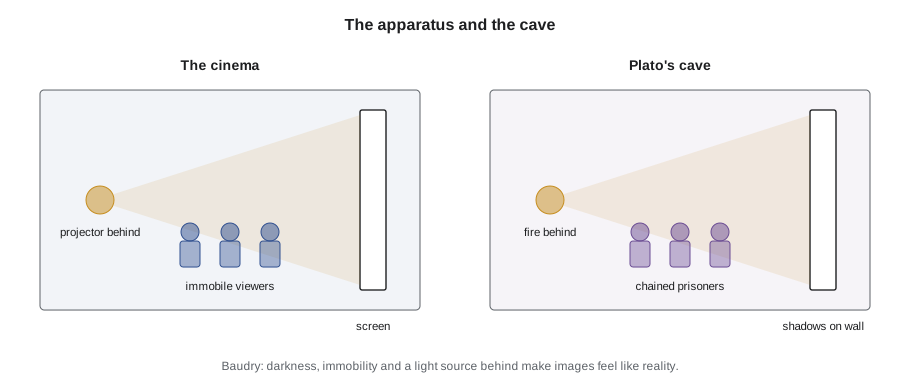
Apparatus theory argued that cinema shapes viewers through its basic technology and viewing situation, regardless of content. Jean-Louis Baudry, in essays of 1970 and 1975, made two influential claims. First, the camera's lens is built on Renaissance perspective, which organizes the image around a single ideal point of view. The viewer, by occupying that point, experiences themselves as a unified, all-seeing subject at the centre of the world. Second, the viewing situation, a darkened room, an immobile audience and a bright projected image, resembles Plato's allegory of the cave and the state of dreaming, encouraging regression and belief.
A related idea was suture, developed by Jean-Pierre Oudart and popularized in English by Daniel Dayan in 1974. In the shot and reverse shot pattern of classical editing, a shot raises the question of who is looking, and the reverse shot answers it by showing a character. The viewer is stitched into the film's space, adopting a character's position without noticing the absent camera. Suture explained, in their account, how classical cinema hides its own construction and binds viewers to its point of view. Lesson 8 returns to its psychoanalytic roots.
In Britain, the journal Screen brought these ideas into English during the 1970s. Colin MacCabe argued that mainstream films are classic realist texts: they organize characters' speech within a hierarchy topped by the narration itself, which presents itself as simply showing the truth. Because this narration hides its own perspective, the viewer accepts it as reality. To break this effect, films would need to expose their construction.
Counter-cinema
If mainstream cinema produced passive, unified spectators through transparent narration, the solution was a cinema that refused transparency. Theorists drew on the German playwright Bertolt Brecht, whose epic theatre used distancing devices, such as direct address, captions and visible stage machinery, to prevent emotional absorption and encourage critical thought. Jean-Luc Godard, after 1968, made films with the Dziga Vertov Group and later Tout va bien (1972), which broke illusion with exposed sets, interviews and political lectures.
In 1972, Peter Wollen summarized the opposition in an essay contrasting the deadly sins of mainstream cinema with the cardinal virtues of counter-cinema. The table paraphrases his seven pairs.
| Mainstream cinema | Counter-cinema | What changes for the viewer |
|---|---|---|
| Narrative transitivity: one event leads smoothly to the next | Narrative intransitivity: digressions and interruptions | The viewer must reflect on the gaps |
| Identification with characters | Estrangement and distance | The viewer judges rather than empathizes |
| Transparency: style hides itself | Foregrounding: style draws attention to itself | The viewer notices construction |
| Single diegesis: one consistent story world | Multiple diegesis: several worlds or levels | The viewer compares perspectives |
| Closure: a resolved ending | Aperture: an open ending | The viewer continues thinking |
| Pleasure | Unpleasure | The viewer is provoked rather than satisfied |
| Fiction | Reality: documentary elements and real voices | The viewer connects film to the world |
Feminist filmmakers in the 1970s, including Laura Mulvey and Peter Wollen in Riddles of the Sphinx (1977), adopted counter-cinema strategies to question how mainstream cinema represented women. Lesson 8 discusses Mulvey's theory.
The audience strikes back: encoding and decoding
Apparatus theory imagined spectators as positions constructed by the text. Researchers in British cultural studies objected that real audiences are diverse and active. In an influential essay first circulated in 1973, Stuart Hall at the Birmingham Centre for Contemporary Cultural Studies argued that media messages are encoded with preferred meanings but decoded by audiences in different ways. A viewer may accept the preferred meaning (a dominant reading), accept it partly while adapting it to their situation (a negotiated reading), or reject it in favour of an opposing framework (an oppositional reading).
Hall's model shifted attention from the film as an apparatus to the social positions of viewers: class, race, gender, nationality and community shape how a film is understood. Later audience research, interviews, fan studies and reception history all build on this insight, and Lesson 8 shows how bell hooks developed the idea of an oppositional gaze.
import random
from collections import Counter
random.seed(7)
groups = {"Group A": [0.60, 0.30, 0.10], "Group B": [0.25, 0.45, 0.30]}
labels = ["dominant", "negotiated", "oppositional"]
for name, weights in groups.items():
    answers = random.choices(labels, weights=weights, k=120)
    c = Counter(answers)
    shares = ", ".join(f"{k} {c[k] / 120:.0%}" for k in labels)
print(f"{name}: {shares}")Group A: dominant 65%, negotiated 29%, oppositional 6% Group B: dominant 31%, negotiated 38%, oppositional 32%
The invented results illustrate a typical finding: groups with different social experiences distribute differently across the three readings of the same film. Real studies use interviews and careful sampling, but the principle is the same.
Ideology and industry today
Ideological criticism remains common, often combined with political economy, the study of who owns media, how it is financed and whose interests shape production. Critics examine how blockbusters represent the military, policing, technology and capitalism, and how concentrated ownership and global franchises narrow the range of stories told.
In Canada, ideological debates have long centred on cultural sovereignty. Hollywood films dominate Canadian screens, and Canadian feature films usually earn only a small share of the domestic box office, especially in English Canada. Policies such as Canadian content rules, public funders such as Telefilm Canada, and recent requirements that streaming services contribute to Canadian production are partly ideological interventions: they aim to ensure that Canadians see stories about their own society rather than absorbing another country's assumptions as universal.
Strengths and limits
Ideological criticism and apparatus theory taught critics to see that form is never neutral and that pleasure can serve power. They encouraged reading against the grain and inspired important experimental and political filmmaking. Their limits are also clear. Apparatus theory often treated all mainstream films as the same and all spectators as passive. It struggled to explain why audiences enjoy films critically, or why the same film can provoke opposite responses. Cognitive theorists (Lesson 11) attacked its psychological assumptions, and cultural studies showed that audiences negotiate meanings. Good ideological criticism today is specific: it analyses particular films, industries and audiences rather than declaring all cinema ideological in the same way.
Using ideological criticism carefully
A useful test for any ideological reading is to state the values you believe a film naturalizes, point to the scenes and stylistic choices that do the work, and consider how a viewer from a different social position might read the same scenes. If your reading survives that test, it is likely to persuade readers who do not already share your politics.
Common mistakes
MistakeUsing ideology to mean simply a political opinion
InsteadIn film theory, ideology means values and beliefs that make a social order seem natural.
MistakeAssuming only overtly political films carry ideology
InsteadComolli and Narboni argued every film is shaped by ideology, including entertainment.
MistakeTreating apparatus theory as a description of real viewers
InsteadIt describes positions constructed by the text; audience research shows real viewers vary.
MistakeEquating counter-cinema with any difficult film
InsteadCounter-cinema deliberately reverses mainstream conventions to provoke critical thought.
MistakeReading every stylistic oddity as a symptom
InsteadSupport a symptomatic reading with patterns of evidence and context.
Summary and key terms
- Ideology means the values and beliefs that make a particular social order seem natural.
- Adorno and Horkheimer described the culture industry; Althusser described ideology interpellating individuals as subjects.
- Comolli and Narboni argued every film is political and identified films that crack dominant ideology from within.
- Baudry's apparatus theory claimed perspective and the viewing situation construct a unified, believing spectator.
- Suture and the classic realist text explained how classical cinema hides its construction.
- Counter-cinema, inspired by Brecht and Godard, reversed mainstream conventions, as summarized by Wollen.
- Hall's encoding and decoding model showed that audiences produce dominant, negotiated and oppositional readings.
- Ideology
- Beliefs and values through which a social order appears natural and inevitable.
- Culture industry
- Adorno and Horkheimer's term for standardized mass-produced entertainment.
- Interpellation
- Althusser's term for ideology hailing individuals as particular subjects.
- Symptomatic reading
- Reading a film for gaps and excesses that reveal ideological strain.
- Apparatus theory
- The theory that cinema's technology and viewing situation shape the spectator.
- Suture
- The process by which editing, especially shot and reverse shot, stitches viewers into the film.
- Classic realist text
- MacCabe's term for narratives that hide their perspective behind apparent truth.
- Distanciation
- Brecht's strategy of preventing absorption so audiences think critically.
- Counter-cinema
- Filmmaking that reverses mainstream conventions to provoke critical viewing.
- Encoding and decoding
- Hall's model of messages produced with preferred meanings and read in different ways.
Practice problems
Work each problem on paper first, then reveal the answer to check.
How does Althusser's idea of interpellation apply to cinema?
Show answer
Films address viewers as particular subjects, and viewers recognize themselves in that address.
What did Comolli and Narboni claim about all films?
Show answer
That every film is political because it is shaped by the ideology of its system.
Describe a symptomatic reading in one sentence.
Show answer
Reading a mainstream film for gaps and excesses that expose its ideological work.
Give Baudry's two main claims.
Show answer
Perspective constructs a unified, all-seeing subject; the darkened viewing situation resembles Plato's cave and dreaming.
Explain suture using shot and reverse shot.
Show answer
A shot raises the question of who is looking; the reverse shot answers it and stitches the viewer in.
Name three of Wollen's counter-cinema virtues.
Show answer
Intransitivity, estrangement, foregrounding, multiple diegesis, aperture, unpleasure, reality.
What are Hall's three decoding positions?
Show answer
Dominant, negotiated and oppositional readings.
Give one criticism of apparatus theory.
Show answer
It treats all spectators as passive and all mainstream films as alike.
How do Canadian content rules relate to ideology?
Show answer
They aim to ensure Canadians see their own society's stories rather than another country's assumptions.
Why did Brecht use distancing devices?
Show answer
To prevent emotional absorption and encourage critical thinking.
Lesson quiz · 5 questions
Score 60% or more to complete this lesson.
Create a free account to save your progress, take quizzes and earn a certificate.