
FILM-430 · Lesson 12 of 12 · 25 min
Film criticism and capstone: writing a critical essay
Theory becomes most useful when it sharpens criticism. This final lesson turns from theories to the practice of writing about films: the history and forms of film criticism, the ways criticism circulates today through aggregators, social platforms and video essays, the ethics of the critic, and a step-by-step process for the capstone, a theoretically informed critical essay on a film of your choice.
FILM-101 Lesson 12 guided you through a formal analysis essay. This capstone builds on that foundation by asking you to combine close analysis with a theoretical framework from this course and to argue for an interpretation that matters.
A short history of film criticism
Film reviewing began in newspapers and trade papers in the 1910s, often as little more than plot summaries and recommendations. Serious criticism developed alongside the classical theory of Lessons 2 and 3, in the film societies and little magazines of the 1920s. After the Second World War, Cahiers du cinéma (Lesson 4) made criticism a training ground for filmmakers and a site of theoretical argument. In the United States, writers such as James Agee and Manny Farber developed a vivid, personal style; Farber's 1962 essay contrasting termite art, which burrows into small details, with white elephant art, which aims at grand masterpieces, remains a favourite of critics.
In the 1960s and 1970s, Pauline Kael and Andrew Sarris turned their auteurist dispute into a public rivalry, and newspaper and magazine critics became cultural figures. From 1975, Gene Siskel and Roger Ebert brought criticism to television, popularizing the thumbs up or down verdict. Academic film studies developed in parallel, and the gap between reviewing and scholarship widened as theory grew more specialized.
Canadian criticism has its own history. Gerald Pratley broadcast film commentary on CBC radio for decades and founded the Ontario Film Institute; magazines such as Cinema Canada (1962 to 1989) and Take One (1966 to 2006) covered Canadian and international film; and Cinema Scope, founded in 1999, became an internationally respected journal of film criticism. In Quebec, journals such as Séquences and 24 images have sustained serious French-language criticism, and critics have long argued about the identity and value of Canadian cinema itself (Lesson 10).
Forms of writing about film
Writing about film takes several forms, each with different readers, purposes and conventions. Knowing which you are writing shapes every choice, from length and tone to how much plot to reveal and how much theory to use.
| Form | Reader | Purpose | Typical length | Use of theory |
|---|---|---|---|---|
| Review | General audience deciding what to watch | Describe, evaluate, recommend | 400 to 1,200 words | Implicit, rarely named |
| Critical essay | Engaged readers and students | Argue for an interpretation and evaluation | 1,500 to 5,000 words | Explicit or strongly informed by theory |
| Academic article | Scholars | Contribute new knowledge to a field | 6,000 to 10,000 words | Explicit, with literature review |
| Programme notes | Festival or cinematheque audience | Contextualize a screening | 300 to 1,000 words | Light, historical |
| Video essay | Online audiences | Argue through images, sound and voice | 5 to 30 minutes | Varies; often visual demonstration |
The video essay deserves special mention. By editing clips, freeze-frames and split screens, video essayists can demonstrate formal claims directly, showing rather than describing a pattern of shots or a repeated motif. Its use of copyrighted clips relies on fair dealing or fair use for criticism and review, covered in FILM-420 Lesson 5, so essayists keep clips short and transformative and attribute their sources.
Aggregators, platforms and the critic's role
Criticism now circulates through aggregators and social platforms. Rotten Tomatoes reports the percentage of approved critics who gave a film a positive review, so a film that every critic finds merely acceptable can score higher than one that half the critics consider a masterpiece. In 2024 it renamed its audience score the Popcornmeter. Metacritic instead converts reviews into numerical scores and calculates a weighted average. Letterboxd has made social, diary-style reviewing popular, especially among younger viewers.
These tools are useful for quick orientation but flatten criticism into numbers and verdicts. They reward consensus and can pressure studios and critics alike. A theoretically informed critic adds what aggregation cannot: argument, context, interpretation and reasons. The simple example below shows how two films with very different critical receptions can produce misleading summary figures.
film_a = [6, 6, 7, 6, 7, 6, 6, 7, 6, 6]
film_b = [10, 9, 10, 4, 3, 10, 9, 4, 10, 3]
for name, scores in [("Film A", film_a), ("Film B", film_b)]:
    positive = sum(s >= 6 for s in scores) / len(scores)
    average = sum(scores) / len(scores)
print(f"{name}: {positive:.0%} positive, average {average:.1f} out of 10")Film A: 100% positive, average 6.3 out of 10 Film B: 60% positive, average 7.2 out of 10
Film A is unanimously positive but unremarkable; Film B divides critics but inspires passion. A percentage-positive score favours Film A, while the average favours Film B. Neither number tells you why critics responded as they did, which is the critic's real task.
The ethics of criticism
Critics carry responsibilities. They should disclose conflicts of interest, such as friendships with filmmakers or paid work for distributors, and be transparent about press screenings and junkets. They should avoid revealing major plot twists in reviews aimed at viewers who have not seen the film, while essays and scholarship may discuss endings openly with a warning. They should represent films accurately, quote and cite fairly, and recognize that their words affect filmmakers' careers, especially for small independent productions.
Academic integrity applies to student criticism. Your essay must be your own work, with every source cited. Many institutions now set rules for the use of generative AI tools: some forbid them, some allow limited uses with disclosure. Follow your course policy, and remember that AI-generated text often contains invented quotations, misattributed theories and plot details that never happened, which careful viewing and research will expose.
The capstone process
The capstone asks you to write a critical essay of 2,500 to 3,500 words on a film of your choice, using at least one theoretical framework from this course and engaging with at least three scholarly or critical sources. The steps below break the work into manageable stages.
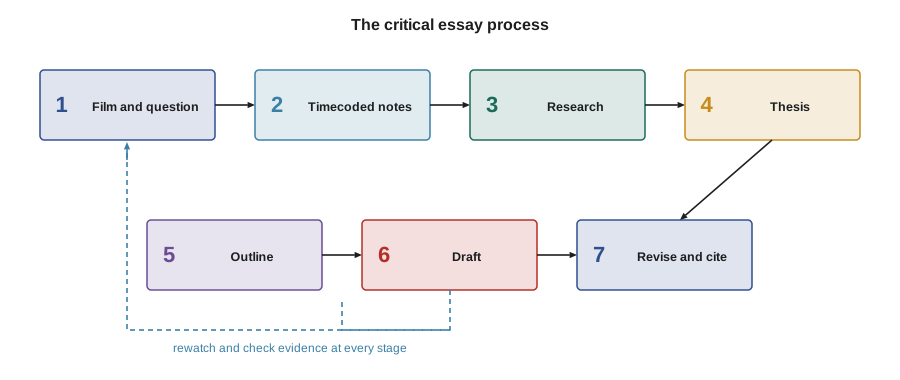
- Choose a film and a question: pick a film you can watch several times, and frame a question that a theory can help answer, such as how the film structures looking, what genre conventions it revises, or what its realism claims.
- Take viewing notes with timecodes: on a second and third viewing, record precise timecodes, shot descriptions, dialogue and sound for key scenes, so that every claim can be supported.
- Research the context and theory: read the theorist you are using in a reliable source, and find critics and scholars who have written about the film or related films.
- Draft a thesis: state an arguable claim that a reasonable reader might dispute, such as an interpretation that goes beyond the obvious.
- Outline the argument: organize evidence into sections that each support part of the thesis, and plan where to address a counterargument.
- Draft with close analysis: describe specific shots, sounds and edits precisely, then explain how they support your claim.
- Revise and cite: test every paragraph against the thesis, cut summary, check facts against the film, and format citations consistently.
Worked problem
From topic to thesis
A student wants to write about a fictional Canadian short film, The Last Ferry, in which an older Inuk woman travels south on a ferry to visit her granddaughter in the city, and the camera stays mostly on her face in long takes while the city appears only in reflections on the window. Develop a thesis using theory from this course.
Show solution
- Topic: a quiet film about travel, family and the city, which is too broad to argue.
- Question: why does the film keep the camera on the woman and show the city only in reflections, and what does this mean?
- Theory: Bazin's realism (Lesson 3) explains how long takes preserve duration and invite viewers to read her face; visual sovereignty (Lesson 10) suggests asking whose perspective the film adopts and who controls the image.
- Thesis: by holding long takes on the woman and reducing the city to reflections, The Last Ferry makes her perception the film's centre and refuses the spectacle of the southern city, turning realist duration into an assertion of Indigenous perspective.
Answer: A good thesis combines a specific formal pattern, a theoretical framework and an interpretive claim that a reader could dispute and the evidence can support.
Writing analysis that persuades
Strong critical writing moves constantly between description and interpretation. Describe a shot precisely enough that a reader who has not seen the film can picture it, then explain its significance in relation to your thesis. Avoid long plot summary; summarize only what readers need to follow your argument. Name the theory and explain its key concepts in your own words before applying them, as earlier lessons have modelled. Address at least one serious counterargument or alternative reading, and explain why your reading is stronger or how the two can coexist.
Pay attention to your verbs. Weak criticism says a film shows or has things; strong criticism says a film juxtaposes, withholds, aligns, frames, undercuts or reframes them. Precise verbs force precise thinking. Finally, end not by restating your thesis but by explaining what your reading reveals: about the film, the theory or cinema more broadly.
Citing films and sources
Use one citation style consistently. Many film and humanities courses use MLA style, set out in the MLA Handbook (ninth edition, 2021), or Chicago style, in The Chicago Manual of Style (eighteenth edition, 2024). Cite films with title, director, distributor or production company and year; cite theorists' books and essays with full publication details; and cite online reviews with author, title, publication, date and web address. When you quote dialogue, transcribe it accurately and keep quotations short.
| Element | MLA style example element | Chicago style example element |
|---|---|---|
| Title | Title in italics, first | Title in italics, first |
| Director | Directed by followed by the name | Directed by followed by the name |
| Company | Production or distribution company | Production or distribution company |
| Year | Year of release | Year of release |
| Format | Optional: platform or medium if relevant | Platform or medium, often included |
Beyond style, honesty is what matters. Cite every idea you take from a source, even when paraphrased. When you are unsure whether something counts as common knowledge, cite it.
Where theory leads next
This course has surveyed a century of thinking about cinema, from Münsterberg and Eisenstein to Sobchack and streaming algorithms. No single theory explains everything, and most good criticism combines approaches. The aim is not to adopt a school but to build a toolkit: knowing which questions each theory asks well, which evidence it needs, and what objections others would raise. Whether you go on to make films, programme festivals, write criticism or study cinema further, these tools will help you see films more clearly and argue about them more convincingly.
Common mistakes
MistakeWriting a thesis that simply describes the plot
InsteadState an arguable interpretive claim that evidence from the film can support.
MistakeUsing theory as decoration in the introduction only
InsteadApply the theory's concepts throughout the analysis, explaining them before use.
MistakeRelying on memory of a single viewing
InsteadRewatch with timecoded notes so every claim rests on precise evidence.
MistakeTreating aggregator scores as critical arguments
InsteadUse scores for orientation only and give reasons, context and interpretation.
MistakeSubmitting AI-generated analysis without checking or disclosure
InsteadFollow your course policy, do your own analysis, and verify every fact and quotation.
Summary and key terms
- Film criticism developed from newspaper reviewing through film societies, Cahiers du cinéma and public critics such as Kael, Sarris and Ebert.
- Canadian and American criticism each developed distinctive magazines, broadcasters and debates.
- Reviews, critical essays, academic articles, programme notes and video essays serve different readers and purposes.
- Aggregators such as Rotten Tomatoes and Metacritic summarize reception but cannot replace argument and context.
- Critics should disclose conflicts, handle spoilers responsibly, represent films accurately and follow academic integrity rules, including on AI.
- The capstone essay moves from a question and timecoded viewing notes through research and a thesis to drafting, revision and citation.
- Persuasive criticism combines precise description, explained theory, counterarguments and consistent citation.
- Review
- Short evaluative writing that helps a general audience decide what to watch.
- Critical essay
- Extended writing that argues for an interpretation and evaluation of a film.
- Programme notes
- Short contextual writing that accompanies a screening.
- Video essay
- Criticism made by editing images, sound and narration to argue a point.
- Termite art
- Farber's term for modest work that explores small details intensely.
- Aggregator
- A website that summarizes many reviews into a score.
- Thesis
- An arguable central claim that an essay sets out to support.
- Timecode
- A precise time reference used to locate shots and moments in a film.
- Counterargument
- An alternative reading or objection that an essay addresses.
- Citation style
- A consistent system, such as MLA or Chicago, for crediting sources.
Practice problems
Work each problem on paper first, then reveal the answer to check.
What did Manny Farber mean by termite art?
Show answer
Modest work that burrows intensely into small details rather than aiming at grand masterpieces.
Name one Canadian and one American film publication.
Show answer
Cinema Scope or Take One; Film Comment or Film Quarterly.
How does a review differ from a critical essay?
Show answer
A review helps a general audience decide what to watch; an essay argues an interpretation at length.
What does the Rotten Tomatoes Tomatometer measure?
Show answer
The percentage of approved critics who gave a film a positive review.
In the invented data, which film scores higher on percentage positive?
Show answer
Film A, with 100 per cent positive reviews.
Give two ethical duties of a critic.
Show answer
Disclose conflicts of interest, avoid spoilers in reviews, represent films accurately.
Why take timecoded viewing notes?
Show answer
So every claim can be supported with precise evidence from the film.
What makes a thesis arguable?
Show answer
A reasonable reader could dispute it, and evidence from the film can support it.
Name the current editions of the MLA Handbook and Chicago Manual of Style.
Show answer
MLA ninth edition (2021); Chicago eighteenth edition (2024).
How should an essay end?
Show answer
By explaining what the reading reveals about the film, theory or cinema, not just restating the thesis.
Lesson quiz · 5 questions
Score 60% or more to complete this lesson.
Create a free account to save your progress, take quizzes and earn a certificate.