
HSE-109 · Lesson 1 of 12 · 28 min
What psychological health and safety is
This is an awareness-level course about psychological health and safety at work. It explains how the way work is designed, organized and managed affects mental health, and what workers, supervisors and employers can do to prevent psychological harm and support people who are struggling, with reference to occupational health and safety (OHS) law, human rights law and the National Standard of Canada for Psychological Health and Safety in the Workplace. If you or someone you are with is in immediate danger, call 911 or your local emergency number. If you are thinking about suicide or are worried about someone, you can call or text 9-8-8, the Suicide Crisis Helpline, at any time, anywhere in Canada.
For most of the history of occupational safety, the word hazard brought to mind things that could crush, cut, burn or poison a worker: unguarded machines, falls from height, toxic chemicals, noise. Those hazards still injure and kill people, and earlier courses in this program deal with them. But over the past few decades employers, regulators and researchers have recognized that work can also harm people's minds. Chronic overload, constant conflict, bullying, fear of job loss, traumatic events, long and irregular hours and a sense of having no control can all lead to stress, anxiety, depression, burnout and other psychological injuries. These injuries are as real as a broken arm. They cause suffering, keep people off work, end careers and, in the worst cases, contribute to deaths.
Psychological health and safety is the part of occupational health and safety that deals with these risks. It asks the same questions safety professionals ask about any hazard: what could cause harm, who could be harmed, how likely and how serious is it, and what controls will prevent it? It also asks a second set of questions that are particular to mental health: how can work support good mental health, and how should a workplace respond when someone is unwell? This first lesson builds the foundations: key terms, the difference between mental health and mental illness, the idea of a continuum, and the three goals of a psychologically healthy and safe workplace.
Mental health, mental illness and psychological injury
The World Health Organization describes mental health as a state of mental well-being that enables people to cope with the stresses of life, realize their abilities, learn well and work well, and contribute to their community. Mental health is not simply the absence of a mental illness. A person can be living with a diagnosed condition, such as depression or bipolar disorder, and still have good mental health on most days because the condition is well managed and their life and work support them. Another person can have no diagnosis at all and still be struggling badly because of grief, conflict or exhaustion.
A mental illness, or mental disorder, is a clinically significant pattern of changes in thinking, mood or behaviour that causes distress or interferes with daily functioning, diagnosed by a qualified professional using recognized criteria. Common examples include depressive disorders, anxiety disorders, post-traumatic stress disorder (PTSD), bipolar disorder and substance use disorders. Mental illnesses have many causes, including genetics, life experiences and physical health, and work is only one possible contributor. That point matters: this course does not suggest that every mental illness is caused by work, and it does not ask supervisors to diagnose anyone.
Psychological injury, or psychological harm, is the term safety law and workers' compensation systems often use for harm to mental health that arises out of work. It includes conditions such as PTSD after a traumatic event, an adjustment disorder after prolonged harassment, or depression linked to chronic, excessive workplace stressors. Workers' compensation boards in both countries now accept some of these claims, although the rules differ widely, as Lesson 4 explains.
The mental health continuum
Mental health is not a switch with two settings. It changes over time and moves along a continuum. A widely used way to picture this is the mental health continuum model, which originated in the Canadian Armed Forces and is used in programs such as The Working Mind from the Mental Health Commission of Canada. It describes four zones, often coloured from green to red:
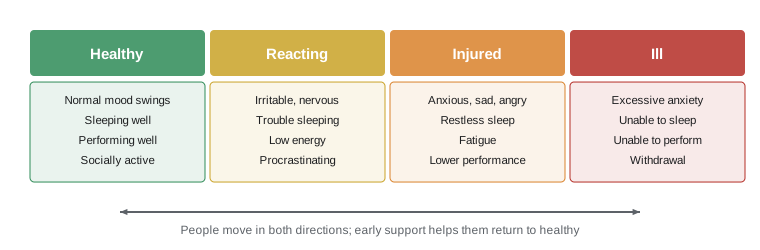
- Healthy: normal fluctuations in mood, sleeping well, physically active, performing well, socially connected.
- Reacting: nervous or irritable, trouble sleeping, low energy, procrastinating, pulling back from others. Most people pass through this zone regularly in response to ordinary stress.
- Injured: anxious, angry or sad most of the time, restless or disturbed sleep, fatigue, reduced performance, more frequent use of alcohol or other substances to cope.
- Ill: excessive anxiety, depressed mood, unable to sleep or sleeping too much, unable to perform duties, withdrawal, possible thoughts of suicide. This zone usually needs professional care.
The model has three practical uses. First, it normalizes ordinary reactions to stress: everyone moves into the reacting zone sometimes, and that is not a sign of weakness or illness. Second, it shows that early recognition matters. A person in the reacting or injured zone can often move back to healthy with rest, support and changes to their work, whereas someone who reaches the ill zone usually needs more time and professional help. Third, it gives workers and supervisors a shared, non-clinical language. Saying "I think I'm in the orange zone this month" is easier for many people than naming a diagnosis.
What a psychologically healthy and safe workplace is
The National Standard of Canada for Psychological Health and Safety in the Workplace, CAN/CSA-Z1003-13/BNQ 9700-803/2013, released in 2013 and reaffirmed since, defines a psychologically healthy and safe workplace as one that promotes workers' psychological well-being and actively works to prevent harm to worker psychological health, including in negligent, reckless or intentional ways. The standard is voluntary, but it is widely used across Canada as a framework, and the Mental Health Commission of Canada (MHCC) champions it. A revised edition is being developed, with publication expected around the end of 2026, so check whether a newer edition is in force when you read this.
Across these frameworks, a psychologically healthy and safe workplace does three things:
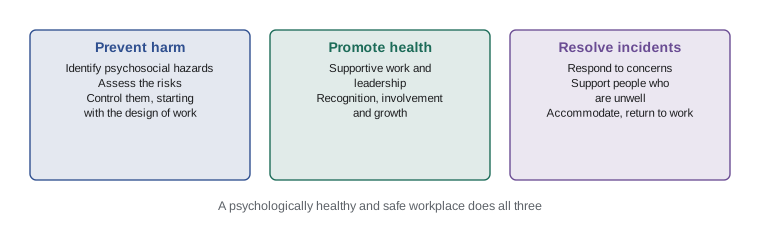
- Prevent harm. It identifies psychosocial hazards, such as excessive workload, poor role clarity, lack of support or exposure to trauma, assesses the risks and controls them, just as it would with physical hazards. This is the core of psychological safety in the OHS sense.
- Promote health. It builds features of work that support good mental health: meaningful work, fair treatment, recognition, reasonable control, good relationships, opportunities to learn and grow, and leaders who care.
- Resolve incidents and concerns. It responds when things go wrong: it handles complaints fairly, supports workers after traumatic events, helps people who are struggling find help, accommodates mental health conditions and supports a safe return to work after absence.
These goals overlap. A team where people feel able to raise problems early helps prevent harm and also helps resolve incidents before they grow. A fair, well-run return to work after a mental health absence protects that worker and shows the rest of the team that it is safe to ask for help.
Two meanings of psychological safety
The phrase psychological safety is used in two different ways, and it is worth keeping them apart. In occupational health and safety, psychological safety means protection from psychological harm: the absence of psychosocial hazards that could injure mental health, in the same way physical safety means protection from physical injury. In organizational behaviour, a term made popular by Professor Amy Edmondson of Harvard Business School, team psychological safety means a shared belief that it is safe to take interpersonal risks, such as speaking up with a concern, admitting a mistake or asking a question, without being punished or humiliated. Both matter, and they reinforce each other. This course uses psychological health and safety for the broad OHS concept and team psychological safety for Edmondson's idea, which is covered in Lesson 10.
Why it matters
There are three main reasons for workplaces to take psychological health and safety seriously. The first is human: mental health problems cause real suffering for workers and their families, and work can either add to that suffering or help relieve it. The second is legal: employers have general duties to protect workers' health, which in most jurisdictions include mental health, plus specific duties on harassment, accommodation and return to work. The third is organizational: poor psychological health and safety shows up as absenteeism, presenteeism (being at work but unable to function well), turnover, conflict, errors, incidents, disability claims and damaged reputation. Lesson 3 looks at the numbers.
Many Canadians will recognize the scale from their own workplaces. The Mental Health Commission of Canada has long reported that in any given week, about 500,000 people in Canada are unable to work because of mental health problems or illnesses, and that roughly one in five people in Canada experiences a mental health problem or illness in a given year.
| Term | Meaning in this course | Example |
|---|---|---|
| Mental health | A state of well-being in which a person can cope, work and contribute | Feeling able to manage a busy week and still rest at weekends |
| Mental illness | A diagnosed condition affecting thinking, mood or behaviour | Major depressive disorder, generalized anxiety disorder, PTSD |
| Psychological injury | Harm to mental health arising out of work | PTSD after a fatal incident on site |
| Psychosocial hazard | An aspect of work design, organization or relationships that can cause psychological harm | Chronic understaffing; bullying; exposure to traumatic calls |
| Psychological health and safety | Preventing psychological harm and promoting well-being at work | A workload review and a supportive return-to-work process |
| Team psychological safety | A shared belief that speaking up will not be punished | A junior nurse questions a medication order without fear |
Roles and responsibilities at a glance
Psychological health and safety is a shared responsibility, but not an equal one. Employers control how work is designed and resourced, so they carry the main duty to identify and control psychosocial hazards. Supervisors and managers shape the day-to-day experience of work: how tasks are assigned, how people are treated, whether concerns are heard. They need training and support to do this well. Workers contribute by following safe practices, treating colleagues with respect, reporting hazards and concerns, and looking after their own health as far as they can. Joint health and safety committees, health and safety representatives, unions, human resources, occupational health providers and EAPs all have parts to play. Later lessons explain each role in more detail.
One caution is important. Psychological health and safety is not mainly about teaching individuals to be more resilient so they can cope with bad work. Resilience training, mindfulness apps and wellness days can help some people, but on their own they treat the symptoms rather than the causes. Just as no safety professional would respond to a dangerous machine by offering workers a course in being careful, a serious psychological health and safety program starts by fixing the work itself, then adds individual supports on top.
Worked problem
Placing workers on the continuum
A team lead notices three changes over a month. Ana, usually cheerful, has become irritable and says she is sleeping badly during a busy project, but her work is on time. Ben has missed four deadlines, has stopped coming to team lunches and mentioned that he is drinking more to unwind. Chris has been absent for two weeks on medical leave with a diagnosed depressive episode. Where on the continuum might each person be, and what is the team lead's role?
Show solution
- Ana shows short-term changes linked to a clear stressor, with performance still intact. That fits the reacting zone. A brief, caring check-in and a look at whether the project workload can be adjusted are appropriate.
- Ben shows several signs together: reduced performance, social withdrawal and more alcohol use to cope. That fits the injured zone. A private, supportive conversation (Lesson 7), information about the EAP and attention to his workload are appropriate, without trying to diagnose him.
- Chris is receiving medical care for a diagnosed illness. That fits the ill zone. The team lead's role is to respect his privacy, keep in appropriate contact if he wishes, and work with HR or disability management on a supportive return to work when his care provider says he is ready (Lesson 9).
- In every case, the team lead uses the continuum to decide how much support to offer, not to label anyone. Only qualified professionals diagnose mental illness.
Answer: Ana is likely reacting, Ben injured and Chris ill. The team lead's role is to notice, check in, offer support and resources, adjust work where possible and protect privacy, not to diagnose.
Common mistakes
MistakeTreating mental health and mental illness as the same thing.
InsteadRecognize that people with a diagnosis can have good mental health, and people without one can be struggling.
MistakeAssuming psychological health and safety means wellness programs and resilience training.
InsteadStart by identifying and controlling psychosocial hazards in how work is designed and managed, then add individual supports.
MistakeExpecting supervisors to diagnose or treat mental illness.
InsteadTrain supervisors to notice changes, have supportive conversations and connect people with help.
MistakeViewing a worker who is stressed as weak or a problem.
InsteadUse the continuum to normalize ordinary reactions and encourage early support.
MistakeConfusing OHS psychological safety with team psychological safety.
InsteadUse psychological health and safety for protection from harm and team psychological safety for freedom to speak up; build both.
Summary and key terms
- Psychological health and safety applies the logic of occupational health and safety to risks to mental health.
- Mental health is a state of well-being; mental illness is a diagnosed condition; they are related but not the same.
- Psychological injury is harm to mental health that arises out of work.
- The mental health continuum runs from healthy through reacting and injured to ill, and people move in both directions.
- A psychologically healthy and safe workplace prevents harm, promotes health and resolves incidents and concerns.
- Psychological safety in OHS means protection from psychological harm; team psychological safety means freedom to speak up without fear.
- Fixing the design and management of work comes before individual resilience programs.
- Psychological health and safety
- Preventing work-related psychological harm and promoting well-being at work.
- Mental health
- A state of well-being in which a person can cope with stress, work productively and contribute.
- Mental illness
- A clinically significant, diagnosed condition affecting thinking, mood or behaviour.
- Psychological injury
- Harm to mental health arising out of or in the course of work.
- Psychosocial hazard
- An aspect of the design, organization or social context of work that can cause psychological harm.
- Mental health continuum
- A model showing mental health moving between healthy, reacting, injured and ill zones.
- Presenteeism
- Being at work while unwell and unable to function fully.
- Team psychological safety
- A shared belief that a team is safe for interpersonal risk-taking such as speaking up.
- Employee assistance program (EAP)
- A confidential, employer-funded service offering short-term counselling and referrals.
- Resilience
- The ability to adapt to and recover from stress and adversity.
Practice problems
Work each problem on paper first, then reveal the answer to check.
Can a person with a diagnosed mental illness have good mental health?
Show answer
Yes. With effective treatment and supportive circumstances, they can feel well and function well most of the time.
Name the four zones of the mental health continuum.
Show answer
Healthy, reacting, injured and ill.
Give two signs that might place someone in the reacting zone.
Show answer
Irritability, trouble sleeping, low energy or procrastination.
What are the three goals of a psychologically healthy and safe workplace?
Show answer
Prevent harm, promote health, and resolve incidents and concerns.
What is a psychosocial hazard?
Show answer
An aspect of how work is designed, organized or managed, or of its social context, that can cause psychological harm.
Why is resilience training alone not enough?
Show answer
It addresses individual coping but not the work-related causes of harm, such as overload or poor management.
Who carries the main duty to control psychosocial hazards?
Show answer
The employer, because it controls how work is designed, resourced and managed.
What is presenteeism?
Show answer
Being at work while unwell and unable to perform fully.
What is team psychological safety?
Show answer
A shared belief that it is safe to speak up, ask questions or admit mistakes without punishment or humiliation.
Should a supervisor tell a struggling worker which mental illness they have?
Show answer
No. Supervisors notice, support and refer; only qualified professionals diagnose.
Lesson quiz · 5 questions
Score 60% or more to complete this lesson.
Create a free account to save your progress, take quizzes and earn a certificate.