
HSE-109 · Lesson 10 of 12 · 24 min
Leadership, psychological safety and workplace culture
Policies and programs matter, but most people's experience of psychological health and safety at work is shaped by two things: how their immediate supervisor treats them, and the unwritten rules of the workplace culture. A worker in an organization with excellent policies can still be harmed by a supervisor who belittles them or a team where admitting a mistake brings ridicule. Equally, a thoughtful leader can make a demanding job sustainable. This lesson looks at the role of leadership, the idea of team psychological safety, and how organizational culture, fairness and civility affect mental health.
Why leadership matters
Supervisors and managers influence almost every psychosocial factor described in Lesson 2. They allocate workload, clarify roles, give or withhold recognition, involve or exclude people in decisions, respond to conflict, approve or deny flexibility and model how people treat each other. Research on employee well-being consistently finds that the quality of the relationship with the direct supervisor is one of the strongest predictors of stress, engagement and intention to leave. A common saying captures it: people join organizations but leave managers.
Leaders also shape whether people feel able to raise concerns. A supervisor who reacts to bad news with anger teaches the team to hide problems. One who thanks people for raising concerns, even uncomfortable ones, teaches the opposite. Because psychosocial hazards are often invisible until someone speaks up, this matters for prevention as well as well-being.
Psychologically healthy leadership behaviours
Research and practice point to a consistent set of leader behaviours that support psychological health and safety:
- Clarity: setting clear expectations and priorities, explaining how each person's work contributes, and communicating honestly about change.
- Fair workload: monitoring workload, protecting people from unreasonable demands and adjusting when demands rise.
- Support: being approachable, checking in regularly, noticing when people are struggling and responding with care (Lesson 7).
- Recognition: acknowledging effort and achievement specifically, sincerely and promptly.
- Involvement: asking for input on how work is done and on decisions that affect the team, and explaining decisions when input cannot be followed.
- Fairness: applying rules consistently, making decisions transparently and treating people with dignity.
- Modelling: taking breaks and vacation, respecting after-hours boundaries, talking openly about mental health and seeking help when needed.
- Acting on concerns: responding quickly to incivility, conflict and reports of hazards, and following through.
These behaviours can be learned. Many organizations now train supervisors specifically in psychologically healthy leadership, often using free resources from occupational health and safety agencies, mental health organizations and universities. Equally important is giving supervisors the time, authority and support to apply what they learn. A supervisor responsible for 40 people with no time for one-to-one conversations cannot provide much support, however well trained.
Team psychological safety
Team psychological safety, a concept developed by Amy Edmondson, is a shared belief held by members of a team that the team is safe for interpersonal risk-taking. In a psychologically safe team, people feel able to ask questions, admit mistakes, raise concerns, offer ideas and disagree, without fear of being embarrassed, rejected or punished. It is not about being nice or avoiding conflict; psychologically safe teams can have vigorous debate. And it is not about lowering standards. Edmondson describes four zones depending on the level of psychological safety and the level of performance standards or accountability:
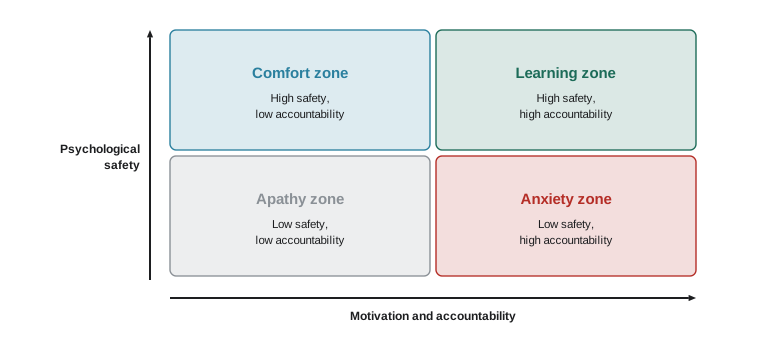
- Apathy zone: low safety and low standards. People are disengaged and do the minimum.
- Comfort zone: high safety but low standards. People enjoy working together but are not challenged to improve.
- Anxiety zone: low safety but high standards. People are under pressure to perform but afraid to speak up, so problems stay hidden and stress is high. Many workplaces sit here.
- Learning zone: high safety and high standards. People are challenged and supported, raise problems early and learn from mistakes.
Research in hospitals, technology companies and many other settings has linked team psychological safety to better learning, innovation, error reporting and performance. Google's Project Aristotle, a large internal study of what makes teams effective, found psychological safety to be the most important of the factors it examined. In safety-critical work, the link is direct: a team member who is afraid to question a senior colleague may stay silent about a hazard or an error.
Building psychological safety
Edmondson suggests three broad leadership practices for building psychological safety:
- Set the stage: frame the work as complex and uncertain, so that everyone's input is needed and mistakes are expected as part of learning; make clear why speaking up matters.
- Invite participation: ask genuine questions, acknowledge your own limits and fallibility, and create structures for input, such as asking each person in turn in meetings or running blameless reviews.
- Respond productively: express appreciation when people speak up, treat failures as opportunities to learn rather than occasions for blame, and deal firmly but fairly with clear violations such as misconduct.
Measuring psychological safety
Psychological safety is often measured with short surveys. Edmondson's original scale has seven statements rated on a scale, such as 1 (strongly disagree) to 7 (strongly agree). Some statements are worded positively, such as "It is safe to take a risk on this team," and some negatively, such as "If you make a mistake on this team, it is often held against you." Negative items must be reverse-scored before averaging, so that a high score always means more psychological safety. On a 1-to-7 scale, reverse-scoring means the new score is 8 minus the original.
Worked problem
Interpreting a team psychological safety survey
A team of 12 completes four items on a 1-to-7 scale. The team averages are: (a) "It is safe to take a risk on this team": 4.2. (b) "If you make a mistake on this team, it is often held against you": 5.4 (negatively worded). (c) "Members of this team are able to bring up problems and tough issues": 3.9. (d) "It is difficult to ask other members of this team for help": 4.6 (negatively worded). Calculate the overall psychological safety score and interpret it.
Show solution
- Reverse-score item (b): \(8 - 5.4 = 2.6\).
- Reverse-score item (d): \(8 - 4.6 = 3.4\).
- Average the four scores: \((4.2 + 2.6 + 3.9 + 3.4) \div 4 = 14.1 \div 4 \approx 3.5\).
- Interpretation: the midpoint of the scale is 4, so an average of about 3.5 suggests psychological safety is somewhat low. The weakest item is that mistakes are held against people (2.6 after reverse-scoring).
- Action: the leader could share the results with the team, acknowledge the issue, introduce blameless reviews of errors, invite input in meetings and model admitting their own mistakes, then re-survey in six months.
Answer: The overall score is about 3.5 out of 7, below the midpoint, with fear that mistakes are held against people as the biggest concern. The results point to blameless learning from errors as the first priority.
Survey results should always be shared with the team and discussed openly. A survey followed by silence damages trust more than no survey at all. Teams should be large enough for anonymity, and results should never be used to punish individual leaders without context and support to improve.
Supporting leaders' own well-being
Supervisors and managers are under pressure too. They are often caught between demands from above and the needs of their teams, handle difficult conversations, absorb distress and may have no one to talk to. Middle managers in particular report high levels of stress in many surveys. Organizations that want psychologically healthy leadership need to look after their leaders: realistic workloads and spans of control, peer networks, coaching, access to the EAP and manager consultation services, and senior leaders who model the same behaviours they expect. A burned-out supervisor cannot support a team well, however well trained.
Organizational culture, fairness and civility
Culture is the set of shared values, beliefs and norms that shape how people behave, often described as how things are really done around here. A culture that values people as well as results, treats mental health openly, and holds everyone, including senior leaders, to standards of respectful behaviour supports psychological health. A culture that celebrates overwork, tolerates abusive high performers or treats asking for help as weakness undermines it, whatever the policies say.
Organizational justice, or perceived fairness, is strongly linked to mental health. Researchers distinguish distributive justice (whether outcomes such as pay, promotions and workloads are fair), procedural justice (whether the processes used to make decisions are fair, consistent and open to input) and interactional justice (whether people are treated with dignity and given honest explanations). Workers who feel decisions are unfair report more stress and lower well-being, even when outcomes are favourable to them.
Incivility, low-intensity rude or disrespectful behaviour such as ignoring colleagues, interrupting, dismissive comments or taking credit for others' work, may seem minor, but research by Christine Porath and others shows that it is widespread and damaging. It reduces performance, increases turnover and can escalate to bullying and harassment (HSE-108). Leaders reduce incivility by modelling respect, setting clear expectations and addressing rude behaviour promptly, regardless of the person's status or results.
Frameworks for healthy work
In Canada, the Mental Health Commission of Canada and organizations such as the Canadian Centre for Occupational Health and Safety (CCOHS) and Workplace Strategies for Mental Health provide free tools for psychologically healthy leadership and culture, built around the thirteen factors of CSA Z1003. Many of these resources are used internationally. The US Surgeon General's Framework for Workplace Mental Health and Well-Being (2022) offers a complementary view, with five essentials: protection from harm, connection and community, work-life harmony, mattering at work, and opportunity for growth, all centred on worker voice and equity.
| Culture that supports psychological health | Culture that undermines it |
|---|---|
| Mental health is discussed openly and help-seeking is respected | Struggling is hidden and seen as weakness |
| Mistakes are treated as learning opportunities | Mistakes are punished or used against people |
| Leaders model breaks, vacation and boundaries | Leaders praise working late and answering email at midnight |
| Respectful behaviour is expected from everyone, including top performers | Abusive behaviour is tolerated if results are good |
| Decisions are explained and people are involved | Decisions are imposed without explanation |
| Recognition is frequent, specific and fair | Recognition is rare or reserved for a favoured few |
Common mistakes
MistakeAssuming psychological safety means avoiding disagreement or lowering standards.
InsteadCombine high psychological safety with high standards to reach the learning zone.
MistakeTraining supervisors but giving them no time to support their teams.
InsteadGive supervisors realistic spans of control, time and authority to apply what they learn.
MistakeForgetting to reverse-score negatively worded survey items.
InsteadReverse-score negative items so a high score always means more psychological safety.
MistakeTolerating abusive behaviour from high performers.
InsteadHold everyone to the same standards of respect, regardless of results or seniority.
MistakeRunning a survey and never discussing the results.
InsteadShare and discuss results with the team and act on them.
Summary and key terms
- Supervisors influence nearly every psychosocial factor and strongly affect stress and engagement.
- Psychologically healthy leadership includes clarity, fair workload, support, recognition, involvement, fairness and modelling.
- Team psychological safety is a shared belief that it is safe to speak up, ask questions and admit mistakes.
- High psychological safety with high standards produces learning and performance; low safety with high standards produces anxiety.
- Leaders build psychological safety by setting the stage, inviting participation and responding productively.
- Survey scales need reverse-scoring of negative items, anonymity and open discussion of results.
- Culture, fairness and civility shape psychological health as much as formal policies.
- Team psychological safety
- A shared belief that a team is safe for interpersonal risk-taking.
- Learning zone
- High psychological safety combined with high standards and accountability.
- Anxiety zone
- High standards with low psychological safety.
- Blameless review
- A review of an error or incident that focuses on systems and learning rather than blame.
- Reverse-scoring
- Converting a negatively worded survey item so high scores mean a better result.
- Organizational culture
- The shared values, beliefs and norms that shape behaviour in an organization.
- Organizational justice
- Perceived fairness of outcomes, processes and treatment at work.
- Incivility
- Low-intensity rude or disrespectful behaviour.
- Span of control
- The number of people a supervisor directly manages.
- Psychologically healthy leadership
- Leadership behaviours that prevent psychological harm and support well-being.
Practice problems
Work each problem on paper first, then reveal the answer to check.
Name four psychologically healthy leadership behaviours.
Show answer
For example, clarity, fair workload, recognition and involvement.
What is team psychological safety?
Show answer
A shared belief that it is safe to take interpersonal risks such as speaking up or admitting mistakes.
Which zone combines low psychological safety and high standards?
Show answer
The anxiety zone.
Does psychological safety mean lowering standards?
Show answer
No. The goal is high safety with high standards.
On a 1-to-7 scale, reverse-score an item with an average of 6.0.
Show answer
8 − 6.0 = 2.0.
Name Edmondson's three leadership practices for building psychological safety.
Show answer
Set the stage, invite participation and respond productively.
What are the three types of organizational justice?
Show answer
Distributive, procedural and interactional justice.
Why is incivility a concern?
Show answer
It reduces performance, increases turnover and can escalate to bullying and harassment.
Name two of the Surgeon General's five essentials.
Show answer
For example, protection from harm and mattering at work.
What should happen after a team survey?
Show answer
Share and discuss the results with the team and agree actions.
Lesson quiz · 5 questions
Score 60% or more to complete this lesson.
Create a free account to save your progress, take quizzes and earn a certificate.