
HSE-109 · Lesson 8 of 12 · 25 min
Substance use, impairment and the workplace
Substance use and mental health are closely linked. Some people use alcohol, cannabis or other drugs to cope with stress, anxiety, trauma or sleep problems; substance use can also worsen mental health and lead to substance use disorders, which are themselves mental health conditions. At work, substance use raises safety concerns, because impairment can cause serious incidents, and it raises fairness and human rights concerns, because addiction is recognized as a disability. This lesson covers how to think about impairment broadly, how to respond supportively and fairly to substance use, and the laws on cannabis, testing and accommodation in each country.
Impairment has many causes
Impairment means a reduced ability to perform work safely and effectively. Alcohol and drugs are only some of the causes. Fatigue (Lesson 6), legally prescribed or over-the-counter medications, illness, acute stress, grief and trauma can all impair judgement, attention, coordination and reaction time. A sound workplace policy therefore focuses on fitness for work: every worker has a responsibility to arrive fit to work safely and to tell their supervisor if they are not, whatever the reason, and every supervisor has a responsibility to respond when they observe signs of impairment. This approach is fairer and more effective than one focused only on illegal drugs.
The spectrum of substance use
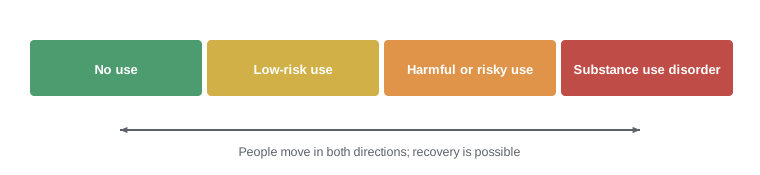
Substance use exists on a spectrum, much like the mental health continuum. Many people do not use a particular substance at all; many others use alcohol or cannabis occasionally and at low risk. Some use at levels or in situations that cause harm, such as drinking heavily the night before a safety-critical shift. A smaller number develop a substance use disorder, a diagnosable condition in which a person continues to use despite significant harm, often with cravings, loss of control and withdrawal symptoms. People can move along the spectrum in either direction, and recovery is common with support and treatment.
Canada's Guidance on Alcohol and Health, published by the Canadian Centre on Substance Use and Addiction in 2023, advises that the risk of harm rises with every additional drink, from low risk at two or fewer standard drinks a week to increasing risk at three to six and high risk above that. Canada's Lower-Risk Cannabis Use Guidelines advise, among other things, not using cannabis before driving or operating machinery and avoiding frequent use. Canada has also faced a severe toxic drug crisis since 2016. Data from several provinces show that a large share of people who died of toxic drug poisoning were employed, with workers in construction and the trades over-represented, so many employers now include opioid awareness and naloxone in their programs.
Work factors that contribute
Psychosocial hazards can contribute to harmful substance use. High stress, long or irregular hours, shift work that disrupts sleep, traumatic exposure, isolation, a culture of heavy drinking at work events, and physically demanding work that leads to chronic pain can all increase risk. A psychological health and safety program that reduces these hazards also helps prevent substance-related harm. Treating substance use only as a matter of individual discipline misses this connection.
Responding to suspected impairment
When a supervisor sees signs that a worker may be impaired, such as slurred speech, the smell of alcohol, unsteady movement, confusion, unusual behaviour or a near miss, the first priority is safety. A common sequence is:
- Remove the worker from safety-sensitive duties immediately and keep them in a safe place.
- Speak to them privately and respectfully, describing what you have observed, without accusing or diagnosing.
- Involve a second supervisor or manager as a witness where possible, and follow your organization's fitness-for-work procedure.
- Arrange safe transport home or to medical care; never let a possibly impaired worker drive.
- Document the observations factually: what you saw, heard and smelled, when, and what actions were taken.
- Follow up with HR, occupational health or disability management on next steps, which may include a fitness-for-work assessment, testing where lawful, accommodation or discipline.
Signs of impairment can also have medical causes, such as a diabetic emergency, stroke or reaction to a medication, so treat the situation as a possible medical emergency if the person seems seriously unwell, and call 911 if needed.
Medications and impairment
Many legal medications can affect alertness, coordination or judgement, including some antihistamines, sleep aids, opioid painkillers, muscle relaxants, some antidepressants and anti-anxiety medications, and medications that lower blood sugar. Starting a new medication, changing a dose or combining medications with alcohol can be especially risky. Workers in safety-sensitive roles should ask their doctor or pharmacist whether a medication could affect their ability to work safely and should tell their supervisor if it might, without needing to disclose the medication or the condition it treats. Supervisors should respond to such a disclosure as a safety and accommodation matter, for example by temporarily assigning other duties, not as a disciplinary issue. A policy that punishes people for disclosing medication effects simply encourages them to hide it.
Opioid overdose awareness
Because of the toxic drug crisis, many Canadian workplaces now train workers to recognize an opioid overdose and use naloxone, a medication that can temporarily reverse an opioid overdose. Since June 2023, Ontario's Occupational Health and Safety Act has required employers who become aware, or ought reasonably to be aware, that there may be a risk of a worker having an opioid overdose at a workplace to provide a naloxone kit, maintain it and ensure a trained worker is available. Signs of an opioid overdose include unresponsiveness, slow or stopped breathing, blue or grey lips and fingertips, very small pupils and gurgling or snoring sounds. The response is to call 911, give naloxone if available and trained, provide rescue breathing or CPR as trained, and stay with the person. The federal Good Samaritan Drug Overdose Act offers some legal protection to people who call for help at an overdose.
Overdose awareness also belongs in the wider psychological health and safety picture. Workers who lose a colleague to an overdose, or who respond to one at work, may be deeply affected and should be offered the same support as after any other critical event (Lesson 11). Talking about substance use without stigma, and making it clear that people who seek help will be supported, helps more people get help before a crisis.
Cannabis and the law
Non-medical cannabis has been legal for adults in Canada since October 17, 2018, under the Cannabis Act, with provinces and territories setting the minimum age, retail rules and where it can be used. Legalization did not change the rule that workers must not be impaired at work. OHS laws and employer policies can prohibit impairment and use at work, and safety-sensitive roles may have stricter rules, such as no use within a set period before a shift. Workers authorized to use cannabis for medical purposes are entitled to have accommodation considered, like any other medication, but an employer does not have to permit impairment in a safety-sensitive role and may accommodate through alternative duties or treatments. Because there is no reliable test that shows current cannabis impairment the way a breathalyser does for alcohol, policies usually rely on observed signs of impairment and on fitness-for-duty assessments.
Testing and human rights in Canada
Canada has no general law requiring or authorizing workplace drug and alcohol testing in the private sector. Instead, testing is shaped by human rights law, arbitration decisions and privacy law. Courts and arbitrators have generally accepted testing in safety-sensitive positions in specific circumstances: for reasonable cause, after a significant incident or near miss, and as part of a return-to-work or monitoring agreement after treatment. Random testing is much more restricted. In Communications, Energy and Paperworkers Union, Local 30 v. Irving Pulp and Paper (2013), the Supreme Court of Canada held that a unilaterally imposed random alcohol testing policy in a dangerous workplace was unreasonable without evidence of a significant problem with alcohol use in that workplace. Pre-employment drug testing is also restricted. Because substance dependence is a disability under human rights law, an employer that learns a worker has an addiction generally has a duty to accommodate, often by supporting treatment and return to work with monitoring, up to the point of undue hardship. In Stewart v. Elk Valley Coal (2017), the Supreme Court of Canada upheld the termination of a worker with an undisclosed cocaine dependence under a policy that offered no penalty to those who disclosed before an incident, finding that the termination was based on the policy breach rather than the addiction. Canadian truck drivers who cross into the US must meet US Department of Transportation testing rules.
Worked problem
Applying Canadian testing principles
A manufacturing company wants to introduce random drug and alcohol testing for all 300 employees after one incident in which a forklift operator appeared impaired. There is no other evidence of a substance use problem at the site. Would this policy likely survive a challenge, and what alternatives would be more defensible?
Show solution
- Scope: the policy covers all employees, including office staff who are not in safety-sensitive roles, which is hard to justify.
- Evidence: following Irving, random testing in a dangerous workplace needs evidence of a significant, workplace-wide problem; one incident is unlikely to be enough.
- Defensible alternatives: reasonable-cause testing and post-incident testing for safety-sensitive roles, supervisor training in recognizing impairment, a clear fitness-for-work policy and an accessible EAP.
- Human rights: the policy must include a path to assessment, treatment and accommodation for workers with a substance use disorder.
- Privacy and process: testing should use reliable methods, protect results and be part of a broader program, ideally developed with the union or worker representatives.
Answer: A blanket random testing policy based on one incident would likely be found unreasonable. Reasonable-cause and post-incident testing for safety-sensitive roles, combined with training, a fitness-for-work policy and accommodation for substance use disorders, would be far more defensible.
A supportive approach
Whatever the legal framework, workplaces that combine clear safety rules with support tend to achieve better outcomes than those that rely on punishment alone. A supportive approach includes:
- A clear, well-communicated policy on fitness for work, covering alcohol, cannabis, other drugs, medications and fatigue.
- Training for supervisors in recognizing impairment and responding consistently and respectfully.
- Encouraging early self-disclosure, with assurance that workers who seek help before an incident will be supported.
- Access to the EAP, treatment and peer support, and recovery-friendly return-to-work plans with clear expectations and, where appropriate, monitoring.
- Avoiding a culture that centres social events on alcohol, and offering alternatives.
- Reducing work factors that contribute to harmful use, such as chronic stress, fatigue and untreated pain.
Common mistakes
MistakeFocusing only on illegal drugs.
InsteadUse a fitness-for-work approach that covers alcohol, cannabis, medications, fatigue and other causes of impairment.
MistakeLetting a possibly impaired worker drive home.
InsteadArrange safe transport, and treat the situation as a possible medical emergency if needed.
MistakeTreating addiction purely as misconduct.
InsteadRecognize substance dependence as a disability that triggers the duty to accommodate, while maintaining safety rules.
MistakeIntroducing random testing for everyone after a single incident.
InsteadLimit testing to safety-sensitive roles and justified circumstances, consistent with human rights and arbitral law.
MistakeIgnoring work factors such as stress, shift work and pain.
InsteadReduce psychosocial and physical hazards that contribute to harmful substance use.
Summary and key terms
- Impairment can come from alcohol, cannabis, other drugs, medications, fatigue, illness and acute stress.
- Substance use runs on a spectrum from no use to substance use disorder, and recovery is common.
- Work factors such as stress, shift work, traumatic exposure and pain can contribute to harmful use.
- Respond to suspected impairment by removing the worker from safety-sensitive duties, speaking privately, documenting and arranging safe transport.
- Opioid overdose awareness and naloxone are increasingly part of workplace programs.
- Cannabis is legal for adults in Canada, but impairment at work is not; testing is limited by human rights and arbitral law.
- Substance dependence is a disability that triggers the duty to accommodate.
- Impairment
- A reduced ability to perform work safely and effectively.
- Fitness for work
- Being physically and mentally able to perform work safely.
- Substance use disorder
- A diagnosable condition of continued substance use despite significant harm.
- Naloxone
- A medication that temporarily reverses the effects of an opioid overdose.
- Safety-sensitive position
- A role in which impairment could cause serious harm to the worker or others.
- Reasonable-cause testing
- Testing based on observed signs of impairment or other credible evidence.
- Post-incident testing
- Testing after a significant incident or near miss.
- Random testing
- Testing workers selected at random without specific cause.
- Recovery-friendly workplace
- A workplace that supports people in recovery from substance use disorders.
- Toxic drug supply
- Illegal drugs contaminated with potent substances such as fentanyl.
Practice problems
Work each problem on paper first, then reveal the answer to check.
Name four causes of impairment at work besides illegal drugs.
Show answer
Alcohol, cannabis, medications and fatigue (also illness and acute stress).
What is the first step when you suspect a worker is impaired?
Show answer
Remove them from safety-sensitive duties and keep them safe.
Why should a possibly impaired worker not drive home?
Show answer
They could cause a crash; arrange safe transport instead.
Name three signs of an opioid overdose.
Show answer
For example, unresponsiveness, slow or stopped breathing and blue or grey lips.
What does naloxone do?
Show answer
It temporarily reverses an opioid overdose.
Since when has non-medical cannabis been legal for adults in Canada?
Show answer
Since October 17, 2018.
What did the Supreme Court decide in Irving Pulp and Paper?
Show answer
That a random alcohol testing policy was unreasonable without evidence of a significant workplace alcohol problem.
Why is there no breathalyser-style test for cannabis impairment?
Show answer
Current tests detect use or metabolites, which can remain long after impairment ends.
Give two features of a supportive approach to substance use.
Show answer
For example, encouraging early self-disclosure and offering EAP and treatment support.
How can psychosocial hazards contribute to harmful substance use?
Show answer
Stress, fatigue, trauma and isolation can lead people to use substances to cope.
Lesson quiz · 5 questions
Score 60% or more to complete this lesson.
Create a free account to save your progress, take quizzes and earn a certificate.