
HSE-109 · Lesson 8 of 12 · 25 min
Substance use, impairment and the workplace
Substance use and mental health are closely linked. Some people use alcohol, cannabis or other drugs to cope with stress, anxiety, trauma or sleep problems; substance use can also worsen mental health and lead to substance use disorders, which are themselves mental health conditions. At work, substance use raises safety concerns, because impairment can cause serious incidents, and it raises fairness and human rights concerns, because addiction is recognized as a disability. This lesson covers how to think about impairment broadly, how to respond supportively and fairly to substance use, and the laws on cannabis, testing and accommodation in each country.
Impairment has many causes
Impairment means a reduced ability to perform work safely and effectively. Alcohol and drugs are only some of the causes. Fatigue (Lesson 6), legally prescribed or over-the-counter medications, illness, acute stress, grief and trauma can all impair judgment, attention, coordination and reaction time. A sound workplace policy therefore focuses on fitness for work: every worker has a responsibility to arrive fit to work safely and to tell their supervisor if they are not, whatever the reason, and every supervisor has a responsibility to respond when they observe signs of impairment. This approach is fairer and more effective than one focused only on illegal drugs.
The spectrum of substance use
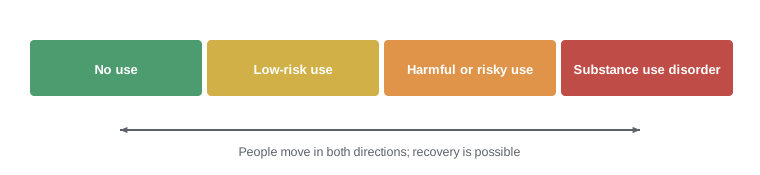
Substance use exists on a spectrum, much like the mental health continuum. Many people do not use a particular substance at all; many others use alcohol or cannabis occasionally and at low risk. Some use at levels or in situations that cause harm, such as drinking heavily the night before a safety-critical shift. A smaller number develop a substance use disorder, a diagnosable condition in which a person continues to use despite significant harm, often with cravings, loss of control and withdrawal symptoms. People can move along the spectrum in either direction, and recovery is common with support and treatment.
US dietary guidelines and public health agencies advise that adults who drink should do so in moderation and that drinking less is better for health than drinking more; the Surgeon General issued an advisory in 2025 on the link between alcohol and cancer risk. The US has faced a severe opioid overdose crisis for more than two decades. Overdose deaths fell from their peak in 2023 but remain high, and research has found elevated overdose rates among workers in construction, extraction and other physically demanding jobs with high injury rates, where opioid prescriptions after injuries have played a part. Many employers now include opioid awareness and naloxone in their programs.
Work factors that contribute
Psychosocial hazards can contribute to harmful substance use. High stress, long or irregular hours, shift work that disrupts sleep, traumatic exposure, isolation, a culture of heavy drinking at work events, and physically demanding work that leads to chronic pain can all increase risk. A psychological health and safety program that reduces these hazards also helps prevent substance-related harm. Treating substance use only as a matter of individual discipline misses this connection.
Responding to suspected impairment
When a supervisor sees signs that a worker may be impaired, such as slurred speech, the smell of alcohol, unsteady movement, confusion, unusual behavior or a near miss, the first priority is safety. A common sequence is:
- Remove the worker from safety-sensitive duties immediately and keep them in a safe place.
- Speak to them privately and respectfully, describing what you have observed, without accusing or diagnosing.
- Involve a second supervisor or manager as a witness where possible, and follow your organization's fitness-for-work procedure.
- Arrange safe transport home or to medical care; never let a possibly impaired worker drive.
- Document the observations factually: what you saw, heard and smelled, when, and what actions were taken.
- Follow up with HR, occupational health or disability management on next steps, which may include a fitness-for-work assessment, testing where lawful, accommodation or discipline.
Signs of impairment can also have medical causes, such as a diabetic emergency, stroke or reaction to a medication, so treat the situation as a possible medical emergency if the person seems seriously unwell, and call 911 if needed.
Medications and impairment
Many legal medications can affect alertness, coordination or judgment, including some antihistamines, sleep aids, opioid painkillers, muscle relaxants, some antidepressants and anti-anxiety medications, and medications that lower blood sugar. Starting a new medication, changing a dose or combining medications with alcohol can be especially risky. Workers in safety-sensitive roles should ask their doctor or pharmacist whether a medication could affect their ability to work safely and should tell their supervisor if it might, without needing to disclose the medication or the condition it treats. Supervisors should respond to such a disclosure as a safety and accommodation matter, for example by temporarily assigning other duties, not as a disciplinary issue. A policy that punishes people for disclosing medication effects simply encourages them to hide it.
Opioid overdose awareness
Because of the opioid crisis, many US workplaces now train workers to recognize an opioid overdose and use naloxone, a medication that can temporarily reverse an opioid overdose and has been available over the counter as a nasal spray since 2023. OSHA and NIOSH have published guidance on workplace naloxone programs. Signs of an opioid overdose include unresponsiveness, slow or stopped breathing, blue or gray lips and fingertips, very small pupils and gurgling or snoring sounds. The response is to call 911, give naloxone if available and trained, provide rescue breathing or CPR as trained, and stay with the person. Most states have Good Samaritan and naloxone access laws that offer some legal protection to people who call for help or give naloxone.
Overdose awareness also belongs in the wider psychological health and safety picture. Workers who lose a colleague to an overdose, or who respond to one at work, may be deeply affected and should be offered the same support as after any other critical event (Lesson 11). Talking about substance use without stigma, and making it clear that people who seek help will be supported, helps more people get help before a crisis.
Cannabis and the law
Cannabis law in the US is a patchwork. A majority of states allow medical cannabis, and roughly half allow adult non-medical use, but cannabis remained a Schedule I controlled substance under federal law for decades. In May 2026 the US Department of Justice moved FDA-approved cannabis drug products and cannabis held under a state medical marijuana license to Schedule III and began a hearing on rescheduling cannabis more broadly, so check the current federal status. Rescheduling does not legalize recreational use, and employers may still prohibit use and impairment at work. Some states, including New York, New Jersey and California, restrict employers from penalizing lawful off-duty cannabis use or from relying on tests that detect only inactive metabolites, usually with exceptions for safety-sensitive and federally regulated jobs. Because there is no reliable test for current cannabis impairment, many employers rely on observed signs of impairment and fitness-for-duty assessments.
Drug and alcohol testing and the ADA
US Department of Transportation (DOT) regulations at 49 CFR Part 40, with modal rules from agencies such as the FMCSA, FAA, FRA and FTA, require drug and alcohol testing for safety-sensitive transportation employees, including pre-employment, random, post-accident, reasonable suspicion, return-to-duty and follow-up tests. DOT has confirmed that state-authorized cannabis use is not a legitimate medical explanation for a positive DOT test, and on May 15, 2026 it stated that this remained true after the partial rescheduling. Employees who violate DOT rules must be removed from safety-sensitive duty and complete an evaluation and treatment process with a substance abuse professional before returning. Federal contractors and grantees are covered by the Drug-Free Workplace Act of 1988. Outside these rules, testing is governed by state law, which varies from permissive to restrictive. Under the ADA, an employee or applicant currently engaging in the illegal use of drugs is not protected when the employer acts on that basis, but people in recovery who no longer use illegal drugs, and people with alcoholism, can be protected as individuals with disabilities. Employers may still prohibit alcohol and illegal drug use at work and hold all employees to the same performance and conduct standards.
Worked problem
Planning random testing under DOT rules
A trucking company has 120 drivers in its FMCSA random testing pool. Assume the minimum annual random rates are 50 percent for drugs and 10 percent for alcohol, and selections are made quarterly. How many tests are needed, and what is the chance a given driver is not selected for a drug test in a year?
Show solution
- Annual drug tests: \(0.50 \times 120 = 60\), or 15 per quarter.
- Annual alcohol tests: \(0.10 \times 120 = 12\), or 3 per quarter.
- Chance of selection in one quarter for one driver: \(15 \div 120 = 0.125\).
- Chance of not being selected in any of four quarters, if each draw is independent: \((1 - 0.125)^4 \approx 0.586\).
- Interpretation: random selection means some drivers are tested more than once and about 59 percent are not tested in a given year, which is expected and preserves the deterrent effect of unpredictability.
Answer: The company needs about 60 random drug tests and 12 random alcohol tests a year (15 and 3 a quarter). A given driver has about a 59 percent chance of not being selected for a drug test in a year.
A supportive approach
Whatever the legal framework, workplaces that combine clear safety rules with support tend to achieve better outcomes than those that rely on punishment alone. A supportive approach includes:
- A clear, well-communicated policy on fitness for work, covering alcohol, cannabis, other drugs, medications and fatigue.
- Training for supervisors in recognizing impairment and responding consistently and respectfully.
- Encouraging early self-disclosure, with assurance that workers who seek help before an incident will be supported.
- Access to the EAP, treatment and peer support, and recovery-friendly return-to-work plans with clear expectations and, where appropriate, monitoring.
- Avoiding a culture that centers social events on alcohol, and offering alternatives.
- Reducing work factors that contribute to harmful use, such as chronic stress, fatigue and untreated pain.
Common mistakes
MistakeFocusing only on illegal drugs.
InsteadUse a fitness-for-work approach that covers alcohol, cannabis, medications, fatigue and other causes of impairment.
MistakeLetting a possibly impaired worker drive home.
InsteadArrange safe transport, and treat the situation as a possible medical emergency if needed.
MistakeTreating addiction purely as misconduct.
InsteadRecognize that people in recovery and people with alcoholism can be protected under the ADA, while maintaining safety and conduct standards.
MistakeAssuming state cannabis legalization changes DOT testing rules.
InsteadFollow 49 CFR Part 40: state-authorized cannabis use does not excuse a positive DOT test.
MistakeIgnoring work factors such as stress, shift work and pain.
InsteadReduce psychosocial and physical hazards that contribute to harmful substance use.
Summary and key terms
- Impairment can come from alcohol, cannabis, other drugs, medications, fatigue, illness and acute stress.
- Substance use runs on a spectrum from no use to substance use disorder, and recovery is common.
- Work factors such as stress, shift work, traumatic exposure and pain can contribute to harmful use.
- Respond to suspected impairment by removing the worker from safety-sensitive duties, speaking privately, documenting and arranging safe transport.
- Opioid overdose awareness and naloxone are increasingly part of workplace programs.
- Cannabis law varies by state and federal status is changing; DOT testing rules remain unchanged.
- The ADA protects people in recovery and people with alcoholism, but not current illegal drug use.
- Impairment
- A reduced ability to perform work safely and effectively.
- Fitness for work
- Being physically and mentally able to perform work safely.
- Substance use disorder
- A diagnosable condition of continued substance use despite significant harm.
- Naloxone
- A medication that temporarily reverses the effects of an opioid overdose.
- Safety-sensitive position
- A role in which impairment could cause serious harm to the worker or others.
- Reasonable-cause testing
- Testing based on observed signs of impairment or other credible evidence.
- Post-incident testing
- Testing after a significant incident or near miss.
- Random testing
- Testing workers selected at random without specific cause.
- Recovery-friendly workplace
- A workplace that supports people in recovery from substance use disorders.
- Toxic drug supply
- Illegal drugs contaminated with potent substances such as fentanyl.
Practice problems
Work each problem on paper first, then reveal the answer to check.
Name four causes of impairment at work besides illegal drugs.
Show answer
Alcohol, cannabis, medications and fatigue (also illness and acute stress).
What is the first step when you suspect a worker is impaired?
Show answer
Remove them from safety-sensitive duties and keep them safe.
Why should a possibly impaired worker not drive home?
Show answer
They could cause a crash; arrange safe transport instead.
Name three signs of an opioid overdose.
Show answer
For example, unresponsiveness, slow or stopped breathing and blue or gray lips.
What does naloxone do?
Show answer
It temporarily reverses an opioid overdose.
Do DOT rules allow a positive cannabis test to be excused by state medical authorization?
Show answer
No. State-authorized use is not a legitimate medical explanation under DOT rules.
Does the ADA protect current illegal drug use?
Show answer
No, but it can protect people in recovery and people with alcoholism.
Why is there no breathalyser-style test for cannabis impairment?
Show answer
Current tests detect use or metabolites, which can remain long after impairment ends.
Give two features of a supportive approach to substance use.
Show answer
For example, encouraging early self-disclosure and offering EAP and treatment support.
How can psychosocial hazards contribute to harmful substance use?
Show answer
Stress, fatigue, trauma and isolation can lead people to use substances to cope.
Lesson quiz · 5 questions
Score 60% or more to complete this lesson.
Create a free account to save your progress, take quizzes and earn a certificate.