
HSE-109 · Lesson 12 of 12 · 28 min
Measuring progress and capstone: a psychological health and safety plan
This final lesson brings the course together. It starts with how to measure progress in psychological health and safety, then works through a capstone case: a realistic organization with real-looking data, in which you will identify psychosocial hazards, prioritize risks, choose controls, plan support and set indicators. The case uses the tools from every earlier lesson. The organization and its numbers are fictional, but the patterns are typical of what many workplaces find.
Measuring progress
Psychological health and safety improves slowly, and the most important outcomes, such as fewer people being harmed, can take years to show clearly in the data. Good measurement therefore combines several kinds of evidence, tracked over time:
- Survey results by psychosocial factor and by group, repeated every one to two years with the same tool, so that changes can be compared.
- Rates rather than raw counts for absence, claims, turnover and complaints, so that changes in workforce size do not distort the picture.
- Activity measures, such as training completion and workload reviews, to show whether planned actions actually happened.
- Qualitative information from focus groups, exit interviews and conversations, which explains the numbers.
Some useful rate calculations:
When interpreting change, consider context. Psychosocial survey scores often dip during major change, even in well-run organizations. Complaints and EAP use may rise when trust improves. Absence can fall while presenteeism rises. Look for consistent patterns across several indicators before drawing conclusions, and always protect individual privacy.
Benchmarks can help put results in context. Survey tools often provide average scores from many organizations, and national statistics give rough comparisons for absence and turnover. Use them cautiously: your own trend over time is usually more meaningful than a comparison with organizations that may differ in size, sector and workforce.
The capstone case: Northgate Community Care
Northgate Community Care is a fictional non-profit home and community care agency in a mid-sized US city, covered by federal OSHA and state employment law. It employs 240 people: 180 home health aides who visit clients in their homes, 24 nurses, 20 schedulers and office staff, and 16 supervisors and managers. Most aides work rotating day and evening shifts, some do overnight visits, and many travel between clients in their own cars.
Over the past year, the agency has collected the following information:
| Indicator | Last year |
|---|---|
| Mental health-related absence | 1,100 days across 240 employees with 230 scheduled days each |
| Leavers | 62 (average headcount 240), of whom 45 were frontline care workers |
| EAP new cases | 14 |
| Reports of verbal abuse or threats by clients or family members | 96 |
| Psychological injury claims | 4 (two after client deaths in traumatic circumstances, two for chronic stress) |
| Average overtime for schedulers | 9 hours a week |
| Schedule changes with less than 48 hours' notice | About 40 percent of frontline shifts |
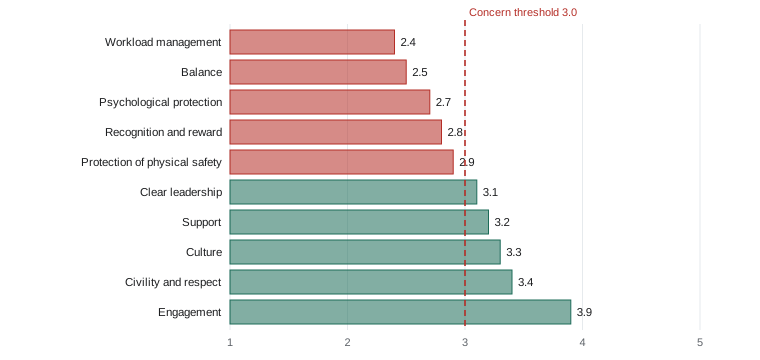
A confidential Guarding Minds at Work style survey was completed by 168 employees (70 percent). Results for selected factors on a 1-to-5 scale, where higher is better and scores below 3.0 indicate a significant concern, were: workload management 2.4; balance 2.5; psychological protection 2.7; recognition and reward 2.8; protection of physical safety 2.9; clear leadership and expectations 3.1; psychological and social support 3.2; organizational culture 3.3; civility and respect 3.4; engagement 3.9. Free-text comments repeatedly mentioned last-minute schedule changes, too little travel time between clients, feeling alone after difficult visits, and fear of being blamed for complaints.
Step 1: calculate key rates
Worked problem
Capstone step 1: rates
Calculate Northgate's mental health-related absence rate, annual turnover and EAP utilization, and estimate the annual cost of mental health-related absence if the average daily cost is $260.
Show solution
- Absence rate: \(1{,}100 \div (240 \times 230) \times 100 = 1{,}100 \div 55{,}200 \times 100 \approx 2.0\) percent of scheduled days.
- Days per employee: \(1{,}100 \div 240 \approx 4.6\) days, about double the 2.4 days used as a benchmark in Lesson 3.
- Turnover: \(62 \div 240 \times 100 \approx 25.8\) percent; frontline care worker turnover is \(45 \div 180 \times 100 = 25\) percent.
- EAP utilization: \(14 \div 240 \times 100 \approx 5.8\) percent.
- Absence cost: \(1{,}100 \times 260 = 286{,}000\) dollars a year.
Answer: Mental health-related absence is about 2.0 percent of scheduled days (4.6 days per employee, costing about $286,000 a year), turnover is about 26 percent, and EAP utilization is about 5.8 percent.
Step 2: identify and prioritize hazards
Bringing together the indicators, survey results and comments, the main psychosocial hazards are: unpredictable scheduling and insufficient travel time (workload and balance); exposure to verbal abuse and threats in clients' homes (physical safety, civility and psychological protection); traumatic exposure to client deaths and distressing situations with little debriefing (support); isolation of frontline workers (support); a blame culture around complaints (psychological protection); low recognition; and scheduler overload, which itself drives last-minute changes.
Worked problem
Capstone step 2: risk scoring
The working group rates five hazards for likelihood and severity on 1-to-5 scales: last-minute schedule changes and short travel time (5, 3); verbal abuse and threats in homes (4, 4); traumatic exposure without support (3, 5); blame culture around complaints (4, 3); scheduler overload (4, 3). Calculate and rank the scores using bands of 1 to 6 low, 8 to 12 medium and 15 to 25 high.
Show solution
- Schedule changes and travel time: \(5 \times 3 = 15\), high.
- Verbal abuse and threats: \(4 \times 4 = 16\), high.
- Traumatic exposure without support: \(3 \times 5 = 15\), high.
- Blame culture: \(4 \times 3 = 12\), medium.
- Scheduler overload: \(4 \times 3 = 12\), medium, but it is a root cause of the schedule changes, so it should be addressed together with them.
Answer: Verbal abuse and threats (16), schedule changes and travel time (15) and traumatic exposure (15) are high priorities; blame culture (12) and scheduler overload (12) are medium but closely linked to the others.
Step 3: choose controls
Using the hierarchy of controls and the job demands-resources model, the working group proposes:
| Hazard | Controls (most effective first) | Lesson |
|---|---|---|
| Schedule changes and travel time | Hire one additional scheduler; scheduling software that builds in realistic travel time; minimum 7 days' schedule notice except emergencies; limit consecutive evening and overnight shifts | 5, 6 |
| Verbal abuse and threats | Client risk flags and pre-visit information; two-person visits or service changes for high-risk clients; right to leave unsafe situations; check-in system; de-escalation training | HSE-108, 2 |
| Traumatic exposure | Critical event plan; supervisor call after any client death; psychological first aid; peer support; easy EAP and specialized care access | 7, 11 |
| Isolation | Regular team huddles (in person or video); buddy system; supervisor check-ins at least every two weeks | 7, 10 |
| Blame culture | Blameless review of complaints and incidents; leader training in responding productively; recognition program | 10 |
| Fatigue and driving | Schedule rules avoiding quick returns; fatigue reporting without penalty; travel time counted as work time | 6 |
The plan also includes the support and resolution side: training all supervisors in supportive conversations and accommodation; a clear process for stay-at-work and return-to-work plans; promoting the EAP and the crisis line; and a fitness-for-work policy covering fatigue, medications and substances.
Step 4: set objectives, indicators and costs
Worked problem
Capstone step 4: objectives and a cautious business case
The program will cost about $150,000 in the first year (scheduler, software, training and peer support) and $110,000 a year after that. Northgate's mental health-related costs are estimated at $286,000 for absence and, from turnover, 25 frontline leavers a year judged avoidable at $8,000 each to replace. Assume cautiously that from year 2 absence falls by 15 percent and avoidable turnover by 20 percent. Calculate the annual benefit and the steady-state ROI, and propose three measurable objectives.
Show solution
- Turnover cost: \(25 \times 8{,}000 = 200{,}000\) dollars a year.
- Absence saving: \(0.15 \times 286{,}000 = 42{,}900\).
- Turnover saving: \(0.20 \times 200{,}000 = 40{,}000\).
- Annual benefit from year 2: \(42{,}900 + 40{,}000 = 82{,}900\), excluding presenteeism, claims and recruitment strain.
- Steady-state ROI: \((82{,}900 - 110{,}000) \div 110{,}000 \approx -0.25\), a net cost of about 25 percent on these benefits alone.
- Objectives: raise the workload management score from 2.4 to at least 3.0 within two years; reduce shifts changed with less than 48 hours' notice from 40 to under 10 percent within one year; reduce frontline turnover from 25 to under 18 percent within two years.
Answer: On the narrow, cautious benefits counted, the program saves about $82,900 a year against $110,000 in running costs, so it is not fully self-funding; adding presenteeism, claims and the cost of chronic vacancies would likely close the gap. The case rests mainly on legal duties and preventing harm, with clear, measurable objectives to track progress.
This result is common and worth noticing. Not every psychological health and safety investment pays for itself on narrow financial measures in the first years. Presenting that honestly, alongside the legal duties to protect workers, the human cost of harm and the indicators that will show progress, builds more trust with decision-makers than an inflated ROI.
Step 5: review and improve
Northgate's working group will report quarterly to senior leadership on activity measures, such as the hiring of the scheduler, training completion and notice for schedule changes, and annually on survey scores, absence, turnover and claims. A repeat survey is planned for 18 months. Management review each year will decide whether to continue, adjust or expand the controls. Workers will receive a short summary of results and actions after each survey, closing the loop.
Course wrap-up
Psychological health and safety asks workplaces to treat risks to mental health with the same seriousness as risks to physical safety: identify the hazards, assess the risks, control them starting with the design of work, support people who are struggling, and keep improving. It also asks something of everyone individually: to notice when colleagues are not themselves, to reach out with care, to speak up about hazards, and to look after their own health.
If you are struggling, you do not have to manage alone. Talk to someone you trust, contact your EAP or a health professional, and in a crisis call or text 988, or call 911 if you or someone else is in immediate danger.
Common mistakes
MistakeComparing raw counts of absence or turnover between years with different headcounts.
InsteadUse rates per employee or per scheduled day.
MistakeTreating each hazard separately when they share a root cause.
InsteadLook for links, such as scheduler overload driving last-minute schedule changes.
MistakeChoosing individual supports before work design changes.
InsteadApply the hierarchy of controls, starting with staffing, scheduling and work design.
MistakeClaiming a program will pay for itself without evidence.
InsteadPresent a cautious, transparent business case alongside legal and human reasons.
MistakeRunning a survey and not reporting back to workers.
InsteadShare results and actions to close the loop and build trust.
Summary and key terms
- Measure progress with repeated surveys, rates, activity measures and qualitative information.
- Interpret changes in context and look for consistent patterns across indicators.
- Combine indicators, survey results and comments to identify hazards and their root causes.
- Prioritize with risk scores, then select controls using the hierarchy of controls and the demands-resources model.
- Include support and resolution measures alongside prevention.
- Set measurable objectives and a cautious, honest business case.
- Review regularly, report back to workers and keep improving.
- Absence rate
- Days lost as a percentage of scheduled working days.
- Turnover rate
- Leavers in a period as a percentage of average headcount.
- Concern threshold
- A survey score below which a factor is treated as a significant concern.
- Root cause
- An underlying factor that gives rise to one or more hazards.
- Risk flag
- A record alerting workers to known risks at a client location.
- Check-in system
- A procedure for confirming the safety of lone or mobile workers at intervals.
- Activity measure
- An indicator showing whether planned actions were carried out.
- Steady-state year
- A year after start-up when costs and benefits are stable.
- Closing the loop
- Reporting results and actions back to the people who provided input.
- Working group
- A team of workers and managers that guides a program.
Practice problems
Work each problem on paper first, then reveal the answer to check.
A team of 50 with 220 scheduled days each loses 330 days. What is the absence rate?
Show answer
330 ÷ 11,000 × 100 = 3.0 percent.
30 people leave from an average headcount of 150. What is turnover?
Show answer
20 percent.
Why use rates rather than counts?
Show answer
Rates adjust for changes in workforce size.
In the case, which hazard is a root cause of last-minute schedule changes?
Show answer
Scheduler overload.
Give one engineering or design control for scheduling problems.
Show answer
Scheduling software that builds in realistic travel time, or hiring an additional scheduler.
Give two controls for verbal abuse in clients' homes.
Show answer
For example, client risk flags and two-person visits for high-risk clients.
What should happen after a client dies in traumatic circumstances?
Show answer
A supervisor call, psychological first aid and access to peer support and the EAP, under a critical event plan.
A program costs $110,000 a year and saves $82,900. What is the ROI?
Show answer
About −25 percent on the benefits counted.
Write a measurable objective for scheduling.
Show answer
Reduce shifts changed with less than 48 hours' notice from 40 to under 10 percent within one year.
Why report survey results back to workers?
Show answer
It closes the loop, shows their input matters and builds trust.
Lesson quiz · 5 questions
Score 60% or more to complete this lesson.
Create a free account to save your progress, take quizzes and earn a certificate.