
HSE-109 · Lesson 2 of 12 · 25 min
Psychosocial hazards at work
A psychosocial hazard is any aspect of how work is designed, organized and managed, or of the social context of work, that has the potential to cause psychological or physical harm. The word psychosocial signals that these hazards sit where the psychological meets the social: they arise from tasks, roles, relationships, leadership and organizational systems rather than from machines or chemicals. They are not the same as personal stressors outside work, such as illness in the family or money worries, although those can interact with work stressors and affect how much a person can cope with.
This lesson describes the main psychosocial hazards recognized in Canadian and international frameworks, explains how they cause harm, and introduces a simple way to assess and prioritize them. The same logic you learned for physical hazards in HSE-103 applies: identify, assess, control and review.
How psychosocial hazards cause harm
Psychosocial hazards usually harm people through the stress response. When a person faces a demand they see as threatening or beyond their resources, the body releases stress hormones such as adrenaline and cortisol. In the short term this is useful: it sharpens attention and mobilizes energy. When the demand is intense, prolonged or repeated without recovery, the stress response stays switched on. Over time this can lead to sleep problems, exhaustion, anxiety, depression, burnout and physical effects such as raised blood pressure, digestive problems, musculoskeletal pain and a higher risk of cardiovascular disease.
Three features make a psychosocial hazard more harmful. The first is intensity: how severe the demand or exposure is, for example a single traumatic event versus routine pressure. The second is duration and frequency: chronic, daily exposure without relief does more damage than an occasional busy week. The third is the lack of protective factors: the same workload is far more harmful when a worker has no control over how to do it, no support from colleagues or supervisors and no recognition for the effort. Two classic research models capture this. The job demand-control model, developed by Robert Karasek, shows that high demands combined with low control, called job strain, are linked to poorer health, and that social support buffers the effect. The effort-reward imbalance model, developed by Johannes Siegrist, shows that high effort combined with low reward, in pay, esteem or security, is also harmful.
The thirteen psychosocial factors
Many US employers use the thirteen psychosocial factors from the Canadian national standard, CSA Z1003, and the free Guarding Minds at Work survey developed at Simon Fraser University, as a practical checklist. ISO 45003 and the Surgeon General's Framework cover the same ground in different words. Each factor can be a source of risk when it is poorly managed and a source of protection when it is managed well.
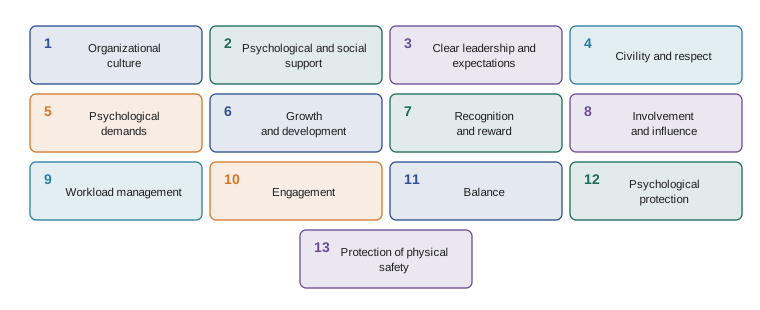
- Organizational culture: the norms, values and beliefs that show whether the organization is characterized by trust, honesty and fairness.
- Psychological and social support: whether co-workers and supervisors support workers' psychological and mental health concerns and respond appropriately.
- Clear leadership and expectations: whether leaders let workers know what they need to do, how their work contributes and whether change is coming.
- Civility and respect: whether people treat each other with respect and consideration, including customers and the public.
- Psychological demands (sometimes called psychological competencies and requirements): whether there is a good fit between workers' interpersonal and emotional skills and the demands of their role.
- Growth and development: whether workers receive encouragement and support to develop their skills.
- Recognition and reward: whether workers' efforts are appropriately acknowledged and appreciated, fairly and on time.
- Involvement and influence: whether workers are included in discussions about how their work is done and how important decisions are made.
- Workload management: whether tasks and responsibilities can be accomplished successfully within the time available.
- Engagement: whether workers feel connected to their work and motivated to do it well.
- Balance: whether the demands of work, family and personal life can be managed together.
- Psychological protection: whether workers feel able to ask questions, seek feedback, report mistakes and propose new ideas without fear of negative consequences. This is the factor closest to team psychological safety.
- Protection of physical safety: whether management takes appropriate action to protect workers' physical safety. Feeling physically unsafe is itself a source of psychological stress.
ISO 45003 categories
ISO 45003 groups psychosocial hazards into three broad categories, which overlap with the thirteen factors but are organized differently:
| Category | Examples of hazards |
|---|---|
| How work is organized | Unclear or conflicting roles; low job control; excessive or too little workload; work pace and deadlines; long, irregular or unpredictable hours; job insecurity; poorly managed organizational change; remote and isolated work |
| Social factors at work | Poor relationships and conflict; lack of support from supervisors or co-workers; poor leadership and communication; lack of recognition; incivility; bullying, harassment and violence; poor work-life balance; organizational culture that discourages speaking up |
| Work environment, equipment and hazardous tasks | Exposure to traumatic events or distressing material; working in hazardous or unpleasant conditions; poor equipment that makes tasks difficult; noise, crowding or poor lighting; lone work in dangerous settings |
Hazards in particular jobs
Some psychosocial hazards are present in almost every workplace, such as workload and leadership. Others are concentrated in particular occupations, and recognizing them is the first step to controlling them.
- Traumatic exposure: paramedics, firefighters, police, correctional officers, emergency dispatchers, nurses, child protection workers and content moderators may repeatedly witness death, serious injury, violence or disturbing material. Repeated exposure can lead to PTSD, secondary or vicarious trauma and moral injury, the distress that comes from being unable to act in line with one's values.
- Emotional labor: customer service, hospitality, call center, health care and teaching roles often require workers to display emotions they do not feel, such as staying calm and pleasant with abusive customers. Sustained emotional labor is linked to exhaustion.
- Low control and machine pacing: assembly lines, warehouse picking against quotas and algorithmically managed gig work can combine high demands with little say over pace or method.
- Isolation: lone workers, remote workers and fly-in, fly-out workers can lack social support and face long separations from family.
- Job insecurity and precarious work: temporary, contract and on-call workers may face unpredictable schedules and income, which are consistent sources of stress.
- Violence and harassment: covered in detail in HSE-108. Exposure to violence, threats, bullying and harassment is one of the most harmful psychosocial hazards and should be part of any psychosocial risk assessment.
Identifying psychosocial hazards
Psychosocial hazards are harder to see than a missing guardrail, so identification uses several sources of information together. Useful methods include:
- Worker surveys, such as Guarding Minds at Work or other validated tools, run confidentially and analyzed by team or group rather than by individual.
- Focus groups and team discussions, ideally facilitated by someone the team trusts, asking what makes work harder or easier.
- Workplace data: absenteeism, overtime, turnover, grievances, complaints, EAP usage (only in aggregate), incident reports and workers' compensation claims for psychological injury.
- Observation and job analysis: watching how work is actually done, looking at staffing levels, schedules and workflow.
- Exit interviews and stay interviews, which often reveal problems that current workers are reluctant to name.
- Input from the joint health and safety committee or safety representative, unions, occupational health and HR.
Confidentiality is essential. People will not report bullying by their supervisor or describe how overwhelmed they feel if they fear it will be traced back to them. Survey results should be reported only for groups large enough that individuals cannot be identified, commonly at least five to ten respondents.
Assessing and prioritizing risk
Once hazards are identified, they need to be assessed. One practical approach combines how likely harm is with how severe it could be, as with physical hazards, using a simple scale. Likelihood reflects how often and how widely workers are exposed and how weak the existing protective factors are. Severity reflects how serious the harm could be, from short-term distress to lasting psychological injury.
A second approach uses survey data. Many tools convert responses into a score for each factor, often grouped into bands such as serious concern, significant concern, minimal concern and relative strength. Factors flagged as serious concerns, especially those affecting many workers, become priorities for action. Either approach should be done with workers, not to them: the people doing the work usually know best where the pressure points are.
Worked problem
Scoring psychosocial risks in a call center
A 60-person contact center identifies four hazards. Abusive calls happen several times a day for most agents and can cause lasting distress (likelihood 5, severity 4). Call-handling targets are tight and agents have little control over breaks (likelihood 4, severity 3). Supervisors rarely give recognition (likelihood 4, severity 2). Scheduling changes are posted with only two days' notice (likelihood 3, severity 3). Calculate the risk scores and rank them, using bands of 1 to 6 low, 8 to 12 medium, 15 to 25 high.
Show solution
- Abusive calls: \(5 \times 4 = 20\), high.
- Tight targets with low control: \(4 \times 3 = 12\), medium.
- Lack of recognition: \(4 \times 2 = 8\), medium.
- Short-notice schedule changes: \(3 \times 3 = 9\), medium.
- Rank: abusive calls (20) first, then targets and control (12), schedule changes (9) and recognition (8).
Answer: Abusive calls are the top priority (20, high), followed by targets with low control (12), short-notice scheduling (9) and lack of recognition (8). Controls might include a clear right to end abusive calls, post-call recovery time, more agent control over breaks, longer schedule notice and regular recognition.
Scores like these are a guide to discussion, not a precise measurement. Two hazards with the same score may deserve different treatment, and a hazard that affects only a few workers but could cause severe harm, such as exposure to a fatal incident, may need urgent attention even if it is rare.
From hazards to controls
The hierarchy of controls applies to psychosocial hazards too. Elimination and substitution might mean removing an unnecessary approval layer that causes delays, or redesigning a quota system that drives unsafe pace. Engineering controls might include better scheduling software, quieter workspaces or technology that filters abusive messages. Administrative controls include clear role descriptions, realistic staffing, predictable schedules, rotation away from traumatic tasks, training for supervisors and fair complaint processes. Individual supports, such as EAP counseling and peer support, come last in the hierarchy but are still important for people who have already been affected. Lessons 5 to 11 explore controls for specific hazards in more detail.
Common mistakes
MistakeTreating stress as a personal weakness rather than a sign of possible hazards in the work.
InsteadLook for work-related causes such as workload, control, support, role clarity and exposure to trauma.
MistakeRunning a mental health survey and reporting results for very small teams.
InsteadProtect confidentiality by reporting only for groups large enough that no one can be identified.
MistakeFocusing only on high workload.
InsteadAssess the full range of factors, including recognition, involvement, civility, balance and psychological protection.
MistakeIgnoring traumatic exposure because it is part of the job.
InsteadRecognize that inherent risks still need controls, such as rotation, debriefing options, peer support and access to specialized care.
MistakeJumping straight to wellness activities after a survey.
InsteadUse the hierarchy of controls and change the work first.
Summary and key terms
- Psychosocial hazards arise from how work is designed, organized and managed, and from its social context.
- They harm people mainly through prolonged stress responses without recovery.
- High demands with low control or low reward, and little support, are especially harmful.
- CSA Z1003 and Guarding Minds at Work describe thirteen psychosocial factors.
- ISO 45003 groups hazards into work organization, social factors and work environment.
- Hazards are identified through confidential surveys, discussions, data and observation, with workers involved.
- Risks can be prioritized with likelihood and severity scores or survey bands, then controlled using the hierarchy of controls.
- Job strain
- The combination of high job demands and low job control.
- Effort-reward imbalance
- A mismatch between high effort at work and low rewards in pay, esteem or security.
- Emotional labor
- Managing one's displayed emotions to meet job expectations.
- Vicarious trauma
- Trauma reactions from repeated exposure to others' traumatic experiences.
- Moral injury
- Distress from acting, or failing to act, against one's moral values.
- Psychological protection
- Feeling able to speak up, ask questions or report mistakes without fear.
- Guarding Minds at Work
- A free set of resources and a survey for assessing the thirteen psychosocial factors.
- ISO 45003
- International guidelines for managing psychosocial risks within an OHS management system.
- Protective factor
- A feature of work that reduces the harm from demands, such as support or control.
- Psychosocial risk assessment
- Identifying psychosocial hazards, estimating risk and deciding on controls.
Practice problems
Work each problem on paper first, then reveal the answer to check.
Define a psychosocial hazard in one sentence.
Show answer
An aspect of how work is designed, organized or managed, or of its social context, that can cause harm.
What is job strain?
Show answer
High job demands combined with low job control.
Name four of the thirteen psychosocial factors.
Show answer
For example: workload management, recognition and reward, civility and respect, and psychological protection.
Which three categories does ISO 45003 use?
Show answer
How work is organized, social factors, and work environment, equipment and hazardous tasks.
Give an example of emotional labor.
Show answer
A call center agent staying calm and pleasant with an abusive caller.
Why must survey results be reported only for larger groups?
Show answer
To protect confidentiality so workers feel safe to answer honestly.
A hazard has likelihood 3 and severity 5. What is its score?
Show answer
15, high on a 25-point scale.
Which occupations face high traumatic exposure?
Show answer
Paramedics, firefighters, police, dispatchers, nurses, child protection workers and content moderators, among others.
Where do individual supports sit in the hierarchy of controls?
Show answer
At the bottom, after changes to the work itself.
Name two data sources that can reveal psychosocial hazards.
Show answer
For example, absenteeism and turnover rates, aggregate EAP use, grievances or psychological injury claims.
Lesson quiz · 5 questions
Score 60% or more to complete this lesson.
Create a free account to save your progress, take quizzes and earn a certificate.