
HSE-109 · Lesson 3 of 12 · 24 min
The scale and cost of mental health problems at work
Mental health problems are among the most common health conditions in working-age adults, and work is one of the places where their effects are felt most. This lesson looks at the size of the problem, what it costs workers, employers and society, and how to make simple cost estimates for your own workplace. Numbers are not the main reason to act; preventing suffering is. But numbers help make the case for resources, show where to focus and give a baseline for measuring progress.
One caution before the figures. Statistics on mental health come from different sources that measure different things: self-reported stress, diagnosed conditions, survey screening tools, workers' compensation claims or disability benefits. They are not directly comparable, they change over time and many are estimates. Always note the source, the year and what was measured, and treat precise-looking numbers with appropriate humility.
Global picture
The World Health Organization estimates that around 15 percent of working-age adults live with a mental disorder at any given time, and that depression and anxiety alone cost the global economy about 12 billion working days and nearly one trillion US dollars in lost productivity every year. In 2022 the WHO and the International Labor Organization (ILO) issued joint guidance on mental health at work, calling on governments and employers to prevent work-related mental health risks, protect and promote mental health at work and support workers with mental health conditions. Gallup's State of the Global Workplace report for 2025 found that around four in ten employees worldwide said they experienced a lot of stress the previous day.
National picture
In the US, the National Survey on Drug Use and Health (NSDUH) estimated that in 2024, 23.4 percent of adults, about 61.5 million people, had any mental illness in the past year, and 5.6 percent had a serious mental illness that substantially interfered with major life activities. The American Psychological Association's Work in America surveys have found that most workers report work-related stress in the past month; in the 2023 survey, about three in four did, and many said it affected their mental health. Mental health conditions are among the leading causes of short- and long-term disability claims reported by US insurers, and depression alone is estimated to cost US employers tens of billions of dollars a year in lost productivity. Gallup's annual workplace research finds that employees who are disengaged or struggling report more stress, more sick days and higher turnover.
Who is most affected
Mental health problems affect people in every occupation and at every level, but the burden is not evenly spread. Research and claims data consistently point to higher rates of work-related stress and psychological injury in several groups:
- Health care and social assistance workers, who face heavy workloads, staffing shortages, exposure to suffering and death, and high rates of violence from patients and clients.
- Public safety personnel such as paramedics, firefighters, police officers, correctional officers and emergency dispatchers, who face repeated traumatic exposure.
- Educators, who report high levels of stress, burnout and workplace violence.
- Workers in customer-facing roles with high emotional labor and frequent abuse from the public.
- Young workers and workers early in their careers, who report higher rates of anxiety and depression in many surveys.
- Workers in precarious employment, with unpredictable hours and income.
- Workers in construction and other male-dominated trades, where suicide rates are high and stigma can discourage seeking help.
- Workers who face discrimination because of race, gender identity, sexual orientation, disability or other characteristics, who may experience additional stressors at work.
These patterns help target prevention, but they should not lead to stereotypes. A manager in an office can be as unwell as a paramedic, and every workplace needs basic psychological health and safety measures.
Suicide and the workplace
Suicide is a serious public health issue that touches many workplaces. Most people who die by suicide in the US are of working age, and men account for about four in five suicide deaths. Research by the Centers for Disease Control and Prevention (CDC) has found higher suicide rates in some occupational groups, including construction and extraction, and the US also has high rates among veterans. Suicide is complex and is almost never caused by a single factor, but work can contribute through job loss, financial strain, traumatic exposure, bullying, isolation and long-term stress, and work can also protect, through belonging, purpose, routine and colleagues who notice and care.
Workplaces can play a real part in prevention: reducing psychosocial hazards, training people to recognize warning signs and ask directly about suicide when they are worried (Lesson 7), making crisis lines and the EAP well known, restricting access to dangerous means where the work involves them, and planning a careful, compassionate response, sometimes called postvention, if a colleague dies by suicide. Safe and respectful language matters too. Saying that someone died by suicide, rather than committed suicide, avoids language that implies a crime, and talking openly but carefully about suicide does not put the idea into someone's head; it can open the door to help.
Working arrangements matter too. Remote and hybrid work have brought real benefits for many people, including less commuting, more flexibility and more control over the working day, but they can also blur boundaries between work and home, increase isolation and make it harder for supervisors to notice when someone is struggling. Workers with caregiving responsibilities, who are disproportionately women, often report particular strain in balancing work and family demands. Good psychological health and safety practice takes these different situations into account rather than assuming one approach fits everyone.
The cost to workers
For workers, the costs of poor psychological health go far beyond lost pay. They include distress, strained relationships, physical health effects, loss of confidence, career setbacks and, for some, long periods of disability. Stigma adds to the harm: many people hide mental health problems at work for fear of being judged, passed over or treated as unreliable, which delays help and makes recovery harder. Workplaces can reduce this hidden cost by making it normal to talk about mental health and by handling disclosures fairly and confidentially.
The cost to employers
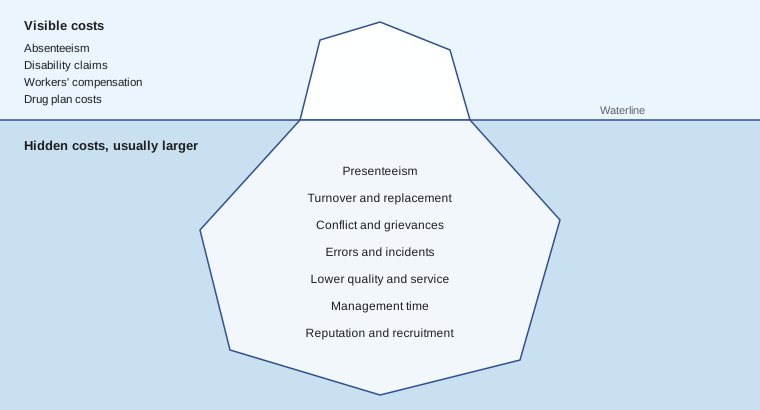
For employers, the visible costs include sick leave, short- and long-term disability, workers' compensation premiums and claims, drug plan costs and EAP fees. The hidden costs are usually larger:
- Presenteeism: workers who come to work while unwell and work at reduced capacity. Many studies estimate that the productivity lost to presenteeism exceeds the productivity lost to absence.
- Turnover: replacing a worker commonly costs a substantial fraction of a year's salary once recruitment, onboarding, training and lost productivity are counted.
- Conflict and grievances: time spent by managers, HR and unions on disputes that grow out of poorly managed stress and relationships.
- Errors, quality problems and safety incidents: fatigue, distraction and burnout increase the chance of mistakes, some of them serious.
- Reputation: organizations known for poor working conditions find it harder to recruit and retain staff and can lose customers.
Estimating costs in your workplace
Simple estimates can help a workplace see the scale of its own costs. They need clearly stated assumptions, and they should be presented as rough ranges rather than precise figures. A basic model has three parts:
Daily cost is usually the average wage plus benefits for one day. Productivity loss is the fraction of normal output lost on days a person works while unwell; studies suggest figures from a few percent for mild symptoms to 20 percent or more for significant depression, so choose a cautious value and test a range.
Worked problem
Estimating the cost of mental health problems in a 400-person organization
An organization has 400 employees with an average daily cost (wages plus benefits) of $320. Assume mental health-related absence averages 2.4 days per employee per year. Assume 20 percent of employees have symptoms that reduce productivity by 10 percent on 220 working days a year. Assume 12 of last year's 50 leavers left mainly because of stress or burnout, and replacing each one costs $30,000. Estimate the annual cost.
Show solution
- Absence: \(400 \times 2.4 \times 320 = 307{,}200\) dollars.
- Presenteeism: \(0.20 \times 400 = 80\) affected workers; \(80 \times 220 \times 0.10 \times 320 = 563{,}200\) dollars.
- Turnover: \(12 \times 30{,}000 = 360{,}000\) dollars.
- Total: \(307{,}200 + 563{,}200 + 360{,}000 = 1{,}230{,}400\) dollars, or about \(3{,}076\) dollars per employee.
- Sensitivity: if productivity loss were 5 percent instead of 10, presenteeism would fall to \(281{,}600\) dollars and the total to about \(948{,}800\) dollars. Report a range, roughly 0.9 to 1.2 million dollars.
Answer: Roughly 0.9 to 1.2 million dollars a year, or about 2,400 to 3,100 dollars per employee, with presenteeism the largest and most uncertain part. The estimate excludes disability claims, errors and conflict, so it is likely to be conservative.
An estimate like this makes a strong case for investment. If a prevention program costing, say, $150,000 a year reduced these costs by even 15 percent, it would roughly pay for itself, before counting the human benefits. Lesson 11 returns to return-on-investment calculations and how to present them honestly.
Using data wisely
| Indicator | What it can show | Limitations |
|---|---|---|
| Sick days and mental health-related absence | Trends over time and between teams | Reasons are often not recorded; privacy limits detail |
| Disability and workers' compensation claims | Serious cases and their causes | Lagging; many cases never become claims |
| EAP usage (aggregate only) | Demand for support and main issues | Rising use may reflect better awareness, not worse health |
| Turnover and exit interviews | Avoidable losses and their reasons | Leavers may not be candid |
| Overtime and vacation not taken | Workload and balance pressures | Need context about seasonal peaks |
| Psychosocial survey scores | Strengths and concerns by factor and group | Response rates and trust affect quality |
No single indicator tells the whole story. Rising EAP use after a stigma-reduction campaign may be good news. Falling sick leave may hide growing presenteeism. Combining indicators, looking at trends over time, and always protecting individual privacy give a more reliable picture.
Common mistakes
MistakeQuoting a precise-looking statistic without its source, year or definition.
InsteadState where the number comes from, when it was measured and what it measures.
MistakeCounting only absence and disability costs.
InsteadInclude presenteeism, turnover, conflict and errors, which are often larger.
MistakePresenting a single cost estimate as fact.
InsteadState assumptions and give a range using sensitivity analysis.
MistakeInterpreting rising EAP use as proof that mental health is getting worse.
InsteadConsider whether awareness and trust have improved, and look at other indicators.
MistakeAssuming only high-risk occupations need attention.
InsteadProvide basic psychological health and safety measures in every workplace.
Summary and key terms
- Mental health problems are among the most common health conditions in working-age adults.
- Depression and anxiety cost the global economy about 12 billion working days a year, according to the WHO.
- About 23 percent of US adults had a mental illness in 2024, according to NSDUH, and most workers report work-related stress.
- Health care, public safety, education and customer-facing workers face particularly high risks.
- Hidden costs such as presenteeism and turnover usually exceed visible costs such as sick leave.
- Simple cost estimates with stated assumptions and ranges help make the case for prevention.
- Combine several indicators and protect privacy when using data.
- Absenteeism
- Time away from work because of illness or other reasons.
- Presenteeism
- Working while unwell with reduced productivity.
- Turnover
- Workers leaving an organization and needing to be replaced.
- Short-term disability
- Income replacement for a temporary inability to work, typically for weeks to months.
- Long-term disability
- Income replacement when a person cannot work for an extended period.
- Stigma
- Negative attitudes and stereotypes that discourage people from seeking help.
- Sensitivity analysis
- Testing how an estimate changes when assumptions change.
- Daily cost
- Average wages plus benefits for one working day.
- Lagging indicator
- A measure of harm that has already happened, such as claims.
- Leading indicator
- A measure of conditions or actions that predict future outcomes, such as survey scores or training completed.
Practice problems
Work each problem on paper first, then reveal the answer to check.
According to the WHO, how many working days are lost globally each year to depression and anxiety?
Show answer
About 12 billion.
What percentage of US adults had any mental illness in 2024, according to NSDUH?
Show answer
About 23.4 percent.
Name two hidden costs of poor psychological health and safety.
Show answer
For example, presenteeism and turnover.
A team of 50 averages 3 days of mental health absence each at $300 a day. What is the absence cost?
Show answer
50 × 3 × 300 = $45,000.
10 workers lose 10 percent productivity on 200 days at $300 a day. What is the presenteeism cost?
Show answer
10 × 200 × 0.10 × 300 = $60,000.
Why give a range rather than a single cost figure?
Show answer
Because key assumptions, such as productivity loss, are uncertain.
Name two occupational groups with high rates of psychological injury.
Show answer
For example, health care workers and public safety personnel.
Why might rising EAP use be a good sign?
Show answer
It may show that awareness and trust have increased and people are seeking help earlier.
Is a disability claim a leading or lagging indicator?
Show answer
A lagging indicator, because the harm has already happened.
How can stigma increase costs?
Show answer
It discourages people from seeking help early, so problems become more serious and longer lasting.
Lesson quiz · 5 questions
Score 60% or more to complete this lesson.
Create a free account to save your progress, take quizzes and earn a certificate.