
HSE-109 · Lesson 11 of 12 · 24 min
Building a psychological health and safety management system
Individual actions, such as a supportive conversation, a workload review or an accommodation, make a real difference. But to prevent psychological harm reliably, across a whole organization and over time, those actions need to be part of a system. A psychological health and safety management system (PHSMS) applies the same plan-do-check-act logic used for other occupational health and safety risks, and for quality and environmental management, to psychosocial risk. This lesson describes the elements of such a system, drawing on CSA Z1003 and ISO 45003, and shows how to make the case for investment.
Plan, do, check, act
Management system standards are built around a continuous improvement cycle: plan what to do, do it, check whether it worked, and act on what you learn. Applied to psychological health and safety, the cycle looks like this:
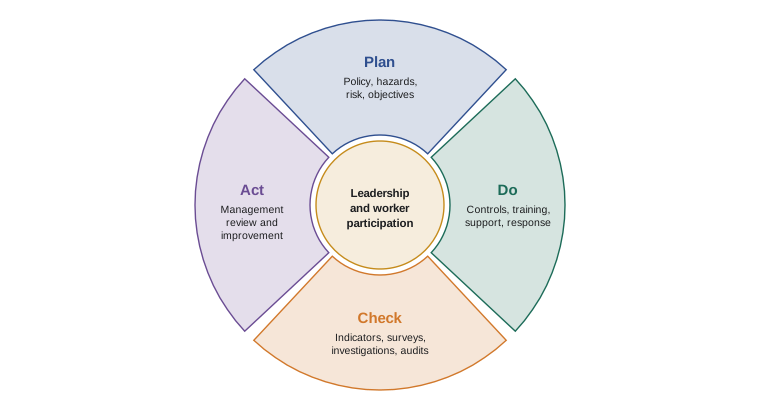
Commitment, leadership and participation
Every successful system starts with visible commitment from senior leadership. That means a written psychological health and safety policy signed by the most senior leader, resources to implement it, clear accountability, and leaders who talk about it and model it. Without senior commitment, programs tend to become a collection of wellness activities run by HR with no influence on how work is designed.
Worker participation is equally essential. Workers know where the pressure points are, and their involvement builds trust. Participation can include joint health and safety committees or representatives, union involvement, a dedicated psychological health and safety working group with members from different levels and functions, and regular consultation on hazards and controls. People with lived experience of mental health problems can offer valuable insight if they choose to take part.
A good policy is short and clear. It states the organization's commitment to preventing psychological harm and promoting well-being, describes the main responsibilities of leaders, supervisors and workers, commits to confidentiality and to non-reprisal for raising concerns, links to related policies such as harassment, accommodation and return to work, and states how the policy will be reviewed.
Planning
Planning starts with understanding the current situation. A baseline review collects data from the sources described in Lesson 2 and Lesson 3: confidential surveys such as Guarding Minds at Work, absence and turnover data, EAP and disability reports in aggregate, incident and complaint records, and discussions with workers. From this, the organization identifies psychosocial hazards, assesses the risks, and sets priorities.
Objectives should be specific and measurable. Rather than "improve mental health", an objective might be "raise the average workload management score in the operations division from 2.8 to 3.4 on the survey scale within 18 months" or "ensure every supervisor completes psychologically healthy leadership training by the end of the year". Each objective needs an owner, resources, a timeline and an indicator.
It also helps to start small and build momentum. Rather than launching many initiatives at once, choose two or three priorities where action is feasible and visible, such as fixing a scheduling problem that workers raise repeatedly, and deliver on them. Early, visible wins show workers that their input leads to change and make them more willing to take part in the next survey or consultation.
Doing: implementing controls and supports
Implementation covers the three goals introduced in Lesson 1:
- Prevention: controls targeting the hazards identified, such as staffing and workload changes, clearer roles, predictable schedules, fatigue management, controls on traumatic exposure, violence and harassment prevention, and fair change management. These should follow the hierarchy of controls, starting with changes to the work itself.
- Promotion: building resources such as recognition, involvement, growth opportunities, flexibility and psychologically healthy leadership.
- Resolution: responding to concerns and incidents through complaint and investigation processes, supportive conversations, the EAP, accommodation, stay-at-work and return-to-work processes, and a plan for critical events.
Training and communication support all three. Typical training includes awareness for all workers, psychologically healthy leadership for supervisors, Mental Health First Aid or similar for selected people, and specialized training for those dealing with trauma, investigations or return to work. Communication should be regular and honest: what the organization is doing, why, what has changed as a result of feedback, and where to get help.
Critical events
A critical event, such as a workplace death or serious injury, an act of violence, a suicide, a natural disaster or a sudden mass layoff, can have a profound psychological impact on workers who witnessed it or are affected by it. A PHSMS should include a critical event response plan, prepared in advance, that covers immediate safety and practical support, communication with workers and families, access to psychological first aid and professional support, monitoring of affected workers over the following weeks, and a gradual return to normal routines. Current evidence favors offering psychological first aid and practical support, and making professional help available to those who need it, rather than requiring everyone to attend a single detailed group debriefing.
Checking: monitoring and evaluation
Checking asks whether the system is working. It uses a balanced set of indicators:
| Type of indicator | Examples |
|---|---|
| Leading: activities | Percentage of supervisors trained; number of workload reviews completed; time taken to respond to concerns |
| Leading: conditions | Psychosocial survey scores by factor and group; psychological safety scores; overtime levels; vacation taken |
| Lagging: outcomes | Mental health-related absence; psychological injury and disability claims; turnover; grievances and harassment complaints |
| Process quality | Return-to-work success rate; time to accommodate; worker ratings of support received |
Leading indicators show whether the organization is doing what it planned and whether conditions are improving; lagging indicators show outcomes, often with a delay. Relying only on lagging indicators means problems are discovered after people have been harmed. Investigations of psychological injuries, complaints and critical events should look for system causes, such as workload, staffing or management practices, rather than stopping at individual factors. Periodic internal audits check whether the system is operating as designed.
Acting: management review and continual improvement
At least once a year, senior leaders should review the system: progress against objectives, indicator trends, audit and investigation findings, worker feedback and changes in the organization or the law. The review should lead to decisions: new objectives, changes to controls, additional resources. Communicating the results of the review to workers closes the loop and shows that their input matters. Over time, the cycle should become part of normal business planning rather than a separate project.
Using ISO 45003 and other frameworks
ISO 45003 sets out these elements for organizations that use, or want to use, an ISO 45001 occupational health and safety management system. ANSI/ASSP Z10.0 offers a compatible American management system framework. The Surgeon General's Framework and NIOSH Total Worker Health resources provide practical tools, and many US organizations also draw on the Canadian standard, CSA Z1003, and its free implementation resources. Experience suggests success depends on strong leadership commitment, worker involvement, using data to set priorities and integrating psychological health and safety into existing systems rather than creating a stand-alone program. Small organizations do not need an elaborate system: a short policy, a simple annual survey or team discussion, a few clear priorities, supervisor training and good use of the EAP can achieve a lot.
Integrating with existing systems
Psychological health and safety works best when it is built into systems the organization already has rather than run as a separate initiative. Psychosocial hazards can be added to the existing hazard identification and risk assessment process and to workplace inspections. Joint health and safety committees can include psychosocial risks in their regular agendas. Incident investigation procedures can be expanded to look for psychosocial contributing factors such as fatigue, workload or pressure to cut corners. Change management processes can include an assessment of the psychological impact of major changes, such as restructuring or new technology, before they are introduced. Procurement and contractor management can consider the psychosocial conditions of contracted work. Performance reviews for managers can include how well they support their teams. Integration makes psychological health and safety part of how the organization normally works, which is what sustains it when the initial enthusiasm fades.
Making the business case
Leaders often want to know whether a psychological health and safety program is worth the cost. A return on investment (ROI) estimate can help, provided it is honest about its assumptions. The basic formula is:
Benefits are the reductions in costs such as absence, presenteeism, turnover and claims, estimated using the methods in Lesson 3. Costs include training, staff time, survey tools, consultants and any changes such as additional staffing. Because many benefits are uncertain and take time to appear, it is wise to present a cautious case, a range and a payback period, and to remember that the main justification is preventing harm.
Worked problem
Estimating return on investment for a program
An organization estimates its annual mental health-related costs at $1.2 million: absence $300,000, presenteeism $550,000 and turnover $350,000. It plans a program costing $180,000 in the first year (training, a coordinator, survey tools and workload changes) and $120,000 a year after that. Assume, cautiously, that the program reduces absence by 10 percent, presenteeism by 8 percent and turnover by 15 percent from the second year. Calculate the annual benefit, the ROI in a steady-state year and the cumulative position after three years.
Show solution
- Absence saving: \(0.10 \times 300{,}000 = 30{,}000\).
- Presenteeism saving: \(0.08 \times 550{,}000 = 44{,}000\).
- Turnover saving: \(0.15 \times 350{,}000 = 52{,}500\).
- Annual benefit from year 2: \(30{,}000 + 44{,}000 + 52{,}500 = 126{,}500\).
- Steady-state ROI: \((126{,}500 - 120{,}000) \div 120{,}000 \approx 0.054\), about 5 percent.
- Three-year totals: costs \(180{,}000 + 120{,}000 + 120{,}000 = 420{,}000\); benefits \(0 + 126{,}500 + 126{,}500 = 253{,}000\); net position \(-167{,}000\).
- Interpretation: on these cautious assumptions, the program roughly breaks even each year once established but does not recover the start-up cost within three years. With reductions of 15, 12 and 20 percent instead, the annual benefit would be \(45{,}000 + 66{,}000 + 70{,}000 = 181{,}000\), an ROI of about 51 percent.
Answer: Cautiously, the program delivers about $126,500 a year in savings from year 2, a steady-state ROI of about 5 percent, and a net cost of about $167,000 over three years; with more optimistic but plausible effects, the ROI rises to about 50 percent. The financial case is modest but positive, and the main justification is preventing harm.
Presenting the figures this way builds credibility. Overstated claims of huge returns invite skepticism, while a cautious case that still breaks even, plus the legal and human reasons for acting, is usually persuasive.
Common mistakes
MistakeLaunching a collection of wellness activities without a system.
InsteadUse plan-do-check-act with leadership commitment, data and worker participation.
MistakeSetting vague objectives such as "improve morale".
InsteadSet specific, measurable objectives with owners, timelines and indicators.
MistakeMeasuring success only with lagging indicators.
InsteadUse a balanced set of leading and lagging indicators.
MistakeRequiring everyone to attend a detailed group debriefing after a critical event.
InsteadOffer psychological first aid, practical support and access to professional help for those who need it.
MistakeOverstating the financial return of a program.
InsteadPresent cautious assumptions, ranges and payback periods, alongside the human and legal case.
Summary and key terms
- A psychological health and safety management system applies plan-do-check-act to psychosocial risk.
- Senior leadership commitment and worker participation are the foundations.
- Planning uses baseline data to identify hazards, assess risk and set measurable objectives.
- Implementation covers prevention, promotion and resolution, supported by training and communication.
- A critical event response plan prepared in advance is essential.
- Checking uses balanced leading and lagging indicators, investigations and audits; acting means management review and improvement.
- Return-on-investment estimates should be cautious and transparent; preventing harm is the main justification.
- Psychological health and safety management system
- A systematic, continuous-improvement approach to managing psychosocial risk.
- Plan-do-check-act
- A four-stage continuous improvement cycle.
- Baseline review
- An initial assessment of current conditions, data and hazards.
- Critical event
- A sudden event with significant psychological impact, such as a workplace death.
- Psychological first aid
- Evidence-informed early support focused on safety, calm, connection and practical help.
- Leading indicator
- A measure of activities or conditions that predict future outcomes.
- Lagging indicator
- A measure of harm or outcomes that have already occurred.
- Management review
- A periodic review by senior leaders of system performance and direction.
- Return on investment
- Net benefits divided by costs.
- Payback period
- The time needed for cumulative benefits to equal cumulative costs.
Practice problems
Work each problem on paper first, then reveal the answer to check.
What are the four stages of the improvement cycle?
Show answer
Plan, do, check and act.
Why is senior leadership commitment essential?
Show answer
Without it, programs lack resources and influence over how work is designed.
Rewrite "reduce stress" as a measurable objective.
Show answer
For example, raise the workload management survey score in a division from 2.8 to 3.4 within 18 months.
Name the three implementation goals.
Show answer
Prevention, promotion and resolution.
Give one leading and one lagging indicator.
Show answer
For example, percentage of supervisors trained (leading) and psychological injury claims (lagging).
What does current evidence favor after a critical event?
Show answer
Psychological first aid, practical support and access to professional help, rather than mandatory detailed debriefing for everyone.
A program costs $100,000 and produces $130,000 in benefits. What is the ROI?
Show answer
(130,000 − 100,000) ÷ 100,000 = 30 percent.
Why present a range for ROI?
Show answer
Because the effects and benefits are uncertain.
What happens at management review?
Show answer
Senior leaders review performance, data and feedback and decide on improvements.
What can a small organization do without an elaborate system?
Show answer
Adopt a short policy, run a simple survey or discussion, set a few priorities, train supervisors and promote the EAP.
Lesson quiz · 5 questions
Score 60% or more to complete this lesson.
Create a free account to save your progress, take quizzes and earn a certificate.