
HSE-109 · Lesson 4 of 12 · 25 min
Psychological health and safety law and standards in Canada
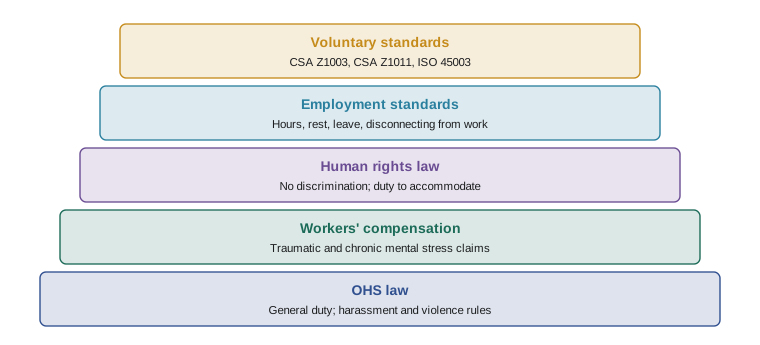
Psychological health and safety in Canada sits at the meeting point of several bodies of law: occupational health and safety statutes, workers' compensation, human rights codes, employment standards, labour law and the common law of employment. On top of these sit voluntary standards, above all the National Standard of Canada, CSA Z1003. Because OHS and employment are mostly provincial and territorial responsibilities, the details vary across the country, and federally regulated workplaces, such as banks, airlines, railways, telecommunications and the federal public service, follow the Canada Labour Code. This lesson gives an overview of the main duties.
Occupational health and safety law
Every Canadian OHS statute places a general duty on employers to protect the health and safety of workers. Ontario's Occupational Health and Safety Act, for example, requires employers to take every precaution reasonable in the circumstances for the protection of a worker, and the Canada Labour Code Part II requires federal employers to ensure that the health and safety at work of every person they employ is protected. Health in these statutes is increasingly understood to include mental health. Some statutes say so directly: Saskatchewan's Employment Act defines occupational health and safety as including the promotion and maintenance of the highest degree of physical, mental and social well-being of workers, and Quebec's Act respecting occupational health and safety requires employers to take the necessary measures to protect the health and ensure the safety and physical and mental well-being of workers.
Several jurisdictions have gone further and named psychosocial risks explicitly. Quebec's Act to modernize the occupational health and safety regime, adopted in 2021 and often called Bill 59, requires prevention programs and action plans to identify and control psychosocial risks related to work, including psychological harassment, sexual violence and domestic violence. Quebec strengthened its rules on psychological harassment and sexual violence again in 2024. Every province and territory, and the federal jurisdiction, now has requirements on workplace harassment and violence, covered in HSE-108. Most also require employers to address hazards from working alone, fatigue in specific sectors and exposure to violence, all of which have psychological dimensions.
Privacy and confidentiality of health information
Every part of psychological health and safety depends on trust, and trust depends on privacy. Several Canadian laws govern how employers collect, use and disclose workers' personal health information. Federally regulated private-sector employers are covered by the Personal Information Protection and Electronic Documents Act (PIPEDA). Alberta and British Columbia have their own Personal Information Protection Acts that apply to private-sector employee information, and Quebec's private-sector privacy law, significantly strengthened by Law 25 between 2022 and 2024, imposes strict rules on consent, confidentiality incidents and privacy impact assessments. Public-sector employers are covered by provincial and federal public-sector privacy laws, and health care providers by health information statutes such as Ontario's Personal Health Information Protection Act. In practice, an employer is generally entitled to information about a worker's functional abilities and limitations, the expected duration of the limitations and the accommodation needed, but not to the diagnosis or treatment details, unless the worker chooses to share them or there is a specific legal reason. Medical information should be held by a limited group, such as occupational health or disability management staff, separately from the personnel file, and shared with supervisors only on a need-to-know basis, usually limited to the restrictions and accommodations. Breaches of confidentiality can violate privacy law, human rights law and collective agreements, and they destroy the trust that a psychological health and safety program needs.
In practice, the general duty means that an employer who knows, or should know, about a serious psychosocial hazard, such as a supervisor who bullies staff, chronic understaffing that leads to exhaustion, or repeated exposure to traumatic events without support, should take reasonable steps to control it. What is reasonable depends on the risk, the knowledge available and the cost and feasibility of controls, the same test that applies to physical hazards.
What does a reasonable employer actually do to meet these duties? Decisions by courts, tribunals, arbitrators and regulators, together with the voluntary standards, point to a consistent set of practices: having a written policy that addresses psychological health and safety, harassment and violence; identifying psychosocial hazards with worker input and taking reasonable steps to control the significant ones; training supervisors to recognize and respond to problems; providing access to support such as an EAP; responding promptly and fairly to complaints and incidents; accommodating workers with mental health conditions; and keeping records that show what was done. None of these requires perfection. They require that the employer take the risk seriously, act on what it knows and be able to show that it did.
Workers' compensation for psychological injury
Workers' compensation boards in every province and territory accept some claims for mental health conditions caused by work, but the rules vary widely. Common patterns include:
- Traumatic mental stress: most boards accept claims for conditions such as PTSD caused by a sudden, frightening or shocking work event, such as witnessing a fatal accident or being assaulted.
- Chronic or cumulative stress: an increasing number of jurisdictions accept claims for conditions caused by chronic stressors. Ontario's Workplace Safety and Insurance Board (WSIB) has accepted claims for chronic mental stress caused by a substantial work-related stressor, including workplace harassment, since January 1, 2018. British Columbia's Workers Compensation Act, section 135, covers mental disorders that are a reaction to one or more traumatic events, or predominantly caused by a significant work-related stressor, including bullying or harassment, or a cumulative series of such stressors.
- Presumptions: many provinces presume that PTSD or other listed mental disorders are work-related for certain occupations, such as firefighters, paramedics, police, correctional officers, emergency dispatchers and, in some provinces, nurses, unless the contrary is shown.
- Exclusions: most boards exclude stress caused by an employer's ordinary decisions about employment, such as changes to work, discipline, demotion or termination, provided those decisions are made in good faith.
Human rights law and the duty to accommodate
Every Canadian human rights code prohibits discrimination in employment on the basis of disability, which includes mental disability. Employers have a duty to accommodate workers with mental health conditions to the point of undue hardship, and to inquire about a worker's needs when they know, or reasonably should know, that a mental health condition may be affecting the worker's performance or behaviour. The Supreme Court of Canada's 1999 Meiorin decision set out the framework for testing whether a workplace standard is a bona fide occupational requirement and whether accommodation has been provided to the point of undue hardship. Accommodation and return to work are covered in Lesson 9. Human rights codes also prohibit harassment on protected grounds, including disability.
Employment standards and labour law
Employment standards legislation sets limits on hours of work, minimum rest periods and leave entitlements, all of which affect fatigue and balance (Lesson 6). Several provinces, and the federal jurisdiction, provide personal emergency, sick or domestic violence leave. Ontario's Working for Workers Act, 2021 requires employers with 25 or more employees to have a written policy on disconnecting from work. Collective agreements often add protections, such as workload provisions, grievance procedures and joint committees, and arbitrators have held employers responsible for poisoned work environments.
Voluntary standards and frameworks
CSA Z1003, the National Standard of Canada for Psychological Health and Safety in the Workplace, released in 2013 and developed with the Bureau de normalisation du Québec (BNQ) and the Mental Health Commission of Canada, is voluntary. It sets out a systematic approach to developing and sustaining a psychologically healthy and safe workplace, based on the thirteen psychosocial factors and a plan-do-check-act management system, covered in Lesson 11. A revised edition is under development, with publication expected around late 2026. Related standards include CSA Z1003.1 for post-secondary student mental health, CSA Z1001 on psychological health and safety for paramedic services, and CSA Z1011 on work disability management systems. Internationally, ISO 45003:2021 provides guidance for managing psychosocial risks within an ISO 45001 management system. Although voluntary, these standards help define what a reasonable employer does and may be referenced in policies, collective agreements and legal decisions.
| Source | What it requires or offers | Examples |
|---|---|---|
| OHS statutes | General duty to protect health, including mental health; specific rules on harassment and violence | Ontario OHSA s. 25(2)(h); Canada Labour Code s. 124; Quebec psychosocial risk provisions |
| Workers' compensation | Compensation for traumatic and, in some provinces, chronic mental stress | WSIB chronic mental stress policy (2018); BC WCA s. 135; occupational presumptions |
| Human rights codes | No discrimination based on mental disability; duty to accommodate to undue hardship | Provincial codes; Canadian Human Rights Act; Meiorin test |
| Employment standards | Hours, rest, leave and disconnecting from work | Federal and provincial hours limits; Ontario right-to-disconnect policies |
| Voluntary standards | Systematic approach to psychological health and safety | CSA Z1003; CSA Z1011; ISO 45003 |
Worked problem
Is a chronic stress claim likely to be accepted?
A worker in Ontario has been subjected by her supervisor to repeated public belittling, threats to her job and abusive emails over eight months. Her doctor diagnoses an adjustment disorder and she stops work. Her employer argues that the supervisor was only managing performance. Using the WSIB chronic mental stress policy described above, how would the claim likely be analysed?
Show solution
- Identify the stressor: repeated belittling, threats and abusive emails over months are workplace harassment, which the policy recognizes as a substantial work-related stressor.
- Check diagnosis: a regulated health professional has diagnosed a mental disorder (an adjustment disorder) using recognized criteria, as the policy requires.
- Consider the exclusion: the policy excludes good-faith employment decisions, such as fair performance management. Public belittling and abusive emails are not good-faith management, so the exclusion is unlikely to apply.
- Causation: the board would look at whether the substantial stressor was the predominant cause of the disorder.
- Parallel duties: regardless of the claim, the employer must investigate the harassment under the OHSA and may have duties under the Human Rights Code if a protected ground is involved.
Answer: The claim has a reasonable chance of acceptance under the chronic mental stress policy, because harassment is a substantial work-related stressor and the conduct goes beyond good-faith management. The employer also has separate OHS and possibly human rights duties.
Common mistakes
MistakeAssuming OHS law covers only physical injuries.
InsteadRecognize that general duties increasingly include mental health and that some laws name psychosocial risks explicitly.
MistakeTreating abusive behaviour as performance management.
InsteadDistinguish good-faith management decisions from harassment, which is not excluded from duties or claims.
MistakeThinking CSA Z1003 is irrelevant because it is voluntary.
InsteadUse it as a benchmark of reasonable practice that can be cited in policies, agreements and decisions.
MistakeWaiting for a worker to request accommodation before acting on clear signs of a problem.
InsteadRecognize the duty to inquire when the employer knows or reasonably should know of a possible mental health issue.
MistakeApplying another jurisdiction's rules.
InsteadCheck the specific provincial, territorial or federal law that applies.
Summary and key terms
- OHS statutes impose general duties that increasingly include mental health, and some name psychosocial risks explicitly.
- Quebec requires prevention programs to identify and control psychosocial risks.
- Workers' compensation covers traumatic mental stress everywhere and chronic stress in a growing number of provinces.
- Ontario has accepted chronic mental stress claims since 2018; BC's Workers Compensation Act s. 135 covers significant work-related stressors.
- Human rights codes require accommodation of mental disabilities to the point of undue hardship.
- Employment standards affect hours, rest, leave and disconnecting from work.
- CSA Z1003 is the voluntary national standard, with a revised edition expected around late 2026.
- General duty
- A broad legal duty to protect workers from hazards, including those without specific rules.
- Chronic mental stress
- Mental stress caused by a substantial work-related stressor over time.
- Traumatic mental stress
- An acute reaction to a sudden, shocking work event.
- Presumption
- A legal rule that a condition is work-related for certain occupations unless shown otherwise.
- Duty to accommodate
- The obligation to adjust work for a worker with a disability, short of undue hardship.
- Undue hardship
- The point at which accommodation would impose excessive cost or risk.
- Mental-mental claim
- A claim for a mental condition caused by mental stress without physical injury.
- Interactive process
- A good-faith dialogue between employer and worker to identify accommodations.
- Bona fide occupational requirement
- A job requirement that is genuinely necessary and cannot be adjusted without undue hardship.
- ISO 45003
- International guidelines for managing psychosocial risks at work.
Practice problems
Work each problem on paper first, then reveal the answer to check.
Which Ontario provision requires every precaution reasonable in the circumstances?
Show answer
Section 25(2)(h) of the Occupational Health and Safety Act.
Which province requires prevention programs to identify psychosocial risks?
Show answer
Quebec, under its 2021 modernization of OHS law.
Since when has the WSIB accepted chronic mental stress claims?
Show answer
Since January 1, 2018.
What does BC Workers Compensation Act s. 135 cover?
Show answer
Mental disorders caused by traumatic events or predominantly by significant work-related stressors, including bullying or harassment.
What do most boards exclude from stress claims?
Show answer
Stress caused by good-faith employment decisions such as discipline, changes to work or termination.
To what point must employers accommodate mental disabilities?
Show answer
To the point of undue hardship.
Is CSA Z1003 mandatory?
Show answer
No, it is voluntary, but it is a benchmark of reasonable practice.
What is a presumption in workers' compensation?
Show answer
A rule that a condition such as PTSD is presumed work-related for certain occupations unless shown otherwise.
Name one employment standard that affects psychological health.
Show answer
Limits on hours of work, rest periods, leave or Ontario's disconnecting-from-work policy requirement.
Which international standard covers psychosocial risk management?
Show answer
ISO 45003:2021.
Lesson quiz · 5 questions
Score 60% or more to complete this lesson.
Create a free account to save your progress, take quizzes and earn a certificate.