
HSE-381 · Lesson 10 of 12 · 17 min
Food allergens
▶ Video coming soon A video version of this lesson is on the way.
Most foodborne illness comes from germs that grow when food is mishandled. Food allergies are different. The food itself is perfectly safe for almost everyone, but for a guest with an allergy, a trace of one protein can cause a reaction within minutes, and a severe reaction, called anaphylaxis, can kill. Cooking does not destroy most allergens, and a crumb or a splash can be enough. Protecting allergic guests depends entirely on information: knowing what is in every dish, passing that knowledge accurately from the guest to the kitchen and back, and preventing cross-contact during preparation.
This lesson explains what food allergies are, which allergens the law names in each country, how Juniper Street keeps track of the allergens in its menu, how an allergy order moves through the restaurant, and what to do if a guest has a reaction.
Allergies, intolerances and celiac disease
A food allergy is a reaction of the immune system to a protein in a food. The body treats the protein as a threat and releases chemicals such as histamine. Symptoms can include hives, swelling of the lips, tongue or throat, itching in the mouth, vomiting, cramps, coughing or wheezing, difficulty breathing, a drop in blood pressure, dizziness and loss of consciousness. Anaphylaxis is a severe reaction involving more than one body system or affecting breathing or circulation, and it can progress very quickly.
A food intolerance, such as lactose intolerance, does not involve the immune system. It can be very unpleasant, but it is not life-threatening in the same way. Celiac disease is an autoimmune reaction to gluten, the protein in wheat, barley and rye; it does not cause anaphylaxis, but even small amounts of gluten damage the intestine, so a guest with celiac disease needs the same care as a guest with an allergy. Staff should not try to judge how serious a guest's condition is. If a guest says they cannot eat something, the kitchen treats it as an allergy.
The allergens the law names
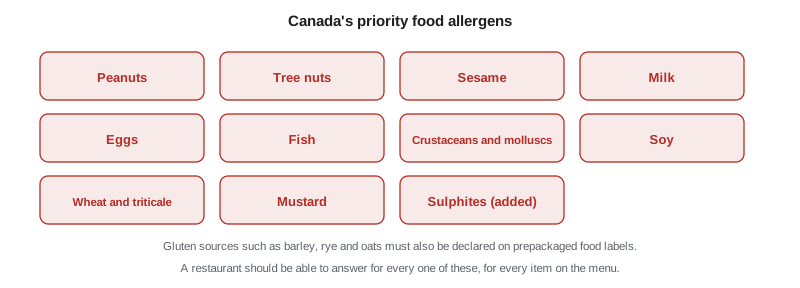
Health Canada lists the priority food allergens: peanuts, tree nuts, sesame, milk, eggs, fish, crustaceans and molluscs, soy, wheat and triticale, and mustard. Gluten sources and added sulphites are also covered by the labelling rules because they cause similar severe reactions or sensitivities. Under the Food and Drug Regulations, prepackaged foods must declare these in the list of ingredients or in a Contains statement.
Food prepared and served in a restaurant is not covered by the federal labelling rules, and BC does not have a separate allergen disclosure law for restaurants. That does not leave restaurants free to guess. A restaurant that tells a guest a dish is safe when it is not can be held responsible for the harm, and health authorities expect food premises to know their ingredients and to have procedures for allergy orders as part of their food safety plan. The prepackaged products a restaurant buys, such as sauces, bread and spice blends, come with ingredient labels, and those labels are the starting point for the restaurant's own records.
Hidden allergens cause many of the problems. Worcestershire sauce contains fish (anchovies). Pesto usually contains pine nuts or other tree nuts and cheese. Many vegetarian burgers contain soy or wheat. Some curry pastes contain peanuts or shrimp. Caesar dressing contains egg, fish and often mustard. Breadcrumbs, batter, gravy, soy sauce and beer contain wheat. Juniper's bar has its own: orgeat syrup in some cocktails is made from almonds, some bitters contain nuts, and wine can contain sulphites.
The allergen matrix
Juniper keeps an allergen matrix: a table listing every menu item, every sauce and garnish, and every allergen it contains. It is built from the recipes and from the labels of every bought-in product, and it lives in two places: a printed binder at the expo window and a sheet in the point-of-sale system that servers can look up. The matrix is only as good as its last update, so Tomás updates it whenever a recipe changes or a supplier changes a product, and checks the labels of new deliveries against it.
The program below shows the idea with a small part of the menu. Given a guest's allergies, it lists the dishes that contain those allergens and the dishes that do not. It also flags dishes cooked in the shared fryer, because fries cooked in the same oil as battered fish can carry fish and wheat protein even though the fries contain neither.
# A small allergen matrix for part of Juniper's menu (Canadian priority allergens).
MENU = {
    "Fish and chips":        {"fish", "wheat", "eggs", "milk"},
    "House fries":           set(),
    "Caesar salad":          {"eggs", "fish", "milk", "wheat", "mustard"},
    "Braised chicken thighs": {"mustard", "sulphites"},
    "Halibut crudo":         {"fish"},
    "Burger":                {"wheat", "sesame", "milk", "eggs"},
    "Pesto pasta":           {"wheat", "tree nuts", "milk"},
}
SHARED_FRYER = {"Fish and chips", "House fries"}
FRYER_CARRIES = {"fish", "wheat", "eggs", "milk"}

def check(allergies):
    safe, unsafe = [], []
    for dish, contains in MENU.items():
        risk = contains & allergies
        if dish in SHARED_FRYER:
            risk |= FRYER_CARRIES & allergies
        (unsafe if risk else safe).append((dish, sorted(risk)))
    return safe, unsafe

safe, unsafe = check({"fish"})
print("Guest allergy: fish")
for dish, why in unsafe:
    print(f"  NOT SAFE  {dish}: {', '.join(why)}")
for dish, _ in safe:
print(f" no fish {dish}")Guest allergy: fish NOT SAFE Fish and chips: fish NOT SAFE House fries: fish NOT SAFE Caesar salad: fish NOT SAFE Halibut crudo: fish no fish Braised chicken thighs no fish Burger no fish Pesto pasta
The fries are flagged even though potatoes contain no fish, and so is the Caesar salad, because the dressing contains anchovies. For a guest with a fish allergy, the server can offer the chicken, the burger or the pasta, or fries cooked in a fresh batch of oil in the small back-up fryer, which Juniper keeps for allergy orders.
An allergy order from table to table
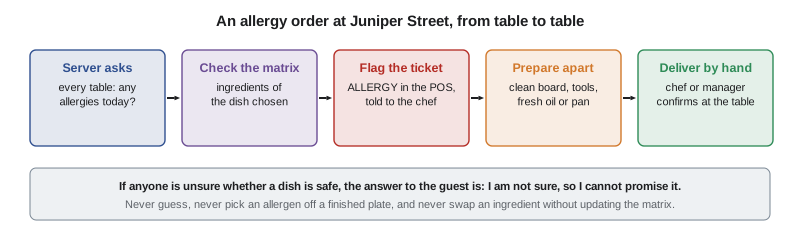
Most allergy incidents in restaurants are not caused by a lack of knowledge but by a broken handoff: the guest told the server, but the server did not tell the kitchen; the ticket was flagged, but a new cook added a garnish; the kitchen made the dish correctly, but a runner took the wrong plate. Juniper's procedure is designed so that each step is checked by the next.
- Ask. Servers ask every table, early, whether anyone has a food allergy. Guests often do not mention allergies unless asked, especially for foods they assume would not contain the allergen.
- Check. The server looks up the dish in the matrix and, if there is any doubt, asks the chef before taking the order. A dish that cannot be made safe is not offered.
- Flag. The order goes into the point-of-sale system with the ALLERGY button and the allergen named, which prints the ticket in red, and the server also tells the chef in person.
- Prepare apart. The cook washes hands and changes gloves, takes a purple board and clean tools from the sealed allergy bin, uses a clean pan or fresh oil, and checks every ingredient, including garnishes and sauces, against the matrix.
- Deliver by hand. The chef or a manager carries the plate to the table separately, names the allergen to the guest and confirms that the dish was made without it.
Two responses are never acceptable. One is guessing: telling a guest that a dish is probably fine. The other is fixing a mistake by removing the allergen from a finished plate, such as picking nuts off a salad or scraping sauce off a steak. The protein is already on the food. A dish made wrongly is thrown out and made again from the beginning.
Preventing cross-contact in the kitchen
Cross-contact is the allergen version of cross-contamination, and the barriers from Lesson 7 apply. Hands and gloves are washed and changed. Boards, knives, pans, tongs and spoons are cleaned with detergent and water before use for an allergy order; sanitizing alone does not remove allergen protein, but washing does. Shared cooking oil, grill surfaces and pasta water are the hardest to control. Flour dust in the air near the pastry corner can settle on nearby food. Squeeze bottles of sauce, bins of grated cheese and garnish trays are common sources, because many hands and spoons go into them during a shift.
Juniper's rules for allergy orders add a few specific steps. The allergy bin holds a purple board, a knife, tongs, a spatula, a small pan and single-use gloves, sealed and restocked after each use. Allergy orders are cooked first in a cleaned area, before other dishes on the same ticket, and covered while they wait. The back-up fryer gets fresh oil at the start of each day and is used only for allergy orders. Nobody makes a promise about shared oil, the grill or the pastry corner that the kitchen cannot keep, and the menu says so.
When a guest has a reaction
Despite every precaution, a guest may have a reaction, sometimes from a food they did not know they were allergic to. Staff need to recognize the signs and act quickly, because in anaphylaxis minutes matter.
- Call 911 at once if the guest has trouble breathing, swelling of the face or throat, or feels faint, or if they say they are having an allergic reaction.
- If the guest has an epinephrine auto-injector, help them use it, or use it for them if they cannot, following the instructions on the device. Epinephrine is the first treatment for anaphylaxis; antihistamines are not a substitute.
- Have the guest lie down with legs raised, or sit up if breathing is easier that way. Do not have them stand or walk.
- A second dose may be given after 5 minutes if symptoms do not improve and a second injector is available. The guest goes to hospital by ambulance even if they feel better, because symptoms can return.
- Keep the dish and the ticket, record what happened, and tell the manager. The food safety plan and the allergen matrix are reviewed afterwards.
HSE-110 covers first aid in more detail. Every shift at Juniper has at least one person on duty with current first aid training, and the allergy reaction steps are posted beside the first aid kit.
A near miss at Juniper
In April a guest at table 14 told Chloe, her server, that she was allergic to tree nuts and ordered the roasted beet salad. The matrix showed no nuts, and Chloe flagged the ticket. Hana, on the cold station, plated the salad and reached for the usual topping, which had recently been changed from toasted sunflower seeds to toasted walnuts when the supplier ran short. The matrix had not been updated. Tomás, checking the ticket at the pass, saw the walnuts, stopped the plate, and had the salad remade with a clean board and bowl. The guest was told what had happened and thanked the kitchen for checking.
Nobody was hurt, but the near miss showed a gap: ingredient substitutions were being made by phone with the supplier and never reached the matrix. Juniper now has a rule that no substitution goes on the line until Tomás has updated the matrix and the cold station's ingredient card, and the supplier's substitution notices are pinned to the receiving clipboard so that whoever receives the delivery sees them.
Summary and key terms
- A food allergy is an immune reaction to a food protein; a trace can cause anaphylaxis, which can kill within minutes, and cooking does not remove allergens.
- Canada's priority allergens are peanuts, tree nuts, sesame, milk, eggs, fish, crustaceans and molluscs, soy, wheat and triticale, and mustard, plus gluten sources and added sulphites.
- Keep an allergen matrix for every dish and ingredient, built from recipes and product labels, and update it before any substitution reaches the line.
- Ask every table, check the matrix, flag the ticket, prepare apart with clean tools and fresh oil, and deliver by hand with confirmation.
- For a reaction, call 911, help the guest use epinephrine, keep them lying down, and send them to hospital even if they improve.
- Food allergy
- A reaction of the immune system to a protein in a food, which can be severe even with tiny amounts.
- Anaphylaxis
- A severe, rapid, potentially fatal allergic reaction affecting breathing, circulation or several body systems.
- Cross-contact
- The transfer of an allergen from one food, surface or utensil to a food that should not contain it.
- Allergen matrix
- A table of every menu item and ingredient and the allergens each contains.
- Epinephrine auto-injector
- A device that delivers a measured dose of epinephrine into the thigh, the first treatment for anaphylaxis.
Talking to guests about allergies
The words staff use matter as much as the procedure. Guests with serious allergies have usually learned to read people: a server who sounds unsure or impatient tells them the kitchen may not take the request seriously. Juniper trains servers to repeat the allergy back to the guest, to name the dishes that are safe rather than reading the whole menu, and to say plainly what the kitchen cannot control, such as shared oil in the main fryers or flour in the air near the pastry corner. A guest who knows the limits can make an informed choice. Staff never describe a dish as allergen-free unless the matrix, the recipe and the preparation all support it, and they never make fun of or question a guest's allergy, even one that sounds unusual. If a guest asks to see ingredient labels for a bought-in product, the manager shows them.
Common mistakes
MistakeIf a guest is allergic to nuts, picking the nuts off a finished salad makes it safe.
InsteadThe allergen protein is already on the food; throw the dish out and make it again with clean tools.
MistakeFries are safe for a guest with a fish allergy because potatoes contain no fish.
InsteadFries cooked in oil shared with battered fish can carry fish protein; use a dedicated fryer with fresh oil or do not offer them.
MistakeWhen unsure, telling the guest the dish is probably fine is helpful.
InsteadNever guess; check with the chef, and if no one is sure, tell the guest the kitchen cannot promise the dish is safe.
Practice problems
Work each problem on paper first, then reveal the answer to check.
Why does sanitizing a cutting board not remove allergens, while washing does?
Show answer
Sanitizer reduces microorganisms but does not remove protein; washing with detergent and water physically removes the allergen residue.
Name three hidden sources of allergens in restaurant food.
Show answer
Any three of: Worcestershire sauce (fish), pesto (tree nuts, milk), Caesar dressing (egg, fish), soy sauce and batter (wheat, soy), curry pastes (peanuts, shellfish), orgeat syrup (almonds).
A supplier delivers a different brand of mayonnaise. What should happen before it is used?
Show answer
Read its label, compare its allergens with the old product, update the allergen matrix and ingredient cards, and tell the cooks and servers of any change.
Lesson quiz · 5 questions
Score 60% or more to complete this lesson.
Create a free account to save your progress, take quizzes and earn a certificate.