
HSE-381 · Lesson 8 of 12 · 19 min
Personal hygiene and illness reporting
▶ Video coming soon A video version of this lesson is on the way.
Every food that leaves Juniper Street's kitchen passes through someone's hands. Most of the time those hands are the last thing that touches the food before a guest eats it. That makes the people in the kitchen both the strongest barrier against foodborne illness and one of its main sources. Norovirus, hepatitis A, Shigella and some strains of E. coli and Salmonella are spread mostly by infected people, often through tiny amounts of feces on hands that looked clean. One sick cook working a busy Saturday can make dozens of people ill.
This lesson covers the habits that keep food workers from contaminating food: handwashing, hand care and gloves, clothing and hair, and eating and drinking at work. It then covers the hardest part of personal hygiene for many kitchens: telling a manager when you are sick and staying away from food until it is safe to come back.
Why people are a source of foodborne illness
Bacteria and viruses live on and in the human body. Staphylococcus aureus is carried in the nose and on the skin of a large share of healthy people and in infected cuts and burns; if it gets into food that is then held warm, it makes a toxin that cooking does not destroy. Norovirus is shed in enormous numbers in the vomit and stool of an infected person, and only a few virus particles are needed to make someone else sick. People can shed norovirus for days after they feel better, and some people who carry hepatitis A or Salmonella have no symptoms at all.
That is why food safety rules focus on two things at once. Routine hygiene, done by everyone all the time, reduces the germs that healthy workers carry. Illness rules keep people who are likely to be shedding large numbers of germs away from food. BC's Food Premises Regulation requires food handlers to be free of communicable diseases that can be spread through food, to wash their hands as often as needed, and to wear clean outer garments; the operator is responsible for making sure that happens.
Handwashing
Handwashing is the single most important habit in a kitchen. Done properly, it removes most of the bacteria and viruses picked up from raw food, surfaces and the body. Done badly, it gives a false sense of safety. The steps are simple, but each one matters.
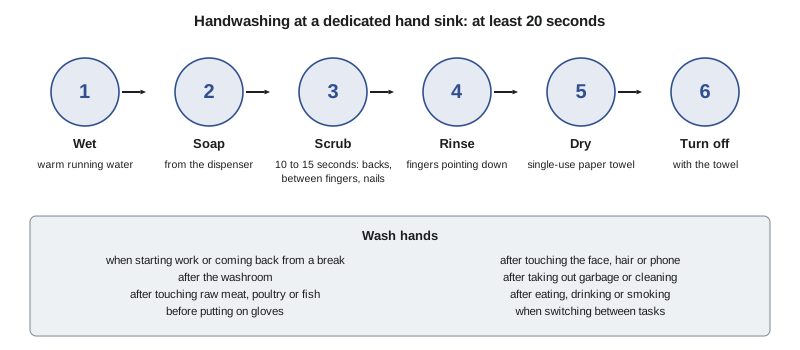
- Wet hands and forearms with warm running water.
- Apply soap from a dispenser and work up a lather.
- Scrub for at least 10 to 15 seconds: palms, backs of hands, between the fingers, around the thumbs, the fingertips and under the nails. The whole wash should take at least 20 seconds.
- Rinse thoroughly under running water with the fingers pointing down, so the water carries the soap and germs off the hands.
- Dry with a single-use paper towel or an air dryer. Shared cloth towels are not allowed.
- Turn off the tap with the paper towel so clean hands do not touch the handle that dirty hands turned on.
Where to wash
Hands are washed only at a dedicated hand sink, never in a food prep sink, a dish sink or a mop sink. BC's regulation requires hand basins that are conveniently located, supplied with hot and cold running water, soap in a dispenser and single-use towels or a dryer. A hand sink blocked by a bus tub, a rack of glasses or a stack of boxes is an infraction, as Juniper found in its spring inspection.
Juniper has four hand sinks: at the raw station, on the line, in the dish pit and behind the bar. Each one is stocked at opening and checked at every shift change. The rule that people find hardest is that nothing else goes in a hand sink: no rinsing ladles, no dumping ice, no filling buckets. Once a hand sink is used for something else, people stop thinking of it as the place to wash hands.
When to wash
The poster above each sink lists the moments when hands must be washed. They come down to one principle: wash hands whenever they may have picked up something that should not reach food, and always before starting work with ready-to-eat food. In practice a line cook at Juniper washes hands dozens of times a shift. The busiest moments, such as switching from handling raw patties to plating, are exactly when people are tempted to skip it.
Hand sanitizer
Alcohol-based hand sanitizer is not a substitute for handwashing in a kitchen. It does not remove grease, food residue or dirt, and it works poorly against norovirus. It may be used after a proper wash, but never instead of one.
Checking that it happens
Most managers believe their staff wash their hands well. Observation usually shows otherwise. Juniper's safety committee runs a short observation audit every month: during a busy lunch, Aisha or Kofi watches the kitchen for an hour and records each moment when hands should have been washed and whether they were. The program below summarizes one audit. It is not about catching people; the results are shared with the whole team and used to fix the obstacles, such as a hand sink in an awkward place or towels running out.
# Summarize a handwashing observation audit (one busy lunch hour).
observed = [
    # (worker, moment, washed?, at least 20 seconds?)
    ("Ben",  "after raw patties, before plating", True,  True),
    ("Ben",  "after raw patties, before plating", False, False),
    ("Hana", "after touching phone",              True,  False),
    ("Hana", "returning from break",              True,  True),
    ("Luis", "after raw chicken, before greens",  True,  True),
    ("Luis", "after taking out garbage",          True,  True),
    ("Noah", "before putting on gloves",          False, False),
    ("Noah", "after raw patties, before plating", True,  True),
    ("Maya", "returning from break",              True,  True),
    ("Kofi", "after dirty dishes, before clean",  True,  False),
]

total = len(observed)
washed = sum(1 for o in observed if o[2])
good = sum(1 for o in observed if o[2] and o[3])
print(f"Moments observed: {total}")
print(f"Hands washed: {washed} ({100 * washed // total}%)")
print(f"Washed well (20 s or more): {good} ({100 * good // total}%)")
missed = {}
for worker, moment, w, ok in observed:
    if not (w and ok):
        missed[moment] = missed.get(moment, 0) + 1
print("Moments to work on:")
for moment, n in sorted(missed.items(), key=lambda kv: -kv[1]):
print(f" {n} x {moment}")Moments observed: 10 Hands washed: 8 (80%) Washed well (20 s or more): 6 (60%) Moments to work on: 1 x after raw patties, before plating 1 x after touching phone 1 x before putting on gloves 1 x after dirty dishes, before clean
Hands were washed at eight of the ten moments, but only six of the washes were long enough. The committee found that the hand sink on the line is beside the fryers, so cooks rushed to get away from the heat. A second hand sink near the pass was added to the summer repair list, and in the meantime the paper towel dispenser was moved so cooks could dry their hands while stepping back from the fryers.
Hand care, gloves and jewellery
Clean hands start with short, clean fingernails without polish or artificial nails, which can chip into food and hold dirt underneath. Cuts, burns and sores on the hands are a special risk because they are often infected with Staphylococcus aureus. A food worker with a wound on the hand or wrist covers it with a clean, waterproof bandage and then wears a single-use glove over it. A wound that is infected, oozing or cannot be covered well means the worker is moved away from food until it heals.
Rings other than a plain band, bracelets and wristwatches are removed before handling food, because they trap germs and food and can fall into dishes. Juniper's rule is the same for both kitchens and bar: no jewellery on hands or wrists except a plain wedding band.
Gloves were covered in Lesson 7. The short version is that gloves are changed as often as hands would be washed, and that hands are washed before putting on a new pair. Gloves can make people careless: a cook wearing gloves may touch raw meat, a phone and a salad without thinking, because the gloves feel like protection.
Clothing, hair and personal habits
Clean outer clothing, changed when it gets dirty, keeps dirt and germs from street clothes and from raw-meat work away from food. Aprons are taken off before going to the washroom or taking out the garbage. Hair is held back with a hat, hairnet or band, and beards are covered with a beard net where the local authority or the house rules require it, because hair falls into food and people touch their hair without noticing.
Eating, drinking, smoking, vaping and chewing gum or tobacco are done only in designated areas away from food and clean equipment. A worker may keep a drink in a covered cup with a lid and a straw at the station, as long as it is placed where it cannot spill onto food or clean dishes. Coughing or sneezing is done into a tissue or the elbow, followed by handwashing.
Reporting illness
Hygiene rules cannot make a sick worker safe. A person with norovirus who vomited before the shift may be shedding billions of virus particles, and no amount of handwashing will bring that down far enough. The only safe answer is to keep the person away from food, and that depends on the person telling a manager.
BC's Food Premises Regulation bars anyone with a disease that can be spread through food from working with food, and the operator must not allow them to. Public health guidance in Canada, including advice from BC and other provinces, asks food handlers to stay off work until at least 48 hours after vomiting or diarrhea have stopped, because people remain infectious after they feel better. A worker diagnosed with an illness such as hepatitis A, typhoid fever, Shigella, E. coli O157 or norovirus is excluded until the health authority says it is safe to return. Health authorities may require testing before a worker returns, and Island Health will investigate if several guests report illness after eating at the same place.
| What the worker has | What Juniper does | When they can return to food work |
|---|---|---|
| Vomiting or diarrhea | Sends the worker home | 48 hours after symptoms stop |
| Jaundice (yellow skin or eyes) | Sends the worker home and calls Island Health | When Island Health clears the worker |
| Diagnosed with norovirus, hepatitis A, Shigella, E. coli O157 or Salmonella | Sends the worker home and follows Island Health advice | When Island Health clears the worker |
| Sore throat with fever | Keeps the worker away from food | When the fever is gone or a doctor clears the worker |
| Infected cut or boil on the hand | Moves the worker away from food unless it can be covered and gloved | When it is healed or properly covered |
Exclusion means the worker may not work in the restaurant at all. Juniper does not distinguish between full exclusion and a restriction to non-food work for vomiting or diarrhea: someone who is vomiting or has diarrhea goes home, because they will also contaminate washrooms, door handles and the staff area.
# A decision aid for illness reports at Juniper (BC public health guidance).
from datetime import datetime, timedelta

def decide(symptom, last_symptom=None):
    if symptom in ("vomiting", "diarrhea"):
        back = last_symptom + timedelta(hours=48)
        return "send home", f"may return {back:%a %d %b %H:%M} if well"
    if symptom in ("jaundice", "diagnosed"):
        return "send home, call Island Health", "return only when cleared"
    if symptom == "sore throat with fever":
        return "no food handling", "return to food when fever is gone"
    if symptom == "infected cut":
        return "no food handling unless covered and gloved", "until healed"
    return "no action needed", "-"

reports = [
    ("Noah", "vomiting", datetime(2026, 6, 6, 3, 30)),
    ("Hana", "sore throat with fever", None),
    ("Rafael", "infected cut", None),
    ("Chloe", "diagnosed", None),
]
for name, symptom, last in reports:
    action, ret = decide(symptom, last)
print(f"{name:7s} {symptom:24s} -> {action}; {ret}")Noah vomiting -> send home; may return Mon 08 Jun 03:30 if well Hana sore throat with fever -> no food handling; return to food when fever is gone Rafael infected cut -> no food handling unless covered and gloved; until healed Chloe diagnosed -> send home, call Island Health; return only when cleared
Making reporting work
Rules on paper do nothing if workers come in sick anyway. People come to work ill because they cannot afford to lose the shift, because they are afraid of letting the team down on a busy night, or because they think their symptoms are nothing serious. Restaurants that want honest reporting make it easy and safe to report. Juniper's approach has four parts.
- Every new worker signs the illness reporting policy at orientation and is told in person that calling in sick with vomiting or diarrhea is expected, not punished.
- The manager on duty asks the question at the start of every shift: any vomiting, diarrhea, fever with sore throat, or yellow skin or eyes since your last shift?
- Elena, the owner, pays shifts lost to a reportable illness, and the BC Employment Standards Act also gives employees paid and unpaid sick days each year.
- Managers arrange cover through a group chat rather than pressuring the sick worker to find a replacement.
When Noah called at 6 a.m. on a Saturday in June to say he had been vomiting overnight, Daniel thanked him, told him to rest, and asked him to call again on Monday. He checked with the rest of the line whether anyone else felt ill, had the staff washroom cleaned and disinfected using the vomit cleanup procedure from Lesson 9, and noted the call in the illness log. No guests became ill. That is what a working reporting system looks like: unremarkable.
Summary and key terms
- Food workers can carry and spread norovirus, hepatitis A, Shigella, Salmonella, E. coli and Staphylococcus aureus even when they feel well.
- Wash hands at a dedicated hand sink for at least 20 seconds, including 10 to 15 seconds of scrubbing, at every moment when hands could contaminate food.
- Keep nails short, cover hand wounds with a waterproof bandage and a glove, remove jewellery, wear clean clothing and restrain hair.
- Workers with vomiting or diarrhea stay away until 48 hours after symptoms stop; those with jaundice or a diagnosed foodborne illness return only when the health authority clears them.
- Reporting works only when workers trust that they will not be punished or lose pay for telling a manager they are sick.
- Hand sink
- A sink used only for washing hands, stocked with soap, single-use towels or a dryer and warm running water.
- Exclusion
- Keeping a sick worker out of the food business entirely until it is safe for them to return.
- Restriction
- Keeping a worker away from exposed food and clean equipment while allowing other duties.
- Big 6
- Norovirus, hepatitis A virus, Shigella, Shiga toxin-producing E. coli, Salmonella Typhi and nontyphoidal Salmonella, the pathogens most easily spread by food workers.
- Jaundice
- Yellowing of the skin or eyes, a possible sign of hepatitis A infection.
Common mistakes
MistakeHand sanitizer gel is a quick substitute for washing between tasks.
InsteadSanitizer does not remove grease or food and works poorly on norovirus; wash at the hand sink, and use sanitizer only afterwards if at all.
MistakeA cook who stopped vomiting this morning and feels fine can work the dinner shift.
InsteadPeople stay infectious after symptoms stop; the worker stays home for the full waiting period.
MistakeRinsing a ladle in the hand sink is harmless when the dish pit is busy.
InsteadA hand sink is only for hands; using it for anything else blocks it and makes people stop treating it as the place to wash.
Practice problems
Work each problem on paper first, then reveal the answer to check.
A server has a small cut on her finger and is scheduled to cut fruit for the bar. What should happen?
Show answer
She covers the cut with a clean waterproof bandage and wears a single-use glove over it; if the cut is infected or cannot be covered, she does other work until it heals.
Why must the paper towel be used to turn off the tap?
Show answer
The tap was turned on with dirty hands; touching it again with clean hands would put germs back on them.
A line cook says his roommate has been diagnosed with norovirus but he feels fine. What should the manager do?
Show answer
Take it seriously: watch for symptoms, keep his handwashing strict and ask Island Health for advice, since he may be infected before symptoms start.
Lesson quiz · 5 questions
Score 60% or more to complete this lesson.
Create a free account to save your progress, take quizzes and earn a certificate.