
HSE-381 · Lesson 9 of 12 · 16 min
Cleaning, sanitizing and pest control
▶ Video coming soon A video version of this lesson is on the way.
A kitchen can look spotless and still be unsafe. Germs are too small to see, and a film of grease or dried food protects them from sanitizer. A kitchen can also look tired, with old equipment and scuffed floors, and be very safe because everything that touches food is properly cleaned and sanitized every day. This lesson explains the difference between cleaning and sanitizing, how Juniper Street washes dishes by machine and by hand, how it plans its cleaning, how it deals with the messiest job in any restaurant, cleaning up after someone vomits, and how it keeps pests out.
Cleaning and sanitizing are two different steps
Cleaning removes visible dirt, food residue and grease from a surface, using detergent, water and scrubbing. Sanitizing reduces the number of microorganisms on a clean surface to a safe level, using heat or an approved chemical. The order matters: sanitizer cannot work through a layer of food or grease, so a surface must be cleaned and rinsed before it is sanitized. Disinfecting is a third, stronger step used on non-food surfaces such as washrooms, or for special situations such as a norovirus cleanup.
Every food-contact surface at Juniper goes through the same five steps: scrape or pre-rinse, wash with detergent, rinse with clean water, sanitize, and air-dry. Air-drying is a step in its own right. Drying with a towel puts germs back onto the surface and wipes off the sanitizer before it has finished working.
How sanitizers work
Restaurants use two kinds of sanitizing: heat and chemicals. Heat sanitizing in a high-temperature dish machine relies on a final rinse hot enough to kill germs; Juniper's machine reaches 82 °C at the rinse. Chemical sanitizers kill germs in a solution of the right strength, at the right temperature, left on the surface for the right contact time. The common ones are chlorine, made from household-type bleach; quaternary ammonium compounds, called quats; and iodine. BC health authorities commonly recommend 100 ppm chlorine or 200 ppm quat for food-contact surfaces, but the product label is the final word on strength and contact time.
Too weak a solution does not kill enough germs. Too strong a solution can leave a chemical residue on food-contact surfaces and harm the people using it. That is why the strength is checked with the test strip made for that product every time the solution is made up, and during the shift as Lesson 7 showed.
Washing dishes
Juniper washes most dishes, glasses, pans and utensils in its door-type high-temperature dish machine. The dishwasher on shift checks the wash and rinse temperatures on the machine's gauges at the start of each shift and every few hours, and runs a temperature-sensitive test strip or a maximum-registering thermometer through a cycle once a day to confirm that the dishes themselves reach a sanitizing temperature, not just the water. If the rinse is not hot enough, the dishes are washed in the three-compartment sink until the booster heater is fixed.
Large pots, the slicer parts, cutting boards that are too big for the racks, and anything that cannot go in the machine are washed by hand in the three-compartment sink.
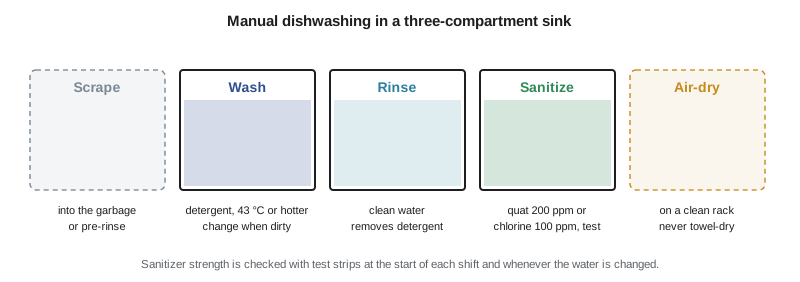
The sink is set up the same way every time. The first compartment holds detergent solution at 43 °C or hotter, hot enough to dissolve grease; the second holds clean rinse water; the third holds sanitizer at the tested strength. Items are scrubbed in the first sink, rinsed in the second, and fully immersed in the third for the contact time on the label, which is often 30 seconds for chlorine and about a minute for quat. They are then placed upside down on a clean rack to air-dry. The water in each compartment is changed when it becomes dirty, greasy or cool, or when the strip shows the sanitizer has dropped.
The program below checks one afternoon's three-compartment sink log against those limits and says what to do about each problem. A log that is filled in but never read is just paperwork; a short script, or a manager reading carefully, turns it into decisions.
# Check a three-compartment sink log against Juniper's limits (BC).
WASH_MIN_C = 43          # detergent water, degrees C
QUAT_RANGE = (200, 400)  # ppm, from the label
CONTACT_MIN_S = 60       # seconds, from the label

log = [
    # (time, wash temp C, quat ppm, contact seconds observed)
    ("14:00", 47, 200, 60),
    ("15:30", 39, 200, 60),
    ("16:45", 45, 100, 60),
    ("18:10", 46, 200, 20),
]

for time, wash, ppm, contact in log:
    fix = []
    if wash < WASH_MIN_C:
        fix.append(f"wash water {wash} C: drain and refill hot")
    if not QUAT_RANGE[0] <= ppm <= QUAT_RANGE[1]:
        fix.append(f"sanitizer {ppm} ppm: remake and retest")
    if contact < CONTACT_MIN_S:
        fix.append(f"only {contact} s in sanitizer: re-sanitize the load")
print(time, "OK" if not fix else "; ".join(fix))14:00 OK 15:30 wash water 39 C: drain and refill hot 16:45 sanitizer 100 ppm: remake and retest 18:10 only 20 s in sanitizer: re-sanitize the load
The last entry is the one that most often goes wrong in a rush: a dishwasher dips a pan in the sanitizer and pulls it straight out. A pan that has not stayed in the sanitizer for the contact time has been rinsed, not sanitized. Juniper put a small kitchen timer on the shelf above the third compartment for exactly this reason.
A cleaning schedule
Some cleaning happens constantly, some daily, some weekly and some only a few times a year. Without a written schedule the infrequent jobs are forgotten until the inspector finds grease behind the fryers. BC's Food Premises Regulation requires every food premises to have a written sanitation plan, which covers cleaning and sanitizing procedures and schedules, pest control and staff training, and the operator must follow it.
| How often | What gets cleaned at Juniper | Who |
|---|---|---|
| Between tasks and every 4 hours in use | Cutting boards, knives, prep tables, slicer, thermometer probes | Whoever is using them |
| Every shift | Line surfaces, reach-ins (outside and handles), floors, hand sinks, dish machine screens | Line cooks and dishwashers |
| Daily | Fryer exteriors, griddle, charbroiler, floor drains, garbage area, staff washroom | Closing crew |
| Weekly | Walk-in shelves and floor, ice machine exterior, under and behind light equipment | Prep crew, checked by Aisha |
| Monthly | Behind and under heavy equipment, walls, dry storage, basement storage room | Closing crew with Tomás |
| On the maker's schedule | Ice machine interior, dish machine descaling, hood filters (see HSE-382) | Contractor or trained staff |
Cleaning chemicals are hazardous products in their own right. HSE-380 covered WHMIS and hazard communication for the people using them. For food safety the rule is simple: chemicals are stored below and away from food, food equipment and single-use items, in their labelled containers, and never in food containers. Spray bottles of sanitizer and degreaser are labelled with their contents, and nobody mixes chemicals, especially bleach with acids or ammonia-based products.
Cleaning up vomit and diarrhea
When a guest or worker vomits in a restaurant, norovirus can spread through tiny droplets up to several metres away, settle on tables, chairs and floors, and survive for days on surfaces. Ordinary sanitizer at food-contact strength does not reliably kill it. A clear procedure and a ready-made kit stop one sick guest from causing an outbreak.
Juniper's procedure is based on guidance from BC public health authorities, which recommend a much stronger chlorine solution for this job, around 1,000 to 5,000 ppm, than for routine sanitizing.
- Move guests and staff away from the area, at least 8 m (25 ft) from the spot if possible, and close off the section. Stop food service in that area.
- The person cleaning puts on disposable gloves, a disposable gown or apron, a face mask and eye protection from the kit.
- Cover the vomit with absorbent powder or paper towels, then scoop it up with a disposable scraper into a plastic bag.
- Clean the area with detergent and water, then apply the strong chlorine solution, or a product registered for norovirus, for the full contact time on the label. Carpet or upholstery may need steam cleaning.
- Throw out all exposed food, including food on nearby tables, open garnishes and anything on the line if the event happened in the kitchen.
- Bag the waste and the protective equipment, take it out to the dumpster, wash hands thoroughly and record the event.
Juniper keeps its kit in a labelled bucket in the back corridor: a premeasured bleach concentrate with instructions, absorbent powder, scrapers, bags, gloves, gowns, masks and goggles. Kofi checks it monthly, and the kit is restocked after every use.
Pest control
Rats, mice, cockroaches and flies carry Salmonella, E. coli and other pathogens on their bodies and in their droppings. A sighting of a live rodent in the kitchen is a critical problem in any inspection, and an infestation can close a restaurant. Pests come for three things: food, water and shelter. Integrated pest management, the approach that health authorities and pest control companies recommend, takes those away and uses chemicals only as a last resort, applied by licensed professionals.
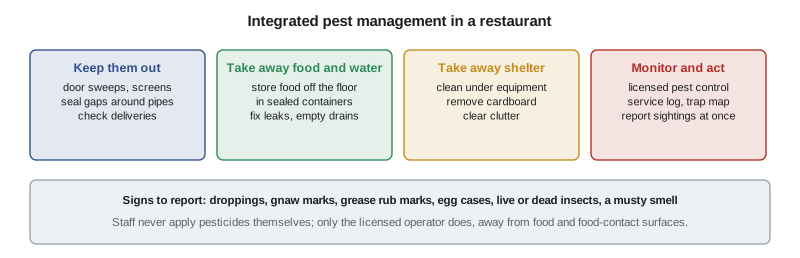
- Keep them out. The back door closes on its own and has a sweep; the screen on the delivery door stays shut; gaps around pipes and wires are sealed with metal mesh and sealant; and deliveries are checked for droppings, gnawed boxes and insects before they come in.
- Take away food and water. Food is stored at least 15 cm (6 in) off the floor in sealed containers; spills are cleaned up immediately; floor drains are kept clear; dripping taps and condensate leaks are fixed.
- Take away shelter. Cardboard is broken down and taken out daily, because cockroaches live and breed in its corrugations; equipment is pulled out and cleaned behind on the monthly schedule; the basement storage room is kept free of clutter.
- Monitor and act. A licensed pest control company visits monthly, checks the bait stations outside and the traps inside, and leaves a service report. Staff report every sighting the same day.
Juniper's staff never use bug sprays or rodent poison themselves. Pesticides used in a food premises must be the right products, applied by a licensed applicator in the right places, with food and equipment protected. A cook who sprays insecticide on the line to deal with a few cockroaches may contaminate food and drive the insects deeper into the walls.
Reading the pest log
The pest control company's reports are only useful if someone reads them for trends. The program below uses an invented year of trap counts for the four monitoring stations inside Juniper and flags any station where the count is rising.
# Flag pest monitoring stations with rising counts (invented data).
counts = {
    # station: insects caught per monthly visit, Jan..Jun
    "dish pit, under machine":   [2, 1, 3, 2, 5, 9],
    "dry storage, back wall":    [0, 0, 1, 0, 0, 1],
    "bar, under ice machine":    [1, 2, 1, 1, 2, 1],
    "basement, near drain":      [3, 4, 6, 7, 10, 14],
}

for station, c in counts.items():
    recent = sum(c[-3:]) / 3
    earlier = sum(c[:3]) / 3
    trend = "RISING" if recent > 1.5 * max(earlier, 1) else "steady"
print(f"{station:27s} last 3 visits avg {recent:4.1f} {trend}")dish pit, under machine last 3 visits avg 5.3 RISING dry storage, back wall last 3 visits avg 0.3 steady bar, under ice machine last 3 visits avg 1.3 steady basement, near drain last 3 visits avg 10.3 RISING
Two stations are rising. At the dish pit the cause turned out to be a leaking drain line under the dish machine, giving cockroaches water and warmth; the plumber fixed it and the pest company treated the void behind the wall. In the basement the floor drain had dried out, letting insects come up from the sewer; it now gets a jug of water every week, and a drain cover was fitted.
Summary and key terms
- Cleaning removes dirt and food; sanitizing reduces germs on a clean surface to a safe level; both are needed, in that order, followed by air-drying.
- Use heat or a chemical sanitizer at the tested strength and label contact time, such as 100 ppm chlorine or 200 ppm quat.
- Wash by hand in a three-compartment sink: wash, rinse, sanitize and air-dry, changing the water when it is dirty or cool.
- Have a written cleaning schedule and a vomit and diarrhea cleanup procedure with a ready kit and a much stronger disinfectant.
- Control pests by blocking entry and removing food, water and shelter, with a licensed company handling monitoring and any pesticides.
- Sanitizing
- Reducing the number of microorganisms on a clean surface to a safe level using heat or an approved chemical.
- Contact time
- The length of time a surface must stay in contact with a sanitizer or disinfectant for it to work.
- Three-compartment sink
- A sink with separate compartments for washing, rinsing and sanitizing items by hand.
- Integrated pest management
- Controlling pests by excluding them, removing food, water and shelter, and monitoring, with chemicals used only as needed by professionals.
- Sanitation plan
- A written plan setting out what is cleaned and sanitized, how, how often and by whom, along with pest control.
Common mistakes
MistakeSpraying sanitizer on a greasy board is enough to make it safe.
InsteadSanitizer cannot work through grease and food residue; wash and rinse first, then sanitize.
MistakeTowel-drying clean dishes makes them ready faster and is more hygienic.
InsteadTowels put germs back on clean surfaces; let items air-dry on a clean rack.
MistakeA few cockroaches can be dealt with using a can of bug spray from the store.
InsteadReport the sighting so the licensed pest company can find the source; staff do not apply pesticides in a food premises.
Practice problems
Work each problem on paper first, then reveal the answer to check.
The sanitizer compartment of the sink tests below the label strength in the middle of the lunch rush. What should the dishwasher do?
Show answer
Drain and remake the sanitizer, retest it, and re-sanitize any items that went through the weak solution before they are used.
Why is a stronger chlorine solution used to clean up vomit than to sanitize a cutting board?
Show answer
Norovirus is hard to kill and is spread in large numbers in vomit; routine sanitizing strength does not reliably inactivate it.
Give three ways to take shelter away from cockroaches in a restaurant.
Show answer
Any three of: break down and remove cardboard daily, clean under and behind equipment, seal cracks and gaps, clear clutter in storage rooms, fix leaks that create damp hiding places.
Lesson quiz · 5 questions
Score 60% or more to complete this lesson.
Create a free account to save your progress, take quizzes and earn a certificate.