
HSE-392 · Lesson 1 of 12 · 23 min
Bloodborne pathogens and how they spread
▶ Video coming soon A video version of this lesson is on the way.
Every day in a busy hospital, hundreds of needles, scalpels, lancets and other sharp devices pass through the hands of nurses, doctors, lab staff, porters, environmental services workers and laundry staff. Almost every one of them is used and thrown away safely. But a small number end up in a thumb, a palm or a forearm, and a few of those carry blood from a patient who has a virus that can be passed on that way. This course is about preventing those injuries, and about knowing exactly what to do if one happens anyway.
HSE-390 Healthcare Workplace Safety Essentials introduced Northbridge Community Hospital, its long-term care wing Maple Court and the Northbridge Home Care team. In HSE-390, sharps and splashes accounted for 28 of the 241 injury reports at Northbridge last year and 19 of the 72 claims, more claims per report than any other cause. That is because almost every sharps injury needs a visit to Occupational Health and Safety and a series of blood tests, even when nobody is hurt badly. This course follows the same people through the whole subject, from what the viruses are, to the law, to the devices and habits that prevent injuries, to the first minutes and the following months after an exposure.
What a bloodborne pathogen is
A pathogen is a germ that can cause disease. A bloodborne pathogen is one that is carried in a person's blood and can be passed to someone else when that blood, or certain other body fluids, gets into their bloodstream or onto a mucous membrane such as the eye, nose or mouth. Many germs can travel in blood, but three matter most to healthcare workers because they are common, they cause serious long-term disease and they are known to have been passed on through workplace injuries.
| Virus | What it does | Prevention for workers | After an exposure |
|---|---|---|---|
| Hepatitis B virus (HBV) | Infects the liver. Most adults clear it, but some develop chronic infection that can lead to cirrhosis and liver cancer. | A safe, highly effective vaccine | Protected if vaccinated and immune; otherwise vaccine and hepatitis B immune globulin |
| Hepatitis C virus (HCV) | Infects the liver. Most people who are infected develop chronic infection, often with no symptoms for years. | No vaccine; prevention depends on avoiding exposure | No preventive treatment; testing finds infection early, and modern antiviral drugs cure most people |
| Human immunodeficiency virus (HIV) | Attacks the immune system. Without treatment it leads to AIDS; with treatment people live long, healthy lives. | No vaccine; prevention depends on avoiding exposure | Post-exposure prophylaxis, a 28-day course of drugs started as soon as possible |
Other germs can spread through blood too, including the agents of syphilis, malaria and some viral hemorrhagic fevers, and hepatitis D, which only infects people who already have hepatitis B. They are rare causes of workplace infection in North American hospitals, and the precautions that protect against the big three protect against them as well.
Which body fluids carry the risk
Blood is the main concern, but it is not the only fluid that can carry these viruses. Some fluids are treated as infectious because the viruses are found in them in useful amounts. Others are not considered a risk for bloodborne viruses unless they contain visible blood.
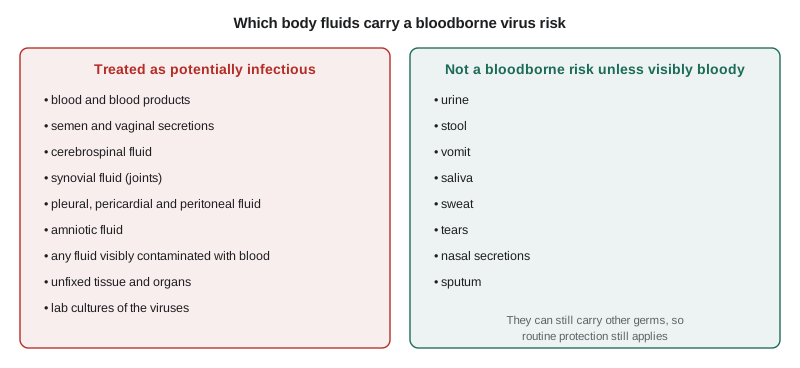
Saliva is a special case. In dentistry, saliva is treated as potentially infectious because dental work so often mixes it with blood. And just because a fluid such as urine or vomit is not a bloodborne risk does not make it safe: it can carry norovirus, C. difficile and many other germs, which is why routine practices apply to every body fluid.
How these viruses reach workers
For a bloodborne virus to infect a worker, infected fluid has to get past the skin. Intact skin is an excellent barrier. There are three main ways the virus gets through:
- Percutaneous exposure: the skin is pierced or cut by a contaminated object, usually a needle, a scalpel, a lancet, a suture needle or broken glass. This is the most dangerous route.
- Mucous membrane exposure: blood or another infectious fluid splashes into the eye, nose or mouth.
- Non-intact skin exposure: the fluid touches skin that is cracked, chapped, cut, scratched or affected by dermatitis.
Bites that break the skin can also transmit hepatitis B and, very rarely, other bloodborne viruses, and they come up in long-term care, mental health units and emergency departments. They are handled as exposures in the same way.
How likely is infection?
Most needlesticks do not transmit anything, because most patients do not have one of these viruses, and even when the patient does, most injuries do not pass it on. The risk of infection after a needlestick from a patient who is known to be infected has been measured in studies of thousands of healthcare workers.
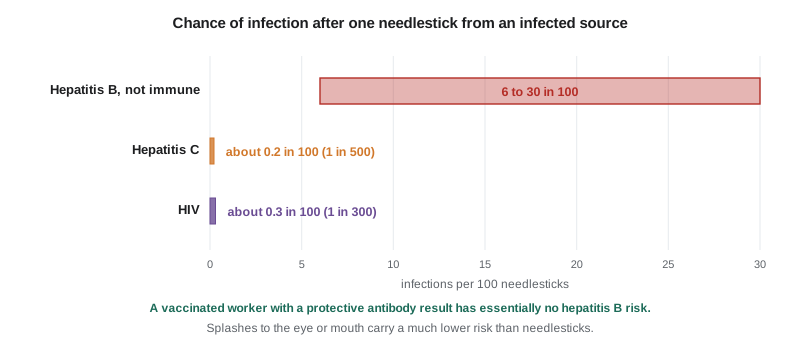
- Hepatitis B: for a worker who is not immune, the risk is between about 6 and 30 in 100, depending mainly on how much virus is in the patient's blood. For a vaccinated worker who has developed immunity, the risk is close to zero. This is why vaccination, covered in Lesson 8, matters so much.
- Hepatitis C: about 0.2 in 100, or roughly 1 in 500, after a needlestick. Splashes to the eyes or mouth have rarely if ever been shown to transmit it.
- HIV: about 0.3 in 100, or roughly 1 in 300, after a needlestick, and about 0.09 in 100 after a splash to a mucous membrane. Risk is lower still if the patient is on treatment and has an undetectable viral load.
These are averages. Some injuries carry a much higher risk than others. The factors that raise the risk are the ones that put more of the patient's blood into the worker:
- A hollow-bore needle, which carries blood inside it, rather than a solid suture needle, which carries only what is on its surface.
- A deep injury rather than a scratch.
- Visible blood on the device.
- A needle that had been in the patient's vein or artery, such as one used to draw blood or start an IV.
- A source patient with a high viral load, such as someone with untreated or advanced infection.
- No glove: a glove wipes off some blood as the needle passes through it.
Daniel, the medical laboratory technologist who covers early-morning blood collection on 4 West, puts it simply when he teaches new staff: a blood collection needle that has just come out of a vein is the most dangerous thing on the unit. It is hollow, it is full of blood and it is sharp at both ends. That is why the device he uses is one where the safety shield goes over the needle with one thumb before it is even out of the patient's arm.
How common are sharps injuries?
The CDC has estimated that about 385,000 sharps injuries happen to healthcare workers in American hospitals each year, and studies in Canada and elsewhere show similar rates. Surveys also show that perhaps half of all sharps injuries are never reported, which means the real number is higher, and it means the people who skip reporting are missing the follow-up that could protect them.
The number of workers actually infected at work has fallen sharply. Hepatitis B infections among American healthcare workers dropped by more than 95 in 100 after the vaccine was recommended for them in the 1980s. Documented cases of HIV passed on at work have been very rare in North America since the late 1990s, helped by safer devices, prompt post-exposure treatment and the fact that most patients with HIV are now on treatment. Hepatitis C remains the most common of the three to be passed on at work, because there is no vaccine and no preventive treatment.
Joanne Pelletier, who runs the Occupational Health and Safety office at Northbridge, keeps a record of every reported sharps injury and splash. She uses it to estimate how many infections the hospital would expect if nobody were vaccinated or treated, which is a useful way to show the committee what the controls are actually achieving.
# Northbridge sharps and splash exposures last year, with the share of
# source patients estimated to carry each virus in a hospital population.
exposures = {"needlestick, hollow-bore": 17, "other sharp": 4, "splash to eye or mouth": 7}

# Chance per exposure that the source patient is infected (rough local estimate)
prevalence = {"HBV": 0.006, "HCV": 0.015, "HIV": 0.003}

# Chance of infection per exposure to an infected source
per_needle = {"HBV": 0.18, "HCV": 0.002, "HIV": 0.003}   # HBV midpoint, worker not immune
per_splash = {"HBV": 0.05, "HCV": 0.0, "HIV": 0.0009}

expected = {v: 0.0 for v in prevalence}
for kind, n in exposures.items():
    rates = per_splash if "splash" in kind else per_needle
    for v in prevalence:
        expected[v] += n * prevalence[v] * rates[v]

print("expected infections per year with no vaccine and no treatment:")
for v, x in expected.items():
    print(f"  {v}: {x:.5f}  (about 1 every {1 / x:,.0f} years)")

# Now assume 95 in 100 workers are vaccinated and immune to hepatitis B
immune = 0.95
print(f"\nHBV with {immune:.0%} of workers immune: {expected['HBV'] * (1 - immune):.5f} per year")expected infections per year with no vaccine and no treatment: HBV: 0.02478 (about 1 every 40 years) HCV: 0.00063 (about 1 every 1,587 years) HIV: 0.00021 (about 1 every 4,810 years) HBV with 95% of workers immune: 0.00124 per year
For a single hospital, the expected number of infections in any one year is small, which is exactly why it is easy to become complacent. Across all the hospitals in a province or a state, and across a working life of 30 or 40 years, the numbers add up, and each infection is a person who now lives with a chronic disease, or a family that worried for months while the tests came back. The code also shows how much vaccination does: with 95 in 100 workers immune, the expected number of hepatitis B infections falls by a factor of 20.
Why prevention beats treatment
Post-exposure treatment and testing are good and getting better, but they are not a substitute for preventing the injury. A worker who has a needlestick from a patient with HIV will usually take a 28-day course of drugs that can cause nausea, tiredness and other side effects. They will have blood tests for months. They may be advised to use condoms and avoid blood donation until the tests are clear. Many describe the waiting as one of the most stressful experiences of their working lives, even when the final result is negative. And there is no preventive treatment at all for hepatitis C.
That is why the rest of this course is organized around the hierarchy of controls from HSE-390: get rid of needles where you can, use devices that shield the sharp, follow work practices that keep hands away from it, and use personal protective equipment for splashes. The response to an exposure comes last because it is the backstop, not the plan.
Worked problem
Daniel's morning on 4 West
At 0610, Daniel draws blood from a patient in room 409 who is restless and pulls her arm away as the needle comes out. Daniel's safety device shields the needle as designed, but in the scramble the tip of the shielded device brushes his gloved wrist. There is no puncture and no blood on his skin. Is this an exposure, and what should he do?
Show solution
- Daniel steps back, makes sure the patient is safe and that the shield is fully locked, and drops the device into the sharps container on his tray.
- He removes his gloves and checks his wrist and the glove carefully in good light. The skin is intact, with no puncture, scratch or blood.
- Without a break in the skin or contact with a mucous membrane or non-intact skin, there is no bloodborne exposure. He cleans his hands and puts on new gloves.
- Because the patient pulled away and the device came close to his skin, he still reports it as a near miss. The report goes to the unit manager, Sarah MacLeod, and to Occupational Health and Safety. It notes that the patient was confused, and suggests that a second staff member help steady the arm for restless patients.
Answer: No exposure happened because the skin was intact and the needle was shielded, but the near miss is reported so that the conditions that caused it can be fixed.
Common mistakes
MistakeThinking a needlestick is only dangerous if the patient is known to have a virus.
InsteadTreat every used sharp as potentially infectious, because many infected people do not know their status.
MistakeAssuming all three viruses carry the same risk.
InsteadHepatitis B is by far the most infectious for a worker who is not immune; vaccination removes most of that risk.
MistakeTreating urine, vomit and stool as safe because they are not bloodborne risks.
InsteadUse routine protection with every body fluid, because they carry many other germs.
MistakeSkipping a report because the injury was only a scratch.
InsteadReport every injury from a used sharp and every splash, and let Occupational Health and Safety decide what follow-up is needed.
MistakeRelying on post-exposure treatment instead of prevention.
InsteadPrevent the injury first; there is no preventive treatment for hepatitis C at all.
Summary and key terms
- The three bloodborne viruses that matter most to healthcare workers are hepatitis B, hepatitis C and HIV.
- Blood and certain other body fluids carry the risk; others do not unless visibly bloody, but still carry other germs.
- The routes are percutaneous injuries, splashes to mucous membranes and contact with non-intact skin.
- After a needlestick from an infected source, the risk is about 6 to 30 in 100 for hepatitis B in a non-immune worker, 1 in 500 for hepatitis C and 1 in 300 for HIV.
- Hollow-bore needles from a vein or artery, deep injuries and visible blood raise the risk.
- Vaccination has nearly eliminated workplace hepatitis B in immune workers; hepatitis C has no vaccine and no preventive treatment.
- Prevention comes first; post-exposure treatment is the backstop.
- Bloodborne pathogen
- A germ carried in blood that can cause disease when it enters another person, such as hepatitis B, hepatitis C or HIV.
- Percutaneous exposure
- An injury that pierces or cuts the skin with a contaminated sharp object.
- Mucous membrane exposure
- A splash of blood or infectious fluid into the eye, nose or mouth.
- Hollow-bore needle
- A needle with a channel through it, used to inject or withdraw fluid, which can carry blood inside it.
- Viral load
- The amount of virus in a person's blood; higher viral loads make transmission more likely.
- Source patient
- The person whose blood or body fluid was involved in an exposure.
Practice problems
Work each problem on paper first, then reveal the answer to check.
Name the three bloodborne viruses that matter most to healthcare workers.
Show answer
Hepatitis B, hepatitis C and HIV.
Which of the three has a vaccine?
Show answer
Hepatitis B.
Give three body fluids that are treated as potentially infectious for bloodborne viruses, apart from blood.
Show answer
Any three of semen, vaginal secretions, cerebrospinal fluid, synovial fluid, pleural, pericardial or peritoneal fluid, amniotic fluid, or any fluid visibly contaminated with blood.
Why is a blood collection needle more dangerous than a suture needle?
Show answer
It is hollow, has been in a vein and carries blood inside it, so an injury can transfer much more blood.
About what is the risk of HIV infection after a needlestick from an infected source?
Show answer
About 0.3 in 100, or roughly 1 in 300.
Why was Daniel's incident in room 409 not an exposure, and why did he still report it?
Show answer
His skin was intact and the needle was shielded, so no blood entered; he reported it as a near miss so the conditions could be fixed.
Lesson quiz · 5 questions
Score 60% or more to complete this lesson.
Create a free account to save your progress, take quizzes and earn a certificate.