
HSE-392 · Lesson 8 of 12 · 21 min
Hepatitis B vaccination
▶ Video coming soon A video version of this lesson is on the way.
Of the three bloodborne viruses in this course, hepatitis B is by far the most infectious after a needlestick, and it is the only one with a vaccine. The vaccine is one of the great success stories of occupational health. Before it became available in the early 1980s, thousands of healthcare workers in North America were infected with hepatitis B at work each year, and some died of liver failure or liver cancer years later. Once vaccination of healthcare workers became standard, infections among them fell by more than 95 in 100. Today, a worker who has been vaccinated and has developed immunity has essentially no risk of catching hepatitis B at work.
This lesson explains who should be vaccinated, how the vaccine is given, how a worker knows it has worked, and what happens if it has not. Decisions about your own vaccination belong with Occupational Health and Safety or your doctor.
Who should be vaccinated
The Canadian Immunization Guide recommends hepatitis B vaccine for healthcare workers and others who may be exposed to blood or body fluids at work, and Ontario hospitals follow the communicable disease surveillance protocols developed by the Ontario Hospital Association and the Ontario Medical Association, which call for hepatitis B immunity in workers with possible exposure. Regulation 67/93 requires the hospital's written measures and procedures to cover immunization. Most Canadians born since the 1990s were vaccinated in school programs, but many older workers and workers educated elsewhere were not, and school vaccination records are often incomplete.
At Northbridge, the hepatitis B program covers nurses, physicians, PSWs, medical laboratory technologist staff, phlebotomists, respiratory therapists, porters, environmental services and laundry staff, maintenance workers who work on plumbing and equipment in clinical areas, home care staff, and designated first aiders in non-clinical departments. Office staff with no exposure are not included, though they can ask.
How the vaccine is given
The hepatitis B vaccine contains a protein from the surface of the virus, made in yeast or other cells. It cannot cause hepatitis B, because it contains no virus. It is given by injection into the upper arm muscle.
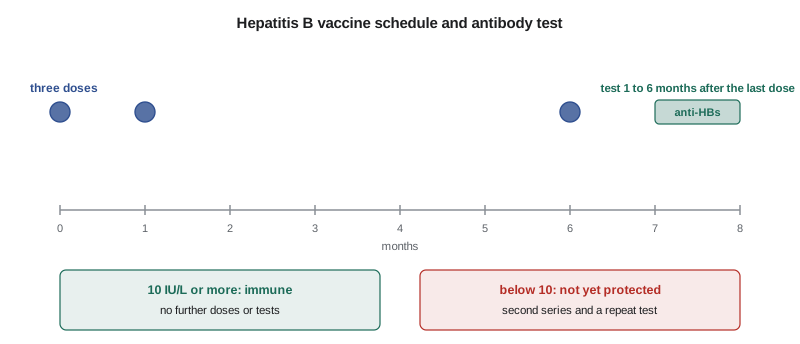
The usual adult schedule is three doses: the first, a second one month later and a third six months after the first. Accelerated schedules exist for people who need protection quickly. If a dose is late, the series is not restarted; the next dose is simply given. A combined hepatitis A and B vaccine is also available for people who need both.
The vaccine is very safe. The most common side effects are a sore arm, and sometimes a mild fever or tiredness for a day. Serious allergic reactions are very rare, and the vaccine is given where staff can respond to one. People with a known severe allergy to a vaccine component, including yeast for some brands, discuss alternatives with occupational health. The vaccine is considered safe in pregnancy and while breastfeeding.
Checking that it worked
Most healthy adults develop protective antibodies after a complete series, but not all. Response is lower in people over 40, smokers, people with obesity, diabetes, kidney disease or a weakened immune system, and in a small share of otherwise healthy people. Because healthcare workers depend on being immune, they have a blood test after the series to check.
The test measures antibodies to the hepatitis B surface antigen, called anti-HBs. The Canadian Immunization Guide recommends testing 1 to 6 months after the last dose. A level of 10 IU/L or more means the worker has responded and is considered protected for life. No further doses or tests are needed, even if antibody levels fall below 10 years later, because the immune memory remains and responds quickly to the virus.
Testing too late is a common problem. If a worker is tested years after the series and the level is below 10, it is not clear whether they never responded or responded and their levels have faded. Occupational health then usually gives one booster dose and tests again a month or two later. A strong rise means the worker was a responder all along.
When the vaccine does not work
A worker whose level is below 10 after a full series gets a second complete series and is tested again. Many people who did not respond to the first series respond to the second, and a different brand may be used. A worker who still has not responded after two full series is called a non-responder. Occupational health will also test them for hepatitis B infection, because a small number of non-responders turn out to have chronic hepatitis B that was never diagnosed.
A non-responder can still work in healthcare. What changes is what happens after an exposure: a non-responder who is exposed to blood from a patient who has, or may have, hepatitis B is given hepatitis B immune globulin, a dose of ready-made antibodies, as soon as possible, and usually a second dose a month later. Lesson 10 covers this. Non-responders should know their status and tell occupational health promptly after any exposure.
No vaccine for hepatitis C or HIV
Workers sometimes ask why there is no equivalent protection against the other two viruses. Researchers have worked for decades on vaccines for both, but hepatitis C and HIV change their surface proteins quickly and hide from the immune system in ways that hepatitis B does not, and no vaccine for either has yet been approved. Until one is, protection against hepatitis C and HIV depends entirely on preventing exposures and, for HIV, on prompt post-exposure prophylaxis. That is a strong reason why vaccination against hepatitis B, though important, is never a reason to relax the sharps practices in the rest of this course.
Declining the vaccine
Vaccination is strongly recommended but not usually a condition of employment in Ontario hospitals. A worker who declines is asked to sign a form showing that they were informed of the risks and offered the vaccine, and can change their mind and be vaccinated at any time. Workers who decline should know that, after an exposure, they may need hepatitis B immune globulin and vaccination, and that their risk of infection from a single exposure to an infected source can be as high as about 30 in 100.
A worker does not have to be vaccinated by the hospital if they can show proof of a complete series and a positive antibody test, or proof that they are already immune because of a past infection. Occupational health records the evidence and the test result.
Talking with a hesitant colleague
Some workers hesitate because of something they read online, a bad reaction to a different vaccine, or simple dislike of needles. Pressure rarely helps. What helps is a plain conversation with someone they trust, often an occupational health nurse, about the actual risk at their job, what the vaccine contains, and what happens after an exposure if they are not immune. Amira, who has worked on 4 West for 11 years, tells new colleagues that she has seen two staff go through months of testing after needlesticks, and that the one who was vaccinated had far less to worry about. Stories like that, from someone who does the same work, often matter more than any poster.
Workers who are already infected
Occasionally, testing finds that a worker already has chronic hepatitis B, often from an infection at birth or in childhood that was never diagnosed. This is confidential health information, handled by occupational health and the worker's own doctor, not the unit. Most infected workers can continue in their jobs with the same precautions as everyone else, because routine care does not expose patients to a worker's blood. Workers who do exposure-prone procedures, mainly certain kinds of surgery, dentistry and obstetrics in which the worker's hands are in a body cavity near sharp instruments, are assessed under national and professional guidance, usually by an expert panel that looks at the worker's viral load and treatment. Effective antiviral treatment lowers the viral load and, under current guidance, often allows such workers to keep practising with monitoring.
Keeping track
Joanne's office keeps a record of every worker's hepatitis B status. Before each committee meeting it produces a summary for each department, and a list of workers whose series or testing is overdue.
from datetime import date

today = date(2026, 3, 2)
# (worker, department, doses received, date of last dose, anti-HBs result or None)
staff = [
    ("A. Haddad", "4 West", 3, date(2015, 6, 1), 120), ("D. Okafor", "lab", 3, date(2012, 3, 9), 85),
    ("K. Tran", "porters", 3, date(2025, 8, 20), None), ("M. Kowalski", "EVS", 2, date(2025, 10, 3), None),
    ("L. Santos", "Maple Court", 3, date(2019, 5, 14), 4), ("P. Shah", "pharmacy", 3, date(2010, 1, 7), 300),
    ("N. Rahman", "home care", 3, date(2024, 11, 2), 55), ("R. Ito", "EVS", 1, date(2025, 12, 1), None),
    ("J. Moreau", "4 West", 0, None, None), ("S. Lund", "ED", 3, date(2025, 12, 15), None),
]

def status(doses, last, result):
    if result is not None:
        return "immune" if result >= 10 else "low result: second series"
    if doses == 0:
        return "not started or declined: follow up"
    if doses < 3:
        due = 30 if doses == 1 else 150      # days to next dose in a 0, 1, 6 month series
        late = (today - last).days > due + 30
        return "series overdue" if late else "series in progress"
    waited = (today - last).days
    return "test overdue" if waited > 180 else "test due now" if waited >= 30 else "test not yet due"

for name, dept, d, last, res in staff:
print(f"{name:12}{dept:12}{status(d, last, res)}")A. Haddad 4 West immune D. Okafor lab immune K. Tran porters test overdue M. Kowalski EVS series in progress L. Santos Maple Court low result: second series P. Shah pharmacy immune N. Rahman home care immune R. Ito EVS series overdue J. Moreau 4 West not started or declined: follow up S. Lund ED test due now
The list shows what Joanne's team has to do this month. Kevin Tran finished his series in August but was never tested, and is now overdue; Sam Lund in the emergency department is due for a test. Marta's series is on track. One environmental services worker is late for her second dose. Lina Santos had a low result after her first series and is now in her second. And one new nurse on 4 West has no record at all, which needs a conversation: she may have proof of immunity from her previous job, or she may need to start the series.
Worked problem
Lina's second series
Lina Santos received three doses of hepatitis B vaccine when she started at Maple Court and was tested two months after the third dose. Her anti-HBs level was 4, below the protective level. She is worried that the vaccine does not work for her. What happens now?
Show solution
- Occupational health explains that some people need a second series, and that many people who did not respond the first time respond to the second.
- Lina receives a second full series, with a different brand, and is tested again one to two months after the last dose.
- If her level is now 10 or more, she is immune and needs nothing further. If it is still below 10, she is a non-responder. Occupational health would then test her for hepatitis B infection and make sure she knows to report any exposure right away, because she would need hepatitis B immune globulin.
- In the meantime, she continues to work normally, using the same precautions as everyone else.
Answer: Lina gets a second series and a repeat test; if she still does not respond, she is managed as a non-responder with immune globulin after any exposure.
Common mistakes
MistakeAssuming a worker vaccinated as a child is definitely immune.
InsteadCheck records and, for healthcare workers, the antibody result, or test after a booster if needed.
MistakeSkipping the antibody test after the series.
InsteadTest at the recommended time after the last dose so the result is clear.
MistakeRestarting the series when a dose is late.
InsteadContinue the series; there is no need to start again.
MistakeGiving boosters every few years to confirmed responders.
InsteadConfirmed responders need no further doses or tests.
MistakeNot knowing you are a non-responder.
InsteadKnow your status and report any exposure at once, because you will need immune globulin.
Summary and key terms
- Hepatitis B vaccination has nearly eliminated workplace hepatitis B infection among immune workers.
- Canadian guidance recommends the vaccine for workers exposed to blood, and hospital immunization procedures are required by Regulation 67/93.
- The usual schedule is three doses at 0, 1 and 6 months.
- An anti-HBs test 1 to 6 months after the last dose confirms immunity at 10 IU/L or more.
- Confirmed responders are protected for life and need no boosters.
- Workers who do not respond get a second series; non-responders need immune globulin after exposures.
- Workers who decline can change their minds at any time.
- Hepatitis B surface antigen (HBsAg)
- A protein on the surface of the hepatitis B virus; its presence in blood shows current infection.
- Anti-HBs
- Antibodies to the hepatitis B surface antigen, which show immunity after vaccination or past infection.
- Responder
- A person whose anti-HBs level reaches the protective level after vaccination.
- Non-responder
- A person who has not reached the protective level after two full vaccine series.
- Hepatitis B immune globulin (HBIG)
- A preparation of ready-made antibodies given after an exposure to protect people who are not immune.
Practice problems
Work each problem on paper first, then reveal the answer to check.
Why can the hepatitis B vaccine not give someone hepatitis B?
Show answer
It contains only a surface protein of the virus, not the virus itself.
What is the usual three-dose schedule?
Show answer
Doses at 0, 1 and 6 months.
What anti-HBs level shows immunity?
Show answer
10 IU/L or more.
Does a confirmed responder need boosters if their levels fall years later?
Show answer
No; immune memory remains and protection is considered lifelong.
What happens after an exposure for a non-responder?
Show answer
They receive hepatitis B immune globulin as soon as possible, usually with a second dose a month later.
Why was Kevin Tran flagged as overdue?
Show answer
He finished his series months earlier but had not had his antibody test.
Lesson quiz · 5 questions
Score 60% or more to complete this lesson.
Create a free account to save your progress, take quizzes and earn a certificate.