
HSE-392 · Lesson 2 of 12 · 22 min
Laws and regulations for sharps and blood exposure
▶ Video coming soon A video version of this lesson is on the way.
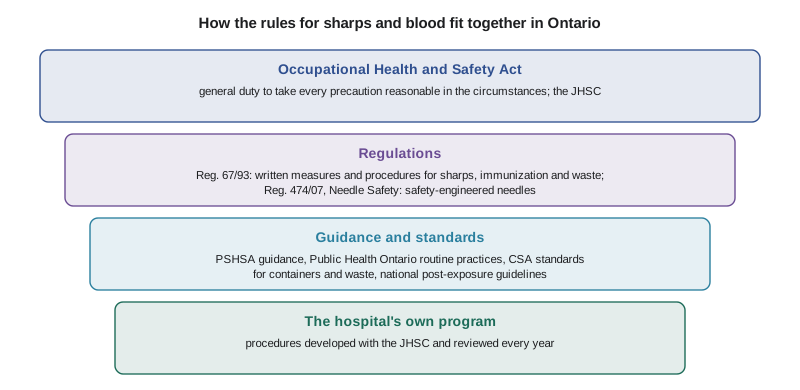
Sharps injuries are one of the few healthcare hazards with their own regulation. Ontario's Needle Safety regulation, made in 2007, requires safety-engineered needles in hospitals, long-term care homes, labs and other health facilities. It sits on top of the general duties in the Occupational Health and Safety Act (OHSA) and the written measures and procedures required by Regulation 67/93. Together they set out what Northbridge Community Hospital must do, and what its workers must do in return. This lesson explains those rules in plain language, so that staff know what to expect and what to ask for when something is missing.
Nothing in this lesson is legal advice. The regulations themselves, and the guidance from the regulator, are the authority; this lesson is a map.
The general duty under the OHSA
Under the OHSA, every employer must take every precaution reasonable in the circumstances for the protection of a worker. That general duty covers bloodborne pathogens even where no specific rule exists: if a reasonable employer would provide a safer device, a closer sharps container or more training, the general duty requires it. The Act also sets up the internal responsibility system described in HSE-390, in which employers, supervisors and workers each have duties, and the joint health and safety committee (JHSC) monitors the system.
Workers have duties too. They must follow the employer's procedures, use the equipment and protective devices the employer requires, and report hazards and injuries to their supervisor. And they keep the right to know, the right to participate and, with limits, the right to refuse unsafe work. As HSE-390 explained, hospital workers cannot refuse when the refusal would directly endanger a patient or when the danger is inherent in the work, but a broken sharps container or a missing safety device is not an inherent danger.
Regulation 67/93: written measures and procedures
Regulation 67/93, Health Care and Residential Facilities, applies to hospitals, long-term care homes and other health and residential facilities. It requires the employer to develop, in consultation with the JHSC or health and safety representative, written measures and procedures for the health and safety of workers. These must cover, among other things:
- Safe work practices and the use of protective equipment.
- The safe handling, use and disposal of needles and other sharp objects.
- The handling, cleaning and disposal of soiled linen and contaminated waste.
- Immunization and inoculation against infectious diseases.
- Hygiene practices and the use of hygiene facilities.
- Training of workers in the measures and procedures that apply to their work.
The measures and procedures must be reviewed at least once a year, again in consultation with the JHSC, and workers must be trained in them. At Northbridge, the sharps and bloodborne pathogens procedure is one of the documents Amira Haddad and the other JHSC members review each spring, and the review is recorded in the committee minutes.
Regulation 474/07: Needle Safety
The Needle Safety regulation applies wherever hollow-bore needles are used on people for therapeutic, preventive, palliative, diagnostic or cosmetic purposes in hospitals, private hospitals, psychiatric facilities, licensed laboratories and specimen collection centres, and long-term care homes. Its core is short:
- Safety-engineered needle: a hollow-bore needle designed to eliminate or minimize the risk of skin puncture, or a needleless device that replaces one, licensed as a medical device by Health Canada.
- Employer duty (section 3): provide an appropriate safety-engineered needle to every worker who needs a hollow-bore needle for their work, unless one cannot be obtained despite reasonable efforts.
- Worker duty (section 4): use the safety-engineered needle provided. A worker may use a conventional needle only if they reasonably believe that the safety-engineered one would create a greater risk of harm to themselves, other workers or the patient, and the employer must train workers on how to make that decision.
- Limited exceptions (section 5): during a declared emergency or a serious public health risk, when the supply of safety-engineered needles has run out and waiting would create a greater risk.
PSHSA's guidance on the regulation stresses that these exceptions are rare and situation-specific, and that blanket exemptions based on habit or preference are not allowed. If a physician or a unit wants to keep using a conventional needle for a particular procedure, the reason must fit section 4 and be covered by the hospital's written procedure.
Most other provinces now have similar requirements, either in a stand-alone regulation or in their general occupational health and safety rules. Alberta's OHS Code, for example, requires safety-engineered medical sharps where they are available and appropriate.
Other rules that apply
- Routine practices: Public Health Ontario's guidance on routine practices and additional precautions, which hospitals are expected to follow, covers sharps handling, PPE and the cleaning of blood spills.
- Immunization: Regulation 67/93 requires measures and procedures for immunization, and the Canadian Immunization Guide recommends the hepatitis B vaccine for healthcare workers who may be exposed to blood.
- Waste: biomedical waste, including sharps, is handled under provincial environmental rules and guidelines, and CSA standards cover sharps containers (CSA Z316.6) and the handling of health care waste (CSA Z317.10).
- Reporting: injuries go to the employer and, where required, to the WSIB, and occupational illnesses to the Ministry of Labour, as Lesson 10 explains.
- Privacy: the Personal Health Information Protection Act governs the source patient's and the worker's health information.
The JHSC's role
The JHSC is where the law meets the unit. Committee members take part in developing and reviewing the written procedures, inspect the workplace at least monthly (in a large hospital, a different part each month so the whole facility is covered over the year), look for things like full sharps containers and missing safety devices, and receive information about injuries and exposures. When Amira found that a new batch of insulin syringes on 4 West had no safety feature, it was the JHSC that put it on the agenda and got it fixed.
Joanne uses a short script to check whether the main documents are up to date, which she runs before each committee meeting.
from datetime import date

today = date(2026, 3, 2)
# (document, date of last review, required interval in days)
docs = [
    ("sharps and bloodborne pathogens procedure", date(2025, 4, 14), 365),
    ("device evaluation record", date(2025, 4, 14), 365),
    ("hepatitis B vaccination program", date(2025, 6, 2), 365),
    ("blood spill procedure", date(2024, 11, 20), 365),
    ("post-exposure protocol", date(2025, 9, 8), 365),
    ("4 West training sign-off", date(2025, 2, 10), 365),
]

for name, last, every in docs:
    due = date.fromordinal(last.toordinal() + every)
    days = (due - today).days
    if days < 0:
        state = f"OVERDUE by {-days} days"
    elif days <= 60:
        state = f"due in {days} days"
    else:
        state = "current"
print(f"{name:42} last {last} due {due} {state}")sharps and bloodborne pathogens procedure last 2025-04-14 due 2026-04-14 due in 43 days device evaluation record last 2025-04-14 due 2026-04-14 due in 43 days hepatitis B vaccination program last 2025-06-02 due 2026-06-02 current blood spill procedure last 2024-11-20 due 2025-11-20 OVERDUE by 102 days post-exposure protocol last 2025-09-08 due 2026-09-08 current 4 West training sign-off last 2025-02-10 due 2026-02-10 OVERDUE by 20 days
Two items are overdue: the blood spill procedure, which slipped last year, and the 4 West training sign-off. Two more are due within two months. A list like this is a simple way for a committee to spot drift before an inspector does.
Who is covered beyond the hospital
The Needle Safety regulation names specific kinds of facilities, but bloodborne hazards turn up in many other workplaces, and the general duty and Regulation 67/93 still apply to health and residential facilities that are not on the list. Northbridge's own home care nurses carry safety-engineered needles because the hospital chooses to extend the rule to them, and the written procedure says so. Outside healthcare, the same general duty covers workers who may meet discarded needles or blood as part of their job: custodians in schools and malls, sanitation and recycling workers, parks staff, police officers, corrections officers, firefighters and paramedics, tattoo and piercing artists, and staff in shelters and supervised consumption sites. Each of those employers needs its own written procedures for finding, handling and disposing of sharps and for responding to an exposure, even if no specific regulation names them.
What an inspector looks for
Inspectors rarely start by reading the whole program. They walk the units and ask staff simple questions, and they compare what they see and hear with what the documents promise. On a typical visit to a medical unit, an inspector might:
- Look inside supply carts, procedure trays and patient rooms for conventional sharps where safety devices should be.
- Check sharps containers: are they within reach, mounted at a sensible height, below the fill line and closed when full?
- Ask a nurse to show how the safety feature on the blood collection set works, and when it should be activated.
- Ask a worker what they would do if they had a needlestick right now, and who they would call.
- Ask whether staff have been asked for their opinion on the devices they use.
- Look at the training records for the unit and the date of the last review of the written program.
- Read a sample of exposure reports and check that each one was followed up and investigated.
Most findings are not dramatic. The common ones are sharps containers mounted too high or filled past the line, out-of-date training, a written program that has not been reviewed in more than a year, conventional devices that crept back in through a substitution or an old stock room, and staff who are not sure what to do after an exposure. Each of these is easy to fix and easy to prevent with regular committee inspections, which is why the next lessons keep returning to them.
Raising a concern
A worker who finds a gap does not need to know which section of which regulation applies. The path is the same as for any other hazard. Tell your supervisor first, because most gaps are fixed fastest at the unit. If the problem is not fixed, raise it with a committee member, who can put it on the agenda and ask for a written response. Report it on the hospital's incident or hazard system, so there is a record. And if the hazard is serious and nothing is being done, workers can contact the regulator, which is also the route for anyone who believes they were punished for raising a safety concern. Northbridge's posters by every staff room say this in four lines, with the phone extensions for Occupational Health and Safety and the committee co-chairs.
Worked problem
The insulin syringes on 4 West
A supply shortage leads purchasing to send 4 West a box of conventional insulin syringes with no safety feature. A nurse uses one before noticing. Amira spots the box on the supply cart during a committee inspection. What does the law expect, and what should happen?
Show solution
- The Needle Safety regulation requires the employer to provide safety-engineered needles. A shortage is not, on its own, one of the narrow emergency exceptions in section 5.
- Amira tells Sarah MacLeod, the unit manager, who removes the box from the cart and gets safety syringes from another unit until the supply is restored.
- Amira raises it at the next JHSC meeting. Purchasing agrees that substitutions of sharps devices must be approved by Occupational Health and Safety and the unit before they are sent out.
- The written procedure is updated to say so, and the change is recorded in the minutes.
Answer: Remove the conventional syringes, restore the safety devices, and change the purchasing procedure so the substitution cannot happen again.
Common mistakes
MistakeAssuming the Needle Safety regulation applies only to nurses.
InsteadIt applies to every worker who needs a hollow-bore needle in the covered facilities, and the general duty and Regulation 67/93 cover everyone else.
MistakeKeeping a conventional device because staff are used to it.
InsteadHabit is not a valid reason; use the safer device unless a documented reason fits the rules.
MistakeTreating the written plan as a binder that never changes.
InsteadReview it at least once a year, and whenever tasks, devices or procedures change.
MistakeChoosing devices without asking the people who use them.
InsteadInvolve frontline workers and the JHSC in evaluating and choosing devices.
MistakeLetting purchasing substitute sharps devices without review.
InsteadRequire approval from occupational health and the unit before any sharps substitution.
Summary and key terms
- The OHSA's general duty covers bloodborne hazards even where no specific rule exists.
- Regulation 67/93 requires written measures and procedures for sharps, PPE, linen and waste, immunization, hygiene and training, developed with the JHSC and reviewed every year.
- Regulation 474/07 requires safety-engineered needles in hospitals, long-term care homes, labs and similar facilities, with narrow exceptions.
- Workers must use the safety-engineered needle provided, and may use a conventional one only when they reasonably believe the safety device would create a greater risk.
- Routine practices guidance, CSA standards for containers and waste, and the Canadian Immunization Guide fill in the details.
- The JHSC reviews the procedures, inspects monthly and follows up on injuries and devices.
- Safety-engineered needle
- A hollow-bore needle designed to eliminate or minimize the risk of skin puncture, or a needleless device that replaces one, licensed by Health Canada.
- Written measures and procedures
- The documents required by Regulation 67/93 that set out how a health facility protects its workers, developed with the JHSC.
- General duty
- The OHSA requirement to take every precaution reasonable in the circumstances for the protection of a worker.
- JHSC
- Joint health and safety committee: the worker and management committee that monitors health and safety in the workplace.
- Conventional needle
- A hollow-bore needle with no engineered protection against needlestick injury.
Practice problems
Work each problem on paper first, then reveal the answer to check.
Which facilities does Regulation 474/07 cover?
Show answer
Hospitals, private hospitals, psychiatric facilities, licensed laboratories and specimen collection centres, and long-term care homes, among others.
When may a worker use a conventional needle instead of the safety-engineered one?
Show answer
When they reasonably believe the safety-engineered needle would create a greater risk of harm to themselves, other workers or the patient.
How often must the written measures and procedures under Regulation 67/93 be reviewed?
Show answer
At least once a year, in consultation with the JHSC or health and safety representative.
Name four topics the written measures and procedures must cover.
Show answer
Any four of safe work practices and PPE, sharps handling and disposal, soiled linen and waste, immunization, hygiene, and training.
Which CSA standard covers sharps containers?
Show answer
CSA Z316.6.
Why was a supply shortage not a valid reason for conventional insulin syringes on 4 West?
Show answer
A shortage is not one of the narrow emergency exceptions, and safety syringes could be obtained from elsewhere.
Lesson quiz · 5 questions
Score 60% or more to complete this lesson.
Create a free account to save your progress, take quizzes and earn a certificate.