
HSE-393 · Lesson 11 of 12 · 21 min
Emergency departments and high-risk units
▶ Video coming soon A video version of this lesson is on the way.
Every unit in a hospital has some risk of violence, but two kinds of unit carry far more than the rest: emergency departments and inpatient mental health units. Northbridge's emergency department sees about 38,000 visits a year through its 26 stretchers, and its 16-bed mental health unit admits people in acute crisis, some of them against their will. Together, these two units account for almost half of the hospital's reported violence. This lesson looks at why they are high risk and at the controls, many of them described earlier in the course, that are combined there most intensively.
Why emergency departments are high risk
Almost everything that raises the risk of violence comes together in an emergency department:
- People in crisis: pain, fear, injury, intoxication, withdrawal, psychosis, suicidal thoughts and grief, often at night.
- Long waits: crowding and waits of many hours, often with little information, in uncomfortable rooms.
- Little information: staff often know nothing about a patient's history when they arrive, so flags and risk scores are not yet available.
- Open access: the department is open to anyone, at all hours, often with family and friends who are frightened or angry.
- Patients held against their will: people brought by police or held for mental health assessment, who may not want to be there.
- Busy, rushed staff: frequent interruptions and little time to notice early warning signs.
Joanne's review of the past year's reports from the emergency department shows how incidents cluster by time of day. Her script groups them into four-hour blocks and marks the busiest.
from collections import Counter

hours = [23, 1, 2, 0, 22, 14, 3, 1, 23, 21, 2, 0, 19, 1, 22, 4, 23, 16, 2, 0,
         1, 20, 23, 2, 11, 0, 22, 3, 1, 23]
blocks = Counter(h // 4 for h in hours)
for b in range(6):
    n = blocks.get(b, 0)
    label = f"{b * 4:02d}:00-{b * 4 + 3:02d}:59"
print(label, "#" * n, n, " <- busiest" if n == max(blocks.values()) else "")00:00-03:59 ############### 15 <- busiest 04:00-07:59 # 1 08:00-11:59 # 1 12:00-15:59 # 1 16:00-19:59 ## 2 20:00-23:59 ########## 10
Most incidents happened between 2000 and 0400, when the waiting room is full of people who have been there for hours, alcohol-related visits peak, and staffing is lowest. That pattern drove most of the changes below.
Controls in the emergency department
Northbridge redesigned its emergency department's approach over two years, using the hierarchy of controls:
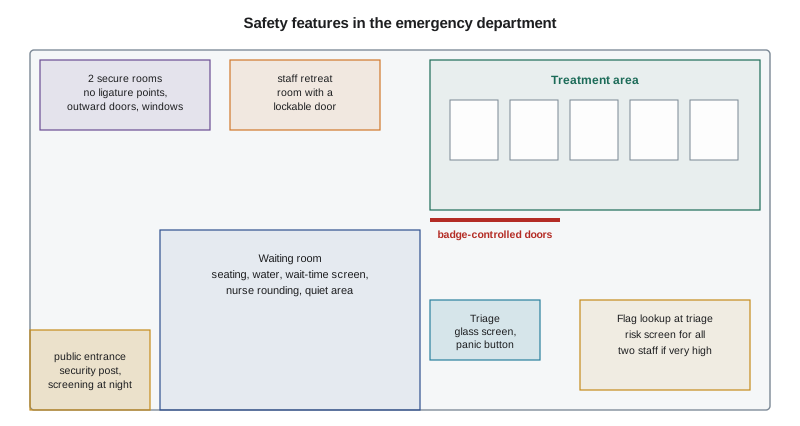
- Reducing triggers at the source: a rapid assessment area so that patients are seen by a clinician sooner; regular rounding in the waiting room by a nurse who updates people on waits and checks for deterioration; a screen showing approximate wait times; water, blankets and phone chargers; and a quiet area for people who are distressed.
- Engineering controls: a security post at the entrance; metal detectors at the public entrance at night; badge-controlled doors between the waiting room and the treatment area; a triage desk with a glass screen and a panic button; two secure rooms for patients in mental health crisis, designed without fixtures that could be used as weapons or ligature points, with outward-opening doors and windows; and a staff retreat room with a lockable door.
- Administrative controls: a flag lookup at triage, so that a returning patient's flag appears the moment they are registered; a risk screen at triage for every patient; a rule that any patient scoring high or flagged is seen by the charge nurse and security is told; two staff for care of patients scoring very high; security officers who join huddles and know the patients; and a visitor policy limiting the number of people with each patient at night.
- Training: all emergency staff, including physicians, registration clerks and housekeeping, complete de-escalation and team response training, with mock codes four times a year.
After the changes, physical assaults reported in the emergency department fell by about a third over the following year, even though reports of threats rose as staff became more willing to report them. The staff survey showed that staff felt safer, especially at night.
Weapons screening
Screening for weapons at the emergency department entrance is now common in larger hospitals and is spreading to smaller ones. It finds and removes knives and other weapons that would otherwise be carried into the department, and staff report feeling safer. It also has costs: staff and equipment, delays at the entrance, and the risk that it makes the hospital feel like a prison or that some groups are searched more than others. Northbridge decided, with the JHSC and community advisers, to screen at the public entrance from 2000 to 0600, when most incidents happen, and to apply it to everyone entering, including staff without a badge, with clear signs, respectful procedures, a locker system for items that are not allowed in, and regular review of who is being stopped.
Patients in mental health crisis
Many people come to the emergency department in a mental health crisis, some voluntarily and some brought by police or ambulance. In Ontario, the Mental Health Act allows police to take a person to hospital for assessment in certain circumstances, and allows a physician to detain a person for up to 72 hours for psychiatric assessment on a Form 1. The person may be frightened, angry or psychotic, and may have been restrained during transport. Waiting for hours in a busy hallway makes things worse.
Northbridge's approach treats these patients as patients first: a secure room rather than a hallway stretcher; early assessment by the mental health team, including a crisis nurse in the emergency department from noon to midnight; offering food, water, a phone call and an explanation of what is happening; offering medication voluntarily when it is indicated; and keeping security nearby but not standing in the doorway. Police officers who bring a patient stay until a safe handover has been agreed, using a shared protocol designed to shorten their wait.
Intoxication and withdrawal
Alcohol and drugs are involved in a large share of emergency department violence. Intoxicated patients may be disinhibited, impulsive and hard to reason with, and some drugs, such as stimulants, can cause severe agitation and paranoia. Withdrawal from alcohol, a few hours to a few days after the last drink, causes tremor, anxiety, hallucinations and, in its severe form, delirium, and it is a common cause of violence on medical units like 4 West as well as in the emergency department.
The safest approach is clinical as much as behavioural: screening every patient for alcohol and drug use, assessing withdrawal with a standard scale and treating it early according to protocol, giving intoxicated patients a quiet place to settle with regular checks, and watching for medical problems such as head injury or low blood sugar that can look like intoxication. Staff do not argue with a very intoxicated person or try to reason them into compliance; they keep the environment calm, offer simple choices, and wait, with help nearby.
Staffing and the night shift
Many of the controls above depend on having enough people. A nurse who is caring for too many patients cannot round in the waiting room, sit with a frightened patient or notice early warning signs, and a unit with no spare staff cannot send a second person into a flagged patient's room. Northbridge's emergency department added a second charge nurse from 1900 to 0300 and moved one security officer from the main entrance to the emergency entrance overnight. Its staffing request process lets staff ask for extra help when the department is full of high-risk patients and records the answer.
Inpatient mental health units
On the inpatient mental health unit, violence is most likely in the first days after admission, during involuntary admission, when patients are told they cannot leave or have privileges limited, and at times of low structure such as evenings and weekends. Many patients on the unit have themselves experienced violence and trauma, and the unit's approach is built around that fact:
- Trauma-informed care: staff assume that patients may have a history of trauma and avoid practices that repeat it, such as unexplained restraint, being touched without warning, or loss of control over basic decisions.
- Therapeutic engagement: staff spend time with patients doing ordinary things, talking, playing cards, walking, rather than watching them from the station. Patients who know staff and trust them are less likely to be violent, and staff notice changes sooner.
- The Safewards model: a set of ten simple interventions developed in England and used in many Canadian and American units, such as agreeing mutual expectations with patients, calm-down methods, positive words at handover, reassurance after incidents on the unit, and talking down. Units using it have reduced conflict and the use of restraint.
- Restraint and seclusion reduction: a deliberate program, led by senior staff, to use them only as a last resort, to review every use, and to learn from each.
- Staffing and skill mix: enough experienced staff on every shift, and extra staff during known high-risk periods such as evenings.
- A structured day: activities, groups and routines that reduce boredom and uncertainty.
Other high-risk areas
The same principles apply in other places where violence is common. Units caring for patients with delirium, such as 4 West, use delirium screening, early treatment, family presence and consistent caregivers. Birch and the other dementia home areas use the approaches in Lesson 4. Intensive care units, where patients waking from sedation may be confused and pull at tubes, use regular delirium assessment and gentle reorientation. Registration desks, cashiers and the outpatient pharmacy use glass screens, panic buttons and clear sight lines. Each unit's assessment, as Lesson 3 described, picks the controls that fit its patients and its work.
Worked problem
A night in the waiting room
At 0130, the emergency waiting room has 22 people in it, and the longest wait is five hours. A man with a hand injury who has been drinking starts shouting at the triage nurse about the wait and kicks a chair. Two other people stand up and start filming. What should happen?
Show solution
- The triage nurse stays behind the glass, calls the charge nurse and presses the panic button to alert security without escalating the situation in the room.
- The security officer at the entrance and the charge nurse arrive. The charge nurse acts as communicator, at a safe distance: she acknowledges the long wait and his pain, explains what is happening, and offers him a quieter place to wait and something for the pain if appropriate.
- Security stands nearby, calm and quiet, and asks the people filming to stop and sit down, explaining that other patients' privacy must be protected.
- The man accepts the quiet area. His hand is reassessed, and he is seen within the hour. The incident is reported as a threat, and a note is added to his record.
- At the morning huddle, the team notes that the waiting-room rounding had been missed for two hours because of a code elsewhere, and asks for a backup nurse to cover rounding at night.
Answer: Help called early without escalating, one calm communicator, security present but quiet, the man's real needs met, and a fix to the system gap that allowed the wait to go unmanaged.
Common mistakes
MistakeLeaving waiting patients without updates for hours.
InsteadRound regularly, update people on waits and check for deterioration.
MistakeKeeping patients in mental health crisis on hallway stretchers.
InsteadUse a secure room, early assessment, basic comforts and explanation.
MistakeWatching mental health patients only from the station.
InsteadEngage with patients through ordinary activity and conversation.
MistakeScreening for weapons without clear rules or review.
InsteadScreen everyone at set times with respectful procedures, and review who is stopped.
MistakeApplying the same controls to every unit.
InsteadUse each unit's assessment to choose the controls that fit its patients and work.
Summary and key terms
- Emergency departments and mental health units carry the highest risk of violence in most hospitals.
- Emergency risk comes from people in crisis, long waits, little information, open access and holds.
- Incidents cluster at night, when waiting rooms are fullest and staffing lowest.
- Controls combine reducing waits and triggers, secure design, access control, triage flags and training.
- Weapons screening can help, but needs clear rules, respect for patients and review.
- Patients in mental health crisis are treated as patients first: secure rooms, early assessment and explanation.
- Mental health units use trauma-informed care, therapeutic engagement, Safewards and restraint reduction.
- Each unit chooses controls based on its own assessment.
- Rapid assessment area
- A part of the emergency department where patients are seen and started on treatment soon after arrival.
- Waiting-room rounding
- Regular checks of waiting patients by a nurse, with updates and reassessment.
- Trauma-informed care
- Care that assumes patients may have experienced trauma and avoids practices that repeat it.
- Therapeutic engagement
- Staff spending time with patients in ordinary activity and conversation to build trust and notice changes.
- Safewards
- A model of ten simple interventions that reduce conflict and restraint on mental health units.
Practice problems
Work each problem on paper first, then reveal the answer to check.
Give four reasons why emergency departments have high rates of violence.
Show answer
Any four of: people in crisis, long waits, little information about patients, open access, patients held against their will, busy staff.
When did most emergency department incidents happen at Northbridge?
Show answer
Between 2000 and 0400.
Name two controls at each of the source, engineering and administrative levels in the emergency department.
Show answer
For example: rapid assessment and waiting-room rounding; a security post and badge-controlled doors; flag lookup at triage and two staff for very high-risk patients.
What are the benefits and costs of weapons screening?
Show answer
It removes weapons and helps staff feel safer, but costs staff and equipment, causes delays and can feel oppressive or be applied unfairly.
How does Northbridge care for patients in mental health crisis in the emergency department?
Show answer
Secure room, early assessment by the mental health team, food, water, a phone call, explanation, voluntary medication, and security nearby but not in the doorway.
What is therapeutic engagement and why does it help?
Show answer
Staff spending time with patients in ordinary activity; it builds trust and lets staff notice changes sooner.
Lesson quiz · 5 questions
Score 60% or more to complete this lesson.
Create a free account to save your progress, take quizzes and earn a certificate.