
HSE-393 · Lesson 4 of 12 · 22 min
Responsive behaviours and dementia care
▶ Video coming soon A video version of this lesson is on the way.
In Birch, the 24-bed home area at Maple Court, most residents live with dementia. Lina Santos, a personal support worker who has worked there for six years, will tell you that she has been hit, kicked, pinched, scratched and spat on more times than she can count, and that almost none of it was meant as an attack. Residents with dementia often cannot explain what they need or understand what is being done to them. When care feels like an assault, they defend themselves. When they are in pain, frightened, cold, bored or overwhelmed, they show it in the only way left to them.
This lesson covers violence in dementia care: why it happens, how staff can find the cause, and how changes in approach, environment and care can prevent most of it. Long-term care has some of the highest rates of violence against workers of any setting, and the methods in this lesson also apply to patients with delirium on medical units and to older adults in emergency departments.
Responsive behaviours
In Canadian long-term care, the term responsive behaviours describes actions, words or gestures by a person living with dementia or another cognitive impairment that are a response to something in their environment, their body or their feelings. The term was chosen deliberately to replace words like aggressive, combative or difficult, which put the problem in the person. Calling a behaviour responsive reminds staff to ask what it is responding to. Ontario's long-term care regulation requires every home to have a program for responsive behaviours, with written approaches to care, ways of identifying triggers, and interventions.
Responsive behaviours include physical actions such as hitting, kicking, grabbing, pushing, biting and throwing things; verbal actions such as screaming, swearing and threats; and other actions such as wandering, exit-seeking, repetitive calling out, undressing and resisting care. Not all of these are violent, but all of them can be signs of an unmet need, and the same approach applies to each.
Why people with dementia strike out
Dementia damages the parts of the brain that handle memory, language, judgment, perception and the control of emotions. A resident may not recognize the person helping them, may not understand why a stranger is taking off their clothes, may misread a smile as a threat, or may not be able to say that their hip hurts. Behaviour becomes their language. The causes usually fall into a few groups, which staff can check one at a time:
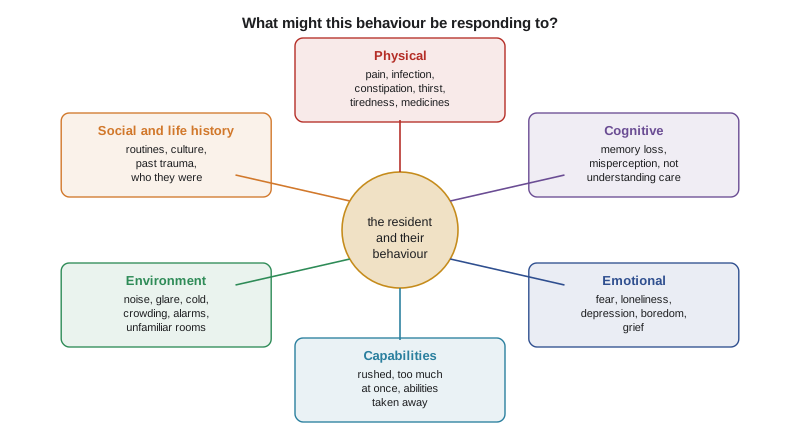
- Physical: pain is the most common hidden cause. Others include urinary tract infection, constipation, dehydration, hunger, tiredness, poor sleep, hearing or vision loss, and side effects of medicines.
- Cognitive: misunderstanding what is happening, not recognizing people or places, or mistaking a reflection or a shadow for an intruder.
- Emotional: fear, anxiety, loneliness, depression, boredom or grief.
- Capabilities: being rushed, asked to do too much at once, or not allowed to do what they still can.
- Environment: noise, crowding, glare, cold bathrooms, alarms, unfamiliar rooms, or being moved.
- Social and life history: a lifelong routine broken, a cultural or religious norm crossed, past trauma, or care from someone of a gender the person finds threatening.
A sudden change in behaviour, especially new violence in someone who was settled, should be treated as a medical question first. In HSE-390, the Birch resident who began grabbing staff turned out to have a urinary tract infection; the behaviour stopped when it was treated. Delirium on top of dementia is common, easily missed and treatable.
Finding the cause: behaviour mapping
When a resident's behaviour puts staff or others at risk, Birch starts a behaviour map, often called the Dementia Observation System in Ontario homes. For five to seven days, staff record what the resident is doing in each half-hour block, day and night. Any episode of responsive behaviour is also recorded on an ABC chart: the antecedent, what happened just before; the behaviour itself; and the consequence, what happened next. The patterns that emerge often point straight at the cause.
Walter Duff, a retired farmer who moved into Birch in the spring, began striking out at staff in late summer. Lina and the team started an ABC chart. After a week, the nurse in charge ran the entries through a short script that counts episodes by time of day and by what was happening just before.
from collections import Counter

log = [  # (time, what happened just before, behaviour)
    ("07:10", "morning care", "hit"), ("07:25", "morning care", "kick"),
    ("09:40", "noisy lounge", "shout"), ("07:05", "morning care", "grab"),
    ("19:30", "bath", "hit"), ("07:15", "morning care", "hit"),
    ("14:10", "visitor left", "shout"), ("07:20", "morning care", "grab"),
    ("19:45", "bath", "kick"), ("07:30", "morning care", "hit"),
]
by_hour = Counter(t.split(":")[0] for t, _, _ in log)
by_trigger = Counter(trigger for _, trigger, _ in log)
print("episodes by hour:", dict(sorted(by_hour.items())))
print("episodes by trigger:")
for trigger, n in by_trigger.most_common():
print(f" {trigger:<14} {n}")episodes by hour: {'07': 6, '09': 1, '14': 1, '19': 2}
episodes by trigger:
morning care 6
bath 2
noisy lounge 1
visitor left 1Six of ten episodes happened during morning care between 0700 and 0730, and two during evening baths. The team talked to Mr. Duff's daughter, who said her father had got up at five every day of his life to milk cows and had always washed and dressed himself before breakfast. At Maple Court he was being woken at seven and washed in bed by whoever was assigned, often two staff he did not know. The team changed his care: he was allowed to wake on his own, usually around six, and was offered a basin and a cloth to wash his own face and hands while Lina helped with the rest; the same two staff did his morning care where possible; and baths were replaced with a towel bath in his room. Episodes fell from about ten a week to one or two.
Approaches that prevent violence during care
Most violence in dementia care happens during close personal care. Small changes in how staff approach and communicate prevent much of it. The approaches below are taught in most dementia care training programs:
- Approach from the front, at eye level. Coming from behind or the side, or standing over someone in bed, can startle and frighten. Stop at the edge of the person's personal space and let them see you.
- Introduce yourself and the task every time. "Hello, Mr. Duff, I'm Lina. I'm here to help you get washed." The person may not remember you from yesterday or from ten minutes ago.
- One step, one instruction at a time. Short, simple sentences, a calm low voice, and time to respond. Show as well as tell.
- Explain before touching, and touch gently. Start with the hands or arms, not the face or private areas. Techniques such as hand-under-hand, where the caregiver's hand is under the resident's, let the person feel in control.
- Offer choices. "Would you like the blue shirt or the green one?" Small choices give back some control.
- Protect dignity and warmth. Keep the person covered, warm the room and the water, close the door and the curtains.
- Stop and come back. If the person becomes distressed, pause, step back, and try again later or with a different caregiver. Few personal care tasks cannot wait twenty minutes.
- Know the person. Life story, routines, preferred name, language, faith and what has upset or calmed them before belong in the care plan where every caregiver can see them.
The rule to stop and come back is the single most effective way to prevent injury during care, and it often goes against the way staff are trained to work: to finish the task, on schedule, whatever happens. Managers have to make it acceptable in practice, by allowing flexible schedules and not counting a postponed bath as a failure.
The environment
The physical space can calm or provoke. Birch made several changes after its assessment:
- Quiet areas away from the television and the nursing station, for residents who become overwhelmed by noise.
- Warmer tub rooms with soft lighting, music the resident likes, and towels warmed in advance.
- Clear sight lines so that staff can see residents who are becoming agitated before an incident.
- Personal objects, photos and familiar furniture in rooms, so residents recognize where they are.
- Meaningful activity: folding laundry, sorting, gardening, music, which reduces boredom and restlessness in the late afternoon.
- Fewer overhead pages and alarms, and staff phones on vibrate.
Medication and restraints
Antipsychotic drugs are sometimes used for severe responsive behaviours, but they have limited benefit for most behaviours in dementia and significant risks, including falls, stroke, sedation and death. Guidelines recommend non-drug approaches first, and drugs only for severe distress or danger, at the lowest dose, for the shortest time, with regular review. Ontario's long-term care regulation strictly limits restraints, which may be used only as a last resort, with consent and monitoring. Neither drugs nor restraints are a substitute for finding and treating the cause.
When the risk remains
Some residents remain at high risk despite every effort: a man with frontotemporal dementia who strikes out without warning, or a resident with severe psychosis. For them, the care plan includes protective measures for staff alongside the person-centred ones:
- Two staff for personal care, with one leading and talking and the other assisting.
- Positioning that keeps staff out of reach of a kick or a swing, and a clear path to the door.
- Personal alarms carried by all staff on the home area, as Lesson 6 describes.
- Referral to specialist behavioural support teams or geriatric psychiatry.
- Flags and care plans that travel with the resident, including to hospital.
Supporting the staff who do this work
Being hit by a resident who does not know what they are doing is still being hit. Staff in dementia care often feel they are not allowed to be upset about it, because the resident is ill, and they rarely report it. Birch's manager made three changes that staff say made the most difference. Every incident, however minor, is reported in a two-minute form, and the reports are discussed at the weekly team huddle as information about the resident's needs, never as a judgment of the caregiver. Staff who are hurt are checked on by the charge nurse before the end of the shift and offered time away from that resident if they want it. And the team celebrates the care plans that work, such as Mr. Duff's, so that staff see that finding the cause pays off.
Training matters too. Staff who understand why residents with dementia strike out, and who have practised the approaches above and simple ways to move out of a grab or a hair pull safely, feel more confident and are hurt less often. New staff at Maple Court complete dementia care training in their first month and work their first shifts alongside an experienced caregiver who knows the residents.
Worked problem
A new resident who resists bathing
A new resident in Birch, Mrs. Halvorsen, screams and hits out every time staff try to bathe her in the tub room. She has advanced dementia and speaks mostly Norwegian when upset. What should the team try?
Show solution
- Check for physical causes: pain on moving, skin problems, fear of falling in the tub, cold.
- Learn her history: her family says she always bathed in the evening, never in front of others, and was terrified of water over her head after a childhood accident.
- Change the approach: a female caregiver she knows, a towel bath or a shower chair in her room in the evening, water never poured over her head, and a few calming words in Norwegian from her family written in the care plan.
- Record the results on the ABC chart for two weeks, and review with the team.
Answer: Find the causes and change the care, not the resident. In practice this mix of approaches usually reduces resistance to bathing a great deal.
Common mistakes
MistakeCalling a resident aggressive or combative.
InsteadDescribe the behaviour and ask what it is responding to.
MistakeTreating new violence in a settled resident as part of the dementia.
InsteadLook first for a medical cause such as pain, infection, constipation or delirium.
MistakeFinishing personal care no matter how distressed the resident becomes.
InsteadStop, step back and come back later or with another caregiver.
MistakeApproaching from behind or standing over a resident in bed.
InsteadApproach from the front, at eye level, and introduce yourself and the task.
MistakeUsing antipsychotic drugs as the first response.
InsteadTry non-drug approaches first; use drugs only for severe distress or danger, briefly and with review.
Summary and key terms
- Responsive behaviours are actions, words or gestures that respond to something in the person's body, environment or feelings.
- Causes fall into groups: physical, cognitive, emotional, capabilities, environment, and social and life history.
- Pain and infection are common hidden causes; new violence calls for a medical check first.
- Behaviour mapping and ABC charts reveal patterns that point to causes.
- Approach from the front, introduce yourself, give one step at a time, offer choices and protect dignity.
- Stopping and coming back later is the most effective way to prevent injury during care.
- Calmer, warmer, quieter environments and meaningful activity reduce responsive behaviours.
- Drugs and restraints are a last resort and never a substitute for finding the cause.
- Responsive behaviours
- Actions, words or gestures by a person with dementia that respond to something in their body, environment or feelings.
- ABC chart
- A record of the antecedent, behaviour and consequence for each episode, used to find patterns.
- Behaviour mapping
- Recording what a resident is doing in each time block over several days to find patterns.
- Hand-under-hand
- A technique in which the caregiver's hand supports the resident's hand from below, giving the resident a sense of control.
- Towel bath
- A bath given in bed or in a chair with warm, wet towels, instead of a tub or shower.
Practice problems
Work each problem on paper first, then reveal the answer to check.
Why is the term responsive behaviours used instead of aggressive?
Show answer
It reminds staff that the behaviour is a response to something, such as pain, fear or the environment, and that the cause can be found.
What should staff check first when a settled resident suddenly becomes violent?
Show answer
A medical cause, such as pain, infection, constipation, dehydration or delirium.
What does ABC stand for in an ABC chart?
Show answer
Antecedent, behaviour and consequence.
What did the ABC chart show about Mr. Duff, and what changed?
Show answer
Most episodes were during morning care at 0700; he was allowed to wake on his own, wash himself with help, have consistent staff, and a towel bath.
What should a caregiver do if a resident becomes distressed during care?
Show answer
Stop, step back, and come back later or with a different caregiver.
Name three environmental changes that reduce responsive behaviours.
Show answer
For example: quiet areas, warmer tub rooms, familiar objects, meaningful activity, fewer alarms and pages.
Lesson quiz · 5 questions
Score 60% or more to complete this lesson.
Create a free account to save your progress, take quizzes and earn a certificate.