
HSE-393 · Lesson 9 of 12 · 22 min
Harassment and discrimination from patients
▶ Video coming soon A video version of this lesson is on the way.
Not all of the harm patients and visitors cause is physical. A patient who makes sexual comments to a young personal support worker every time she enters his room, a visitor who refuses to let a Black nurse care for his mother, a patient who calls a gay porter names in the elevator, a family that photographs staff and posts the pictures online with abusive comments: these are harassment, and in many cases discrimination. They are common in healthcare, they are badly under-reported, and they wear staff down over time in ways that can be as damaging as an assault. This lesson covers what the law requires, how staff can respond in the moment, and how the hospital supports them.
What harassment from patients looks like
Surveys of healthcare staff consistently find that harassment from patients and visitors is widespread. The most common forms are:
- Sexual harassment: comments about appearance or bodies, sexual jokes and propositions, requests for unnecessary intimate care, touching, grabbing, exposure, and following staff or contacting them outside work.
- Racist and other discriminatory abuse: slurs, insults, and comments about a worker's race, ethnicity, accent, religion, gender identity, sexual orientation, age or disability.
- Refusal of care based on identity: demanding a different nurse or physician because of race, religion, accent or appearance.
- Bullying and intimidation: repeated insults, belittling, threats to complain or sue, and filming or photographing staff without consent to intimidate them.
- Online harassment: posting staff names, photos or false claims on social media.
Some patients who behave this way have conditions that affect their judgment, such as dementia, brain injury, delirium or mania, and sexual disinhibition is a recognized symptom of several of them. That changes how the hospital responds, as with physical violence, but it does not mean staff have to accept the behaviour, or that it is not harmful to them.
What the law requires
The OHSA defines workplace harassment as engaging in a course of vexatious comment or conduct against a worker in a workplace that is known or ought reasonably to be known to be unwelcome, and it includes workplace sexual harassment. The definition covers harassment by anyone, including patients and visitors. Employers must have a written harassment policy, reviewed every year, and a program to implement it that includes measures and procedures for workers to report incidents to someone other than the person responsible if that person is the harasser, how incidents and complaints will be investigated and dealt with, how information will be kept confidential, and how the worker and the alleged harasser will be told the results. Employers must investigate incidents and complaints in a way that is appropriate in the circumstances.
The Ontario Human Rights Code adds a separate duty. Employers must maintain a workplace free from harassment and discrimination on the grounds the Code protects, such as race, ancestry, place of origin, colour, ethnic origin, creed, sex, sexual orientation, gender identity, age and disability. Human rights decisions have found that this duty includes taking reasonable steps when the harassment comes from clients or customers. A hospital that tells a nurse to ignore racist abuse from a patient, or quietly reassigns staff to meet a patient's racist demand, can breach the Code.
Responding in the moment
Staff often freeze when a patient says or does something offensive, partly from surprise and partly because they are trained to be caring and patient. Having a few practised responses makes it easier to act. A simple approach has three steps: name the behaviour, set the limit, and redirect to the care.
| Situation | Name it | Set the limit | Redirect |
|---|---|---|---|
| A sexual comment | "That comment is not appropriate." | "Please don't talk to me like that." | "Let's get your dressing changed." |
| Touching | "Please take your hand away." | "I won't continue if you touch me like that." | "Can you hold the rail while I help you?" |
| A racist remark | "That's a hurtful thing to say." | "I won't accept comments about my race." | "I'm your nurse today, and I'm here to help you." |
| Filming without consent | "I see you're filming me." | "Please stop; I don't consent to being recorded." | "I'm happy to answer your questions." |
The tone is calm and matter-of-fact, not angry. The aim is not to win an argument or teach a lesson, but to stop the behaviour and get on with care. If the behaviour continues, the worker leaves the room, makes sure the patient is safe, and tells the charge nurse.
For patients with dementia or other conditions affecting judgment, the same approach is used more gently and with more redirection: a firm, kind "No, Mr. Kaplan", moving his hand away, and turning his attention to something else. The behaviour is recorded on the ABC chart described in Lesson 4, because it may have a cause, such as boredom, a misunderstanding of what care is happening, or a medication, that the team can address.
The response ladder
When harassment continues, the hospital takes escalating steps, from the least to the most restrictive, until it stops. Northbridge's procedure follows a ladder:
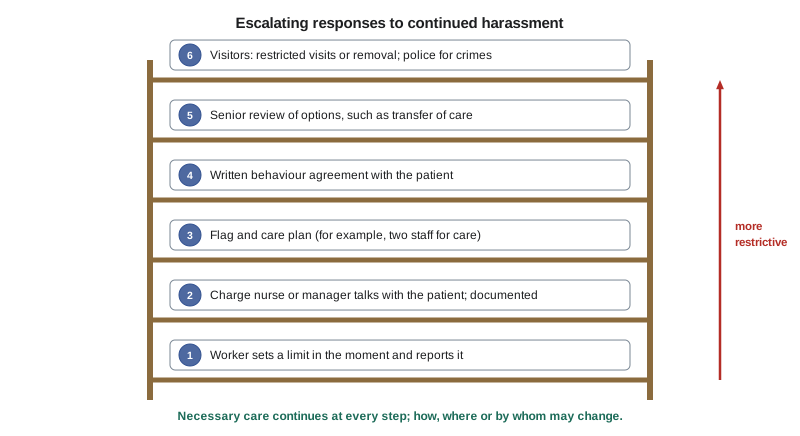
- The worker sets a limit in the moment, as above, and reports it.
- The charge nurse or manager talks with the patient, explains that the behaviour is not acceptable and what will happen if it continues, and documents the conversation. A conversation with someone in authority stops a large share of harassment.
- A flag and care plan tell other staff about the behaviour and set precautions, such as two staff for intimate care or the door left open.
- A written behaviour agreement sets out expectations and consequences, signed or acknowledged by the patient.
- A senior review of further options, such as transfer of care to another unit or facility where that is clinically safe, or, for outpatients, care at another site.
- For visitors, restrictions on visiting, supervised visits, or removal by security, and police involvement for conduct that is criminal, such as sexual assault or threats.
Throughout, the patient continues to receive the care they need. A hospital does not deny necessary treatment as a punishment. But how, where and by whom that care is given can change.
Requests for a different caregiver
Patients sometimes ask for a different nurse or physician. Some requests are reasonable: a woman who has experienced sexual violence asking for a female caregiver for intimate care, a patient who wants a caregiver who speaks their language, or a patient who has lost trust in a particular worker after a conflict. Others are discriminatory: refusing a caregiver because of their race, ethnicity, religion or accent.
Northbridge's policy distinguishes between the two. Requests based on a patient's own needs, such as trauma, religious modesty for intimate care, language or a breakdown in the relationship, are accommodated where possible. Requests based on a caregiver's race, ethnicity, religion, accent, sexual orientation or similar characteristics are not honoured, except in an emergency when delay would harm the patient, and are handled by the charge nurse or manager, not by the worker who was rejected. The manager speaks with the patient, explains the hospital's position and the qualifications of the assigned caregiver, and documents the conversation. The worker is told what happened and is offered the choice of whether to continue caring for the patient, but is never quietly removed to satisfy a discriminatory demand.
Filming and online harassment
Phones have added a new kind of harassment. Patients and visitors sometimes film staff during tense moments, then post the video with names and abusive comments, or threaten to. Northbridge's policy allows patients to record their own conversations with clinicians about their care, which can help them remember information, but does not allow filming of staff without consent to intimidate them, filming of other patients, or filming in areas where privacy is expected. Staff who are being filmed can say calmly that they do not consent and ask the person to stop, then call the charge nurse if it continues. If staff find themselves named or pictured in abusive posts, they report it to their manager; the hospital's communications and legal teams can ask platforms to remove content that breaches their rules, and security or police are involved when posts include threats or personal details such as a home address.
Reporting and patterns
Harassment from patients is reported through the same system as physical violence, with its own categories so that patterns can be seen. Joanne reviews the categories each quarter:
from collections import Counter

reports = [  # (category, unit, patient had cognitive impairment?)
    ("sexual comment", "4 West", False), ("racist remark", "Emergency", False),
    ("sexual touching", "Birch", True), ("refused caregiver", "3 East", False),
    ("sexual comment", "Birch", True), ("racist remark", "Emergency", False),
    ("filming", "Emergency", False), ("sexual comment", "4 West", False),
    ("racist remark", "4 West", False), ("sexual touching", "4 West", True),
]
cats = Counter(c for c, _, _ in reports)
units = Counter(u for _, u, _ in reports)
impaired = sum(1 for *_, imp in reports if imp)
print("by category:", ", ".join(f"{c} {n}" for c, n in cats.most_common()))
print("by unit:    ", ", ".join(f"{u} {n}" for u, n in units.most_common()))
print(f"patient had cognitive impairment: {impaired} of {len(reports)}")by category: sexual comment 3, racist remark 3, sexual touching 2, refused caregiver 1, filming 1 by unit: 4 West 4, Emergency 3, Birch 2, 3 East 1 patient had cognitive impairment: 3 of 10
The numbers are small, and Joanne knows from the staff survey that most harassment is never reported. Even so, the review shows something useful: racist remarks cluster in the emergency department, where waits are long and staff change constantly, and sexual comments and touching on 4 West mostly come from patients without cognitive impairment. That second finding led to a change: charge nurses on 4 West now speak to patients the first time a report is made, rather than waiting for a pattern.
Supporting staff
The harm of harassment builds up. A nurse who hears a racist remark once may shrug it off; a nurse who hears them every week, and sees nothing done, may leave. Support includes:
- Managers who believe staff, act quickly and visibly, and tell staff what was done.
- A clear message, repeated often, that staff do not have to tolerate abuse as part of the job.
- Time away from the patient, and the choice not to continue caring for them where that is safe.
- Access to peer support, the employee and family assistance program and, for racism, support from colleagues and networks who share the experience.
- Protection from retaliation for reporting, including from patients who threaten to complain.
Worked problem
A refusal in the emergency department
A man brings his elderly mother to the emergency department. When the triage nurse, Ade Okonkwo, comes to take her history, the son says loudly that he wants "a Canadian nurse, not one of you". His mother is short of breath. What should happen?
Show solution
- Ade steps back and asks the charge nurse to come. He does not argue with the son or try to handle the refusal himself.
- The charge nurse speaks to the son away from other patients: Ade is a fully qualified nurse assigned to his mother; the hospital does not assign staff based on race or origin; his mother needs to be assessed now.
- Because the mother needs urgent assessment and the son is blocking it, the charge nurse completes the assessment herself with Ade present, so that care is not delayed, and documents why.
- The charge nurse checks on Ade, who chooses to remain on the case. The incident is reported as harassment, and the son is told that further abuse will lead to restrictions on his presence.
Answer: The charge nurse, not the targeted nurse, deals with the refusal; care is not delayed; the discriminatory demand is not met by quietly reassigning staff; the incident is reported and the nurse is supported.
Common mistakes
MistakeTelling staff to ignore harassment because the patient is ill.
InsteadRespond to the behaviour, with more redirection for patients whose judgment is affected, and record it.
MistakeQuietly reassigning a nurse to meet a racist demand.
InsteadHave the manager address the request, explain the policy and support the worker.
MistakeLeaving the targeted worker to handle the confrontation alone.
InsteadThe charge nurse or manager steps in and speaks to the patient or visitor.
MistakeWithholding necessary care as a consequence.
InsteadChange how, where or by whom care is given, never whether it is given.
MistakeTreating verbal abuse as too minor to report.
InsteadReport it; harassment builds up and patterns can be addressed.
Summary and key terms
- Harassment from patients and visitors includes sexual harassment, racist and other discriminatory abuse, refusals based on identity, intimidation and online abuse.
- The OHSA requires a harassment policy and program, with reporting, investigation, confidentiality and feedback.
- The Human Rights Code requires employers to take reasonable steps against harassment by clients.
- In the moment: name the behaviour, set the limit and redirect to the care.
- Continued harassment calls for escalating steps, from a manager's conversation to restrictions on visitors.
- Necessary care continues; how, where and by whom it is given can change.
- Requests based on a patient's needs may be accommodated; requests based on a caregiver's identity are not.
- Managers act quickly, staff are protected from retaliation and support is offered.
- Workplace harassment
- Unwelcome comments or conduct against a worker, including sexual harassment, that the person knows or ought to know are unwelcome.
- Discriminatory request
- A demand for a different caregiver because of the caregiver's race, religion, origin, accent or similar characteristic.
- Sexual disinhibition
- Sexual behaviour caused by a condition that affects judgment, such as dementia or brain injury.
- Behaviour agreement
- A written statement of expected behaviour and consequences agreed with a patient.
- Retaliation
- Punishment or harm for reporting harassment or violence, which the law forbids.
Practice problems
Work each problem on paper first, then reveal the answer to check.
Give four forms of harassment staff experience from patients.
Show answer
Any four of: sexual comments or touching, racist or discriminatory abuse, refusal of care based on identity, bullying and intimidation, filming, online harassment.
What are the three steps for responding in the moment?
Show answer
Name the behaviour, set the limit, and redirect to the care.
A patient with dementia touches a PSW inappropriately. How does the response differ?
Show answer
It is gentler and uses more redirection, and the behaviour is recorded to look for causes, but the limit is still set.
Which caregiver requests may be accommodated, and which are not?
Show answer
Requests based on the patient's needs, such as trauma, religious modesty or language, may be; requests based on the caregiver's race, religion, origin or similar are not.
Who should deal with a discriminatory refusal of care?
Show answer
The charge nurse or manager, not the worker who was rejected.
What did Joanne's review find about 4 West?
Show answer
Most sexual comments and touching came from patients without cognitive impairment, so charge nurses now speak to patients after the first report.
Lesson quiz · 5 questions
Score 60% or more to complete this lesson.
Create a free account to save your progress, take quizzes and earn a certificate.