
PHOT-320 · Lesson 12 of 12 · 31 min
Careers, business and capstone picture story
This final lesson brings the course together. It looks at the paths into photojournalism today, the economics of staff and freelance work, how to build a portfolio and a sustainable business, and how to keep developing as a visual journalist. It ends with a capstone: planning, shooting, editing and captioning a picture story that applies everything from news judgement to ethics, law and safety.
Paths into photojournalism
There is no single route into the profession. Some photographers study journalism or photography at college or university, where they learn reporting, ethics and law alongside visual skills and build portfolios through student publications and internships. Others come from other fields, bringing knowledge of a subject such as science, sport or a community, and learn photography through workshops and practice. Internships at newspapers, wire services and magazines remain an important entry point, though fewer exist than in the past. Many photographers start by freelancing for local publications, building relationships with editors through reliable, accurate work.
Employers and clients look for a strong portfolio of published work, evidence of news judgement and the ability to tell stories, technical reliability under pressure, accurate captions, ethical conduct, and increasingly video and audio skills, social media literacy and the ability to work across platforms. Knowledge of a beat, language skills and relationships with communities that are under-covered are valuable assets.
Staff jobs
Staff jobs at newspapers have declined, but they still exist at wire services, larger newspapers, broadcasters' digital operations, magazines, universities, sports teams and leagues, government agencies and nonprofits. Some of these, such as team or government photography, are not independent journalism and come with different obligations. Staff positions offer a salary, benefits, equipment, legal backing and a steady flow of assignments. They also mean less control over assignments and the use of your pictures, and the copyright usually belongs to the employer.
Freelancing as a business
Most photojournalists today work as freelancers for at least part of their careers. Freelancing means running a business: finding clients, setting rates, negotiating terms, invoicing, keeping records, paying taxes, buying equipment and insurance, and protecting rights. The key financial concept is that a day rate must cover not just the shooting day but all the unbilled time and costs that make the work possible.
Worked problem
What day rate do you need?
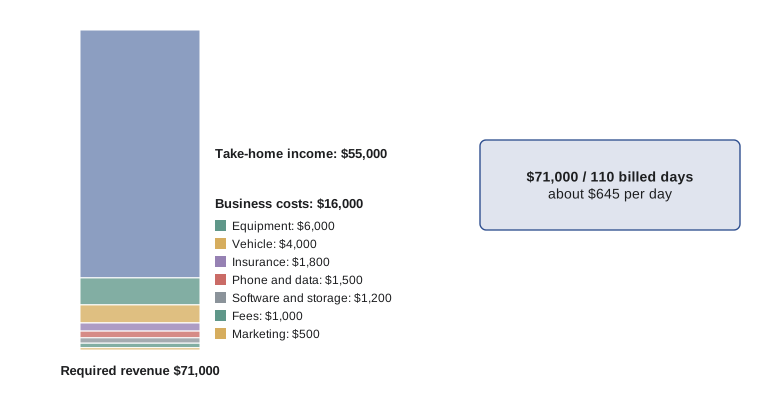
A freelancer wants a take-home income of $55,000 a year before income tax. Annual business costs are: equipment replacement $6,000, insurance $1,800, software and storage $1,200, phone and data $1,500, vehicle $4,000, professional fees and memberships $1,000, and marketing $500. They expect to bill 110 days a year, because the rest of the time goes to pitching, editing, admin and gaps between work. What average day rate do they need?
Show solution
- Business costs: 6,000 + 1,800 + 1,200 + 1,500 + 4,000 + 1,000 + 500 = $16,000.
- Total revenue needed: $55,000 + $16,000 = $71,000.
- Day rate: $71,000 / 110 ≈ $645.
Answer: About $645 per billed day on average, before sales tax. If editorial clients pay $400 a day, the freelancer must bill more days, add better-paid commercial work, or earn from licensing and other streams.
Editorial rates vary widely by market and publication, and the figures here are illustrative. Professional associations publish guidance and surveys, and freelancers share information informally. Know your costs before negotiating, and do not accept terms that make the work unsustainable, such as all-rights contracts at editorial day rates.
Contracts and rights
Read every contract. Key terms for freelance news work include the fee and what it covers, expenses, payment terms and timing, the rights granted, whether exclusive or non-exclusive, for how long and in which media, credit, kill fees if the work is not used, liability and indemnity, and insurance. Many publications offer standard contracts that ask for broad rights; associations advise freelancers to negotiate, for example to grant first publication rights with a time limit and retain the right to license afterwards. Lesson 10 covered copyright ownership in each country, and PHOT-302 covered licensing in detail.
Taxes and insurance
In Canada, freelancers report business income and expenses on their income tax return, usually on form T2125, and pay both the employee and employer portions of Canada Pension Plan contributions on net self-employment income. They must register for GST/HST once taxable revenues exceed $30,000 in four consecutive calendar quarters, and then charge it on invoices and file returns; registration can also be voluntary. Quebec freelancers also deal with QST. Keep receipts and records for at least six years. Insurance to consider includes equipment coverage, commercial general liability, professional liability or errors and omissions coverage, and, for dangerous assignments, specialist life, health and evacuation insurance.
Worked problem
Setting aside money for tax
A freelancer in Ontario earns $60,000 in a year with $16,000 of expenses, so $44,000 net. Assume CPP contributions on self-employment of about 11.9 percent of net income above the $3,500 basic exemption, and income tax of about 15 percent of net income after deductions. Roughly how much should they set aside? Ignore GST/HST, which is collected for the government.
Show solution
- CPP: (44,000 − 3,500) × 0.119 ≈ $4,820.
- Income tax estimate: 44,000 × 0.15 ≈ $6,600 (an illustrative effective rate).
- Total: about $11,400, or roughly 26 percent of net income.
Answer: Roughly a quarter of net income. Many freelancers move about 25 to 30 percent of every payment into a separate tax account. Rates and rules change each year, so check with an accountant.
Building a portfolio and a presence
A portfolio should show your best, most relevant work, edited tightly. For news work, include a mix of single news pictures, features, portraits, sports if relevant, and at least one or two complete picture stories with captions. Show range but also a clear voice. Update it regularly and tailor it to the client: a sports editor and a magazine photo editor look for different things. Websites, portfolio platforms and social media all play a role, but editors still value a direct, concise pitch and a link to a well-edited portfolio over a large social following.
Contests and grants can raise your profile. Major contests include World Press Photo, Pictures of the Year International and national awards in each country. Read entry rules carefully, especially on processing and AI, as Lesson 9 described. Grants from foundations and arts councils fund long-term projects; applications require clear proposals, budgets and samples.
Continuing to develop
Photojournalism keeps changing. Skills that have become important include video and audio storytelling, vertical formats for mobile platforms, drone photography under the rules in each country, data visualization partnerships, and verification of others' material. Workshops, mentorships, portfolio reviews and professional associations help photographers grow. Reading and looking widely, studying the history of the medium, and learning from editors' critiques remain the best teachers.
| Skill | Why it matters now |
|---|---|
| Video and audio | Many outlets want short video alongside stills |
| Verification | Editors handle large volumes of user-generated and possibly fake images |
| Content provenance | Credentials and metadata help prove authenticity |
| Community engagement | Trust grows from relationships beyond crisis coverage |
| Business skills | Freelancers must price, negotiate and manage rights |
| Safety and wellbeing | Hostile environment training and trauma awareness protect careers |
Capstone: a picture story
The capstone asks you to produce a complete picture story of 8 to 12 images, with captions and a short text, on a subject in your community. It should draw on every lesson in this course.
First, choose and pitch the story. Apply the news values from Lesson 3: why does this story matter, to whom, and why now? Prefer a subject that is under-covered, that you can access over several weeks, and that has visual potential. Write a one-paragraph pitch with the story, the pictures you expect and the access you have or need.
Second, plan access, consent and safety. Following Lessons 5 and 11, explain your project honestly to subjects, seek informed consent for intimate or sensitive moments, and complete a simple risk assessment if any part of the work involves hazards. Check the legal issues from Lesson 10, such as photographing minors, private property or court-related matters.
Third, shoot over at least three sessions. Aim for the picture types from Lesson 5: establishing, portraits, interactions, details, a sequence, a signature image and a closer. Observe rather than direct. Record caption information at every session.
Fourth, edit and sequence. Following Lessons 5 and 7, select with a partner or mentor, choose 8 to 12 images that each add something new, and sequence them with a strong opening and close. Adjust only within the ethical limits of Lesson 9, and keep your originals.
Fifth, caption and present. Write captions to the standards of Lesson 8, answering who, what, where, when and why, with attribution where needed. Add correct IPTC metadata, including creator, copyright and caption. Write a short introduction of 150 to 250 words. If possible, export with content credentials.
Sixth, reflect. Write a short note on the ethical and practical decisions you made: what you chose not to photograph or publish and why, how you handled consent, what you would do differently, and what the story taught you about the people and place.

Worked problem
Planning the capstone schedule
You have six weeks for the capstone. Allow one week for research and the pitch, three weeks with two shooting sessions a week, one week for editing and captions and half a week each for writing and reflection. How many shooting sessions do you plan, and does the schedule fit?
Show solution
- Research and pitch: 1 week.
- Shooting: 3 weeks × 2 sessions = 6 sessions.
- Editing and captions: 1 week. Writing: 0.5 week. Reflection: 0.5 week.
- Total: 1 + 3 + 1 + 0.5 + 0.5 = 6 weeks.
Answer: Six shooting sessions in a schedule that exactly fills six weeks. Because it has no slack, start caption logs and rough edits during the shooting weeks so editing week is not overloaded.
Worked problem
Scoring the capstone
An instructor scores the capstone with these weights: news value and story 20 percent, picture quality and variety 25 percent, sequencing 15 percent, captions and metadata 20 percent, ethics and reflection 20 percent. A student scores 80, 90, 70, 60 and 85 percent in those areas. What is the overall score, and where should the student focus?
Show solution
- News value: 0.20 × 80 = 16.
- Pictures: 0.25 × 90 = 22.5.
- Sequencing: 0.15 × 70 = 10.5.
- Captions: 0.20 × 60 = 12.
- Ethics: 0.20 × 85 = 17.
- Total: 16 + 22.5 + 10.5 + 12 + 17 = 78 percent.
Answer: 78 percent. The captions score of 60 percent is the weakest and carries 20 percent of the weight; improving captions to 85 percent would add 5 points. Strong pictures with weak captions are a common pattern, and fixing it is the fastest way to improve.
Looking after the long term
A sustainable career depends on more than pictures. Back up and organize your archive, because it is an asset that can be licensed for decades. Build relationships with editors by being reliable, accurate and easy to work with. Protect your health, including the effects of trauma described in Lesson 11. And keep asking the questions that brought you to photojournalism in the first place: what is happening, who is affected, and how can a photograph help people understand?
Common mistakes
MistakeSetting a day rate by matching what others charge without knowing your costs.
InsteadCalculate income, costs and billable days first.
MistakeSigning all-rights contracts at editorial rates.
InsteadNegotiate limited rights and keep the ability to license later.
MistakeSpending all of every payment and facing a large tax bill.
InsteadSet aside about a quarter of net income for tax.
MistakeShowing every good picture in a portfolio.
InsteadEdit tightly and tailor the portfolio to the client.
MistakeLeaving captions until the capstone's final day.
InsteadLog caption information after every session.
Summary and key terms
- Paths into photojournalism include education, internships, other careers and freelancing for local outlets.
- Staff jobs offer stability and backing; freelancing offers independence and rights but is a business.
- A day rate must cover income and costs across billable days, not just the shooting day.
- Read contracts carefully and keep rights where possible.
- Set aside about a quarter of net income for tax, and carry appropriate insurance.
- A tight, tailored portfolio and continued learning sustain a career.
- The capstone picture story draws on news judgement, access, ethics, editing, captions, law and safety.
Practice problems
Work each problem on paper first, then reveal the answer to check.
Income $50,000, costs $14,000, 100 billed days. Day rate?
Show answer
$64,000 / 100 = $640.
Why do freelancers bill fewer days than they work?
Show answer
Time goes to pitching, editing, admin and gaps between assignments.
Name four key contract terms.
Show answer
Any four of fee, expenses, payment terms, rights, credit, kill fee, liability and insurance.
What share of net income do many freelancers set aside for tax?
Show answer
About 25 to 30 percent.
Name two kinds of insurance a freelancer should consider.
Show answer
Any two of equipment, general liability, professional liability or E&O, health, and specialist hostile-environment cover.
What should a news portfolio include?
Show answer
Single news pictures, features, portraits and at least one complete captioned picture story.
How many images should the capstone story contain?
Show answer
8 to 12.
Name the six capstone steps.
Show answer
Pitch, access and safety, shoot, edit and sequence, caption and metadata, reflect.
Weighted score: 0.5 × 80 + 0.5 × 60?
Show answer
70.
Why tailor a portfolio to the client?
Show answer
Different editors look for different kinds of work.
Lesson quiz · 5 questions
Score 60% or more to complete this lesson.
Create a free account to save your progress, take quizzes and earn a certificate.