
PHOT-320 · Lesson 4 of 12 · 29 min
Covering breaking and spot news
Breaking news is the most demanding work in photojournalism. Events are unplanned, information is incomplete, conditions are often dangerous, and the first pictures are needed within minutes. A photographer covering a fire, a crash, a storm or a sudden protest must get there safely, find a position, make pictures that show what happened, gather caption information and transmit, all while respecting emergency workers, victims and the law. This lesson covers the practical craft of spot news. The legal framework for access and police interaction is covered in Lesson 10, and the street-photography basics in PHOT-230.
Finding out and getting there
News of breaking events reaches photographers through many channels: the photo desk, emergency service social media accounts and alerts, public safety apps, tips from readers and sources, other journalists, and in some places scanner traffic. In both countries many police services have moved to encrypted radio, so scanners are less useful than they once were, and official social media accounts and media lines have become more important. Some jurisdictions restrict the use of scanners in vehicles, so check local rules.
Speed matters, but arriving safely matters more. Photographers should never break traffic laws to get to a scene, follow emergency vehicles closely, or park where they block access for responders. A good habit is to keep a car kit ready: a charged camera with a wide and a telephoto zoom, spare batteries and cards, a reflective vest, a hard hat for some scenes, sturdy boots, a headlamp, water, a first aid kit, and press identification. Phones should be charged and able to transmit.
Arriving: read the scene before shooting
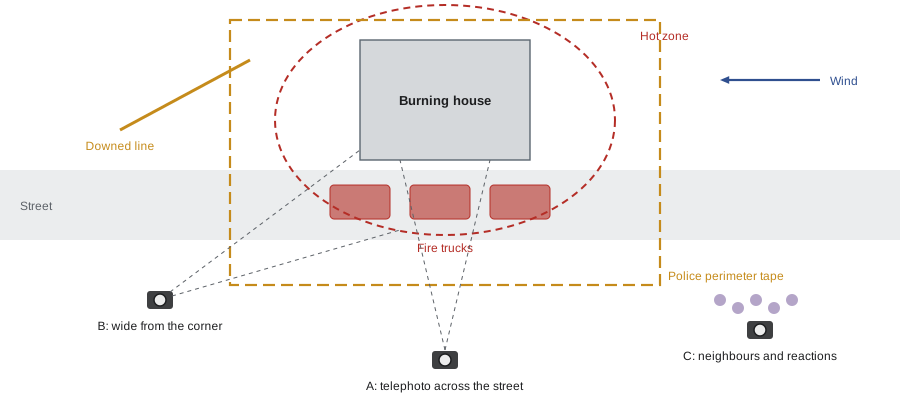
On arrival, take a few seconds to assess the scene. Where are the hazards: fire, smoke, traffic, downed power lines, unstable structures, hazardous materials, crowds, weapons? Where are the responders working, and where is the perimeter? Where is the light coming from? Who are the people involved, and where are witnesses and family members? A quick, wide establishing picture records the scene before it changes and is often the most useful image for editors.
Then work from wide to tight: an overview that shows the scale, medium shots of responders at work, and tighter pictures of details and faces where appropriate. Keep moving to find better angles, but stay outside restricted areas. Look behind you as well as at the event: reactions of onlookers, neighbours and families are often the most telling pictures.
Perimeters and police lines
Emergency services set up perimeters to protect the public, preserve evidence and give responders room to work. Photographers should respect perimeters and follow lawful directions from police and fire officials. In both Canada and the United States, journalists generally have no greater right of access than the public to an emergency scene, although many agencies give credentialed media some access or set up media staging areas. What you can see and photograph from a public place outside the perimeter, you can usually photograph.
Tension arises when officers order journalists away from places they are lawfully entitled to be, demand that they stop photographing, or seize equipment. The best practice is to stay calm, identify yourself as a journalist, comply with lawful orders to move, and document the encounter. Arguing on the spot rarely helps; complaints and legal challenges come later. Lesson 10 covers the specific rules on obstruction, recording police and seizure of journalistic material in each country.
| Do | Do not |
|---|---|
| Carry press identification and show it when asked | Cross tape or enter hot zones |
| Stay out of responders' way and off hoses and equipment | Use flash in responders' faces at night |
| Follow lawful directions to move | Argue with officers on the scene |
| Record names of officials who give orders | Hide what you are doing |
| Ask a media officer for access or a briefing | Assume your press pass grants special rights |
Safety first
No picture is worth serious injury. Specific hazards at common breaking news scenes include smoke inhalation and falling debris at fires, traffic at crashes, electrocution from downed lines after storms, flood water that may hide hazards and carry contamination, and crowd crush or projectiles at protests. Wear high-visibility clothing at road scenes, stay upwind of smoke and chemical releases, never enter flood water you cannot see through, and keep an exit route in crowds. Photographers covering civil unrest increasingly wear helmets, eye protection and respirators, and some take hostile environment training, discussed in Lesson 11.
Know your limits and your equipment. Long lenses let you work from a safe distance. A partner or colleague who knows where you are adds safety, and so does telling the desk your location and checking in regularly.
Lenses, distance and framing
Long lenses are the breaking news photographer's tool for working from outside a perimeter. The width of the scene a lens covers at a given distance follows from similar triangles:
where \( W \) is the width of the scene covered, \( d \) the distance to the subject, \( w \) the sensor width, and \( f \) the focal length. On a full-frame sensor, \( w = 36 \) mm.
Worked problem
Framing a firefighter from the perimeter
You are 60 m from a firefighter on a ladder, kept back by tape. You want the frame to be about 4 m wide so the firefighter and ladder fill it. What focal length do you need on a full-frame camera? With a 70–200 mm zoom at 200 mm, how wide is the frame?
Show solution
- Rearrange the formula: \( f = d w / W = 60 \times 36 / 4 = 540 \) mm.
- At 200 mm the frame is \( W = 60 \times 36 / 200 = 10.8 \) m wide.
- A 1.4× teleconverter gives 280 mm and a 7.7 m frame; cropping a high-resolution file to 4 m keeps about 4/10.8 ≈ 37 percent of the width.
Answer: About 540 mm. With a 200 mm lens you get a 10.8 m wide frame and must crop or move. Many breaking news photographers carry a 100–400 mm zoom for exactly this situation.
Exposure at night and in bad weather
Much breaking news happens at night, in rain or snow, or in smoke. Modern cameras handle high ISO well, so the usual approach is to raise ISO before slowing the shutter: moving responders need at least about 1/250 s to freeze, and handheld long lenses need fast shutter speeds to avoid shake. Emergency lights flash and change colour quickly, so expose for the scene, not the lights, and take several frames to catch the lights in a useful phase. Flash can help for close details but blinds responders, flattens scenes and draws attention, so use it sparingly and never in a responder's face.
Worked problem
Choosing night settings
At a night crash scene, a meter reading for the lit area gives f/2.8 at 1/60 s at ISO 1600. You want 1/250 s to freeze responders. What ISO do you need at f/2.8?
Show solution
- From 1/60 s to 1/250 s is about two stops faster (1/60, 1/125, 1/250).
- Each stop needs twice the ISO: 1600 → 3200 → 6400.
- So use ISO 6400 at f/2.8 and 1/250 s, and accept some noise.
Answer: ISO 6400. Noise is acceptable in news; blur from movement or camera shake usually is not.
Photographing people at the worst moment
Breaking news often means photographing people who are injured, frightened or grieving. Photographers must make split-second decisions: whether to photograph, how close to get, and whether to step in and help. Most ethics codes and newsroom guidelines accept that documenting suffering serves the public, but they also ask photographers to show compassion, avoid gratuitous intrusion and treat subjects with dignity. If you are the only person able to help someone in immediate danger, helping comes first. Lesson 11 covers trauma-informed practice and consent in detail.
Practical habits help: use longer lenses rather than pushing into people's space, avoid photographing identifiable victims in ways that humiliate them, be careful about photographing children, and identify yourself if asked. Families of victims may react angrily; respond calmly and respectfully, and do not argue.
Gathering caption information on scene
A breaking news picture without accurate information is of little use. While shooting, gather the facts: what happened, where exactly, when, who was involved, and the source of each fact. Note the names and titles of officials who speak, and ask people you photograph for their names and how to spell them, if appropriate. Record the time and location. If you cannot confirm a fact, say so to the desk and in the caption. Do not guess at injuries, causes or numbers; quote officials and attribute. Lesson 8 covers captions in detail.
Transmitting fast
Editors want the first pictures as soon as possible, sometimes within minutes. A common pattern is to send a few strong frames from the camera or phone early, then edit more carefully and send a fuller set. Many cameras can transfer images to a phone over Wi-Fi or by cable, and the phone can upload them over cellular data. Lesson 7 covers workflow and transmission. The key rule for breaking news is to send fast but never sacrifice accuracy: a wrong caption sent quickly does more harm than a correct one sent later.
Worked problem
How long will it take to file?
You want to send 5 JPEG images of 12 MB each from a scene over a cellular connection with an upload speed of 8 Mbit/s. Allow 20 percent overhead for protocol and retries. How long will the upload take? How long for 3 images resized to 4 MB each?
Show solution
- Data: 5 × 12 MB = 60 MB = 480 Mbit.
- With 20 percent overhead: 480 × 1.2 = 576 Mbit.
- Time: 576 / 8 = 72 s, about 1 minute 12 seconds.
- Three resized images: 3 × 4 × 8 × 1.2 = 115.2 Mbit, and 115.2 / 8 ≈ 14 s.
Answer: About 72 seconds for the full set, or about 14 seconds for three smaller files. Sending a small first batch quickly, then the full files, keeps the desk supplied while you keep shooting.
After the scene
When the immediate news is over, many breaking stories continue: investigations, funerals, rebuilding and anniversaries. Note contacts, locations and the names of people who agreed to be photographed, because follow-up stories often need the same people and places. Check how your pictures were used and whether captions were correct, and tell the desk at once if you find an error. Finally, take a moment to recognize the effect of what you saw; Lesson 11 explains why this matters for photographers' long-term health.
Breaking news skills improve with every call, but only if you review your work honestly. After a breaking assignment, compare your first file with the final published selection and with other outlets' coverage, and ask what you would do differently: a better position, an earlier wide frame, a more complete caption or a faster transmission.
Common mistakes
MistakeDriving dangerously or following emergency vehicles to reach a scene.
InsteadArrive safely; obey traffic laws and park out of responders' way.
MistakeStarting with tight shots and missing the overview.
InsteadMake a wide establishing frame first, then work tighter.
MistakeCrossing perimeter tape because you have a press card.
InsteadPress cards rarely give extra access rights; stay outside and ask for access.
MistakeUsing flash in responders' faces at night.
InsteadRaise ISO and use available light; use flash sparingly for close details.
MistakeSending pictures with guessed numbers of injured.
InsteadAttribute every fact to an official or witness, or leave it out.
Summary and key terms
- Breaking news needs speed, but safe arrival comes first.
- Read the scene for hazards, perimeters, light and people before shooting.
- Work from a wide establishing picture to medium and tight frames, and watch reactions.
- Respect perimeters and lawful directions; journalists generally have no special access rights.
- Use long lenses to work from a distance: \( W = dw/f \).
- Raise ISO before slowing the shutter at night; be sparing with flash.
- Gather accurate caption information and transmit a small first batch quickly.
Practice problems
Work each problem on paper first, then reveal the answer to check.
What should you photograph first on arriving at a scene?
Show answer
A wide establishing picture of the overall scene.
Do journalists generally have more access rights at emergency scenes than the public?
Show answer
No, though agencies may give credentialed media some access.
Width covered at 50 m with a 400 mm lens on full frame?
Show answer
50 × 36 / 400 = 4.5 m.
Focal length to cover 3 m at 30 m on full frame?
Show answer
30 × 36 / 3 = 360 mm.
Going from 1/125 s to 1/500 s at the same aperture, how much more ISO?
Show answer
Two stops: four times the ISO.
Why avoid flash in responders' faces?
Show answer
It blinds them and interferes with their work.
Name three items in a breaking news car kit.
Show answer
Any three of camera and lenses, spare batteries and cards, reflective vest, hard hat, boots, headlamp, first aid kit, water, ID.
Upload time for 40 MB at 10 Mbit/s with no overhead?
Show answer
320 Mbit / 10 = 32 s.
What should you do if you cannot confirm the number of injured?
Show answer
Attribute to an official or leave it out, and tell the desk.
When does helping someone come before photographing?
Show answer
When you are the only person able to help someone in immediate danger.
Lesson quiz · 5 questions
Score 60% or more to complete this lesson.
Create a free account to save your progress, take quizzes and earn a certificate.