
PHOT-320 · Lesson 9 of 12 · 27 min
Ethics codes, manipulation and AI-generated images
Photojournalism's value rests on trust: the audience's belief that a news photograph shows something that really happened, in the way it happened. Ethics codes spell out what that trust requires. This lesson covers the main codes used in Canada and the United States, the rules on staging and manipulation, cases where photographers broke those rules, and the new challenges of generative AI. It also covers the ethics of selection, conflicts of interest and minimizing harm.
The main codes
Several codes guide North American photojournalists. The National Press Photographers Association (NPPA) Code of Ethics, revised several times over the association's history, sets out standards specific to visual journalism. It asks photographers to be accurate and comprehensive in representing subjects, to resist being manipulated by staged photo opportunities, to be complete and provide context, to treat subjects with respect and dignity, and, in its best-known line, not to manipulate images or add or alter sound in any way that can mislead viewers or misrepresent subjects. It also asks photographers not to pay sources or subjects or reward them materially for information or participation.
The Society of Professional Journalists (SPJ) Code of Ethics, used widely in the United States, is organized around four principles: seek truth and report it, minimize harm, act independently, and be accountable and transparent. It says journalists should never deliberately distort facts or context, including visual information, and should clearly label illustrations and re-enactments.
In Canada, the Canadian Association of Journalists (CAJ) publishes Ethics Guidelines that cover accuracy, fairness, independence, respect for privacy and accountability, and say that journalists do not manipulate images in a way that misleads. The Canadian Press, the Associated Press, Reuters and other organizations publish their own detailed standards for photographs, and individual newspapers and broadcasters have codes that staff and freelancers must follow. Press councils in some provinces, and the Canadian National NewsMedia Council, hear complaints about member publications.
Contests set rules too. World Press Photo, a Dutch foundation that runs one of the best-known photojournalism contests, publishes a code of ethics and entry rules. For its 2026 contest it defined a photograph as an image of a real moment captured by light on a sensor or film, and excluded AI-generated images, generative fill, multiple exposures and composites, while allowing standard adjustments that do not change content. Entrants must supply original files, which are checked against the submitted images.
| Code | Body | Key visual rules |
|---|---|---|
| NPPA Code of Ethics | National Press Photographers Association (US) | No misleading manipulation; resist staged photo ops; no payment to subjects |
| SPJ Code of Ethics | Society of Professional Journalists (US) | No distortion of visual facts; label illustrations and re-enactments |
| CAJ Ethics Guidelines | Canadian Association of Journalists | No misleading manipulation; accuracy, fairness, privacy |
| Agency standards | The Canadian Press, AP, Reuters and others | Detailed rules on editing, staging, captions and AI |
| Contest rules | World Press Photo and others | Defined allowed adjustments; originals checked; AI excluded |
Staging and directing
Staging means arranging, directing or re-enacting a scene and presenting it as if it happened naturally. It includes asking people to repeat an action, moving objects into the frame, posing people as if candid, and recreating an event that the photographer missed. Staging is forbidden in news and documentary photography. It differs from portraiture, where the subject knows they are being photographed and the picture is presented as a portrait.
Photo opportunities, events arranged by politicians, companies or campaigns for cameras, are a related issue. Photographing them is often necessary, but photographers should show what is really happening, avoid making the event look more spontaneous than it was, and look for pictures that reveal the arrangement when that is part of the story. The NPPA code asks photographers to resist being manipulated by staged photo opportunities.
Manipulation
Manipulation means changing the content of an image after capture: adding, removing, moving or altering elements, combining images, or editing so heavily that the image misleads. Digital tools made manipulation easy and hard to detect, and the history of the digital era includes many cases where photographers lost their jobs or reputations over it. These cases, described here without reproducing the images, illustrate the lines that were crossed.
In 1982 National Geographic digitally moved one of the pyramids of Giza closer to another so a horizontal photograph would fit its vertical cover, an early warning of what digital tools could do. In 1994 Time magazine published a cover using a police booking photograph of O. J. Simpson that had been darkened and blurred, while Newsweek ran the same photograph unaltered beside it on newsstands; Time was widely criticized and apologized. In 2003 a Los Angeles Times photographer covering the war in Iraq combined two frames into one to improve the composition and was fired when the composite was discovered. In 2006 Reuters withdrew hundreds of images by a freelancer in Lebanon after he cloned extra smoke into a picture of an air strike. In 2014 the Associated Press cut ties with a freelance photographer in Syria who had removed a colleague's camera from a frame. In 2015 World Press Photo withdrew an award after finding that a winning story included staged scenes, and the contest has disqualified many entries since for excessive processing.
The pattern in these cases is consistent. The changes often seemed small or aesthetic to the photographer: a cleaner composition, a stronger sky, a distracting object removed. But each changed what the picture showed, and once discovered, each damaged trust in all of the photographer's and the publication's work.
The grey zone
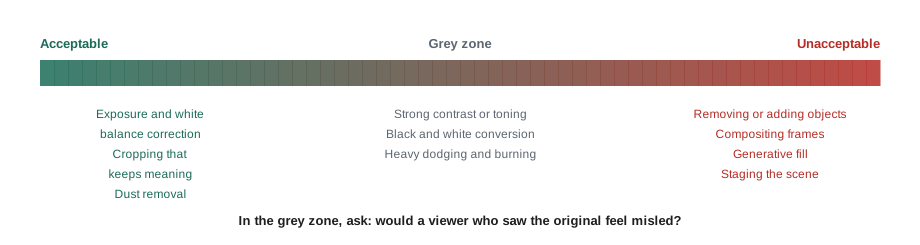
Some edits fall between clearly acceptable and clearly forbidden. Strong contrast, deep shadows and heavy toning can change a picture's mood and, at the extreme, hide or emphasize content. Black and white conversion is generally accepted, but it removes information. Cropping can change meaning, for example by removing a person who changes the story's context, such as an officer standing calmly behind a protester. Selective focus and lens choice shape what is emphasized. Contest juries and newsroom editors judge these cases by asking whether the processing changes what a reasonable viewer understands about the scene.
A practical test is to compare the edited image with the original side by side and ask: would a viewer who saw the original feel misled by the edited version? If the answer is yes, or maybe, the edit has gone too far.
Generative AI
Generative AI tools can now create realistic images of events, people and places from text prompts, and can extend, alter or fill in parts of real photographs. For photojournalism this raises three problems. First, AI images can be passed off as news photographs, spreading false information. Second, AI editing tools built into ordinary software, such as generative fill or AI-powered object removal, make content changes easy to make by accident or habit. Third, the existence of convincing fakes lets people dismiss real photographs as fake, a problem researchers call the liar's dividend.
News organizations have responded with clear rules. Most major agencies and publishers prohibit using generative AI to create or alter news photographs, and require any AI-generated illustration to be clearly labelled as such and not to depict real news events in a realistic way. Many also restrict AI-powered editing features in software to non-content corrections. Photographers should know which tools in their software use generative AI and avoid them for news work. Content credentials and the IPTC digital source type field, covered in Lesson 7, help record whether AI was used.
Detecting AI images is difficult. Visual clues such as malformed hands, garbled text or inconsistent lighting are becoming rarer as tools improve. Automated detectors exist but make mistakes, and their usefulness depends on how common fakes are among the images being checked.
Worked problem
How reliable is an AI detector?
A newsroom receives 1,000 images from the public during a breaking news event. Suppose 2 percent are AI-generated fakes. A detector correctly flags 95 percent of fakes and wrongly flags 5 percent of real images. If an image is flagged, what is the probability it is actually fake?
Show solution
- Fakes: 1,000 × 0.02 = 20. Real: 980.
- Fakes correctly flagged: 20 × 0.95 = 19.
- Real images wrongly flagged: 980 × 0.05 = 49.
- Total flagged: 19 + 49 = 68.
- Probability that a flagged image is fake: 19 / 68 ≈ 0.28, or 28 percent.
Answer: Only about 28 percent of flagged images are actually fake; most flags are false alarms because real images vastly outnumber fakes. A detector result is a reason to investigate, not a verdict. Verification still depends on sources, originals and context.
Selection, framing and fairness
Ethics is not only about editing. Which moment a photographer chooses, from which position, with which lens, and which frame an editor selects, all shape meaning. A politician caught mid-blink can look foolish; a low angle can make someone look powerful; a picture of a single damaged house can make a whole town look destroyed. Ethics codes ask photographers to be fair and to represent events and people accurately and comprehensively. This does not mean every picture must be flattering or neutral, but that the overall coverage should be fair and should not distort.
Conflicts of interest and independence
Photographers should avoid situations that compromise independence or appear to. Common issues include accepting gifts, free travel or access from organizations they cover; paying subjects for pictures or access; photographing events for organizations they belong to or campaigns they support; and selling news pictures for advertising use by the same subjects. Many publications forbid staff from political activity that could be seen as taking sides. Freelancers who also do commercial or advocacy work should disclose relationships to editors and avoid covering clients as news.
Minimizing harm
The SPJ code's principle to minimize harm applies especially to photographs, which can be more intrusive and lasting than words. Questions to ask include: Does the picture's news value justify its intrusion? Are the people in it vulnerable, such as children, victims of crime or people in crisis? Could publication expose them to danger, harassment or discrimination? Is a graphic image necessary to tell the story, and if so, how should it be presented, with warnings or placement that lets readers choose? Lesson 11 develops these questions in the context of trauma and consent.
Worked problem
Weighing a graphic image
An editor considers a graphic photograph from a mass casualty event. Using a simple scale of 0 to 3, the editor scores public interest 3 (it shows the scale of a major event), necessity 2 (other pictures show the scene less clearly), identifiability of victims 3 (faces are visible), and likely harm to families 3. The newsroom's guideline is to publish only if public interest plus necessity exceeds identifiability plus harm, or if the harm can be reduced. What should the editor do?
Show solution
- Public interest plus necessity: 3 + 2 = 5.
- Identifiability plus harm: 3 + 3 = 6.
- 5 is less than 6, so the guideline says do not publish as is.
- Alternatives: choose a frame where victims are not identifiable (identifiability 0, harm 1, total 1), or publish behind a warning with careful placement.
Answer: Do not publish the image as is. A different frame that shows the scale without identifiable victims meets the guideline. Scoring does not replace judgement, but it makes the reasoning explicit and consistent.
Common mistakes
MistakeAsking subjects to repeat an action for a better frame.
InsteadWait for natural moments; never stage news or documentary pictures.
MistakeCloning out a distracting object because it seems minor.
InsteadAny change to content breaks the rules, however small.
MistakeUsing generative fill to extend a background for a layout.
InsteadCrop or choose another frame; generative tools alter content.
MistakeTreating an AI detector's flag as proof.
InsteadUse it as a prompt to investigate sources and originals.
MistakeAccepting free travel from a company you are covering.
InsteadDecline or disclose, following your publication's rules.
Summary and key terms
- The NPPA, SPJ and CAJ codes, agency standards and contest rules govern news photographs.
- Staging, directing a scene and presenting it as candid, is forbidden in news and documentary.
- Manipulation changes content; the cases that ended careers often began with small aesthetic changes.
- In the grey zone, ask whether a viewer who saw the original would feel misled.
- Generative AI must not create or alter news photographs; AI illustrations must be clearly labelled.
- AI detectors produce many false alarms when fakes are rare; verification still matters most.
- Fair selection, independence and minimizing harm are as important as honest editing.
Practice problems
Work each problem on paper first, then reveal the answer to check.
Name the four principles of the SPJ code.
Show answer
Seek truth and report it, minimize harm, act independently, and be accountable and transparent.
What is staging?
Show answer
Arranging or re-enacting a scene and presenting it as natural.
Is removing a sensor dust spot acceptable?
Show answer
Yes; it corrects the camera, not the scene.
Is removing a bystander acceptable?
Show answer
No; it changes the content.
What is the liar's dividend?
Show answer
The ability to dismiss real images as fake because fakes exist.
100 images, 10 fakes, detector catches 90 percent and falsely flags 10 percent of real. How many flags?
Show answer
9 true plus 9 false = 18 flags.
In that case, what share of flags are real fakes?
Show answer
9 / 18 = 50 percent.
Give a practical test for a grey-zone edit.
Show answer
Would a viewer who saw the original feel misled by the edited version?
Why do ethics codes discourage free travel from subjects?
Show answer
It compromises or appears to compromise independence.
How should an AI-generated illustration be presented?
Show answer
Clearly labelled, and not as a realistic depiction of a real news event.
Lesson quiz · 5 questions
Score 60% or more to complete this lesson.
Create a free account to save your progress, take quizzes and earn a certificate.