
PHOT-320 · Lesson 6 of 12 · 28 min
Sports and event photojournalism
Sports and organized events, from hockey games and marathons to concerts, political rallies and parades, make up a large share of news photography. They are planned, so photographers can prepare, but the decisive moments last a fraction of a second and the best positions are limited and controlled. This lesson covers accreditation and positioning, the technical demands of action photography including the arithmetic of motion blur, anticipating peak moments, telling the story beyond the action, and working to deadline at events.
Accreditation and access
Most professional and major amateur sporting events, and many concerts and political events, require accreditation. Organizers issue credentials, often called passes, to journalists from recognized outlets, usually on request from an editor in advance. Credentials define where you can go: the field level, the photo positions, the mixed zone where athletes speak to media, or only the press seats. They also come with conditions: limits on video, restrictions on commercial use of images, and sometimes rules on transmission or on which songs of a concert may be photographed.
Read the terms carefully. Some event organizers have tried to impose terms that claim copyright in journalists' pictures or restrict their editorial use; professional associations and news organizations push back against such terms. Breaking credential rules can cost you access for your whole organization. Freelancers often find it hard to get credentials without an assignment letter from a publication.
Positions and planning
Know the venue and the sport. In hockey, photographers shoot through holes cut in the glass or from elevated positions; in football, they work the sidelines and end zones; in basketball, from the baseline; in track and field, from designated spots at the finish line and along the straight. Each position favours certain plays. Plan which part of the action you want, consider the background and light, and arrive early to claim a good spot if positions are first-come.
Light matters indoors and out. Arenas and gyms vary widely in brightness and colour, and some LED lighting flickers at a rate that causes banding at fast shutter speeds; many cameras have anti-flicker modes. Outdoor day games bring harsh light and shadows; night games need high ISO. Check white balance and exposure before the event starts.
Freezing action: the arithmetic of motion blur
A moving subject blurs if it moves too far on the sensor during the exposure. The distance it moves on the sensor depends on its speed, the shutter time and the magnification:
where \( b \) is the blur on the sensor, \( v \) the subject's speed across the frame, \( t \) the exposure time, \( f \) the focal length and \( d \) the distance to the subject. Dividing \( b \) by the pixel pitch gives the blur in pixels. As a rough guide, blur of fewer than about two or three pixels at full resolution looks sharp in publication.
Worked problem
Freezing a sprinter
A sprinter runs at 10 m/s across the frame, 25 m away, photographed with a 400 mm lens on a full-frame camera with a pixel pitch of 4.4 µm (about 45 megapixels). How much blur is there at 1/1,000 s and at 1/4,000 s?
Show solution
- At 1/1,000 s: \( b = 10 \times 0.001 \times 0.4 / 25 = 0.00016 \) m = 0.16 mm = 160 µm.
- In pixels: 160 / 4.4 ≈ 36 pixels.
- At 1/4,000 s: blur is a quarter, about 40 µm, or 9 pixels.
- Limbs move faster than the body, so arms and legs blur more.
Answer: About 36 pixels at 1/1,000 s and 9 at 1/4,000 s. At full resolution some blur remains even at 1/4,000 s, but at publication size, where the image is reduced several times, 1/2,000 to 1/4,000 s looks sharp for the body.
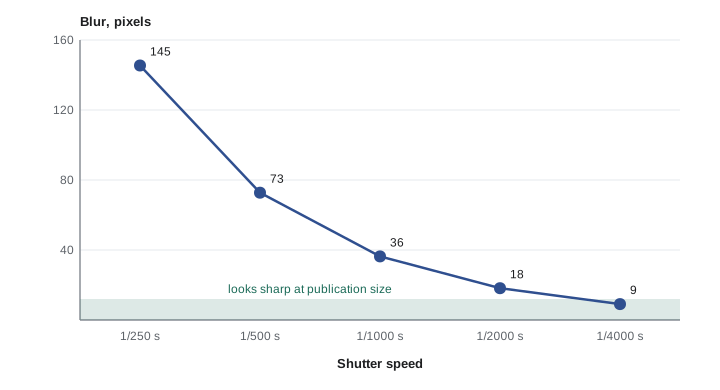
Moving toward or away from the camera causes less sideways blur than crossing the frame, which is why head-on action can be frozen at slower speeds. Panning, following the subject with the camera during a slower exposure, deliberately blurs the background while keeping the subject relatively sharp, giving a sense of speed. A typical panning speed for runners or cyclists is 1/30 to 1/125 s; expect many misses.
Focus, burst rates and anticipation
Modern cameras track focus on moving subjects, recognize faces, eyes and sometimes specific sports, and shoot bursts of 20 or more frames a second, with some electronic shutters faster still. These tools help, but they do not replace anticipation. The decisive moment, a ball at the bat, a goal, a finish-line lunge, is often a single frame. Photographers who know the sport position themselves where the action will happen and start shooting before the peak.
Worked problem
Frames during a peak moment
A basketball dunk's peak, when the player's hand is at the rim with the ball, lasts about 0.15 s. How many frames will a camera capture during that peak at 10, 20 and 30 frames per second?
Show solution
- At 10 fps: 0.15 × 10 = 1.5, so one or two frames.
- At 20 fps: 0.15 × 20 = 3 frames.
- At 30 fps: 0.15 × 30 = 4.5, so four or five frames.
Answer: One or two frames at 10 fps, three at 20 fps and four or five at 30 fps. Higher frame rates raise the odds of catching the peak, but only if the photographer is pointed at the right place at the right time; they also multiply the editing load.
Lenses and working distance
Sports photographers carry long, fast lenses: 300 mm f/2.8, 400 mm f/2.8 or zooms such as 100–400 mm and 70–200 mm f/2.8, often on two bodies, plus a wide lens for celebrations and crowds. The field of view formula from Lesson 4, \( W = dw/f \), tells you how much of the field a lens covers. A full-frame camera with a 400 mm lens 30 m from the action covers \( 30 \times 36 / 400 = 2.7 \) m, enough for one or two players. Remote cameras, triggered by radio, can be placed behind goals, above the field or at the finish line to give angles a photographer cannot reach in person; they need permission and secure mounting.
| Sport or event | Typical lens | Typical shutter | Notes |
|---|---|---|---|
| Hockey | 70–200 mm f/2.8 through glass | 1/1,000 s or faster | Clean the glass; watch for flicker |
| Football or soccer | 400 mm f/2.8 plus 70–200 mm | 1/1,600 s | Shoot toward the action |
| Basketball | 24–70 mm and 70–200 mm f/2.8 | 1/1,000 s | Baseline position; remotes above the rim |
| Track sprint | 300–400 mm | 1/2,000–1/4,000 s | Finish line position is assigned |
| Concert | 24–70 mm and 70–200 mm f/2.8 | 1/250–1/500 s | Often only the first songs; no flash |
| Political rally | 24–70 mm and 100–400 mm | 1/250–1/500 s | Riser positions; watch the crowd too |
Beyond the action
The best sports coverage shows more than plays. Reactions, the joy of winners and despair of losers, fans, coaches, injuries and emotional moments on the bench often make stronger and more memorable pictures than the action itself. A good habit is to keep shooting after the whistle: celebrations, handshakes and walks off the field. At events such as rallies and concerts, the audience is part of the story; a picture of the crowd's reaction can say more than another picture of the speaker.
Features about athletes and events, such as an amateur team's early-morning practice or a community's preparations for a festival, add depth. So do pictures that show the issues around sport and events: costs, safety, injuries, inclusion and the economics of facilities.
Events with a political or social edge
Political rallies, protests and some cultural events require extra care. Organizers may restrict photographers to risers or pens and try to control the images. Crowds can be hostile to journalists. Pictures can be used to identify participants, which raises questions about their safety, especially at protests. Photojournalists should be accurate about crowd sizes, avoid making events look larger or smaller than they were by choice of angle and crop, and caption fairly. A tight shot of a small group of supporters can suggest a crowd; a wide shot can show the empty seats.
Worked problem
Estimating crowd size fairly
A rally fills an area of about 60 m by 40 m. Crowd researchers often use densities of about 1 person per square metre for a loose crowd, 2 for a dense crowd and 4 for a very packed crowd. From your elevated position, the crowd looks dense in the front third and loose elsewhere. Estimate the crowd.
Show solution
- Total area: 60 × 40 = 2,400 square metres.
- Front third: 800 square metres at 2 per square metre = 1,600 people.
- Remaining 1,600 square metres at 1 per square metre = 1,600 people.
- Estimate: about 3,200 people.
Answer: About 3,000 to 3,500 people. Photographers rarely publish their own estimates; attribute crowd figures to organizers, police or independent counts, and make sure your pictures do not exaggerate or minimize the crowd.
Deadlines at events
Many events end close to deadline, especially evening games for print editions. Photographers often transmit during the event: at intermissions, at half-time, or continuously from the camera to an editor working remotely, who captions and moves the pictures. Wire services at major events use teams of photographers and editors, with cameras sending images to editing stations within seconds. Even at small events, sending a few pictures at half-time lets the desk start building the story. Lesson 7 covers workflow and transmission.
A simple game plan
Before a game, write a short plan: the positions you will use in each period or half, the players likely to matter, the plays to watch for, and when you will transmit. For a hockey game, that might mean starting at the glass in the attacking zone of the home team, moving to an elevated position for the second period when the light on the ice is more even, and returning to the glass for the third period and the post-game celebration. Plans change with the game, but having one keeps you from drifting.
Covering community and amateur sport
Not all sports photography happens in professional venues. School games, community leagues, para sports and amateur competitions are important to local audiences and often allow closer access and more relaxed conditions. They also bring specific responsibilities: many participants are children, so follow your publication's policy on identifying minors, and get names and spellings from coaches or organizers. Light in community rinks and gyms is often poor and uneven, so expect to work at high ISO and look for the brightest part of the playing area. These assignments are good training grounds for timing and anticipation.
Editing sports to deadline
Sports editing rewards speed and decisiveness. Choose the frame that shows the decisive play or the peak of emotion, check that the ball or puck is visible where it matters, confirm player identities against rosters and numbers, and caption with the score and time of the play where relevant. A sharp, well-timed picture of the winning goal with an accurate caption is worth more to the desk than a dozen near-identical action frames sent later.
Common mistakes
MistakeShooting only the action and putting the camera down at the whistle.
InsteadKeep shooting reactions, celebrations and dejection.
MistakeTrusting autofocus and burst rates instead of anticipating.
InsteadKnow the sport and be pointed at the right place before the peak.
MistakeUsing 1/500 s for fast action crossing the frame.
InsteadCalculate blur; sprinters and skaters need 1/2,000 s or faster.
MistakeSigning credential terms that give away copyright without reading them.
InsteadRead terms, and consult your editor or association about problems.
MistakeFraming a small group tightly to suggest a large crowd.
InsteadShow crowds fairly and attribute crowd counts.
Summary and key terms
- Sports and events need accreditation; credentials define access and conditions.
- Know the venue, positions, light and flicker before the event.
- Motion blur on the sensor is \( b = vtf/d \); compare it with pixel pitch.
- Fast burst rates help, but anticipation catches the peak moment.
- Long, fast lenses and remote cameras reach the action; \( W = dw/f \) sets coverage.
- Reactions, fans and features often tell the story better than plays.
- At political events, show crowds fairly and attribute counts; transmit during events.
Practice problems
Work each problem on paper first, then reveal the answer to check.
Blur on the sensor for 5 m/s, 1/1,000 s, 200 mm, 20 m?
Show answer
5 × 0.001 × 0.2 / 20 = 0.00005 m = 50 µm.
Convert 50 µm of blur to pixels at 5 µm pitch.
Show answer
10 pixels.
What happens to blur if shutter speed doubles?
Show answer
It halves.
Frames captured at 20 fps during a 0.2 s peak?
Show answer
4 frames.
Width covered by a 300 mm lens at 30 m on full frame?
Show answer
30 × 36 / 300 = 3.6 m.
Why does head-on action blur less?
Show answer
Movement toward the camera causes little sideways movement on the sensor.
Give a typical panning shutter speed for cyclists.
Show answer
About 1/30 to 1/125 s.
What should you do after the final whistle?
Show answer
Keep shooting reactions and celebrations.
Estimate a crowd in 1,000 square metres at 2 per square metre.
Show answer
About 2,000 people.
Why read credential terms?
Show answer
They may restrict use or claim rights, and breaking them can cost access.
Lesson quiz · 5 questions
Score 60% or more to complete this lesson.
Create a free account to save your progress, take quizzes and earn a certificate.