
PHOT-330 · Lesson 1 of 12 · 25 min
The landscape and nature photography genre
Landscape and nature photography is one of the oldest and most popular genres in the medium. It ranges from grand mountain vistas at dawn to the pattern of frost on a leaf, from a wolf crossing a frozen river to a single wildflower on the prairie. This course treats landscape and nature as a professional and artistic practice: it builds on the exposure, lens and lighting skills from earlier courses and adds the planning, fieldcraft, technique, ethics and safety that working outdoors demands. This first lesson maps the genre, looks at its traditions in Canada and the United States, describes the markets for nature images and sets out the habits that separate deliberate nature photographers from people who simply carry a camera on a hike.
What counts as landscape and nature photography
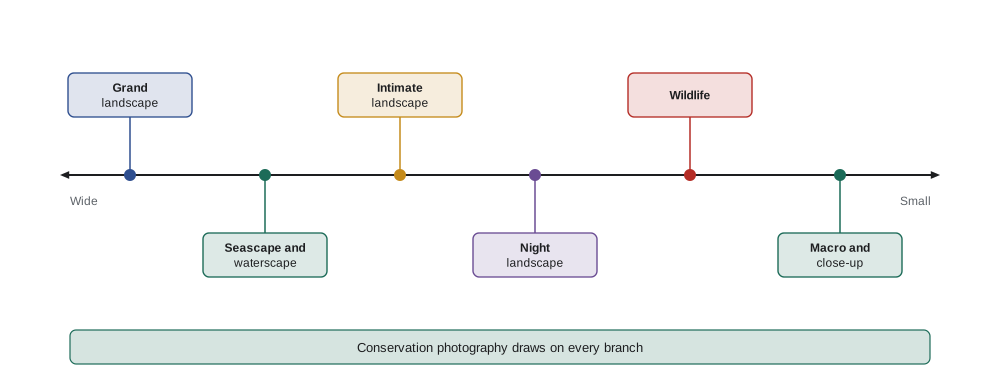
The genre has several overlapping branches. Grand landscapes show wide scenes with a strong sense of place and depth: mountains, coastlines, forests, plains and deserts. Intimate landscapes isolate a smaller part of the land, such as a patch of autumn aspens, a pattern in sand or the texture of a cliff, often with no horizon at all. Seascapes and waterscapes concentrate on oceans, lakes, rivers and waterfalls and often use long exposures. Night landscapes combine the land with stars, the Milky Way or the aurora. Wildlife photography shows animals in their environment, from portraits to behaviour. Macro and close-up nature works at small scales: insects, plants, fungi and ice. Conservation photography uses all of these to support the protection of places and species.
These branches use different tools and skills. A grand landscape might need a wide lens, a tripod, a polarizer and a plan for the light weeks in advance. A wildlife image might need a 600 mm lens, a hide, fast autofocus and days of patience. A macro image might need a dedicated macro lens, a diffuser and dozens of frames for focus stacking. Most nature photographers specialize, but the best understand the whole genre, because light, composition and ethics run through all of it.
Traditions in Canada and the United States
Landscape images played an important part in how both countries imagined themselves. In the nineteenth century, survey and railway photographers carried large view cameras into the mountains and the West. Their pictures of the Rockies, Yosemite and the Grand Canyon circulated widely and helped build public support for protecting those places. The creation of national parks in both countries, starting with Yellowstone in 1872 and Banff in 1885, was tied to the idea of scenic landscapes that people could visit and see.
In Canada, painting shaped the visual idea of the land as much as photography did. The Group of Seven, a circle of painters active mainly in the 1920s, depicted the rugged shield country of northern Ontario, the Rockies and the Arctic with bold shapes and strong colour. Their work still influences how many Canadian photographers frame wind-bent pines, rocky shorelines and autumn hills. Later Canadian photographers built careers documenting the country's parks, wildlife and northern regions, often through magazines, books and public agencies. Indigenous artists and photographers have increasingly brought their own perspectives to images of the land, which are often about relationship, use and stewardship rather than untouched wilderness.
In the United States, the most famous landscape photographer is Ansel Adams, whose black-and-white images of Yosemite and the American West, made from the 1920s to the 1960s, set a standard for technical control and dramatic tone. Adams and Fred Archer developed the Zone System, a method of planning exposure and development so that each part of a scene lands on a chosen tone. Adams was also an advocate for wilderness protection. Other American traditions include the colour work of photographers who popularized large-format colour landscapes in magazines and books, and the New Topographics movement of the 1970s, which deliberately photographed ordinary, altered landscapes such as suburbs and industrial sites to question the idea of pristine nature.
These traditions matter for a working photographer because audiences carry them in their heads. A tightly framed mountain peak at sunrise reads as heroic; a muddy roadside clearing reads as critical. Knowing the history lets you work with those expectations or against them on purpose.
Contemporary practice
Today, landscape and nature photography is shaped by digital cameras with wide dynamic range, high-resolution sensors and fast autofocus; by drones; by smartphone cameras that handle many scenes well; and above all by social media. Iconic viewpoints that once took effort to find are now shared, geotagged and visited by thousands of people. That has created new problems, discussed in Lesson 10: crowding, trampled vegetation, disturbed wildlife and a sameness of images taken from the same spots.
Many contemporary photographers respond by working closer to home, returning to the same places across seasons, favouring intimate scenes over famous vistas, and using their images to tell stories about change: wildfire, glacial retreat, invasive species or restoration. Others work in documentary or scientific roles, photographing research, species surveys or environmental impacts. The best work tends to come from deep knowledge of a place rather than a quick visit.
Markets for nature images
Nature photography can be a hobby, a side income or a career, but full-time careers are rare and usually built from several income streams. Common sources include:
- Assignments for magazines, conservation organizations, tourism boards and parks agencies, often with travel and expenses covered.
- Licensing existing images through agencies, direct sales to publishers, or stock libraries, though stock prices have fallen sharply.
- Fine art prints sold through galleries, markets, websites and exhibitions.
- Workshops and tours that teach others in the field, which for many professionals are the largest income source.
- Books, courses and online content, including video and paid communities.
- Brand work with outdoor gear makers, tourism operators and conservation groups.
- Scientific and conservation work for researchers, agencies and non-profits, where accuracy and documentation matter more than drama.
| Income stream | Typical strengths | Typical challenges |
|---|---|---|
| Assignments | Paid travel, prestige, editorial reach | Few outlets, competitive, irregular |
| Licensing and stock | Passive income from an archive | Low prices, large libraries needed |
| Fine art prints | High margin per sale | Marketing, framing and inventory costs |
| Workshops and tours | Reliable demand, uses expertise | Permits, insurance, guiding skills |
| Online content and courses | Scales to large audiences | Constant production, platform risk |
| Scientific and conservation work | Meaningful, steady with good clients | Modest pay, strict accuracy needs |
Worked problem
A mixed income plan
A nature photographer expects the following in a year: 6 workshops at $1,800 net each, 25 print sales at an average margin of $140, licensing income of $3,200 and two assignments at $2,500 each. What is the total, and what share comes from workshops?
Show solution
- Workshops: 6 × 1,800 = $10,800.
- Prints: 25 × 140 = $3,500.
- Licensing: $3,200. Assignments: 2 × 2,500 = $5,000.
- Total: 10,800 + 3,500 + 3,200 + 5,000 = $22,500.
- Workshop share: 10,800 / 22,500 = 0.48, or 48 percent.
Answer: $22,500, with workshops providing 48 percent. Like many nature photographers, this one depends on teaching more than on selling images, which is why permits, insurance and guiding skills (Lessons 10 and 11) matter for a career.
Habits of a deliberate nature photographer
Good nature photography rarely happens by accident. Experienced photographers share several habits:
- They plan. They study maps, sun and moon positions, tides, weather forecasts and seasonal events, and they arrive early (Lesson 2).
- They return. They visit the same places repeatedly in different seasons and conditions, learning where the light falls and when animals move.
- They know their subjects. Wildlife photographers read field guides and research papers; landscape photographers learn geology, botany and weather.
- They control their tools. They can set focus, exposure and filters by feel, in the dark and the cold, so that technique never stops them when the moment arrives.
- They edit hard. They keep only the strongest frames and are honest about what was done to them (Lesson 12).
- They put the subject first. They follow the rule that the welfare of wildlife and the land comes before the picture (Lesson 10).
- They stay safe. They prepare for weather, terrain and wildlife and tell someone where they are going (Lesson 11).
Light and season as subjects
In landscape work, light is often the real subject. The same lake can look flat and dull at noon, glowing at sunrise, moody under storm clouds and magical in fog. The low sun of early morning and late evening gives warm colour, long shadows and texture; overcast light is soft and good for forests, waterfalls and intimate scenes; dramatic weather such as clearing storms, mist and snow often produces the most memorable images. Earlier courses covered the basics of sun position and twilight (PHOT-311); this course applies them to wild places, where you cannot move the subject and must instead choose the time and place.
Season matters as much as time of day. In much of Canada and the northern United States, the year brings dramatic changes: spring melt and wildflowers, summer green and long days, autumn colour, and winter snow, ice and short days with low sun. At high latitudes, the low winter sun can give golden light all day, while summer nights barely get dark. Planning around these cycles is the subject of the next lesson.
Equipment overview
Nature photography does not require the most expensive gear, but some tools make a real difference. A typical kit includes a camera body with good dynamic range and weather sealing; a wide-angle zoom for landscapes; a standard or short telephoto zoom; a long telephoto for wildlife; a macro lens for close-ups; a sturdy tripod with a good head; filters, especially a circular polarizer and neutral density filters; a remote release; spare batteries and memory cards; and weather protection for both the camera and the photographer. Lessons 4 to 9 explain how each of these is used.
| Branch | Core lenses | Key accessories |
|---|---|---|
| Grand landscape | 14 to 35 mm, 24 to 70 mm | Tripod, polarizer, ND and graduated filters |
| Intimate landscape | 70 to 200 mm | Tripod, polarizer |
| Night sky | Fast 14 to 24 mm | Tripod, headlamp with red light, lens heater |
| Wildlife | 100 to 600 mm or longer | Gimbal head, beanbag, hide, camouflage |
| Macro | 90 to 105 mm macro | Diffuser, flash, focusing rail |
Responsibility and representation
Nature photographs shape what people think about wild places and animals. A photograph can inspire people to protect a landscape or encourage crowds that damage it. An image of a tame-looking fox fed by tourists can teach viewers that feeding wildlife is harmless, when it often leads to the animal being killed. A composite that adds a moon or an animal can mislead viewers about what nature looks like. Throughout the course, we will return to three questions: Is this image honest about what happened? Did making it harm the subject or the place? What will it encourage others to do?
How this course fits the program
This course builds on PHOT-201 for exposure and lenses, PHOT-302 for business and releases and PHOT-311 for sun position, twilight and perspective. Its lessons follow the work of a nature photographer from planning through technique, ethics, safety and presentation, ending in a seasonal portfolio project.
Common mistakes
MistakeTreating nature photography as luck: hiking and hoping something happens.
InsteadPlan for light, season and subject, and return to places repeatedly.
MistakeCopying famous viewpoints exactly because they are popular online.
InsteadLearn from them, then look for your own compositions and lesser-known places.
MistakeAssuming expensive gear is the main ingredient.
InsteadFieldcraft, timing and composition matter more; buy gear to solve specific problems.
MistakeSeeing ethics as an afterthought once the picture is made.
InsteadPut the welfare of wildlife and the land first, before and during the shoot.
MistakePlanning a career around print sales alone.
InsteadExpect several income streams, often led by teaching and assignments.
Summary and key terms
- Landscape and nature photography includes grand and intimate landscapes, waterscapes, night skies, wildlife, macro and conservation work.
- Nineteenth-century survey photographs helped build support for national parks such as Yellowstone and Banff.
- The Group of Seven shaped the Canadian visual idea of the land; Ansel Adams and the Zone System shaped American landscape photography.
- Social media has made famous viewpoints crowded and images more similar; many photographers now favour depth in one place.
- Income usually comes from several streams, with workshops often the largest.
- Deliberate photographers plan, return, learn their subjects, control their tools and put the subject first.
- Light and season are often the real subjects of landscape images.
Practice problems
Work each problem on paper first, then reveal the answer to check.
Name the branch of nature photography that isolates small parts of the land.
Show answer
Intimate landscape.
Which national park was created first, Yellowstone or Banff?
Show answer
Yellowstone, in 1872; Banff followed in 1885.
What did the Zone System help photographers control?
Show answer
How scene tones are placed on chosen print values through exposure and development.
What did the New Topographics photographers choose to show?
Show answer
Ordinary, altered landscapes such as suburbs and industrial sites.
A photographer runs 4 workshops at $2,000 net and sells 10 prints at $150 margin. Total?
Show answer
8,000 + 1,500 = $9,500.
Give two problems caused by geotagged viewpoints.
Show answer
Crowding and trampled vegetation, among others such as disturbed wildlife.
Why is overcast light useful in forests?
Show answer
It is soft and reduces harsh contrast between highlights and shadows.
Which lens range suits wildlife?
Show answer
Long telephoto, about 100 to 600 mm or longer.
List three questions to ask about any nature image.
Show answer
Is it honest? Did it harm the subject or place? What will it encourage others to do?
Why do experienced photographers return to the same places?
Show answer
To learn how light, seasons and wildlife behave there and find stronger images.
Lesson quiz · 5 questions
Score 60% or more to complete this lesson.
Create a free account to save your progress, take quizzes and earn a certificate.