
PHOT-330 · Lesson 9 of 12 · 33 min
Macro and close-up nature photography
Some of the most surprising nature photographs show the small world: the compound eye of a dragonfly, dew drops on a spider's web, the gills of a mushroom, frost crystals on a window or the structure of a wildflower. Macro and close-up photography reveals details invisible at normal viewing distances and can be practised in a backyard, a city park or a forest edge. This lesson applies the close-up optics introduced in PHOT-310 for products to living subjects outdoors: magnification and working distance, equipment options, the very shallow depth of field at high magnification, focus stacking in the field, light and flash, wind, and the ethics of photographing insects, plants and fungi without harming them.
Magnification and what counts as macro
Magnification is the ratio of the size of the subject's image on the sensor to its real size. A 1:1 ratio, or 1×, means a 10 mm insect makes a 10 mm image on the sensor; on a full-frame sensor 36 mm wide, it fills just over a quarter of the width. True macro photography usually means magnifications of about 1:2 (0.5×) to 1:1 or more; anything less is close-up photography. Some specialized lenses reach 2× to 5×.
The field of view at magnification \( m \) on a sensor of width \( w \) is simply \( w / m \). At 1:1 on full frame, the frame covers 36 × 24 mm; at 0.5×, 72 × 48 mm; at 2×, 18 × 12 mm.
Worked problem
Choosing a magnification
A photographer wants a bumblebee about 18 mm long to fill about 60 percent of the width of a full-frame image. What magnification is needed?
Show solution
- Desired frame width: 18 / 0.6 = 30 mm.
- Magnification: \( m = 36 / 30 = 1.2 \).
Answer: About 1.2×, just beyond 1:1. A standard 1:1 macro lens would show the bee at about half the frame width; cropping slightly or adding a little extension gets closer. On APS-C, 1:1 alone gives a frame about 24 mm wide, so the bee would fill about 75 percent.
Equipment options
Several tools give close-focus capability, each with trade-offs:
- Dedicated macro lenses, typically 60, 90 to 105, or 150 to 200 mm, focus to 1:1 with excellent sharpness. Longer focal lengths give more working distance, which matters for skittish insects and for avoiding shadows from the camera.
- Extension tubes are hollow spacers between camera and lens that let any lens focus closer. Extension \( e \) on a lens of focal length \( f \) focused at infinity gives magnification of about \( m = e / f \). They contain no glass, so they do not reduce sharpness, but they cost light.
- Close-up lenses, also called diopters, screw onto the front of a lens like a filter and reduce its focusing distance. Good two-element versions work well on telephoto zooms, giving close-ups with useful working distance.
- Reversing a lens, mounting a wide or standard lens backwards with an adapter, gives high magnification cheaply but with no automatic aperture or autofocus.
- Specialized high-magnification lenses reach 2× to 5× or more for very small subjects, at the cost of tiny depth of field and working distance.
Worked problem
Magnification from extension tubes
A photographer adds 36 mm of extension tubes to a 50 mm lens focused at infinity. What magnification results, and what if the tubes are used on a 100 mm lens instead?
Show solution
- 50 mm lens: \( m = 36 / 50 = 0.72 \).
- 100 mm lens: \( m = 36 / 100 = 0.36 \).
Answer: About 0.72× on the 50 mm lens and 0.36× on the 100 mm lens. The same extension gives more magnification on shorter lenses, but with less working distance. Focusing the lens closer than infinity adds further magnification.
Working distance
Working distance is the space between the front of the lens and the subject. At the same magnification, longer lenses give more working distance. For a simple thin lens, the distance from lens to subject at magnification \( m \) is about \( f(1 + 1/m) \), as PHOT-310 showed for products; real macro lenses use internal focusing and complex designs, so their actual working distances differ, but the principle holds.
| Macro lens | Approximate working distance at 1:1 | Typical use |
|---|---|---|
| 60 mm | About 10 cm | Flowers, still subjects, tight spaces |
| 100 mm | About 15 cm | General nature macro, insects |
| 180 mm | About 25 cm | Skittish insects, more background control |
More working distance helps with insects that flee when approached, keeps the camera's shadow off the subject and makes room for light modifiers. Longer lenses also have a narrower angle of view, so they show less background, which helps simplify busy scenes.
Depth of field at macro distances
At high magnification, depth of field becomes tiny. A useful approximation for total depth of field \( D \) at magnification \( m \), f-number \( N \) and circle of confusion \( c \) is:
At macro distances, depth of field depends on magnification and aperture, but hardly at all on focal length: a 60 mm and a 180 mm lens at the same magnification and f-number give nearly the same depth.
Worked problem
How deep is the zone of sharpness?
A photographer shoots a flower stamen at 1:1 on full frame with c = 0.03 mm. What is the depth of field at f/5.6, f/11 and f/16?
Show solution
- At 1:1, \( (1 + m)/m^2 = 2 \).
- f/5.6: \( D = 2 \times 5.6 \times 0.03 \times 2 ≈ 0.67 \) mm.
- f/11: \( D ≈ 1.32 \) mm.
- f/16: \( D ≈ 1.92 \) mm.
Answer: Less than 2 mm even at f/16. An insect's eye may be sharp while its antennae and legs are blurred. This is why careful placement of the plane of focus and focus stacking are central to macro work.
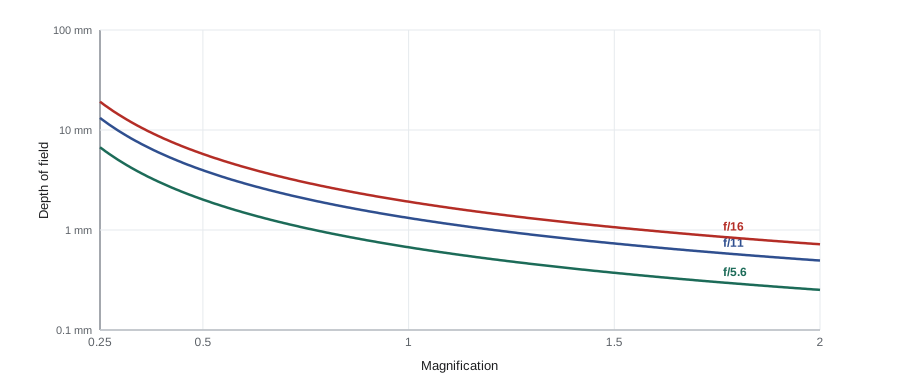
The effective aperture also changes at close focus. As a lens moves away from the sensor to focus closer, less light reaches the sensor; the effective f-number is about \( N(1 + m) \), so a lens set to f/8 behaves like f/16 at 1:1. Most modern cameras report and meter this automatically, but it matters for diffraction: at 1:1, f/16 has the diffraction of about f/32, which is very soft on high-resolution sensors. Many macro photographers work at f/8 to f/11 and stack.
Placing the plane of focus
With so little depth to work with, where you put it matters more than how much you have. For insects, the eye should almost always be sharp. Aligning the sensor parallel to the main plane of the subject, such as the side of a butterfly's wings or the face of a flower, puts more of it in focus at once. Moving the whole camera slightly forward and back, rather than turning the focus ring, is often the easiest way to fine-tune focus at high magnification; a focusing rail on a tripod makes this precise.
Focus stacking in the field
Focus stacking, introduced in Lesson 4, is standard in macro. The number of frames depends on the depth of the subject and the depth of field per frame. With frames overlapping by about a quarter, each frame advances about three quarters of its depth of field.
Worked problem
Frames for a stacked mushroom
A mushroom cap and gills span 12 mm in depth. At 1:1 and f/8 (c = 0.03 mm), how many frames are needed with 25 percent overlap?
Show solution
- Depth per frame: \( D = 2 \times 8 \times 0.03 \times 2 = 0.96 \) mm.
- Step with 25 percent overlap: 0.75 × 0.96 = 0.72 mm.
- Frames: 12 / 0.72 ≈ 16.7, so about 17 frames (plus one or two at each end for safety).
Answer: About 17 to 20 frames. On a still subject in calm air, a focusing rail or the camera's focus bracketing makes this practical. Living insects rarely stay still for so long, except in the cool of early morning.
Field stacking works best on subjects that do not move: fungi, lichens, flowers on calm days, frost and resting insects at dawn when they are too cold to fly. Wind is the enemy. A plant clamp, a windbreak made from a jacket or a portable reflector, and patience help. Some cameras can shoot rapid focus brackets of dozens of frames in a second or two, which handles slight movement.
Light for macro
Small subjects need a lot of light to shoot at fast shutter speeds and small apertures. Natural light works well on overcast days or with a diffuser held between the sun and the subject, which softens harsh shadows. A small reflector can fill shadows. Backlight makes translucent petals, leaves and insect wings glow.
Flash is widely used in macro. A small flash, a ring flash or twin flash on the lens, or a flash with a large diffuser close to the subject, freezes motion and allows small apertures. Because the subject is close, a small diffused flash acts as a relatively large, soft light source. Flash can produce black backgrounds if the background is far away and receives little light; to avoid this, balance flash with ambient light using a slower shutter speed or higher ISO, or place a natural background closer.
Worked problem
Flash duration freezes motion
At 1:1, a hoverfly's body moves 2 mm/s while hovering. A small flash at low power has a duration of about 1/10,000 s. How far does the fly move during the flash, and is it sharp compared with a depth of field of about 1 mm?
Show solution
- Distance moved: 2 mm/s × 1/10,000 s = 0.0002 mm.
- On the sensor at 1:1, that is 0.2 µm, far smaller than a pixel.
Answer: It moves about 0.0002 mm, so the flash freezes it completely. The bigger challenge is keeping the moving fly within the 1 mm zone of focus, which takes many attempts.
Subjects through the seasons
Macro subjects change with the seasons in temperate regions. Spring brings emerging leaves, early flowers and the first insects; summer is peak season for insects, spiders and wildflowers; autumn offers fungi, seed heads, dew and spider webs; winter brings frost, ice crystals, snowflakes and lichens. Dew-covered insects at dawn and frost patterns on cold mornings are classic subjects that reward early starts. Water droplets on leaves and webs act as tiny lenses that reflect or refract the scene behind.
Ethics of macro nature photography
Small creatures deserve the same respect as large ones. Common practices that harm subjects include chilling insects in refrigerators or freezers to slow them down, gluing or pinning live insects, moving animals to better backgrounds, breaking stems or pulling plants for a cleaner composition, damaging fungi or lichens, and trampling vegetation around a rare plant. Photographers increasingly reject these practices, and many competitions require disclosure of captive or manipulated subjects (Lesson 12).
Good practice includes photographing subjects where they are, at their own pace; using natural behaviour such as cold early-morning stillness instead of artificial chilling; holding stems aside gently with a clamp rather than breaking them; staying on paths near sensitive plants; and avoiding disturbance of nests, burrows and egg masses. Rare plants and insects may be legally protected under species-at-risk laws, discussed in Lesson 10; even photographing them can require care about sharing locations, because collectors and crowds may follow.
Some photographers keep insects briefly in a container to photograph them in a controlled setting and then release them where found. This can be done humanely, but it should be disclosed when the image is presented as natural behaviour.
Common mistakes
MistakeStopping down to f/22 at 1:1 to gain depth of field.
InsteadRemember the effective aperture is about \( N(1+m) \); work around f/8 to f/11 and stack.
MistakeLetting the eye of an insect fall out of focus.
InsteadPlace the plane of focus on the eye and align the sensor with the subject's main plane.
MistakeChilling insects in a freezer to keep them still.
InsteadPhotograph at dawn when insects are naturally still, or accept motion and use flash.
MistakePulling plants or breaking stems for a cleaner background.
InsteadChange angle, use a clamp or a wider aperture to soften distractions.
MistakeUsing bare flash that leaves a black background.
InsteadDiffuse the flash and balance it with ambient light.
Summary and key terms
- Magnification is image size divided by subject size; macro usually means about 0.5× to 1× or more.
- Frame width at magnification \( m \) is sensor width divided by \( m \).
- Macro lenses, extension tubes (\( m ≈ e/f \)), close-up lenses and reversed lenses all give close focus.
- Longer macro lenses give more working distance for skittish subjects.
- Depth of field \( ≈ 2Nc(1+m)/m^2 \) is often under 2 mm at 1:1.
- Effective aperture is about \( N(1+m) \); diffraction limits stopping down.
- Respect small subjects: no chilling, gluing or breaking plants; disclose captive setups.
Practice problems
Work each problem on paper first, then reveal the answer to check.
Frame width on APS-C (24 mm sensor width) at 2×?
Show answer
12 mm.
Magnification from 25 mm of extension on a 50 mm lens?
Show answer
0.5×.
Effective aperture of f/8 at 1:1?
Show answer
f/16.
Depth of field at 0.5×, f/8, c = 0.03 mm?
Show answer
2 × 8 × 0.03 × 1.5 / 0.25 = 2.88 mm.
Depth of field at 2×, f/8, c = 0.03 mm?
Show answer
2 × 8 × 0.03 × 3 / 4 = 0.36 mm.
Frames to stack 6 mm of depth at 0.96 mm per frame, 25 percent overlap?
Show answer
6 / 0.72 ≈ 8.3, about 9 frames.
Why do longer macro lenses help with insects?
Show answer
They give more working distance, so insects are less likely to flee.
Why might flash produce a black background?
Show answer
The background is far away and receives little flash or ambient light.
When are insects naturally still?
Show answer
In the cool of early morning.
Name two harmful macro practices.
Show answer
Chilling insects and breaking or pulling plants (also gluing or relocating animals).
Lesson quiz · 5 questions
Score 60% or more to complete this lesson.
Create a free account to save your progress, take quizzes and earn a certificate.