
PHOT-340 · Lesson 10 of 12 · 25 min
Second shooters and teams
One photographer cannot be in two places at once. During getting ready, the two partners are often in different locations; during the ceremony, the processional, the waiting partner's reaction and the parents all happen at the same moment; at a conference, three sessions run in parallel. A second shooter, assistant or larger team extends coverage, adds angles and provides a backup if something goes wrong. Teams also bring management responsibilities: hiring, briefing, paying, contracts, image ownership and quality control. This lesson covers the roles on an event team, when a second photographer is worth the cost, how to divide coverage, briefing and communication, contracts with second shooters, employee and contractor status, payment and taxes, and building a reliable network.
Roles on an event team
- Lead photographer. Responsible for the client relationship, the plan, the main coverage and the final product.
- Second shooter. An experienced photographer who covers additional angles, locations and moments with their own judgement, following the lead's plan and style.
- Assistant. Carries gear, holds lights and reflectors, wrangles groups, manages cards and backups, and sometimes shoots; often someone learning the trade.
- Associate photographer. A photographer who leads events under the studio's brand, common in larger studios that book more weddings than one person can shoot.
- On-site editor or digital technician. Downloads cards, backs up and edits selects for same-day delivery, common at conferences and some weddings.
- Videographer. Usually a separate vendor, but some studios offer photo and video teams; coordination is essential (lesson 3).
When a second photographer is worth it
Second shooters add cost, but for many events they make the coverage more complete and more reliable. Common reasons include:
- Two getting-ready locations at the same time.
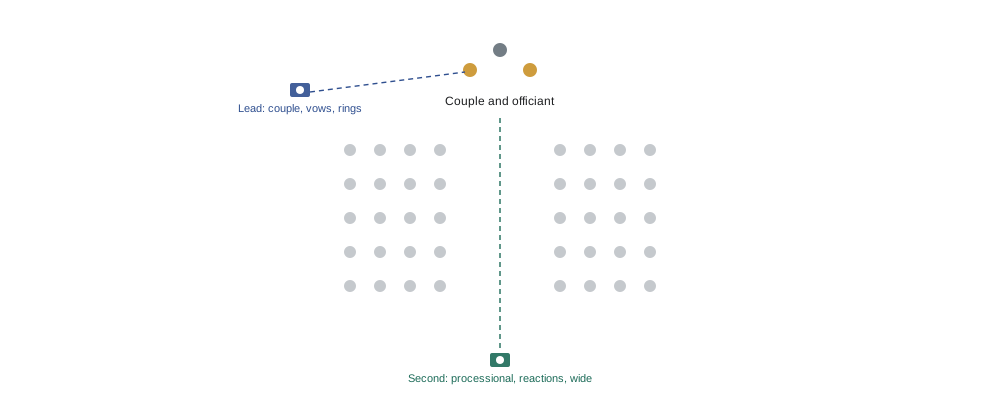
- Ceremony angles: one photographer covers the couple from the front while the other captures the processional, reactions and a wide view from the back.
- Large guest counts, where candids and table images need more time.
- Cultural and multi-day weddings with simultaneous events and many family members (lesson 5).
- Conferences with parallel sessions and same-day delivery (lesson 9).
- Backup: if the lead's gear fails or the lead is unwell, a second photographer can keep coverage going.
Small elopements, short parties and single-track corporate events usually do not need one.
Dividing coverage
A clear division prevents both photographers from shooting the same moment from the same angle, and prevents both from missing another. Plan who covers what for each part of the day:
| Part of the day | Lead photographer | Second shooter |
|---|---|---|
| Getting ready | Partner A, details, dress | Partner B and their family |
| Ceremony | Front-side: couple, vows, rings, kiss | Back: processional, reactions, wide views |
| Family formals | Photographs the groups | Gathers people and shoots candids nearby |
| Couple portraits | Main portraits | Wider and candid angles, or cocktail hour |
| Reception | Speakers, first dance, key moments | Reactions, guests, room and details |
In the ceremony, the two photographers should avoid appearing in each other's frames: agree in advance where each will stand, and look at each other's positions before key moments. Matching camera clocks to the second precisely, before the day, makes it possible to merge images in time order during editing, a step that is easy to forget and annoying to fix afterwards.
Briefing and communication
A second shooter needs the same information as the lead, in a shorter form: timeline, addresses, contact numbers, family names and sensitivities, the shot list, the style expected, the dress code and any rules from officiants or venues. Send a written brief a few days before and review it in a short call. Agree on how you will communicate on the day: phone messages, hand signals across the ceremony, or brief check-ins at transitions. Clients should know whether a second photographer is coming and who they are.
Consistency matters: if the lead shoots warm, softly exposed images and the second shoots cool, contrasty ones, the gallery will feel disjointed. Agree on white balance approach, exposure preferences and lens choices, and share example galleries. Lesson 11 covers matching edits from two cameras.
Contracts with second shooters
A written agreement with each second shooter should cover:
- Scope: dates, hours, location, role and expected coverage.
- Pay: fee, overtime rate, travel and meal arrangements, and payment timing.
- Equipment: what the second shooter must bring, including two bodies with dual card slots, and who insures it.
- Files: when and how cards or files are handed over, and that the second shooter keeps their own backup until the lead confirms receipt.
- Copyright and use: who owns the images and whether the second shooter may use them in their own portfolio, usually with conditions such as waiting until the lead has delivered, crediting the studio and not using them to solicit the lead's clients.
- Conduct and confidentiality: representing the lead's brand, not handing out personal business cards, and keeping client information private.
- Cancellation: what happens if either party cancels.
Copyright ownership follows the rules in lesson 2. A second shooter working as an independent contractor generally owns the copyright in images they take unless the agreement assigns it, or, in the United States, the work falls within a work-made-for-hire category with a written agreement, which is unusual for event photography. Many lead photographers therefore include an assignment or a broad exclusive licence in their second-shooter agreements, while granting the second shooter a portfolio licence.
Employee or independent contractor
Most second shooters work as independent contractors, but tax and employment authorities look at the actual relationship, not just the label. Misclassifying an employee as a contractor can lead to unpaid payroll contributions, penalties and employment-standards claims.
In Canada, the Canada Revenue Agency and the courts assess the whole relationship, drawing on the test confirmed by the Supreme Court in *671122 Ontario Ltd. v. Sagaz Industries* (2001): the key question is whether the worker is in business on their own account, considering control over how the work is done, who provides the equipment, whether the worker can hire helpers, the chance of profit and risk of loss, and the parties' intentions. A second shooter who uses their own gear, works for several studios, sets their own rates and decides how to photograph within the brief looks like a contractor; an assistant who works regular hours for one studio under close direction with the studio's equipment may be an employee, requiring payroll deductions for CPP, EI and income tax and coverage under provincial employment standards. Provincial workers' compensation boards apply their own tests. CRA's CPT1 ruling request is available when status is unclear. If a contractor is registered for GST/HST, they charge it on their invoice.
Paying second shooters
Second-shooter pay varies with experience and market, commonly as a flat fee for a wedding day or an hourly rate, plus overtime. Some leads pay more to second shooters who also cull or edit. When pricing packages, include the full cost of a second photographer, not just their fee, because each extra photographer adds images to cull and edit.
Worked problem
The cost of a second shooter
A second shooter charges $450 for an 8-hour wedding plus $60 per hour overtime and $0.55 per kilometre for a 120 km round trip. The wedding runs one hour over. The second shooter adds about 900 frames, which take the lead 2 hours to cull and 3 hours to edit, valued at $50 per hour. The second shooter is registered for GST/HST and charges 13 percent. The lead's own business is registered and can claim input tax credits. What does the second shooter really cost the lead, and what should the package price add?
Show solution
- Fee: \( 450 + 60 = 510 \) dollars.
- Mileage: \( 0.55 \times 120 = 66 \).
- Subtotal: \( 576 \); HST of 74.88 is recoverable as an input tax credit, so it is not a real cost.
- Lead's extra time: \( 5 \times 50 = 250 \).
- Real cost: \( 576 + 250 = 826 \) dollars.
Answer: About $826, far more than the $450 headline fee. A package that adds a second photographer for $500 loses money; something closer to $900 to $1,000 covers the cost and a margin, as in lesson 12.
Assistants and training
Assistants make the lead faster and the event smoother: holding a light on a pole, moving stands, gathering family groups, carrying a bag, backing up cards during dinner. Training an assistant, especially one who wants to become a photographer, is a long-standing tradition in the field. Be clear about expectations, pay fairly, and be careful that unpaid internships comply with employment-standards law; many jurisdictions treat unpaid work for a business as employment unless it is part of a recognized educational program.
Building a reliable network
Reliable second shooters are valuable, especially in peak season when good photographers are booked. Build a network by working as a second shooter yourself, meeting photographers through associations and workshops, and trying new second shooters at smaller events before a major wedding. Keep a shared list of colleagues who can step in as replacements in emergencies, a promise many contracts make (lesson 2), and reciprocate when they need help.
Being a good second shooter
Second shooting is also a career stage, and doing it well builds a reputation. A good second shooter reads the brief, arrives early and dressed appropriately, follows the lead's plan and style, anticipates where the lead will be and fills the gaps, stays out of the lead's frames, never markets their own business to the client or guests, hands over files promptly and in full, and keeps quiet about any problems during the event, raising them privately with the lead afterwards. Second shooters who also help with gear and family groups, without being asked, are the ones who get booked again.
Running a multi-photographer studio
Some studios grow beyond one lead by hiring associate photographers who shoot weddings under the studio's brand. This model allows the owner to book more events than one person could shoot, but it requires a strong system: consistent training, a shared style guide, standard timelines and briefs, central culling and editing to keep galleries consistent, and clear agreements on pay, copyright and portfolio use. Clients must know before booking which photographer will cover their event, because many couples choose a photographer for their individual work and may feel misled if someone else arrives. Being transparent about who will shoot is also a consumer protection issue, because misleading clients about who provides a service can be treated as a false representation.
Communication on the day
Even with a careful plan, things change during the day. Agree on simple signals for common situations: a nod that means "I have it covered," a raised hand that means "move left," or a quick message when a timeline block runs late. Check in at natural breaks, such as after the ceremony and during dinner, to compare what each photographer has captured and fill any gaps before the evening. A short debrief after the event helps both photographers improve.
Insurance and liability for team members
Each team member's role affects insurance. Contractors usually carry their own equipment and liability insurance, which lead photographers should verify before booking them, because a venue may hold the lead responsible for anyone working under their name. Employees are covered by the employer's policies and by workers' compensation, where it applies. Write these expectations into the second-shooter agreement.
Common mistakes
MistakeBringing a second shooter without dividing coverage.
InsteadPlan who covers what for each part of the day.
MistakeForgetting to synchronize camera clocks.
InsteadMatch all camera clocks to the second before the event.
MistakeWorking with second shooters on a handshake.
InsteadUse a written agreement covering scope, pay, files, copyright, conduct and cancellation.
MistakeCalling a regular, closely directed assistant a contractor to avoid payroll.
InsteadAssess status by the real relationship and follow payroll rules when someone is an employee.
MistakePricing a second photographer at their fee alone.
InsteadInclude travel, overtime and the lead's extra culling and editing time.
Summary and key terms
- Second shooters, assistants and editors extend coverage, add angles and provide backup.
- Second photographers are most valuable for split getting-ready, ceremonies, large or cultural weddings and multi-track conferences.
- Divide coverage clearly, avoid each other's frames and synchronize camera clocks.
- Brief second shooters in writing and agree on style and communication.
- Agreements cover scope, pay, gear, files, copyright, portfolio use, conduct and cancellation.
- Worker status depends on the real relationship under the Sagaz test and CRA guidance.
- Price second photographers at their full cost, including editing time.
Practice problems
Work each problem on paper first, then reveal the answer to check.
Give three reasons to hire a second shooter.
Show answer
Two getting-ready locations, ceremony angles, large or cultural weddings, parallel sessions or backup (any three).
Where does the second shooter often stand during the ceremony?
Show answer
At the back, covering the processional, reactions and wide views.
Why synchronize camera clocks?
Show answer
To merge images in time order during editing.
List four items in a second-shooter agreement.
Show answer
Scope, pay, equipment, files, copyright, conduct or cancellation (any four).
Who owns images taken by a contractor second shooter without an assignment?
Show answer
Generally the second shooter.
What is the central question in the Sagaz test?
Show answer
Whether the worker is in business on their own account.
A second shooter costs $500 plus $60 travel, and adds 4 hours of editing at $50/hour. Real cost?
Show answer
500 + 60 + 200 = $760.
Why try a new second shooter at a smaller event first?
Show answer
To check reliability and fit before a major wedding.
What should a second shooter do with their copies after handing over files?
Show answer
Keep their backup until the lead confirms receipt.
Why be careful with unpaid assistants?
Show answer
Employment-standards law may treat unpaid work for a business as employment.
Lesson quiz · 5 questions
Score 60% or more to complete this lesson.
Create a free account to save your progress, take quizzes and earn a certificate.