
PHOT-340 · Lesson 3 of 12 · 27 min
Planning: timelines, shot lists, scouting and vendor coordination
The photographs from a well-run event look effortless because the work happened weeks earlier. Planning turns a client's wishes into a practical schedule, makes sure the light and locations will support the images they want, identifies the people who must be photographed, and connects the photographer with the planner, venue and other vendors who control the day. This lesson covers the planning questionnaire, building a photography timeline backwards from fixed points such as the ceremony and sunset, buffers, shot lists and family formals lists, scouting venues and portrait locations, weather and contingency plans, and coordination with other vendors. The same methods apply to corporate events and concerts, with different fixed points such as keynote times and set lists (lesson 9).
The planning questionnaire
Four to eight weeks before a wedding, most photographers send a questionnaire or hold a planning call. It gathers the information needed to build a timeline and shot list:
- addresses and times for each location: getting ready, ceremony, portraits, cocktail hour, reception;
- names and contact numbers for the planner or day-of coordinator, and for a family member who can help gather people for groups;
- the order of the ceremony and reception, including cultural or religious elements, speeches, first dance, parent dances, cake cutting and send-off;
- family formals the couple wants, with names, relationships and any sensitivities;
- special details: heirlooms, rings, invitations, flowers, a grandparent's attendance, a surprise performance;
- restrictions: officiant or venue rules on flash and movement, guests who must not be photographed, and unplugged ceremonies where guests are asked not to use phones.
The answers go into a single document shared with the second shooter and, where useful, the planner.
Building the timeline backwards
A photography timeline starts from the fixed points of the day, usually the ceremony start, sunset and dinner service, and works backwards and forwards from them. Each block of photography needs a realistic duration, plus travel time and buffer.
Typical durations for a wedding, which experienced photographers adjust to each event:
| Block | Typical time | Notes |
|---|---|---|
| Details (rings, dress, invitations) | 20 to 30 min | Often while hair and makeup finish |
| Getting ready and dressing | 30 to 45 min | Two locations need two photographers or extra time |
| First look (optional) | 15 to 20 min | Allows portraits before the ceremony |
| Ceremony | 20 to 60 min | Cultural and religious ceremonies can run longer |
| Family formals | 20 to 30 min | About 2 to 3 min per group |
| Wedding party | 15 to 20 min | Larger parties take longer |
| Couple portraits | 20 to 40 min | Plus a short golden-hour session if possible |
| Reception key moments | 2 to 3 hours | Entrances, speeches, first dance, cake, dancing |
Worked problem
A timeline from ceremony and sunset
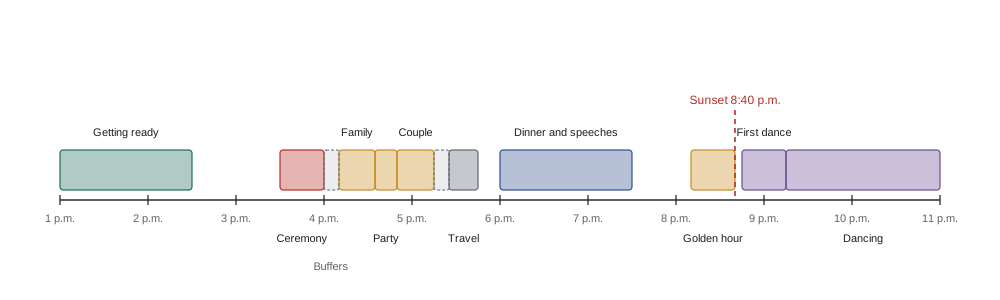
A ceremony starts at 3:30 p.m. and is expected to last 30 minutes. Sunset is at 8:40 p.m.; the couple wants portraits in the 30 minutes before sunset. Family formals at the ceremony site need 10 groups at 2.5 minutes each. Wedding party photos need 15 minutes and couple portraits 25 minutes, with a 20-minute drive to the reception venue. Dinner starts at 6:00 p.m. Build the afternoon schedule with 10-minute buffers after the ceremony and before leaving for the reception.
Show solution
- Ceremony: 3:30 to 4:00.
- Buffer for receiving line and hugs: 4:00 to 4:10.
- Family formals: 10 × 2.5 = 25 min, 4:10 to 4:35.
- Wedding party: 4:35 to 4:50.
- Couple portraits: 4:50 to 5:15.
- Buffer and packing: 5:15 to 5:25, then drive 5:25 to 5:45.
- Reception arrival 5:45, dinner 6:00.
- Golden-hour portraits: 8:10 to 8:40, between dinner and the evening dances.
Answer: The schedule works with 15 minutes to spare before dinner, and a short golden-hour session at 8:10 p.m. gives the best light of the day without taking the couple away from guests for long. If the ceremony starts 15 minutes late, the buffers and the gap before dinner absorb it.
Light and sunset
Sunset and golden-hour times change through the year and by latitude, as covered in PHOT-311 and PHOT-330. In June in southern Canada and the northern United States, sunset can be after 9 p.m., making golden-hour portraits easy to fit after dinner; in October, sunset may be before 6:30 p.m., so portraits must happen before the reception or under artificial light. Photographers check sunset times for the date and location when building the timeline, and consider shade: a ceremony in full midday sun with the couple facing the sun produces squinting and harsh shadows, while turning the altar or choosing a shaded spot can help. Discuss these choices with the couple and planner early, because ceremony layouts are often fixed weeks in advance.
Buffers and realism
Weddings almost always run late. Hair and makeup overrun, ceremonies start after guests are seated, receiving lines take longer than expected, and travel between venues is slower than map estimates. A timeline without buffers forces the photographer to rush portraits or skip groups. Practical rules: add 10 to 15 minutes after each major transition; plan family formals with a helper who knows the family; and schedule the most important images first in each block, so that if time runs out, the less important ones are dropped.
Share the photography timeline with the planner, so the overall day schedule reflects photography needs. Many planners welcome a photographer's input on timing because it helps them run the day.
Shot lists and family formals
A shot list records the images the client specifically wants. Experienced photographers discourage long generic shot lists copied from the internet, which can turn a wedding into a checklist and distract the photographer from real moments. A better list contains the specific items that only the client knows: a grandmother's ring, a photo with a childhood friend, the family dog, a cultural ritual with particular meaning.
The family formals list is different: it should be complete and specific, because these are the images families most often regret not having. A good list names each group in the order it will be photographed, groups people logically to minimize movement, and notes sensitivities such as divorced parents who prefer separate photos.
- Start with the largest groups that include grandparents or elderly relatives, so they can sit down early.
- Build groups by adding or removing a few people at a time: couple with one partner's parents, add siblings, add grandparents, then switch families.
- Note children's names so they can be called quickly and released early.
- Appoint a family helper on each side who knows everyone and can find missing people.
Worked problem
Time for family formals
A couple's list has 14 family groups. Experience suggests 2 minutes per group for simple changes and 4 minutes for groups that require gathering people from elsewhere. Four of the groups involve gathering. How long should the photographer schedule, and what would change with a helper?
Show solution
- Simple groups: 10 × 2 = 20 min.
- Gathering groups: 4 × 4 = 16 min.
- Total: 36 min.
- With a family helper who gathers people while the previous group is being photographed, gathering groups might drop to 2.5 min each: 4 × 2.5 = 10 min, total 30 min.
Answer: Schedule about 35 to 40 minutes, or about 30 minutes with an organized helper. If the timeline allows only 25 minutes, ask the couple to shorten the list or move some groups to the reception.
Scouting venues and portrait locations
Visiting venues before the event, or at least researching them thoroughly, lets the photographer plan positions, light and backup locations. A scouting visit, ideally at the same time of day as the event, answers questions such as:
- Where will the light come from during the ceremony, and will the couple be backlit, in shade or in harsh sun?
- What are the ceiling height and colour in the reception room, and can flash be bounced (lesson 7)?
- Where can the photographer stand during the ceremony without blocking guests, and are there restrictions on moving in the aisle or behind the altar?
- Where are the portrait spots for sun, shade and rain, and how long does it take to walk to them?
- Where are power outlets, quiet rooms for storing gear, and parking or loading areas?
If a visit is impossible, use venue photos, maps, satellite views, sun-position apps and conversations with the venue coordinator or photographers who have worked there. Record the plan in notes or a simple diagram.
Weather and contingency plans
Outdoor events need a rain plan, a heat plan and, in much of Canada and the northern United States, a cold plan for late-season dates. The planner usually manages the venue's backup plan; the photographer needs a photography backup: indoor portrait locations with window light, covered areas, umbrellas that look good in pictures, and flash for dark conditions. In hot weather, schedule portraits in shade or at the end of the day and bring water for the couple and wedding party. In smoky conditions during wildfire season, air quality may limit outdoor portraits; the haze can create soft orange light, but health comes first.
Contingency planning also covers people: a late officiant, a missing ring, a sick family member or a delayed vendor. The photographer cannot solve everything but can stay calm, adjust the schedule, and keep photographing what is happening.
Coordinating with vendors
The planner, venue coordinator, officiant, DJ or band, videographer, florist and caterer all affect photography. Good coordination includes:
- Planner and coordinator: confirm the timeline, cue points for entrances and speeches, and where the photographer should be.
- Officiant: ask about rules for photography during the ceremony, such as no flash, no movement past a certain point, or no photos during a prayer.
- Videographer: agree on positions so neither blocks the other, and on lighting, because video lights and photography flash can conflict.
- DJ or band: ask them to announce key moments and give the photographer a signal before speeches and dances.
- Caterer: confirm when the photographer can eat; a meal during speeches is a common mistake, because toasts often start during dinner.
Exchange phone numbers before the day and introduce yourself on arrival. After the event, sharing a few images with vendors (under the licence discussed in lesson 2) strengthens relationships and referrals.
The final planning call
About two weeks before the event, a short call confirms the details and catches changes: a new ceremony time, an added family member, a rain forecast, or a late surprise such as a choir or a sparkler exit. Walk through the timeline block by block with the couple or planner, read back the family formals list, confirm the names and phone numbers of helpers, and agree on the plan for bad weather. Send the final timeline to everyone who needs it, including the second shooter. On the day, carry a printed copy as well as a digital one, because phones run out of battery and signal is often poor in old stone churches and rural venues. A one-page summary that fits in a pocket is easier to consult during a busy afternoon than a long document.
Finally, plan your own day: where you will park, when you will eat, where you can charge batteries and back up cards, and how long you will need to set up flashes before the reception doors open.
Common mistakes
MistakeBuilding a timeline with no buffers.
InsteadAdd 10 to 15 minutes after transitions and schedule the most important images first.
MistakeCopying a long generic shot list from the internet.
InsteadAsk for specific personal items and build a complete family formals list.
MistakeIgnoring sunset times when planning portraits.
InsteadCheck sunset for the date and location and plan golden-hour or indoor alternatives.
MistakeLeaving family groups to chance on the day.
InsteadOrder groups logically and appoint a family helper on each side.
MistakeEating dinner when speeches begin.
InsteadConfirm the speech schedule with the planner and caterer before taking a break.
Summary and key terms
- Planning turns wishes into a practical schedule and coordinates the people who control the day.
- Questionnaires gather locations, contacts, order of events, family lists, details and restrictions.
- Build timelines backwards from fixed points such as the ceremony start, dinner and sunset.
- Add buffers, because events run late, and schedule the most important images first.
- Keep shot lists specific and family formals lists complete, ordered and assisted by helpers.
- Scout venues for light, positions, portrait spots and backup locations.
- Coordinate with the planner, officiant, videographer, DJ and caterer before the day.
Practice problems
Work each problem on paper first, then reveal the answer to check.
Name three fixed points used to build a wedding timeline.
Show answer
Ceremony start, dinner service and sunset.
How long should 12 family groups take at 2.5 minutes each?
Show answer
30 minutes.
Why schedule the most important images first in each block?
Show answer
So that if time runs out, only less important images are lost.
Why discourage long generic shot lists?
Show answer
They turn coverage into a checklist and distract from real moments.
Who should help gather family members?
Show answer
A helper from each family who knows the people.
Ceremony ends at 4:20; formals take 25 minutes and wedding party 15. When does the wedding party block end, with a 10-minute buffer after the ceremony?
Show answer
4:20 + 10 + 25 + 15 = 5:10 p.m.
What should you ask the officiant?
Show answer
Rules on flash, movement and photography during parts of the ceremony.
Give two scouting questions about a reception room.
Show answer
Ceiling height and colour for bouncing flash; where to stand without blocking guests.
What is a photography rain plan?
Show answer
Indoor or covered portrait locations, umbrellas and flash for dark conditions.
Why coordinate with the videographer?
Show answer
To avoid blocking each other and conflicts between lights.
Lesson quiz · 5 questions
Score 60% or more to complete this lesson.
Create a free account to save your progress, take quizzes and earn a certificate.