
PHOT-340 · Lesson 5 of 12 · 27 min
Ceremonies and cultural sensitivity
The ceremony is the heart of most weddings and many other events, and it is where photographers have the least freedom. Officiants, religious traditions and families set rules about where photographers may stand, whether flash is allowed and which moments must not be photographed at all. Canada and the United States are home to couples of every faith and heritage, and many weddings blend traditions. This lesson covers how to cover a ceremony, the positions and lenses that work, how to work with officiants and their rules, and how to approach religious and cultural ceremonies respectfully, with brief descriptions of several traditions photographers often encounter. The descriptions are general: practices vary widely between families, communities and regions, so the most important skill is to ask the couple and officiant what will happen and what matters to them.
Covering a ceremony
Most ceremonies follow a structure, even when the details differ: guests are seated, the wedding party and couple enter, there are readings, music or rituals, vows and ring exchanges or their equivalent, a declaration or blessing, a kiss or other gesture, the signing of documents and the recessional. Key images include the entrance of each partner, the reaction of the waiting partner, the parents, the vows, the rings or rituals, the kiss, the recessional and wide views that show the setting and guests. Reactions are as important as actions: a father's face during the vows may become the most valued image of the day.
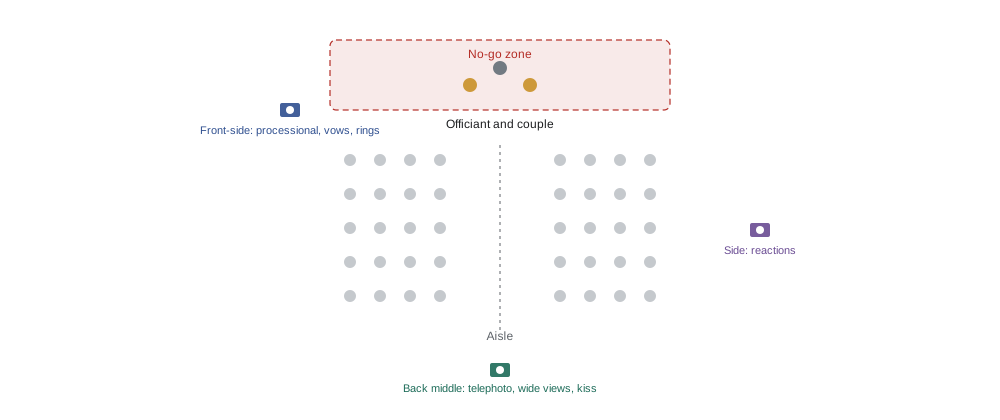
With one photographer, the usual approach is to start at the front for the processional, move to the side or back during readings, and return to the aisle for the recessional, while staying out of guests' sightlines. With two photographers, one covers the couple from the front or side while the other covers the entrance, reactions and wide views from the back, as described in lesson 10.
Lenses and settings for ceremonies
Ceremonies are usually quiet, often dim, and impossible to repeat. A telephoto zoom such as 70-200 mm f/2.8 lets the photographer stay at the side or back while filling the frame with faces; a fast prime handles dim churches and evening ceremonies. Silent shutters are valuable during vows. Shutter speed must freeze small movements: about 1/200 s for walking processionals, 1/125 s for standing couples with a telephoto lens and image stabilization, and faster for children.
Worked problem
Focal length from the back of the aisle
A photographer stands at the back of a church, 22 m from the couple, and wants a horizontal frame that shows the couple and officiant across about 3 m. What focal length is needed on full frame (36 mm sensor width)? With image stabilization, what is a safe shutter speed, and what ISO is needed at f/2.8 if the meter reads 1/60 s at ISO 1,600?
Show solution
- Focal length: \( f = 36 \times 22 / 3 = 264 \) mm, beyond a 70-200 mm lens.
- At 200 mm the frame width is \( 36 \times 22 / 200 ≈ 4.0 \) m, so crop slightly or move closer to about 17 m.
- Subject movement limits shutter speed to about 1/125 s or 1/160 s.
- From 1/60 s to 1/125 s is about one stop: ISO 1,600 becomes about ISO 3,200.
Answer: About 264 mm for a 3 m frame from 22 m; with a 70-200 mm lens, move to about 17 m or crop. At 1/125 s and f/2.8, ISO 3,200 is needed, which modern cameras handle well. Plan for these settings when scouting dim venues.
Working with officiants and their rules
Officiants set the rules for their ceremonies, and photographers must follow them even if the couple would prefer otherwise. Common rules include no flash during the ceremony, staying behind a certain point or out of the chancel or sanctuary area, no photography during prayers or particular rituals, and staying in one position. Some officiants welcome photographers; others have had bad experiences with intrusive ones. Arrive early, introduce yourself, ask about rules and thank them. If a rule makes a key image impossible, explain the options to the couple before the day; for example, a re-enacted ring exchange after the ceremony.
Unplugged ceremonies, where guests are asked to put away phones, have become common because guests holding up phones block the photographer's view and distract from the moment. Some couples ask the officiant to announce this; photographers can suggest it.
Principles of cultural sensitivity
Respectful coverage of religious and cultural ceremonies rests on a few principles:
- Ask, do not assume. Learn from the couple and their families what will happen, which moments matter and what must not be photographed.
- Learn the basics in advance, but recognize that every family practises differently.
- Dress appropriately, for example covering the head or shoulders, removing shoes, or wearing modest clothing in certain places of worship.
- Respect sacred spaces and moments, staying out of areas closed to visitors and not photographing rituals that participants consider private.
- Understand the length and schedule, since some ceremonies last hours or happen over several days.
- Know who matters, such as particular relatives, elders or religious figures whose presence should be recorded.
- Use correct names, for rituals, garments and people, and pronounce them as the family does.
Hiring a second shooter or assistant from the same community, or asking a family member to guide you, can help. Photographers who regularly cover a tradition develop deep knowledge that clients value.
Examples of traditions
The following short descriptions introduce traditions that photographers often encounter in Canada and the United States. They are simplified and vary between communities.
Christian weddings in churches often include a processional, readings, vows, a ring exchange, a blessing and a recessional. Catholic weddings may include a full Mass, and some churches restrict movement during communion. Orthodox weddings include the crowning, with crowns held above the couple, and a procession around a table, often with strict rules on photographer movement.
Jewish weddings may include the signing of the ketubah (marriage contract) before the ceremony, the bedeken (veiling), the ceremony under a chuppah (canopy), the circling of one partner by the other in some traditions, the seven blessings, and the breaking of a glass, followed by yichud, a few minutes the couple spend alone, which should not be photographed. Orthodox weddings may separate men and women and restrict photography on certain days; ask about any rules related to the Sabbath or holy days.
South Asian weddings, including Hindu, Sikh and Muslim weddings from India, Pakistan, Bangladesh, Sri Lanka and the diaspora, often span several days with events such as a mehndi (henna) evening, a sangeet (music and dance) night, a haldi (turmeric) ceremony, a baraat (the groom's procession, sometimes with a horse and drums), and the main ceremony. Hindu ceremonies often take place under a mandap and include the saat phere (seven rounds around a sacred fire); Sikh ceremonies, the Anand Karaj, take place in a gurdwara, where heads must be covered and shoes removed, and include four rounds around the Guru Granth Sahib. These weddings can involve hundreds of guests, vivid clothing and fast-moving rituals; many families expect extensive coverage of relatives.
Chinese weddings may include door games where the groom's party must pass playful challenges, a tea ceremony where the couple serve tea to elders in order of seniority and receive blessings and gifts, and a banquet with many courses and table visits. The tea ceremony order matters, and capturing each elder's moment is important to families.
Muslim weddings vary widely by culture. The nikah, the marriage contract and ceremony, may be held at a mosque or home, and families may separate men and women or prefer that women are not photographed by a male photographer. Some families request a female photographer for parts of the event.
Indigenous ceremonies in Canada and the United States differ greatly between nations and communities. Some couples include smudging, songs, blankets or other ceremonial elements; some of these may not be photographed. Always ask the couple, the officiant or an elder what is appropriate, and follow their guidance on photographing sacred items, songs and people.
| Tradition | Moments families often value | Questions to ask |
|---|---|---|
| Christian (church) | Processional, vows, rings, blessing | Where can I stand? Is flash allowed? |
| Jewish | Ketubah signing, chuppah, glass breaking | Any Sabbath or holy-day rules? Is yichud private? |
| Hindu | Baraat, mandap rituals, saat phere | Order and timing of rituals? Which relatives matter most? |
| Sikh | Anand Karaj rounds, family blessings | Gurdwara rules on head covering and movement? |
| Chinese | Door games, tea ceremony | Order of elders for the tea ceremony? |
| Muslim | Nikah, family gatherings | Any separation of men and women or photographer gender preference? |
| Indigenous | Elements the couple chooses to share | What may and may not be photographed? |
Multi-day and fusion weddings
Multi-day weddings require planning for stamina, storage, editing volume and pricing. A three-day South Asian wedding might mean 30 hours of coverage and 5,000 or more frames, with several venues and outfit changes. Photographers often price these events per day or per event and bring larger teams. Fusion weddings, combining two traditions, are increasingly common: a Chinese tea ceremony in the morning and a Christian ceremony in the afternoon, or a Jewish and Hindu blend. Planning must cover both sets of customs, and photographers should confirm which family members need to be photographed in each part.
Worked problem
Multi-day coverage planning
A three-day wedding includes a 4-hour mehndi evening, a 5-hour sangeet, and a main day with 12 hours of coverage. The photographer expects about 300 edited images per 4 hours of evening events and 900 for the main day, and editing takes about 1.5 minutes per delivered image. How many images will be delivered, and how many editing hours will that take?
Show solution
- Mehndi: 300 images.
- Sangeet: \( 5/4 \times 300 = 375 \) images.
- Main day: 900 images.
- Total: \( 300 + 375 + 900 = 1{,}575 \) images.
- Editing time: \( 1{,}575 \times 1.5 = 2{,}362.5 \) minutes, about 39 hours.
Answer: About 1,575 images and 39 hours of editing, on top of culling (lesson 11). Pricing must reflect this volume; multi-day weddings priced like a single day lose money.
Respecting privacy and dignity at ceremonies
Some moments belong to the participants: private prayers, emotional breakdowns, guests who do not want to be photographed, or rituals that the family considers sacred. Photographers should follow the family's wishes, avoid intrusive close-ups during private moments unless invited, and think carefully before sharing images of guests or religious rituals publicly. When in doubt, ask.
Civil and non-religious ceremonies
Many couples marry in civil or humanist ceremonies led by a marriage commissioner, a justice of the peace, a licensed officiant or a friend authorized for the day, in places ranging from city halls to backyards, mountaintops and breweries. These ceremonies are often shorter, sometimes only ten or fifteen minutes, and the officiant may have few rules about photography. That freedom brings its own challenge: everything happens quickly, with little warning between the vows, the rings and the kiss. Ask the officiant for a copy of the script or order of service so you know what comes next, and ask them to step aside for the kiss so they are not in the middle of the frame.
Common mistakes
MistakeWalking up the aisle during vows to get a closer shot.
InsteadUse a telephoto lens from approved positions and follow the officiant's rules.
MistakeAssuming every ceremony follows the same order.
InsteadAsk the couple and officiant for the order and meaning of each part.
MistakeWearing shoes or leaving your head uncovered in a gurdwara or other sacred space where this is required.
InsteadLearn and follow dress and conduct rules for each venue.
MistakePhotographing rituals the family considers private.
InsteadAsk what may be photographed and respect private moments.
MistakePricing a three-day wedding like a single day.
InsteadPrice by days, events and editing volume.
Summary and key terms
- Ceremonies are quiet, often dim and unrepeatable, with strict rules on movement and flash.
- Key images include entrances, reactions, vows, rituals, the kiss and wide views.
- Telephoto lenses, fast primes and silent shutters let photographers work unobtrusively.
- Officiants set the rules; ask early and explain any limits to the couple.
- Cultural sensitivity means asking, learning basics, dressing appropriately and respecting sacred moments.
- Traditions such as Jewish, South Asian, Chinese, Muslim and Indigenous ceremonies have distinctive moments and rules.
- Multi-day and fusion weddings need larger teams, more planning and pricing by days and volume.
Practice problems
Work each problem on paper first, then reveal the answer to check.
Name four key ceremony images.
Show answer
Entrances, reactions, vows or rituals, the kiss and the recessional (any four).
From 18 m, what focal length frames 3 m on full frame?
Show answer
36 × 18 / 3 = 216 mm.
Who sets rules for photography during a ceremony?
Show answer
The officiant and the place of worship.
What is an unplugged ceremony?
Show answer
One where guests are asked not to use phones or cameras.
Why should yichud not be photographed?
Show answer
It is a private time for the couple.
What must visitors do in a gurdwara?
Show answer
Cover their heads and remove their shoes.
Why does the order of elders matter in a tea ceremony?
Show answer
Tea is served by seniority, and each elder's moment matters to families.
What should you ask before photographing an Indigenous ceremony?
Show answer
What may and may not be photographed, from the couple, officiant or an elder.
A two-day wedding delivers 1,200 images at 1.5 min each. Editing hours?
Show answer
1,800 min = 30 hours.
What is a fusion wedding?
Show answer
A wedding combining two or more traditions.
Lesson quiz · 5 questions
Score 60% or more to complete this lesson.
Create a free account to save your progress, take quizzes and earn a certificate.