
PHOT-401 · Lesson 12 of 12 · 37 min
Exhibiting, rights and capstone: a fine art project
This final lesson brings the course together. It looks at where and how fine art photographers show work, the fees and agreements involved, how to plan editions and prices, and the moral rights that protect the integrity of your work once it leaves the studio. It then sets out the capstone: a resolved body of work, edited, sequenced, printed, written about and planned for exhibition, presented for critique. VIS-410 covers careers, portfolios and grant writing in depth; this lesson focuses on exhibiting a specific body of work and on the rights that attach to it.
Where fine art photography is shown
Photographers show work in many kinds of spaces, each with its own expectations.
- Public galleries and museums: funded by governments, donors and memberships, they organize curated exhibitions and build collections.
- Artist-run centres and non-profit spaces: smaller organizations, often run by artists, that show experimental and emerging work and are often an artist's first significant exhibition venue.
- Commercial galleries: private businesses that represent artists, show their work and sell it, usually taking a commission on sales.
- Festivals: photography festivals present many exhibitions across a city for a period of weeks, often with open calls, portfolio reviews and talks.
- University and college galleries: spaces attached to schools that show students, faculty and visiting artists.
- Alternative and temporary venues: storefronts, outdoor sites, libraries, community centres, billboards and online platforms.
Exhibiting in Canada and the United States
In Canada, artist-run centres form a national network that has supported contemporary art since the late 1960s and 1970s, many with funding from the Canada Council for the Arts and provincial and municipal arts councils. Canadian copyright law includes an exhibition right: under section 3(1)(g) of the Copyright Act, artists have the right to present at a public exhibition, for a purpose other than sale or hire, an artistic work created after June 7, 1988. CARFAC (Canadian Artists' Representation / Le Front des artistes canadiens) and its Quebec counterpart RAAV (Regroupement des artistes en arts visuels du Québec) publish the CARFAC-RAAV Minimum Recommended Fee Schedule, widely treated as the national standard for exhibition and other fees. The schedule is updated each year; it sets recommended minimums rather than legal requirements, and fees vary with the type of exhibition, such as solo, two- or three-person, or group, and with the size of the presenting institution. Many arts councils expect the public galleries and artist-run centres they fund to pay artist fees at or above these levels. Always check the current schedule rather than relying on old figures.
Exhibition agreements
Whatever the venue, put the arrangement in writing. A clear exhibition agreement protects both artist and venue and prevents misunderstandings. It usually covers the following.
- Dates of the exhibition, installation and removal.
- The works to be shown and who selects them.
- Fees payable to the artist and when they are paid.
- Who pays for production, framing, shipping, installation and insurance.
- Insurance coverage while works are in transit and on display, and the values used.
- Sales, if any: who handles them, prices and commission.
- Rights to reproduce images of the work for publicity and documentation, with credit.
- Responsibilities for damage, loss and condition reports.
CARFAC and other artists' organizations publish sample agreements and guidance. Read every agreement carefully and ask questions about anything unclear.
Worked problem
An illustrative exhibition fee and expense estimate
An artist-run centre offers you a solo exhibition. Suppose, for illustration only, that the applicable minimum exhibition fee is $1,800, the centre will pay up to $600 for shipping, and you must cover your own framing for 14 works at $160 each and travel costing $450. What is your net position before any sales?
Show solution
- Income: \( 1800 + 600 = 2400 \) dollars, assuming shipping costs reach the full $600.
- Framing: \( 14 \times 160 = 2240 \) dollars.
- Total costs: \( 2240 + 600 + 450 = 3290 \) dollars, including the $600 of shipping.
- Net: \( 2400 - 3290 = -890 \) dollars.
Answer: You would be about $890 short before sales, even with a fee. Options include asking whether the venue can contribute to framing, reusing frames from a previous show, choosing a less costly presentation, or applying for production funding. Treat these figures as illustrative only.
Editions
Fine art photographs are usually sold in limited editions so that buyers know how many prints of an image at a given size will exist. An edition might be, for example, five prints plus two artist's proofs (APs), which the artist keeps or sells later. Each print is usually signed and numbered, such as 2/5, and accompanied by a certificate of authenticity giving title, date, size, paper, edition number and the artist's signature.
Edition decisions should be made before selling and recorded carefully. Common approaches include different edition sizes at different print sizes, with smaller editions at larger sizes, and stepped pricing, in which the price rises as the edition sells out. Once an edition is declared, do not print more at that size; breaking an edition damages trust with collectors and galleries.
| Size | Edition | Opening price | Price for final two prints |
|---|---|---|---|
| Small | 10 plus 2 AP | $900 | $1,300 |
| Medium | 5 plus 2 AP | $2,200 | $3,000 |
| Large | 3 plus 1 AP | $4,800 | $6,200 |
The prices above are illustrative only. Real prices depend on the artist's career stage, exhibition and sales history, the market in which they show, production costs and gallery advice. Emerging artists are often advised to price modestly and consistently, and to raise prices gradually as demand and recognition grow.
Worked problem
Stepped pricing and gallery commission
A medium edition of 5 is priced at $2,200 for prints 1 to 3 and $3,000 for prints 4 and 5. A commercial gallery takes a 50% commission, which is common. Production costs are $420 per print. If the whole edition sells, what does the artist earn after commission and production?
Show solution
- Gross sales: \( 3 \times 2200 + 2 \times 3000 = 6600 + 6000 = 12600 \) dollars.
- Artist's share after 50% commission: \( 0.5 \times 12600 = 6300 \) dollars.
- Production: \( 5 \times 420 = 2100 \) dollars.
- Net: \( 6300 - 2100 = 4200 \) dollars.
Answer: The artist nets about $4,200 from a sold-out edition with gross sales of $12,600. Commission and production costs are why retail prices often seem high relative to what artists receive. Agreements may split production costs differently, so read them carefully.
Moral rights
Copyright gives economic rights, such as the right to reproduce a work. Moral rights protect the personal connection between artists and their works: the right to be associated with the work and the right to have its integrity respected. Canada and the United States treat moral rights quite differently, especially for photographs.
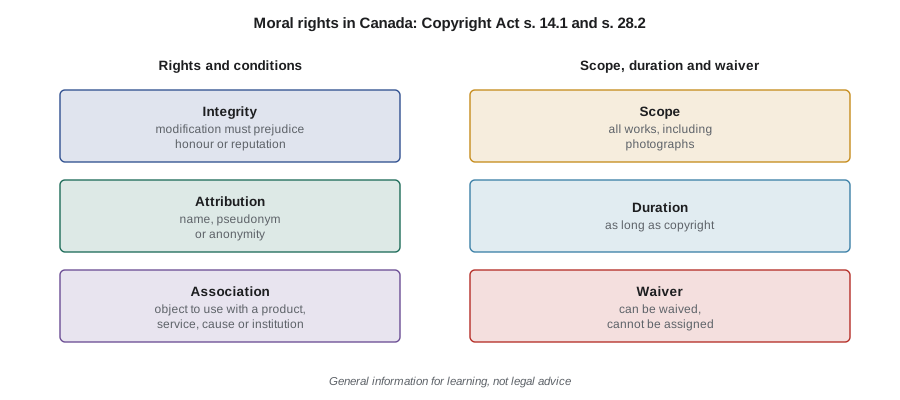
In Canada, the Copyright Act gives authors of all kinds of works, including photographs, moral rights under section 14.1: the right to the integrity of the work, the right to be associated with it as its author by name or pseudonym, or to remain anonymous, and the right to object to its use in association with a product, service, cause or institution. Moral rights last as long as copyright, cannot be assigned, but can be waived in whole or in part. Under section 28.2, the right of integrity is infringed only if the work is distorted, mutilated or otherwise modified, or used in association with something, to the prejudice of the author's honour or reputation. For paintings, sculptures and engravings, any distortion or modification is deemed prejudicial, but photographs are not in that deemed category, so a photographer must show prejudice. The leading early case, Snow v. Eaton Centre (1982), involved the sculptor Michael Snow, whose suspended sculpture of geese in a Toronto shopping centre was decorated with ribbons without his consent; the court ordered them removed. Gallery agreements sometimes ask artists to waive moral rights; consider carefully before agreeing.
Worked problem
Does a moral right apply?
A corporate collector buys one of your editioned prints and hangs it in its lobby, cropped by a framer to fit a narrow space, beside the company's advertising slogan. Under Canadian law, which moral rights might be engaged, and what would you need to show?
Show solution
- The cropping could engage the right of integrity, because the work has been modified, and its use beside a slogan could engage the right against association with a product or cause.
- Because photographs are not in the deemed-prejudice category, you would need to show that the modification or association prejudices your honour or reputation.
- You should also check whether you signed any waiver of moral rights at the point of sale.
Answer: Moral rights may be engaged, but outcomes depend on evidence of prejudice, any waiver, and the specific facts. Seek advice from a lawyer or artists' organization, and prevent problems by including presentation terms in sales agreements.
Planning an exhibition of a body of work
Planning starts long before installation. Typical milestones include confirming the venue and agreement, finalizing the edit and sequence, test printing and ordering final prints, framing, preparing labels and wall text, arranging shipping and insurance, coordinating publicity, installing and lighting, holding an opening or talk, documenting the installation, and deinstalling. Many photographers work backwards from the opening date, allowing several weeks for printing and framing and extra time for problems.
Worked problem
Working backwards from an opening date
Your exhibition opens in 16 weeks. Framing takes 3 weeks after prints arrive; printing takes 2 weeks after files are final; you want 2 weeks of slack before installation, which takes 1 week. By which week must your files be final?
Show solution
- Count back from the opening at week 16: installation starts at week 15.
- Slack: 2 weeks, so framing must be finished by week 13.
- Framing: 3 weeks, so prints must arrive by week 10.
- Printing: 2 weeks, so files must be final by week 8.
Answer: Files must be final by about week 8, halfway to the opening. That leaves the first eight weeks for final editing, sequencing, test prints and writing.
An illustrative production budget for a body of work
Funding for a body of work may come from your own resources, sales, arts council grants, residencies, commissions or crowdfunding. VIS-410 covers grant writing; here, the point is that a clear budget makes any funding request realistic.
Worked problem
Building an illustrative production budget
You plan to complete and exhibit a body of 18 works. Estimated costs are: travel for shooting $2,400; materials and storage $650; test prints $300; final prints 18 at $140; frames 18 at $165; shipping $700; documentation photography $400. Add a 10% contingency. What is the total?
Show solution
- Final prints: \( 18 \times 140 = 2520 \) dollars.
- Frames: \( 18 \times 165 = 2970 \) dollars.
- Subtotal: \( 2400 + 650 + 300 + 2520 + 2970 + 700 + 400 = 9940 \) dollars.
- Contingency: \( 0.10 \times 9940 = 994 \) dollars.
- Total: \( 9940 + 994 = 10934 \) dollars.
Answer: About $10,934. This is illustrative; grant programmes have their own rules about eligible costs, artist fees and contingency, which you must follow.
The capstone project
The capstone asks you to complete a resolved body of fine art photographic work that demonstrates everything in this course. It should be a personal project developed over the term, built on the concept, research and development work from lessons 1 to 3, using a deliberate visual strategy from lesson 4 and an ethical approach from lesson 5.
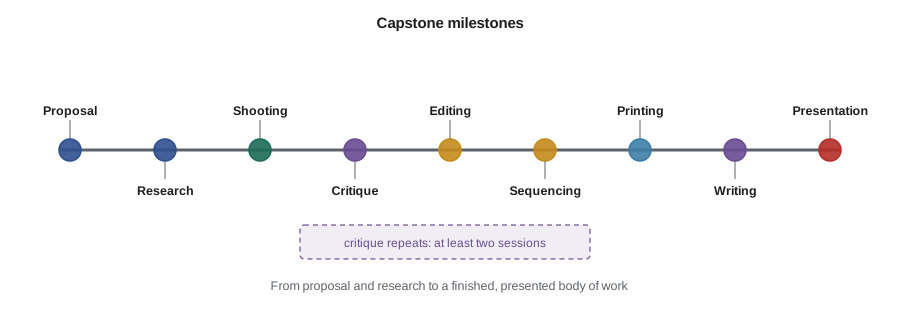
The capstone package includes the following.
- A final series of 12 to 24 images, edited and sequenced, presented as prints, a book dummy or an exhibition installation.
- A project statement of about 150 to 250 words and a short biography.
- A sequencing rationale with a rhythm chart.
- An exhibition plan with a wall layout, hanging heights, spacing, print sizes and presentation choices, plus a budget.
- A critique log recording feedback from at least two Critical Response Process sessions and how you responded.
- An ethics file documenting consent, permissions and any community protocols followed.
- A short reflective essay on what you learned and what comes next.
| Component | Weight | What is assessed |
|---|---|---|
| Body of work | 40% | Concept, visual strategy, coherence, technical resolution |
| Edit and sequence | 15% | Selection, rhythm, opening and ending |
| Presentation plan | 15% | Print, framing and hanging decisions, budget |
| Writing | 15% | Statement, bio, labels, clarity |
| Critique and reflection | 10% | Use of feedback, self-critique |
| Ethics file | 5% | Consent, permissions, protocols |
Worked problem
Calculating a capstone grade
A student scores 82% on the body of work, 75% on edit and sequence, 90% on the presentation plan, 70% on writing, 88% on critique and reflection and 100% on the ethics file. Using the weights above, what is the final grade?
Show solution
- Body of work: \( 0.40 \times 82 = 32.8 \).
- Edit and sequence: \( 0.15 \times 75 = 11.25 \).
- Presentation: \( 0.15 \times 90 = 13.5 \).
- Writing: \( 0.15 \times 70 = 10.5 \).
- Critique and reflection: \( 0.10 \times 88 = 8.8 \).
- Ethics: \( 0.05 \times 100 = 5.0 \).
- Total: \( 32.8 + 11.25 + 13.5 + 10.5 + 8.8 + 5.0 = 81.85 \).
Answer: About 81.9%. The writing score is the weakest component, so revising the statement would be the most efficient improvement.
After the course
A finished body of work is a beginning. Document the installation, update your website and portfolio, send the work to festivals, publishers and open calls, keep a critique group going, and start research for the next project. PHOT-430 develops the photobook; VIS-410 covers careers, grants and portfolios. Many photographers find that their next project grows from questions the last one raised.
Common mistakes
MistakeAgreeing to an exhibition without a written agreement
InsteadPut dates, fees, costs, insurance, sales and reproduction rights in writing.
MistakeAssuming exhibition fees are set by law everywhere
InsteadCanada has an exhibition right and CARFAC-RAAV recommended minimums; the US relies on negotiation and voluntary standards.
MistakePrinting more copies after an edition is declared
InsteadRecord editions carefully and never exceed a declared edition at that size.
MistakeAssuming all photographs have the same moral rights protection in both countries
InsteadCheck scope: Canadian moral rights cover photographs generally; VARA covers only signed exhibition photographs in editions of 200 or fewer.
MistakeStarting printing a few days before an exhibition
InsteadWork backwards from the opening and build in slack.
Summary and key terms
- Fine art photography is shown in public galleries, artist-run centres and non-profits, commercial galleries, festivals and alternative spaces.
- Canada recognizes an exhibition right, and CARFAC-RAAV publishes recommended minimum fees updated each year.
- In the United States, exhibition fees depend on negotiation and voluntary standards such as W.A.G.E. certification.
- Written agreements should cover dates, fees, costs, insurance, sales and reproduction rights.
- Editions, artist's proofs and stepped pricing should be planned and recorded before selling.
- Canadian moral rights cover photographs but require proof of prejudice; VARA covers only limited-edition exhibition photographs.
- The capstone brings concept, editing, sequencing, presentation, writing, critique and ethics into one finished body of work.
- Artist-run centre
- A non-profit gallery run by and for artists.
- Exhibition right
- The Canadian right to be paid for public exhibition of works not shown for sale or hire.
- CARFAC-RAAV fee schedule
- Canada's recommended minimum fees for artists' exhibitions and services.
- W.A.G.E.
- A US organization that promotes and certifies payment of artist fees.
- Edition
- A declared, limited number of prints of an image at a given size.
- Artist's proof
- A print outside the numbered edition, kept or sold by the artist.
- Certificate of authenticity
- A document recording a print's details and edition number.
- Moral rights
- Rights protecting an artist's attribution and the integrity of the work.
- VARA
- The US Visual Artists Rights Act of 1990.
- Waiver
- A written agreement not to exercise certain rights.
Practice problems
Work each problem on paper first, then reveal the answer to check.
Under which section of Canada's Copyright Act is the exhibition right found?
Show answer
Section 3(1)(g).
Are CARFAC-RAAV fees legal requirements?
Show answer
No, they are recommended minimums, though many funders expect them to be paid.
Name four items an exhibition agreement should cover.
Show answer
Dates, works, fees, costs, insurance, sales, reproduction rights, damage.
An edition of 5 sells three at $2,000 and two at $2,800. What are gross sales?
Show answer
\( 6000 + 5600 = 11600 \) dollars.
After 50% commission, what does the artist receive from $11,600?
Show answer
$5,800.
Which photographs does VARA protect?
Show answer
Photographs made for exhibition only, in a single signed copy or a signed, numbered edition of 200 or fewer.
Can Canadian moral rights be assigned?
Show answer
No, but they can be waived.
An opening is in week 20; working back takes 9 weeks. When must files be final?
Show answer
Week 11.
A budget subtotal is $8,000. What is it with 10% contingency?
Show answer
$8,800.
Name three items in the capstone package.
Show answer
Final series, statement and bio, sequencing rationale, exhibition plan, critique log, ethics file, reflective essay.
Lesson quiz · 5 questions
Score 60% or more to complete this lesson.
Create a free account to save your progress, take quizzes and earn a certificate.