
PHOT-401 · Lesson 7 of 12 · 29 min
Critique I: giving and receiving critique
Critique is the structured discussion of work in progress, and it is central to how artists learn and grow. In art schools, the group critique, or "crit," is a defining ritual: students pin up their work and peers and instructors discuss it. Professional artists continue the practice through peer groups, studio visits, portfolio reviews and conversations with curators, editors and publishers. Done well, critique gives artists perspectives they cannot get alone and helps them see what their work actually communicates. Done badly, it can be vague, harsh or discouraging. This lesson teaches how to give useful feedback and how to receive it, and introduces structured formats, including the Critical Response Process, that make critique fairer and more productive.
What critique is for
The purpose of critique is to help the artist make the work better on its own terms. It is not a competition, a performance by the critic or a verdict on the artist's worth. Useful critique helps the artist understand how the work is read by others, identifies strengths to build on, raises questions the artist may not have asked, and points to specific problems with possible paths forward. The artist remains in charge of what to do with the feedback.
A useful distinction is between critique of the work and judgement of the person. "The sequence loses energy in the middle, where three similar landscapes sit together" is about the work. "You're not very good at sequencing" is about the person and does not help.
Formats of critique
Critique happens in several formats, each with strengths and limits.
- Group critique: several artists present work in turn to a group led by a facilitator or instructor. It offers many perspectives but can be dominated by confident voices.
- One-to-one studio visit: a curator, mentor or peer visits the artist's studio or meets online to discuss work in depth. It is personal and detailed but depends heavily on one person's views.
- Portfolio review: a timed session, often 20 minutes, with an editor, curator or publisher at a festival or event. It is efficient and professional but brief.
- Written critique: a peer or instructor writes comments. It allows careful thought but loses conversation.
- Online critique: forums, video calls and shared folders. They connect distant peers but can encourage quick, shallow reactions.
The Critical Response Process
The Critical Response Process was developed by the American choreographer Liz Lerman in the early 1990s and is now used across art forms, including photography, in schools, studios and organizations. It structures feedback in four steps with three roles: the artist, responders and a facilitator. Its central idea is that the artist should be an active participant rather than a passive recipient, and that opinions should come last and only with the artist's permission.
- Step 1, statements of meaning: responders say what was meaningful, evocative, interesting, exciting or striking in the work. This builds a foundation of what the work is already doing.
- Step 2, the artist as questioner: the artist asks questions about the work, such as "Does the change from colour to black and white in the second half feel intentional?" Responders answer the artist's questions.
- Step 3, neutral questions from responders: responders ask questions without embedded opinions. Instead of "Why is the print so dark?", which implies a judgement, they ask "What were you aiming for with the tonal range?"
- Step 4, opinion time: responders may state opinions, but they first ask the artist whether they want to hear an opinion on a specific topic, for example "I have an opinion about the sequence ending. Would you like to hear it?" The artist may say yes or no.
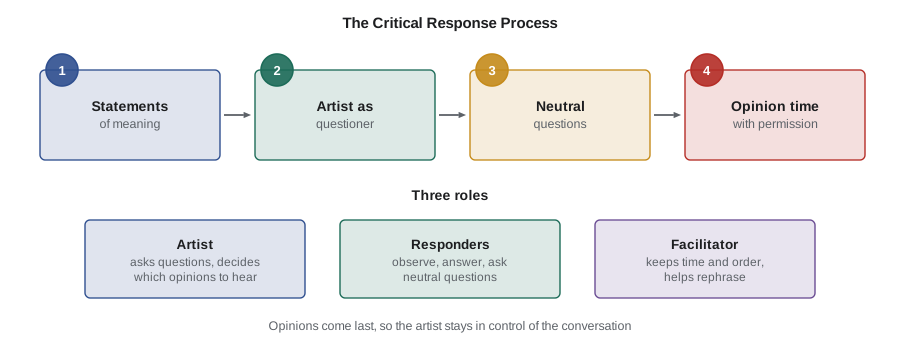
The facilitator keeps the process on track, gently redirects responders who slip into opinions too early, and helps rephrase questions so they are neutral. The process can feel slow at first, but it typically produces richer, more usable feedback than an open free-for-all.
Worked problem
Rephrasing questions to be neutral
In step 3, a responder asks three questions: "Why didn't you crop out the distracting sign?", "Don't you think the portraits are too similar?" and "Why did you choose such small prints?" Rephrase them as neutral questions.
Show solution
- The first assumes the sign is distracting. Neutral: "What role do you see the sign playing in that image?"
- The second is an opinion disguised as a question. Neutral: "How did you decide on the range of poses and framings in the portraits?"
- The third implies the size is wrong. Neutral: "What led you to that print size?"
Answer: Each neutral question asks about the artist's choices without signalling a judgement, giving the artist space to explain and think.
Giving useful feedback
Whatever the format, useful feedback has common features.
- Specific: refer to particular images, areas, choices and effects. "In the fourth image, the bright window at the edge pulls my eye away from the face" is useful.
- Descriptive before evaluative: say what you see and how it affects you before saying what you would change.
- Grounded in the artist's intentions: ask what the artist is trying to do and respond to that, not to the work you would have made.
- Balanced: identify what is working as clearly as what is not; strengths tell the artist what to keep.
- Actionable: where you offer a suggestion, make it something the artist could try, while respecting that they may choose otherwise.
- Honest and kind: avoid empty praise and avoid cruelty; both waste the artist's time.
A simple frame many artists use is "I notice, I wonder, I suggest." "I notice the colour is cooler in the later images. I wonder whether that is meant to show time passing. I suggest trying them in a sequence that makes that shift feel deliberate."
| Weak feedback | Why it is weak | Useful version |
|---|---|---|
| I love it | Gives no information | The repeated frontal framing makes the faces feel dignified and calm |
| It doesn't work for me | Vague and personal | The sequence loses momentum where three similar interiors sit together |
| You should shoot in black and white | Imposes the critic's taste | How did you decide on colour? The warm palette seems important to the mood |
| The prints are too dark | Assumes the artist's aim | The shadows block up in images 3 and 7; was that intended? |
Receiving feedback
Receiving critique well is a skill, and it may matter even more than giving it. Many artists feel defensive when their work is discussed; that is natural, because the work is personal. Some practical habits help.
- Listen fully before responding. Take notes or ask a friend to take them, because you will not remember everything.
- Ask clarifying questions rather than defending. "Can you say more about what felt repetitive?" is more useful than "I did that on purpose."
- Separate the information from the tone. Even poorly phrased feedback may contain something useful.
- Look for patterns. One person's reaction may be idiosyncratic; three people saying the same thing is worth attention.
- Take time before acting. Let feedback settle for a day or two, then decide what to use.
- Remember that you decide. Critique informs your choices; it does not make them for you.
Running a group critique
Group critiques work best with clear structure. Agree on time per artist, on a format such as the Critical Response Process or a simple sequence of description, questions and suggestions, and on ground rules: speak about the work, not the person; let the artist speak first or last as agreed; avoid interrupting; make sure quieter voices are heard.
Worked problem
Planning a group critique session
A three-hour session must include 9 artists. You want a 10-minute break and 5 minutes of setup and wrap-up in total. How many minutes can each artist have, and how might you split each slot using the Critical Response Process?
Show solution
- Available time: \( 180 - 10 - 5 = 165 \) minutes.
- Per artist: \( 165 / 9 \approx 18.3 \), so about 18 minutes.
- A possible split: 2 minutes for the artist to introduce the work, 4 minutes of statements of meaning, 4 minutes of artist questions, 4 minutes of neutral questions and 4 minutes of opinion time.
Answer: About 18 minutes per artist, split roughly into 2, 4, 4, 4 and 4 minutes, with a timekeeper to keep the session fair.
Using rubrics in critique
In schools and juried contexts, rubrics list criteria and performance levels so that feedback is consistent. A rubric can help structure critique, but it should not replace conversation. Criteria for a fine art series often include concept, visual strategy, coherence, technical resolution, ethics and presentation.
Worked problem
Averaging rubric scores from several responders
Four responders score a series out of 5 on coherence: 4, 3, 4 and 5. On technical resolution they score 2, 3, 2 and 3. What are the average scores, and what does the spread suggest?
Show solution
- Coherence average: \( (4 + 3 + 4 + 5) / 4 = 4.0 \).
- Technical resolution average: \( (2 + 3 + 2 + 3) / 4 = 2.5 \).
- Both spreads are small, so responders broadly agree: the series hangs together well but needs work on printing or technical consistency.
Answer: Coherence averages 4.0 and technical resolution 2.5. Agreement among responders makes the second result worth acting on.
Power, culture and inclusion in critique
Critique is shaped by power and culture. Instructors, senior artists and dominant personalities can shape a room's response. Some traditions of critique have been harsh or dismissive, and some students, especially those whose backgrounds or subjects differ from the majority, have experienced critique that misread or devalued their work. Facilitators should be aware of these dynamics, invite responders with relevant knowledge, avoid assuming one cultural frame, and give artists the option to set the terms of feedback. Structured methods like the Critical Response Process were partly designed to address these problems.
Critique beyond school
After graduation, you will need to create your own critique opportunities. Form a peer group that meets monthly; trade studio visits with artists you respect; book portfolio reviews at festivals; share work in progress with trusted mentors. VIS-410 covers portfolio reviews and professional networks in more detail. Artists who maintain regular critique throughout their careers generally keep developing; those who stop often stall.
Documenting critique
Feedback is easy to forget, and critique sessions often move quickly. Keep a critique log for each project: the date, who responded, the work shown, the main points raised, your own reactions and what you decided to do. Over time, the log reveals patterns, such as a recurring concern about technical consistency or repeated praise for a particular kind of image, that single sessions do not. It also gives you material for reflective writing and for explaining your development in applications and interviews. For the capstone in lesson 12, the critique log is a required part of the package, so start one now and use it in every session for the rest of the course.
Common mistakes
MistakeGiving opinions immediately without understanding the artist's aims
InsteadDescribe, ask questions and learn the artist's intentions before offering opinions.
MistakeAsking leading questions that hide judgements
InsteadAsk neutral questions about the artist's choices.
MistakeDefending every choice during critique
InsteadListen, take notes and ask clarifying questions.
MistakeActing on every comment immediately
InsteadLet feedback settle, look for patterns and decide deliberately.
MistakeLetting a few voices dominate a group critique
InsteadUse structure, timekeeping and facilitation so all voices are heard.
Summary and key terms
- Critique helps the artist improve the work on its own terms; it is not a verdict on the person.
- Formats include group critiques, studio visits, portfolio reviews, written and online critique.
- The Critical Response Process uses four steps: statements of meaning, artist questions, neutral questions and permissioned opinions.
- Useful feedback is specific, descriptive, grounded in the artist's intentions, balanced, actionable, honest and kind.
- Receiving feedback well means listening, clarifying, looking for patterns and deciding later.
- Group critiques need clear time limits, structure and ground rules.
- Power and culture shape critique, so facilitators must work to include all voices fairly.
- Critique
- A structured discussion of work in progress.
- Crit
- An informal name for a group critique in art schools.
- Critical Response Process
- Liz Lerman's four-step method for structured feedback.
- Statement of meaning
- A responder's observation of what is meaningful or striking in a work.
- Neutral question
- A question that asks about choices without implying a judgement.
- Opinion time
- The final step of the Critical Response Process, where opinions are offered with permission.
- Facilitator
- The person who guides a critique and keeps it on track.
- Studio visit
- A one-to-one discussion of an artist's work, often in their studio.
- Portfolio review
- A short, timed session with an editor, curator or publisher.
- Rubric
- A set of criteria and performance levels used for consistent assessment.
Practice problems
Work each problem on paper first, then reveal the answer to check.
What are the four steps of the Critical Response Process?
Show answer
Statements of meaning, artist as questioner, neutral questions, opinion time.
Rephrase "Why are the prints so small?" as a neutral question.
Show answer
"What led you to that print size?"
What does "I notice, I wonder, I suggest" help with?
Show answer
Structuring feedback that is descriptive, curious and actionable.
Name three habits for receiving feedback well.
Show answer
Listen fully, ask clarifying questions, look for patterns, wait before acting.
A 180-minute session has 15 minutes of breaks and setup and 9 artists. How long per artist?
Show answer
\( 165 / 9 \approx 18 \) minutes.
Four responders score 4, 3, 4 and 5. What is the average?
Show answer
4.0.
Why should opinions come last in the Critical Response Process?
Show answer
So that the artist's aims are understood first and the artist controls what feedback they hear.
Give an example of feedback about the work rather than the person.
Show answer
The sequence loses energy where three similar landscapes sit together.
Name two formats of critique besides group critique.
Show answer
Studio visit, portfolio review, written or online critique.
Why is critique important after graduation?
Show answer
Regular outside perspective keeps artists developing.
Lesson quiz · 5 questions
Score 60% or more to complete this lesson.
Create a free account to save your progress, take quizzes and earn a certificate.