
PHOT-401 · Lesson 2 of 12 · 30 min
Concept, intention and research
Every fine art project starts somewhere, but rarely with a fully formed idea. Some artists begin with a subject they cannot stop thinking about, some with a place they keep returning to, some with a question, a feeling, a visual habit they notice in their own pictures, or a technique they want to push. This lesson is about turning that starting point into a concept: a clear enough sense of what the work is about and why it matters to give the project direction, while leaving room for discovery. It also covers research, which in art means much more than reading. It means looking at other artists, learning about your subject, testing ideas with the camera and understanding the conversation your work will enter.
What a concept is, and what it is not
A concept is the idea or question that drives a body of work. It is usually expressible in one or two sentences: "how families perform happiness for the camera," "the way a northern town changes as its mine closes," "what remains of a childhood home after it is sold," "how light makes ordinary rooms feel unfamiliar." A concept is not the same as a subject. The subject is what is in front of the camera; the concept is what the work is about. Two artists can photograph the same subject, say a shopping mall, with completely different concepts: one about consumer desire, another about the mall as the last public square for teenagers, a third about the strange beauty of empty corridors at dawn.
A concept is also not a slogan or a lesson. Work that exists only to deliver a message the viewer already knows tends to feel flat. Strong concepts open questions rather than close them, and they leave space for the viewer's own thinking.
Where ideas come from
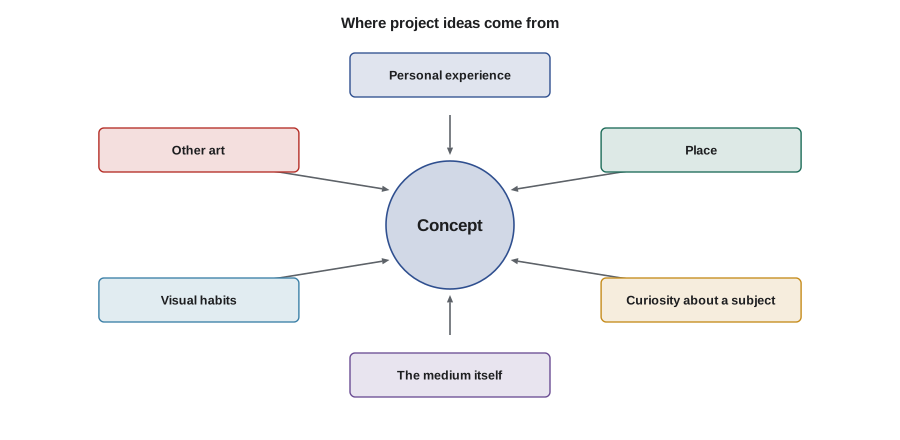
Artists find ideas in many places, and most of them are close to home.
- Personal experience: your history, family, community, identity, losses and attachments. Personal work often has the depth that comes from knowing a subject from the inside.
- Place: a neighbourhood, landscape, building or route you know well or want to understand.
- Curiosity about a subject: a profession, an ecosystem, a historical event, a social issue you want to look at closely over time.
- The medium itself: questions about what photography is, how it records time, how it relates to truth, or how images circulate online.
- Visual habits: patterns you notice in your own archive, such as a recurring colour, a way of framing people, or a fascination with windows, which can be developed deliberately.
- Other art: a work that moves or annoys you can suggest an idea, as long as you respond to it rather than copy it.
A useful exercise is to go back through two or three years of your own photographs and sort them into piles by what keeps appearing. The piles often reveal concerns you did not know you had. Many strong projects begin when an artist recognizes a thread that was already running through their work.
Intention and openness
Intention is what you want the work to do: provoke a question, record something vanishing, express a feeling, challenge a stereotype, create a particular mood. Holding a clear intention helps you make decisions about what to photograph, how, and what to leave out. But intentions can become cages. If you decide too firmly in advance what the work will say, you may stop noticing what the photographs are actually showing you.
Experienced artists move back and forth. They start with an intention, make work, look hard at what they made, and let the images revise the intention. A project about a family farm might begin as a nostalgic portrait of rural life and become, after a year of shooting, a quieter study of an ageing parent's hands and routines. That shift is not failure; it is the project finding its real subject.
Research beyond reading
Research in a fine art project has several strands, and you need all of them.
- Subject research: learning about what you are photographing through reading, interviews, archives, local history and time spent with people. A project about a fishing community is stronger if you understand the economics, seasons and history of the fishery.
- Visual research: looking closely at how other artists have treated similar subjects, ideas or forms, and noting what you admire and what you want to avoid.
- Contextual research: understanding the critical and theoretical conversation your work enters, drawing on what you studied in VIS-210, and reading recent reviews, essays and artist interviews.
- Practical research: testing cameras, lenses, film or sensor choices, lighting, printing papers and presentation formats with small experiments before committing.
Keep all of this in your process journal. A simple structure works: a page or file for each artist you study, with notes on what they do and why it matters to you; a section for subject notes and sources; and a running log of tests with images, settings and reflections.
| Strand | Question it answers | Typical activities |
|---|---|---|
| Subject | What do I need to know about what I am photographing? | Reading, interviews, archives, time on location |
| Visual | How have other artists treated this subject or idea? | Studying books, exhibitions and artist websites |
| Contextual | What conversation does my work enter? | Reading reviews, essays and theory |
| Practical | What tools and forms best serve the idea? | Test shoots, print tests, format experiments |
Influence and originality
Every artist is influenced. The question is whether you digest influences or merely imitate them. A common pattern in student work is to fall in love with one photographer's style and reproduce it: the same flat light, colour palette and subject matter. The result can be technically impressive and still feel secondhand. Curators and jurors see these imitations constantly and recognize them at once.
A better approach is to study influences analytically. Ask what a photographer is actually doing: Why that distance? Why that light? Why that sequence? What idea does the style serve? Then ask whether that strategy serves your idea. Often the answer is "partly." You might borrow one artist's frontal composition, another's interest in archives and a third's use of text, and combine them into something that belongs to you. Original work usually comes from an unusual combination of influences filtered through a particular subject you know well.
Worked problem
Analysing an influence instead of copying it
Jordan admires a photographer known for large, frontal, evenly lit colour portraits of teenagers made with a view camera. Jordan's own project is about apprentices in skilled trades. How should Jordan use this influence?
Show solution
- Identify what the admired work does: frontal framing gives subjects dignity and lets viewers study faces and clothing; even light avoids drama; the slow camera produces a still, formal mood.
- Ask which choices serve the trades project. Frontal dignity and stillness suit a project about skill and pride, so those can be adopted.
- Ask what must change. Apprentices are defined by their tools and workplaces, so Jordan might include more environment, work clothing and hands, and might pair portraits with close studies of tools, which the admired photographer does not do.
- Note the influence honestly in the journal and, later, perhaps in conversation or an essay, without copying signature elements such as a particular colour palette or the same age group of subjects.
Answer: Jordan borrows the strategy of frontal, dignified portraiture because it serves the idea, adds environment and tool studies specific to the trades, and develops a distinct series rather than an imitation.
Writing a working concept statement
Early in a project, write a short working concept statement of 50 to 100 words. It is for you, not for the public, and you will revise it many times. It should answer three questions: what you are photographing, what you are exploring through it, and why it matters to you or to others. Avoid jargon and grand claims. A plain, specific statement is far more useful than an impressive-sounding one.
Worked problem
Revising a vague concept
A student's first concept statement reads: "My work explores the human condition and the relationship between memory, identity and space through the medium of photography." How can it be made useful?
Show solution
- Identify the problem: every word is abstract. "The human condition" could describe almost any artwork, and there is no subject.
- Ask the student what they are actually photographing. The answer is their grandmother's apartment in Winnipeg, which is being emptied after she moved into care.
- Ask what they are exploring. They are interested in how objects hold memories and what happens when the objects are dispersed.
- Rewrite: "I am photographing my grandmother's apartment in Winnipeg over the six weeks it takes my family to empty it. The series looks at how ordinary objects carry family memory, and what remains when they are sorted, kept, given away or thrown out."
Answer: The revised statement names a specific subject, place, time frame and question, in plain language, and immediately suggests how the work might look and be sequenced.
Testing the concept with the camera
Concepts are tested by making work. Plan a short series of test shoots early, perhaps three to five sessions over two or three weeks, with the explicit goal of learning rather than making finished images. After each session, look at contact sheets or a grid of thumbnails and ask: Which images feel alive? Which feel like illustrations of my idea rather than discoveries? What is surprising? What would I need to do differently to make more images like the best ones?
It is normal for early tests to disappoint. Many artists describe the first months of a project as finding the right distance, light, camera and pace for the subject. A test that fails clearly is valuable, because it tells you what not to do.
Worked problem
How much testing to budget
You have a 14-week term for this project. You want at least three weeks of testing, at least six weeks of main production, two weeks of editing and sequencing, and one week for printing and presentation. How much slack is left, and why does it matter?
Show solution
- Add the planned weeks: \( 3 + 6 + 2 + 1 = 12 \) weeks.
- Slack is \( 14 - 12 = 2 \) weeks.
- Slack absorbs bad weather, access problems, illness and reshoots after critique, which happen in almost every project.
Answer: Two weeks of slack. Without it, any delay in production squeezes editing and printing, which are often where a series succeeds or fails.
Ethical questions at the concept stage
Some ethical questions should be asked at the very beginning, before a single picture is made. Whose story is this, and who has the right to tell it? Are you photographing a community you belong to, one you are close to, or one you are visiting? What might the people or place you photograph gain or lose from the work? Could the images be misread or misused once they leave your control? These questions do not mean you should only photograph your own life, but they should shape how you approach the project, how you involve the people in it and how you present it. Lesson 5 explores consent and representation in depth, including legal differences between Canada and the United States.
Keeping the concept alive
A concept is a tool, not a contract. Revisit your working statement every few weeks and after every critique. Ask whether the images you are making still answer it, whether the question has sharpened, and whether a more interesting question has appeared. Date each version in your journal; the sequence of revisions often becomes the clearest record of how the project developed and is useful when you later write your public artist statement (lesson 11).
Common mistakes
MistakeConfusing the subject with the concept
InsteadSeparate what is in front of the camera from what the work is exploring.
MistakeWriting an abstract, jargon-filled concept statement
InsteadWrite a plain, specific statement naming the subject, question and why it matters.
MistakeCopying a favourite photographer's style
InsteadAnalyse what an influence does and adopt only the strategies that serve your idea.
MistakeFixing the intention so firmly that you ignore what the images show
InsteadLet the work revise the intention through regular review.
MistakeSkipping subject research because art is about feeling
InsteadResearch the subject, history and context so the work has depth and accuracy.
Summary and key terms
- A concept is the idea or question that drives a body of work, distinct from its subject.
- Ideas often come from personal experience, place, curiosity, the medium, visual habits and other art.
- Intention guides decisions, but the images should be allowed to revise it.
- Research includes subject, visual, contextual and practical strands, recorded in a process journal.
- Originality usually comes from combining influences analytically rather than imitating one style.
- A working concept statement of 50 to 100 words names the subject, the question and why it matters.
- Ethical questions about whose story is told belong at the start of a project.
- Concept
- The idea or question that drives a body of work.
- Subject
- What appears in front of the camera.
- Intention
- What the artist wants the work to do or explore.
- Visual research
- Studying how other artists have treated similar subjects or ideas.
- Contextual research
- Understanding the critical conversation a work enters.
- Influence
- The effect of other artists' work on one's own choices.
- Working concept statement
- A short private statement of a project's subject, question and purpose, revised often.
- Test shoot
- A session made to learn and refine an approach rather than to produce final images.
- Contact sheet
- A grid of small images from a shoot used for review and selection.
- Slack
- Unplanned time in a schedule that absorbs delays.
Practice problems
Work each problem on paper first, then reveal the answer to check.
Explain the difference between subject and concept with an example.
Show answer
A mall is the subject; consumer desire or teenagers' public space is the concept.
Name four sources of ideas for a project.
Show answer
Personal experience, place, curiosity about a subject, the medium itself, visual habits or other art.
What are the four strands of research?
Show answer
Subject, visual, contextual and practical.
What three things should a working concept statement name?
Show answer
The subject, the question or idea, and why it matters.
Why is imitating one photographer's style risky?
Show answer
Work looks secondhand and jurors recognize it; it rarely serves your own idea.
A 14-week project plans 3 weeks of testing, 6 of production, 2 of editing and 1 of printing. How much slack remains?
Show answer
\( 14 - 12 = 2 \) weeks.
What questions should you ask after a test shoot?
Show answer
Which images feel alive, what surprised you and what to change to get more of the best.
Why revisit the concept regularly?
Show answer
The images may reveal a sharper or more interesting question.
Give one ethical question to ask before starting a project about a community.
Show answer
Whose story is this, and who has the right to tell it?
What does sorting your archive by recurring themes reveal?
Show answer
Concerns and visual habits that can be developed into a project.
Lesson quiz · 5 questions
Score 60% or more to complete this lesson.
Create a free account to save your progress, take quizzes and earn a certificate.