
PHOT-410 · Lesson 12 of 12 · 26 min
Capstone: a photography studio business plan
This final lesson brings the course together in a capstone project: a concise business plan and pricing sheet for a photography studio. You will work through a full example, a small studio offering brand content for local businesses and family portraits, and then prepare your own plan for a business you could realistically run. The example uses figures from earlier lessons so you can see how cost of doing business, pricing, licensing, contracts, marketing, sales, finances, insurance and growth fit together in one document. The numbers are illustrative; your plan should use your own market research and costs, and an accountant or adviser should review its tax and legal assumptions.
The example studio
Tidewater Studio is a new sole proprietorship in Halifax, Nova Scotia, run by one photographer with occasional assistants. It serves two markets: brand content (product, team and location images) for small and medium local businesses, and family portraits sold with printed products. The photographer has five years of experience as an assistant and second shooter, a portfolio of commercial work, and a network among local restaurants and retailers. She rents studio space by the hour and works from a home office.
Her value proposition for brand content is "consistent, on-brand images for independent food and retail businesses, delivered within five working days, licensed for the uses they need." For families, it is "relaxed outdoor sessions and heirloom prints for families who want photographs on their walls, not just on their phones."
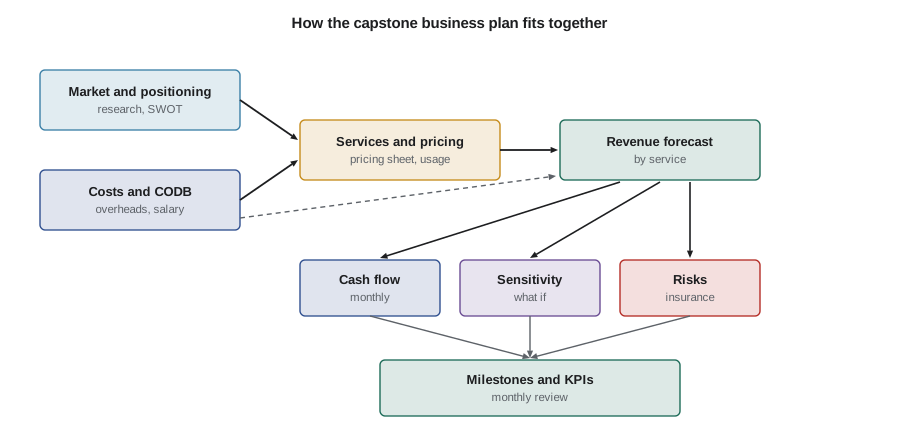
Market and positioning
The market analysis summarizes the evidence gathered in Lesson 1: there are about 1,200 independent food and retail businesses within 20 km, many of which post daily on social media and sell online, and few local photographers specialize in them. Competitors include generalist photographers charging low day rates without usage terms, agencies that are too expensive for small businesses, and AI-generated or phone images. Families in the area spend on portraits mainly in autumn, before the holidays, and in spring.
The SWOT analysis notes strengths (food and product lighting skills, local network), weaknesses (no studio of her own, limited sales experience), opportunities (businesses' need for steady content, demand for authentic local imagery) and threats (low-cost competitors, AI imagery, seasonal portrait demand).
Services and pricing sheet
The pricing sheet starts from CODB and uses the models in Lessons 3 and 4.
| Service | Price | Includes |
|---|---|---|
| Brand content day | $1,450 creative fee | Up to 8 hours, edited selects, web and social licence for 1 year, local |
| Brand content half day | $850 creative fee | Up to 4 hours, as above |
| Extended usage | From base licence $1,000 times multipliers | Print, advertising, national or longer terms |
| Content retainer | $1,200 per month | 1 shoot day and 30 edited images per month, rolling licence |
| Team headshots | $325 for first person, $95 each additional | On location, 2 retouched images each |
| Family session | $250 session fee | 1 hour outdoors, viewing and ordering meeting |
| Print collections | $600, $950 or $1,400 | Wall prints and albums in three tiers |
| Workshop | $295 per participant | One-day product photography workshop |
P: Prices exclude HST at 14%, which the studio charges once registered; with expected revenue far above $30,000, she registers from the start and claims input tax credits on equipment and supplies. Direct expenses such as assistants, props, rentals and travel are estimated and billed separately.
Cost of doing business
Using the overheads from Lesson 3, the studio's annual overheads are $46,000, and the owner plans a salary of $60,000 plus $9,000 for benefits and retirement savings, a total of $115,000. With an expected 100 billable days across both markets, CODB is $1,150 per day. The brand content day rate of $1,450 gives a margin of about 21% on a billed day, before usage fees, which add further profit.
Revenue forecast
Worked problem
First-year revenue and profit forecast
The plan forecasts 45 brand content days averaging $1,450 creative fee plus $450 of usage fees, one retainer client for 10 months at $1,200, 50 family sessions with an average total sale of $700, $4,000 of additional print sales, and 3 workshops with 10 participants each at $295. Direct costs not billed to clients are $8,000 for brand work, $200 of product costs per family session, and $900 fixed plus $45 per participant for each workshop. Overheads are $46,000 and owner salary and benefits $69,000. What are revenue and profit before tax?
Show solution
- Brand days: \( 45 \times (1450 + 450) = 45 \times 1900 = \$85\,500 \).
- Retainer: \( 10 \times 1200 = \$12\,000 \); families: \( 50 \times 700 = \$35\,000 \); prints: \( \$4000 \); workshops: \( 3 \times 10 \times 295 = \$8850 \).
- Total revenue: \( 85\,500 + 12\,000 + 35\,000 + 4000 + 8850 = \$145\,350 \).
- Direct costs: \( 8000 + 50 \times 200 + 3 \times 900 + 30 \times 45 = 8000 + 10\,000 + 2700 + 1350 = \$22\,050 \).
- Profit: \( 145\,350 - 22\,050 - 46\,000 - 69\,000 = \$8300 \).
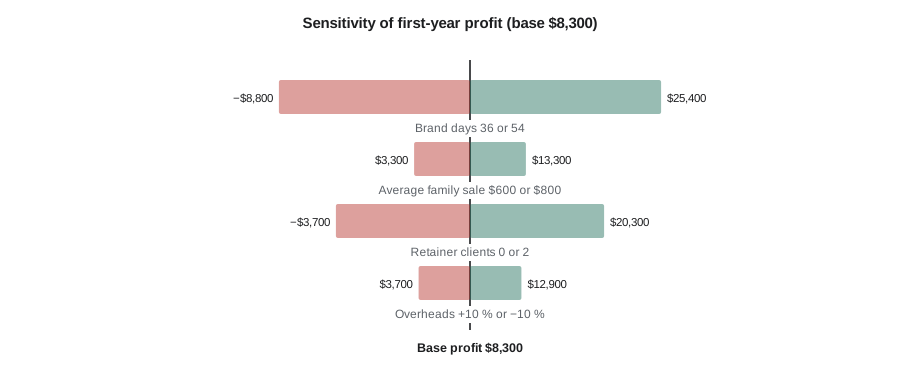
Answer: Revenue of $145,350 and profit before tax of $8,300, about 5.7% of revenue, after paying the owner $69,000 in salary and benefits. The plan is viable but has little margin for error, so the next step is to test what happens if the forecast is wrong.
Worked problem
Sensitivity test
What happens to profit if brand content days fall 20% short of the forecast, and what change would restore the original profit?
Show solution
- Brand days fall from 45 to 36: lost revenue \( 9 \times 1900 = \$17\,100 \).
- New profit: \( 8300 - 17\,100 = -\$8800 \), a loss.
- To recover $17,100 with family sessions contributing \( 700 - 200 = \$500 \) each would need \( 17\,100 / 500 = 34.2 \), about 35 extra sessions.
- Alternatively, a second retainer client for 12 months adds \( 12 \times 1200 = \$14\,400 \), and a 5% price rise on the 36 remaining brand days adds \( 36 \times 1450 \times 0.05 = \$2610 \), together \( \$17\,010 \).
Answer: A 20% shortfall in brand work turns a small profit into an $8,800 loss. The plan should therefore include a cash reserve, a target of two retainer clients, and a price review after six months, rather than relying on the optimistic forecast.
Marketing and sales plan
The marketing plan follows Lessons 6 and 7. For brand content, the main channels are direct outreach to 100 targeted local businesses with a short portfolio tailored to food and retail, partnerships with two local design agencies, and a website with a page for each service. For families, the main channels are referrals, an email list of past clients and inquirers (with consent), a spring and autumn promotion, and social media showing finished wall displays. The marketing budget is 5% of forecast revenue, about $7,300, tracked by cost per lead and cost per booking. The sales process uses a consultation for every brand client and a viewing and ordering meeting for every family, with three print collection tiers to guide choices.
Operations, contracts and rights
Operations cover the workflow from inquiry to delivery: a CRM to track inquiries, standard estimate and contract templates reviewed by a lawyer, model and property release forms, an editing workflow with presets, delivery through online galleries, and a 3-2-1 backup system. Brand contracts specify usage, territory and duration, make the licence effective on payment and include a cancellation schedule. Family contracts set out deposits, rescheduling for weather and the ordering process. All images carry copyright metadata, licences are logged with expiry dates for renewal, and portfolio use of family images requires consent.
Rights are managed under Canadian law: the studio owns copyright in commissioned photographs and grants licences in writing, families may use their portraits for private purposes, and the studio registers key commercial images with CIPO where useful.
Finances, tax and risk
The financial section includes the revenue forecast, a monthly cash-flow forecast showing the seasonal dip in winter and spring, and a cash reserve target of three months of fixed costs. The studio sets aside 30% of every payment in a tax savings account.
As a sole proprietor, the owner reports income on T2125, pays CPP contributions on her self-employment earnings, makes quarterly instalments once required, and claims CCA on equipment and a share of home office costs. Insurance includes equipment coverage, $2 million of general liability, professional liability and disability insurance.
The risk register from Lesson 10 lists the main risks, with a replacement network for illness, dual card slots and backup gear for equipment failure, deposits and payment terms for late payment, and diversification across two markets for demand risk.
Milestones and key performance indicators
| Quarter | Milestone | Measure |
|---|---|---|
| Q1 | Launch website, contracts, CRM; outreach to 50 businesses | 15 brand consultations, first retainer |
| Q2 | Spring family promotion; first workshop | 15 family sessions, 12 brand days |
| Q3 | Outreach to 50 more businesses; price review | Second retainer target, cash reserve of 2 months |
| Q4 | Autumn family season; annual review | 25 family sessions, 45 brand days for the year |
The key performance indicators (KPIs) tracked monthly are inquiries by source, conversion rate from consultation to booking, average sale per family, brand days billed against CODB, client concentration, days to payment and months of cash reserve. A KPI that misses target for two months triggers a review of the plan.
Your capstone
Prepare a business plan of 8 to 12 pages for a photography business you could realistically launch or grow, with a one-page pricing sheet. Include:
- A summary, value proposition, market analysis and SWOT.
- Services and a pricing sheet based on your CODB, with at least one usage-based price.
- A legal structure and registration checklist for your country, province or state.
- A contract outline with deposit, cancellation, usage and payment terms.
- A marketing plan with channels, budget, funnel assumptions and KPIs.
- A revenue forecast, a twelve-month cash-flow forecast, a break-even calculation and a sensitivity test.
- Tax obligations, including sales tax registration and self-employment contributions.
- An equipment list with depreciation, an insurance plan and a risk register.
- A growth plan stating whether and how you will get help or scale.
Present the plan as if to a lender or business adviser, and be ready to explain every assumption. Strong plans are honest about risk, show the numbers clearly and connect pricing to costs and market evidence.
Presenting the plan
When you present your capstone, lead with the story of the business in one or two minutes: who it serves, what it offers and why it will succeed. Then walk through the numbers, highlighting the assumptions that matter most and how you tested them. Expect questions about pricing, competition and cash flow, and answer with evidence from your research rather than optimism. A clear, honest plan is more persuasive than an ambitious one with unexplained numbers.
Common mistakes
MistakeWriting a plan with only optimistic numbers
InsteadInclude a sensitivity test and a cash reserve.
MistakeSetting prices without reference to CODB
InsteadShow how each price covers cost of doing business and profit.
MistakeForgetting tax obligations in the forecast
InsteadInclude sales tax, income tax and self-employment contributions.
MistakeTreating marketing as an afterthought
InsteadBudget marketing and set measurable funnel targets.
MistakeNever reviewing the plan after writing it
InsteadTrack KPIs monthly and review the plan when they miss targets.
Summary and key terms
- The capstone plan connects positioning, services, pricing, costs, forecasts and risks.
- A pricing sheet built from CODB and usage protects margins.
- Revenue forecasts must be tested with sensitivity analysis.
- A small profit margin calls for reserves, diversified income and price reviews.
- Marketing, sales, operations and rights management are part of the plan, not extras.
- Tax, insurance and risk sections reflect the rules of your country.
- Milestones and KPIs make the plan a working tool.
- Capstone
- A final project integrating the skills of a course.
- Pricing sheet
- A summary of services, prices and inclusions.
- Revenue forecast
- A projection of income by service for a period.
- Sensitivity test
- An analysis of how results change when assumptions vary.
- Key performance indicator (KPI)
- A measure tracked to judge progress toward goals.
- Milestone
- A planned achievement by a set date.
- Days to payment
- The average time clients take to pay invoices.
- Cash reserve target
- The amount of cash a business aims to hold for emergencies.
- Diversification
- Spreading income across several markets or clients.
- Value proposition
- A statement of why a specific customer should choose you.
Practice problems
Work each problem on paper first, then reveal the answer to check.
40 brand days at $1,900 each give what revenue?
Show answer
\( 40 \times 1900 = \$76\,000 \).
Revenue $120,000, direct costs $20,000, overheads $40,000, owner pay $55,000. What is profit?
Show answer
\( 120\,000 - 20\,000 - 40\,000 - 55\,000 = \$5000 \).
Profit is $8,000 on revenue of $160,000. What is the margin?
Show answer
\( 8000 / 160\,000 = 5\% \).
Brand days fall from 50 to 40 at $1,800 each. What revenue is lost?
Show answer
\( 10 \times 1800 = \$18\,000 \).
Each family session contributes $450. How many extra sessions replace $9,000?
Show answer
\( 9000 / 450 = 20 \).
Name four KPIs for a photography studio.
Show answer
Inquiries, conversion rate, average sale, days billed, days to payment, cash reserve.
Marketing budget at 5% of $140,000 revenue?
Show answer
\( \$7000 \).
Why include a sensitivity test?
Show answer
To see how much results depend on uncertain assumptions.
What should trigger a review of the plan?
Show answer
A KPI missing its target for two months, or major market changes.
Name the main sections of the capstone plan.
Show answer
Summary, market, services and pricing, structure, contracts, marketing, finances, tax, equipment and insurance, growth.
Lesson quiz · 5 questions
Score 60% or more to complete this lesson.
Create a free account to save your progress, take quizzes and earn a certificate.