
PHOT-410 · Lesson 3 of 12 · 32 min
Cost of doing business and pricing strategy
Pricing is where many photography businesses succeed or fail. Price too low and you can be fully booked yet still unable to replace equipment, take holidays or save for retirement. Price too high for your market and the phone stops ringing. Good pricing starts from your own numbers, the cost of doing business, and then adjusts for what the market will pay and how you want to be positioned. This lesson shows how to calculate your cost of doing business, how to set a day rate or session price that covers it, how to find your break-even point, and how the common pricing models for photography work. Specific commercial estimates and usage fees appear in PHOT-310, and event packages in PHOT-340; this lesson provides the foundation beneath both.
Cost of doing business
Your cost of doing business (CODB) is the amount you must earn on each working day to cover all overheads and pay yourself a reasonable salary, before any profit and before costs specific to a single job. Associations such as the American Society of Media Photographers and the National Press Photographers Association have long promoted CODB calculators, and the method works anywhere.
The calculation has three steps.
- Add up annual overheads: costs you pay whether or not you shoot, such as studio rent, insurance, software, website, phone, accounting, marketing, vehicle costs, education and an allowance for replacing equipment.
- Add the salary you want to pay yourself, before personal income tax, and an amount for benefits you must now fund yourself, such as health coverage, retirement savings and paid time off.
- Divide the total by the number of days you realistically bill in a year.
The hardest part is being honest about billable days. A year has about 260 weekdays, but a self-employed photographer also spends days marketing, editing, meeting clients, doing bookkeeping, maintaining gear, travelling, learning, and taking holidays and sick days. Many commercial photographers bill only 80 to 120 shoot days a year. Using 250 days in the calculation produces a dangerously low price.
Worked problem
Calculating CODB
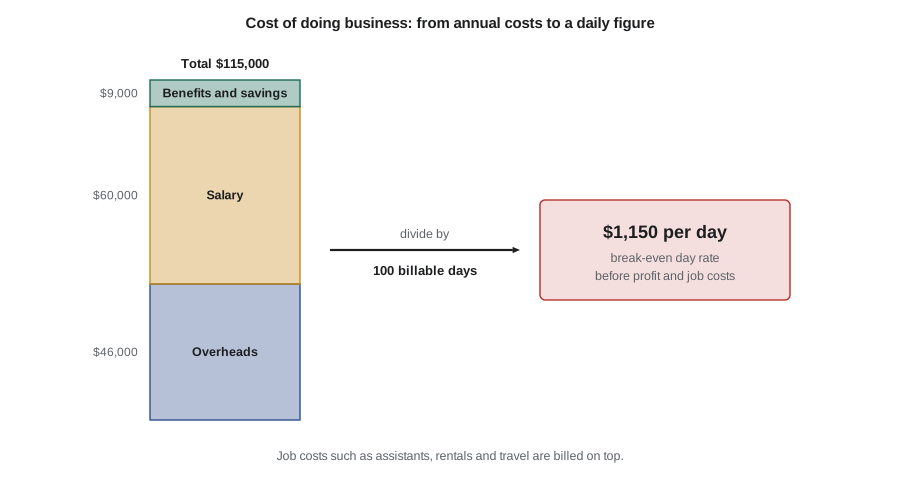
A commercial photographer has these annual overheads: studio rent $18,000, insurance $2,400, software and cloud storage $1,800, website and marketing $4,800, phone and internet $1,500, accounting $2,000, vehicle $4,500, education $1,000, equipment replacement allowance $8,000 and miscellaneous $2,000. She wants a salary of $60,000 and sets aside $9,000 for benefits and retirement savings. She expects to bill 100 shoot days a year. What is her CODB per day?
Show solution
- Overheads: \( 18\,000 + 2400 + 1800 + 4800 + 1500 + 2000 + 4500 + 1000 + 8000 + 2000 = \$46\,000 \).
- Salary and benefits: \( 60\,000 + 9000 = \$69\,000 \).
- Total to recover: \( 46\,000 + 69\,000 = \$115\,000 \).
- CODB per day: \( 115\,000 / 100 = \$1150 \).
Answer: She must earn $1,150 per billed day just to break even with her chosen salary. Any day rate below that loses money, however busy she is.
From CODB to a price
CODB is a floor, not a price. A business also needs profit: a return that funds growth, survives bad years and rewards risk. Profit is usually expressed as a margin on the selling price. If the desired margin is \( m \), the price that achieves it on a cost \( C \) is
Margin and markup are often confused. A 20% margin means profit is 20% of the price; a 20% markup means the price is 20% above cost, which is only about a 16.7% margin. Use one term consistently in your own calculations.
Worked problem
Setting a day rate with profit
Using the CODB of $1,150 per day, what day rate gives a 20% profit margin? What markup does that represent?
Show solution
- Price: \( P = 1150 / (1 - 0.20) = 1150 / 0.80 = \$1437.50 \).
- Profit per day: \( 1437.50 - 1150 = \$287.50 \), which is \( 287.50 / 1437.50 = 20\% \) of the price.
- Markup on cost: \( 287.50 / 1150 = 25\% \).
Answer: About $1,440 a day, rounded to $1,450 for quoting. A 20% margin equals a 25% markup on cost.
Direct costs are billed separately
CODB covers overheads and salary, not the costs of a particular job. Direct or job costs such as assistants, stylists, props, location fees, rental gear, travel, accommodation, permits, retouching by outside contractors and prints should be estimated and billed on top of your fee, sometimes with a handling markup of 10 to 20% to cover the time and financial risk of managing them. A common error is quoting a single all-inclusive number and then discovering that an assistant and a van ate most of the fee.
Break-even analysis
Break-even analysis asks how many jobs you need each month to cover fixed costs. Each job contributes its price minus its variable costs; fixed costs are covered when contributions add up to them.
Here, fixed costs include your own salary or draw, since a business that does not pay its owner has not really broken even.
Worked problem
Break-even shoots per month
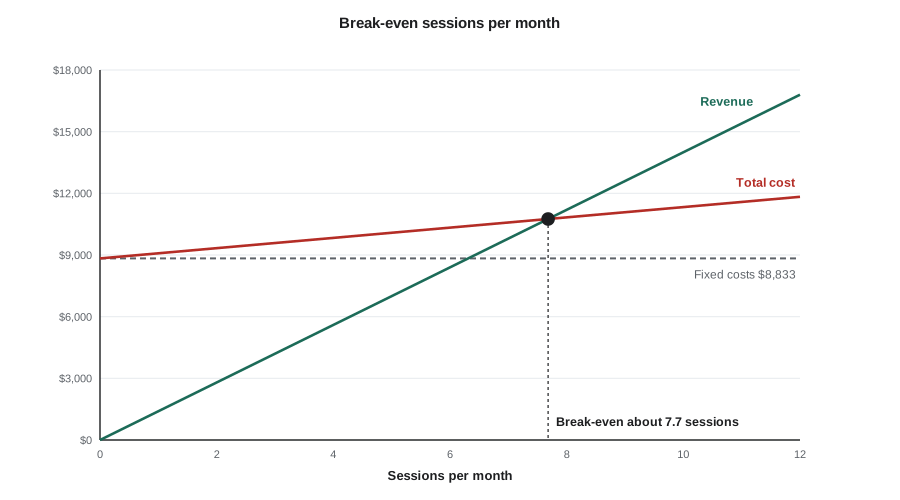
A portrait studio has monthly fixed costs of $3,833 for overheads and pays the owner a draw of $5,000 a month. The average session brings in $1,400 of revenue, and variable costs per session (prints, products, card fees and editing help) are $250. How many sessions per month does the studio need to break even?
Show solution
- Fixed costs including draw: \( 3833 + 5000 = \$8833 \).
- Contribution per session: \( 1400 - 250 = \$1150 \).
- Break-even sessions: \( 8833 / 1150 \approx 7.68 \).
- Sessions are whole numbers, so round up to 8.
Answer: Eight sessions a month. Every session beyond the eighth adds $1,150 of profit; every month below eight draws down savings.
Pricing models
Photographers sell in different ways depending on market and client. The main pricing models are as follows.
- Day rate or half-day rate: a fee for time on set, common in editorial and corporate work. Simple, but it ties income directly to time and may ignore the value of how images are used.
- Creative fee plus usage licence: a fee for the creative work and production, plus a separate licence fee based on how, where and for how long the images will be used. This is standard in advertising; Lesson 4 explains usage.
- Per-image pricing: a fee for each final image, common in product, real estate and e-commerce work. It suits clients who need predictable unit costs; watch the time per image.
- Session fee plus products: a modest fee for the session, with most revenue from prints, albums and digital files sold afterwards, common in portrait studios.
- Packages: bundles at set prices with defined hours, deliverables and products, common in weddings and events. Packages simplify choice and raise the average sale when well designed.
- Retainers: a monthly fee for a set amount of work, such as a fixed number of shoot days or images each month for a brand's social channels. Retainers smooth cash flow but need clear limits on scope.
| Model | Quote | Pros | Cons |
|---|---|---|---|
| Day rate | $1,450 per day | Simple to explain | Ignores how images are used |
| Creative fee plus usage | $1,450 creative fee plus $1,800 licence | Captures value of use | Clients may resist separate licence |
| Per image | 20 images at $90 = $1,800 | Predictable for clients | Risky if the shoot takes longer |
| Retainer | $3,200 per month for 2 days and 40 images | Steady cash flow | Scope creep without clear limits |
Worked problem
Comparing per-image and day-rate quotes
A client needs 30 product images. You can shoot and edit about 12 images per day including set-up. Your day rate is $1,450. What per-image price gives the same revenue, and what is the risk?
Show solution
- Days needed: \( 30 / 12 = 2.5 \) days.
- Equivalent revenue: \( 2.5 \times 1450 = \$3625 \).
- Per-image price: \( 3625 / 30 \approx \$120.83 \), say $121.
- If the products are harder than expected and you only manage 10 per day, the job takes 3 days, worth \( 3 \times 1450 = \$4350 \), but the per-image quote still pays $3,630.
Answer: About $121 per image matches your day rate at 12 images a day. Per-image pricing transfers the productivity risk to you, so build in a margin or limit the number of variations per product.
Market-based and value-based pricing
Cost-based pricing tells you the minimum. Market-based pricing looks at what competitors charge for comparable work; it helps you avoid being wildly out of line but can trap a market in low prices. Value-based pricing looks at what the images are worth to the client: a campaign image used on billboards nationwide for two years is worth far more to the brand than a single social post, even if both took the same day to shoot. Experienced photographers combine all three: cost sets the floor, market sets the range, and value determines where in that range a quote should sit.
Positioning and price signals
Price communicates. In many creative markets, buyers read a low price as a signal of low quality or inexperience, and a higher price, backed by a strong portfolio and service, as a signal of reliability. This does not mean you should raise prices without limit, but it does mean competing mainly on price is a weak strategy for a one-person business: a cheaper competitor can always appear. Compete instead on specialization, quality, speed, reliability and client experience.
Discounts deserve care. A discount should be a deliberate tool, such as an off-season incentive, a package for booking several sessions, or a rate for a non-profit you want to support, rather than a reflex when a client hesitates. Always show the full price and the discount on the estimate so the client sees the value.
Raising prices
Prices should rise over time with inflation, experience and demand. A simple signal is booking rate: if you are booking nearly every inquiry, your prices are probably too low. Raise prices for new clients first, give existing clients notice, and keep a record of how conversion changes. A modest increase often loses few clients while raising profit considerably, because the whole increase flows to the bottom line.
Worked problem
Effect of a price increase
A photographer does 120 sessions a year at $800 with $200 of variable cost each. If she raises the price by 10% and loses 5% of bookings, how does annual contribution change?
Show solution
- Current contribution: \( 120 \times (800 - 200) = 120 \times 600 = \$72\,000 \).
- New price: \( 800 \times 1.10 = \$880 \); new sessions: \( 120 \times 0.95 = 114 \).
- New contribution: \( 114 \times (880 - 200) = 114 \times 680 = \$77\,520 \).
- Change: \( 77\,520 - 72\,000 = \$5520 \) more, with 6 fewer sessions to shoot.
Answer: Contribution rises by $5,520 and she works 6 fewer sessions, a better result on both counts.
Common mistakes
MistakeDividing costs by 250 or more billable days
InsteadUse a realistic number of billed days, often 80 to 150 for photographers.
MistakeTreating CODB as the price
InsteadAdd a profit margin and bill direct costs separately.
MistakeConfusing margin with markup
InsteadUse \( P = C / (1 - m) \) for a target margin and label figures clearly.
MistakeQuoting one all-inclusive number without listing expenses
InsteadItemize assistants, rentals, travel and other job costs.
MistakeCompeting mainly on price
InsteadCompete on specialization, quality, reliability and service.
Summary and key terms
- CODB is annual overheads plus owner salary and benefits divided by realistic billable days.
- Price equals cost divided by one minus the target margin; a 20% margin equals a 25% markup.
- Direct job costs are estimated and billed separately, sometimes with a handling markup.
- Break-even jobs equal fixed costs divided by contribution per job.
- Common models are day rates, creative fee plus usage, per image, session plus products, packages and retainers.
- Cost sets the floor, the market sets the range and value sets the position within it.
- Modest price increases often raise profit even if a few bookings are lost.
- Cost of doing business (CODB)
- The daily amount needed to cover overheads and owner salary.
- Billable day
- A working day that is charged to a client.
- Overheads
- Costs that continue whether or not you shoot.
- Direct costs
- Costs specific to a job, such as assistants and rentals.
- Profit margin
- Profit as a percentage of the selling price.
- Markup
- Profit as a percentage of cost.
- Break-even point
- The level of sales at which revenue equals total costs.
- Contribution
- Price minus variable cost per job.
- Retainer
- A recurring fee for a defined amount of ongoing work.
- Value-based pricing
- Pricing based on the value of the work to the client.
Practice problems
Work each problem on paper first, then reveal the answer to check.
Overheads are $40,000, salary and benefits $60,000 and billable days 125. What is CODB?
Show answer
\( 100\,000 / 125 = \$800 \) per day.
Cost is $900 and target margin 25%. What is the price?
Show answer
\( 900 / 0.75 = \$1200 \).
A price is $1,000 and cost $800. What are the margin and markup?
Show answer
Margin 20%, markup 25%.
Fixed costs are $6,000 per month and contribution per job $750. What is break-even?
Show answer
\( 6000 / 750 = 8 \) jobs.
Name three pricing models used by photographers.
Show answer
Day rate, creative fee plus usage, per image, session plus products, packages, retainers.
Why bill direct costs separately?
Show answer
So job-specific costs do not erode the fee and clients see what they pay for.
You shoot 15 images a day at a $1,200 day rate. What per-image price matches?
Show answer
\( 1200 / 15 = \$80 \).
Why is 250 billable days unrealistic for most photographers?
Show answer
Marketing, editing, admin, travel, holidays and sick days take many working days.
What does booking nearly every inquiry suggest?
Show answer
Prices are probably too low.
100 sessions at $500 with $150 variable cost become 92 sessions at $560. What is the change in contribution?
Show answer
\( 92 \times 410 - 100 \times 350 = 37\,720 - 35\,000 = \$2720 \) more.
Lesson quiz · 5 questions
Score 60% or more to complete this lesson.
Create a free account to save your progress, take quizzes and earn a certificate.