
PHOT-410 · Lesson 6 of 12 · 28 min
Marketing and branding
Marketing is everything you do to make the right clients aware of your work, trust you and contact you. For a photographer, the portfolio is the core of marketing, but it is not enough by itself: excellent work that nobody sees earns nothing. This lesson covers positioning and branding, the marketing funnel, the main channels photographers use, how to measure marketing with cost per lead and customer lifetime value, and the laws on email marketing and reviews in Canada and the United States. VIS-410 covers portfolio editing, websites and social media presence in detail; this lesson treats marketing as a business system that you plan, budget and measure.
Positioning
Positioning is the place you want to occupy in your clients' minds relative to alternatives. A clear position answers three questions: who you serve, what you are best at for them, and why you are different. Specialists are easier to remember and recommend than generalists. "The architectural photographer who understands heritage buildings" is a position; "photographer available for all occasions" is not.
Positioning also guides decisions. If you position yourself as a premium family photographer known for relaxed outdoor sessions, then a discount coupon site, a cluttered website and studio backdrops all undermine that position, while a calm website, high-quality printed products and a careful client experience reinforce it.
Brand
A brand is the set of impressions people form about your business. It includes visible elements, such as your name, logo, typography, colours and the look of your images, but also less visible ones: how quickly you reply, how you speak to clients, how you handle problems, and what people say about you when you are not present. For photographers, the images themselves are the strongest brand element; a consistent style makes your work recognizable.
Keep brand elements consistent across your website, social profiles, email signature, contracts, invoices and packaging. A short brand guide listing your logo files, colours, fonts and tone of voice makes this easier, especially if an assistant or designer helps you.
The marketing funnel
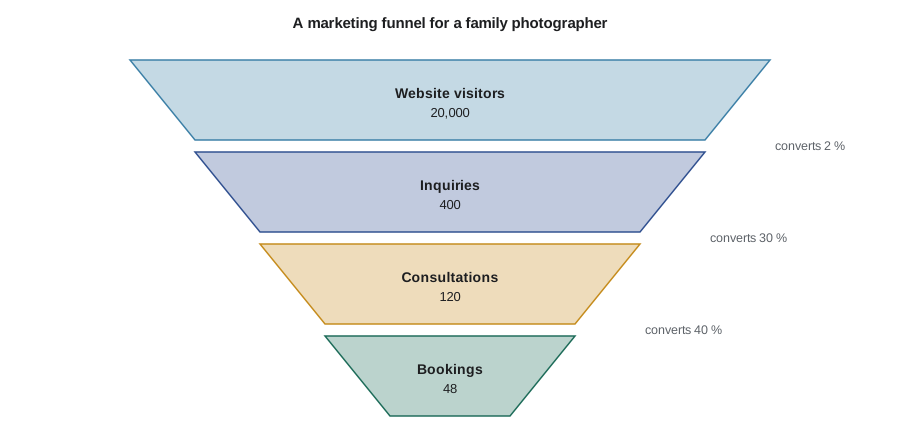
The marketing funnel describes how prospects move from first awareness to becoming clients. The stages are often named awareness, interest, consideration and booking, with repeat and referral stages after the job. Each stage loses people, and the conversion rate at each stage tells you where to focus.
Worked problem
Working through a funnel
A family photographer's website gets 20,000 visitors a year. 2% send an inquiry, 30% of inquiries book a consultation call, and 40% of consultations become bookings. How many bookings does she get? If she improves the inquiry rate to 2.5% by adding clear prices and a booking button, how many bookings result?
Show solution
- Inquiries: \( 20\,000 \times 0.02 = 400 \).
- Consultations: \( 400 \times 0.30 = 120 \).
- Bookings: \( 120 \times 0.40 = 48 \).
- With a 2.5% inquiry rate: \( 20\,000 \times 0.025 \times 0.30 \times 0.40 = 60 \) bookings.
Answer: 48 bookings, rising to 60 with the better inquiry rate, a 25% increase without any more traffic. Improving conversion is often cheaper than buying more visitors.
Marketing channels
Photographers use a mix of channels, and the best mix depends on the market.
- Referrals and word of mouth: often the most valuable channel for portrait, wedding and commercial work alike. Make referrals easy by asking satisfied clients, thanking referrers and staying in touch with past clients.
- Search: a website that appears when people search for a type of photography in your area. Clear pages for each service, location details, fast loading and genuine reviews help; VIS-410 covers websites and search.
- Social media: useful for showing work and personality, especially for consumer markets, but reach depends on platform algorithms that change without notice.
- Email newsletters: an audience you control directly, useful for seasonal promotions, mini-sessions and staying in touch.
- Direct outreach: targeted emails, portfolio meetings and promotional mailers to art buyers, agencies and businesses, common in commercial work.
- Partnerships: relationships with wedding planners, venues, designers, real estate agents or marketing agencies who refer clients.
- Paid advertising: search ads and social ads that can bring inquiries quickly, but must be measured carefully to avoid wasting money.
- Directories, competitions and associations: listings and awards that add credibility and sometimes leads.
A sound principle is to own your audience where possible. Followers on a platform can disappear if an account is suspended or an algorithm changes, but an email list and a website remain yours.
Measuring marketing
Marketing spending should be measured like any other investment. Three simple measures help.
- Cost per lead: total spending on a channel divided by the number of inquiries it produced.
- Cost per acquisition: spending divided by the number of bookings it produced.
- Return on marketing spend: profit from those bookings divided by spending.
Ask every inquiry how they found you, and record the answer. Without that habit, it is impossible to know which channels work.
Worked problem
Cost per lead and per booking
A photographer spends $2,400 on social ads over a season. The ads produce 160 inquiries, of which 24 book. The average booking brings $1,100 in revenue with $300 of direct costs. What are the cost per lead, the cost per booking and the return on the spend?
Show solution
- Cost per lead: \( 2400 / 160 = \$15 \).
- Cost per booking: \( 2400 / 24 = \$100 \).
- Contribution from bookings: \( 24 \times (1100 - 300) = 24 \times 800 = \$19\,200 \).
- Return after ad cost: \( 19\,200 - 2400 = \$16\,800 \), or \( 16\,800 / 2400 = 7 \) times the spend.
Answer: $15 per lead and $100 per booking, with contribution after advertising seven times the spend. The ads are clearly worthwhile, provided the bookings would not have arrived anyway through referrals.
Customer lifetime value
Customer lifetime value (CLV) estimates the total contribution a client brings over the whole relationship, not just the first job. It tells you how much you can sensibly spend to win a client, and it shows the value of retention.
Worked problem
Lifetime value of a family client
A family portrait client spends $650 per session on average, books 1.4 sessions a year, stays for 4 years and the gross margin on sales is 70%. What is the CLV, and what does it suggest about marketing spending?
Show solution
- CLV: \( 650 \times 1.4 \times 4 \times 0.70 = \$2548 \).
- If referrals from each client are worth an extra half client on average, the value is higher still.
- Spending $100 to acquire such a client is a small share of \( 2548 \).
Answer: About $2,550. Because a family client returns for years, it is worth spending on acquisition and much more on service and staying in touch.
Email marketing law
Email is a powerful marketing tool, and both countries regulate it, but in different ways.
Canada's Anti-Spam Legislation (CASL) uses an opt-in model: you need consent before sending a commercial electronic message. Consent can be express, such as a client ticking a box to join your newsletter, or implied in limited situations, such as an existing business relationship from a purchase within the past two years or an inquiry within the past six months. Every message must identify you, include contact information and offer an unsubscribe mechanism that works, with requests honoured within 10 business days. Administrative penalties can reach $10 million per violation for businesses. Keep records of how and when each person consented.
Whatever the legal minimum, a list of people who asked to hear from you performs far better than a bought or scraped list. Never add clients to a newsletter without clear consent, and make unsubscribing easy.
Reviews and testimonials
Reviews influence buyers strongly, especially in consumer markets. Asking happy clients to leave a review is legitimate; inventing reviews, paying for positive ones or hiding negative ones is not.
In Canada, the Competition Act prohibits false or misleading representations, and the Competition Bureau has treated fake reviews and undisclosed paid endorsements as deceptive marketing. Amendments in 2022 and 2024 increased penalties and addressed practices such as drip pricing, where an advertised price excludes unavoidable fees. Ad Standards guidance requires that material connections, such as a free session given in exchange for a review, be disclosed. In Quebec, the Charter of the French Language also sets requirements for commercial advertising and websites.
Respond to negative reviews calmly and briefly, acknowledge the client's experience, and take details offline. Prospective clients read your responses as much as the review.
A marketing plan and budget
A marketing plan sets out goals, target clients, positioning, channels, a calendar and a budget. Small businesses commonly spend somewhere between 3 and 10% of revenue on marketing, with new businesses at the higher end while they build awareness. Plan around your seasons: a wedding photographer markets heavily after the holiday season, when many couples become engaged; a family photographer promotes autumn sessions in late summer; a commercial photographer sends promotions when agencies plan annual campaigns. Review results each quarter and move money from channels that do not perform to those that do.
Content that markets for you
For many photographers, the most effective marketing is useful content: blog posts about local locations for portraits, guides to preparing for a headshot session, case studies showing how a brand used your images and what results it saw, or short videos of your process. Such content helps search engines understand what you offer, gives social media posts substance, and lets prospects see your expertise before they contact you. Case studies are especially persuasive for commercial clients, because they show business outcomes, such as an increase in online sales after new product photography, rather than just attractive pictures. Ask clients for permission and any figures they are willing to share.
Promotions and seasonality
Short promotions, such as mini-sessions before the holidays or a spring headshot day for a local business association, can fill quieter periods and introduce new clients to your work. Plan them as part of the calendar rather than as reactions to slow weeks, set a clear limit on the number of spots, and make sure the price still covers your costs. A promotion that brings in clients who return at full price later is a good investment; one that trains clients to wait for discounts is not. Track the results of each promotion, including how many participants book again within a year, so you can judge its real value.
Whatever channels you choose, consistency matters more than intensity. A steady rhythm of outreach, posting and newsletters, maintained through busy seasons as well as quiet ones, builds awareness that a burst of activity followed by silence cannot.
Common mistakes
MistakePositioning as a generalist for every occasion
InsteadChoose a focus that clients can remember and recommend.
MistakeRelying entirely on one social platform
InsteadBuild an email list and website that you control.
MistakeSpending on ads without tracking results
InsteadRecord lead sources and calculate cost per lead and per booking.
MistakeAdding clients to a newsletter without consent
InsteadGet clear consent, keep records and make unsubscribing easy.
MistakeOffering incentives for positive reviews only
InsteadAsk for honest reviews and disclose any material connection.
Summary and key terms
- Positioning defines who you serve, what you are best at and why you are different.
- A brand includes visual identity, image style, service and reputation.
- The funnel moves prospects from awareness to booking, and conversion at each stage multiplies.
- Channels include referrals, search, social media, email, outreach, partnerships, ads and directories.
- Cost per lead, cost per acquisition and return on spend measure marketing.
- Customer lifetime value shows how much a client is worth over the whole relationship.
- CASL requires consent; CAN-SPAM requires opt-out and honest messages; both countries ban fake reviews.
- Positioning
- The place a business aims to occupy in clients' minds relative to alternatives.
- Brand
- The set of impressions people form about a business.
- Marketing funnel
- The stages prospects pass through from awareness to booking.
- Conversion rate
- The share of prospects who move to the next stage.
- Cost per lead
- Marketing spending divided by the number of inquiries produced.
- Cost per acquisition
- Marketing spending divided by the number of bookings produced.
- Customer lifetime value
- The total contribution a client brings over the relationship.
- Express consent
- Clear permission given by a person to receive messages.
- Material connection
- A relationship, such as a payment or gift, that could affect an endorsement.
- Drip pricing
- Advertising a price that excludes unavoidable additional fees.
Practice problems
Work each problem on paper first, then reveal the answer to check.
10,000 visitors, 3% inquire, 40% consult, 50% book. How many bookings?
Show answer
\( 10\,000 \times 0.03 \times 0.4 \times 0.5 = 60 \).
$1,500 of ads produce 100 leads and 15 bookings. What are cost per lead and per booking?
Show answer
$15 per lead and $100 per booking.
Average sale $500, 2 purchases a year, 3 years, 60% margin. What is the CLV?
Show answer
\( 500 \times 2 \times 3 \times 0.6 = \$1800 \).
Which law uses an opt-in model for commercial email?
Show answer
Canada's Anti-Spam Legislation (CASL).
Within how many business days must unsubscribe requests be honoured under both laws?
Show answer
10 business days.
Name three marketing channels for a commercial photographer.
Show answer
Direct outreach, referrals, search, partnerships with agencies, associations, ads.
Why own your audience?
Show answer
Platform reach can vanish; an email list and website remain yours.
What does the FTC reviews rule prohibit?
Show answer
Fake reviews, buying positive reviews, undisclosed insider reviews and review suppression.
Give an example of a positioning statement.
Show answer
For example: headshots for lawyers and accountants, delivered within 48 hours.
Revenue is $90,000. What is a marketing budget at 5%?
Show answer
\( 0.05 \times 90\,000 = \$4500 \).
Lesson quiz · 5 questions
Score 60% or more to complete this lesson.
Create a free account to save your progress, take quizzes and earn a certificate.