
PHOT-410 · Lesson 2 of 12 · 26 min
Business planning and structure
A business plan is a working document that sets out what your photography business will do, for whom, how it will make money, and what it needs to get there. You do not need a fifty-page document to start, and most photographers never show their plan to a bank. The value is in the thinking: putting numbers to assumptions, noticing gaps, and creating a reference point to measure progress against. This lesson covers the parts of a photography business plan, setting goals, legal structure, registration and the practical set-up steps that make the business real. CRE-330 examines business structures for creators in depth, including the tax trade-offs of incorporating; here we focus on how those choices fit into planning a photography business.
Why plan
Many photographers start by accepting jobs from friends and gradually find themselves in business without a plan. That works until something goes wrong: a slow season, an unexpected tax bill, a large client who pays late, or a broken camera with no savings to replace it. A plan does not prevent these problems, but it makes them visible in advance. It forces you to estimate how much revenue you need, how many jobs that means, and whether the market can supply them.
A plan is also useful when you need outside support. Lenders, landlords for studio space, grant programmes and potential partners may ask for one. Even when nobody asks, a written plan helps you make consistent decisions about which jobs to take and which to refuse.
Parts of a photography business plan
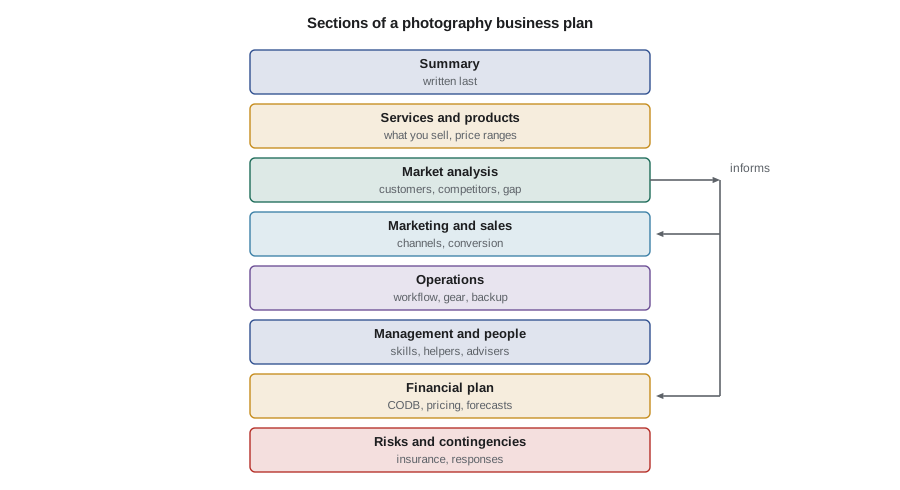
A concise plan for a photography business usually contains the following sections. Each can be a page or less at first.
- Summary: a short overview written last, describing the business, its market and its goals.
- Services and products: what you sell, with price ranges and what each includes.
- Market analysis: your target customers, their needs, competitors and the gap you fill.
- Marketing and sales plan: how customers will find you and how you will convert inquiries into bookings.
- Operations: workflow, equipment, studio or location arrangements, suppliers, software and backup systems.
- Management and people: your skills, any partners, assistants or contractors, and advisers such as an accountant.
- Financial plan: start-up costs, cost of doing business, pricing, a revenue forecast, a cash-flow forecast and a break-even analysis.
- Risks and contingencies: what could go wrong and how you will respond, including insurance.
SWOT and goals
A SWOT analysis lists strengths and weaknesses, which are internal to your business, and opportunities and threats, which come from outside. For a photographer, a strength might be a distinctive lighting style or fluency in a second language; a weakness might be limited sales experience or no studio; an opportunity might be a growing number of small businesses needing content; a threat might be AI imagery or a large competitor opening nearby. The analysis is only useful if it leads to actions: use strengths to pursue opportunities, fix or work around weaknesses, and prepare for threats.
Goals turn the plan into action. The common SMART test asks that goals be specific, measurable, achievable, relevant and time-bound. "Get more clients" fails the test. "Book 40 family sessions at an average sale of $700 between September and December" passes it, and can be tracked month by month.
Worked problem
Turning an income goal into a booking target
A photographer wants to pay herself $55,000 a year before personal income tax. Her business overheads are $28,000 a year, and her average job brings in $900 of revenue with $150 of direct costs such as prints, travel and an assistant. How many jobs does she need per year and per month?
Show solution
- Total needed from jobs: \( 55\,000 + 28\,000 = \$83\,000 \).
- Contribution per job after direct costs: \( 900 - 150 = \$750 \).
- Jobs per year: \( 83\,000 / 750 \approx 110.7 \), so 111 jobs.
- Jobs per month: \( 111 / 12 \approx 9.3 \), about 9 to 10 jobs.
Answer: About 111 jobs a year, or 9 to 10 a month. If the market cannot supply that many, she must raise prices, raise the average sale or cut costs; the plan reveals this before the year begins.
Legal structure
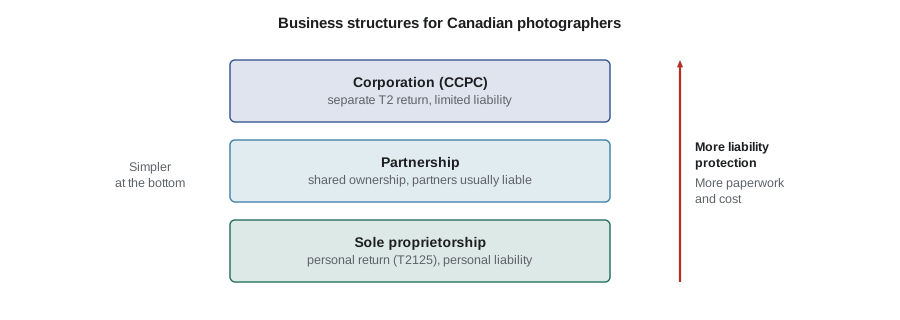
The legal structure determines who owns the business, who is liable for its debts, how it is taxed and what paperwork it needs. Most photographers start as sole proprietors because it is simple and cheap; some later incorporate or form another entity as income grows or risks increase.
In Canada, the main choices are a sole proprietorship, a partnership and a corporation. A sole proprietorship is not a separate legal person: you and the business are the same, you report business income on your personal return (form T2125) and you are personally liable for debts and claims. A corporation, federal or provincial, is a separate legal person that files its own T2 return. A Canadian-controlled private corporation (CCPC) can pay a low small-business tax rate on active business income, but money taken out as salary or dividends is taxed again personally, so incorporating mainly helps when you can leave profits in the company. Incorporation also adds costs for set-up, annual filings and accounting.
| Structure | Liability | Tax filing | Typical fit |
|---|---|---|---|
| Sole proprietorship | Personal, unlimited | Personal return with T2125 | Starting out, modest income |
| Partnership | Partners personally liable unless limited | Partnership information return, partners report shares | Two or more photographers sharing a business |
| Corporation (CCPC) | Limited to company assets, subject to personal guarantees | Corporate T2 return, plus personal tax on salary or dividends | Higher income left in the business, larger risks |
Limited liability is never complete. Banks often require personal guarantees for loans and leases, and you remain personally responsible for your own negligence. Insurance, covered in Lesson 10, is usually more important than structure for protecting a photographer from claims. CRE-330 works through the numbers of when a change of structure pays off; ask an accountant before deciding.
Registration and set-up
Once you have chosen a structure, a few practical steps make the business official.
- Business name: if you trade under a name other than your own legal name, register it with your province (for example, through ServiceOntario or the Quebec enterprise register).
- Business number: get a business number from the Canada Revenue Agency, which you will need for a GST/HST account and, later, payroll.
- Municipal licence and zoning: check whether your city requires a business licence and whether a home studio is allowed under local zoning rules.
- Bank account: open a separate business account and, ideally, a business credit card.
Keep a set-up checklist and a folder with all registration documents, account numbers and renewal dates. Many small penalties come from missed annual renewals rather than from tax itself.
Worked problem
Comparing start-up costs
A new photographer in Ontario estimates start-up costs: a used camera body and two lenses $5,200, lighting kit $1,400, computer $2,800, software for the first year $500, website and domain $400, business name registration $60, insurance deposit $300 and a 3-month cash reserve of $6,000. What total funding does she need?
Show solution
- Equipment: \( 5200 + 1400 + 2800 = \$9400 \).
- Other set-up: \( 500 + 400 + 60 + 300 = \$1260 \).
- Total with reserve: \( 9400 + 1260 + 6000 = \$16\,660 \).
Answer: About $16,660. The cash reserve is more than a third of the total, which is typical: a new business needs money to live on while bookings build.
Advisers and support
Few photographers are experts in accounting or law, and they do not need to be. A small team of advisers saves money over time: an accountant or tax preparer who understands self-employed creatives, a lawyer who can review your standard contract once, an insurance broker who knows photography risks, and a mentor or peer group. Professional associations offer contract templates, insurance programmes, pricing surveys and advocacy; VIS-410 lists the main associations in each country. Small-business support centres and public business advisory services also offer free or low-cost workshops on planning and financing.
Reviewing the plan
A plan is useful only if you look at it again. Set a monthly review to compare actual bookings, revenue and spending against the forecast, and a fuller review each year to update prices, goals and the market analysis. When results diverge from the plan, ask why: was the forecast unrealistic, did the market change, or did marketing fall short? The aim is learning, not guilt.
Financing the start
Most photographers fund their start from savings, gradual equipment purchases and income from a day job or assisting work, rather than from loans. That is usually wise: a business that starts without debt can survive slow months more easily. Where outside money is needed, options include a small business loan or line of credit from a bank, equipment financing or leasing, credit cards (expensive if balances are carried), loans from family, and public programmes for young or new entrepreneurs. Each lender will want to see a plan, a credit history and evidence that you understand your costs and market.
Before borrowing, compare the monthly repayment with your forecast cash flow, not just with annual profit. A loan that looks affordable on annual figures can still strain cash in a slow season. Buying used equipment, renting specialist gear and expanding your kit as paid work justifies it are often better than borrowing to buy everything new at the start.
Planning for different scenarios
A single forecast is a guess. A stronger plan sets out three scenarios: a cautious case, an expected case and an optimistic case, each with its own number of bookings, average sale and costs. The cautious case shows whether you can survive if bookings are slow; the optimistic case shows what you would need, such as an assistant or more studio time, if demand is strong. Decide in advance what you will do if results track the cautious case for three months, such as cutting discretionary spending, increasing marketing in your strongest channel or taking extra assisting work. Planning these responses calmly, before the pressure arrives, is one of the main benefits of writing a plan at all.
Write the plan in plain language and keep the numbers in a spreadsheet linked to it, so that changing one assumption, such as the average sale, updates every forecast at once. A plan that is easy to change is a plan you will keep using.
Common mistakes
MistakeWriting a long plan once and never reading it again
InsteadKeep a short plan and review it monthly against actual results.
MistakeSetting vague goals such as more clients
InsteadSet specific, measurable goals with deadlines and track them.
MistakeAssuming incorporation removes all personal liability
InsteadRemember personal guarantees and your own negligence; rely on insurance as well.
MistakeMixing personal and business money in one account
InsteadOpen a separate business account and card from the start.
MistakeForgetting a cash reserve in start-up costs
InsteadInclude several months of living and operating costs in your funding plan.
Summary and key terms
- A business plan sets out services, market, marketing, operations, people, finances and risks.
- SWOT analysis and SMART goals turn the plan into actions.
- Income goals can be converted into booking targets using contribution per job.
- Sole proprietorships are simple; incorporated entities add liability protection, tax options and paperwork.
- Registration steps include business names, tax numbers, local licences and a separate bank account.
- Accountants, lawyers, insurance brokers and associations are valuable advisers.
- Review the plan monthly and update it yearly.
- Business plan
- A document describing what a business will do and how it will succeed.
- SWOT analysis
- A review of strengths, weaknesses, opportunities and threats.
- SMART goal
- A goal that is specific, measurable, achievable, relevant and time-bound.
- Sole proprietorship
- An unincorporated business owned by one person, who is personally liable.
- Limited liability
- Protection of personal assets from business debts, with exceptions.
- Personal guarantee
- A promise by an owner to repay a business debt personally.
- Contribution per job
- Revenue from a job minus its direct costs.
- Start-up costs
- One-time costs of launching a business, plus an initial reserve.
- Trade name
- A name a business uses that differs from the owner's legal name.
- Cash reserve
- Money set aside to cover costs while revenue builds or during slow periods.
Practice problems
Work each problem on paper first, then reveal the answer to check.
Name four sections of a photography business plan.
Show answer
Any four: summary, services, market analysis, marketing, operations, people, financial plan, risks.
Overheads are $30,000, desired pay $50,000 and contribution per job $800. How many jobs are needed?
Show answer
\( 80\,000 / 800 = 100 \) jobs.
Classify a distinctive lighting style in a SWOT analysis.
Show answer
A strength.
Classify a new low-cost competitor in a SWOT analysis.
Show answer
A threat.
Rewrite "get more weddings" as a SMART goal.
Show answer
For example: book 25 weddings at an average of $4,000 for next season by March 31.
Why does limited liability not fully protect a photographer?
Show answer
Personal guarantees and personal negligence can still expose personal assets.
Why open a separate business bank account?
Show answer
It simplifies bookkeeping, tax and proof of business expenses.
Start-up equipment is $8,000, other costs $1,500 and reserve $5,000. What is total funding?
Show answer
\( 8000 + 1500 + 5000 = \$14\,500 \).
Name two advisers a photographer should have.
Show answer
An accountant, a lawyer, an insurance broker or a mentor.
How often should a plan be compared with results?
Show answer
Monthly, with a fuller annual review.
Lesson quiz · 5 questions
Score 60% or more to complete this lesson.
Create a free account to save your progress, take quizzes and earn a certificate.