
PHOT-499 · Lesson 12 of 12 · 32 min
Capstone launch: next steps, funding and reflection
The capstone ends with two deliverables that look backward and forward: a written reflection on the project, and a plan for the first year of practice after graduation. Together they turn the capstone from a final assignment into a first professional project with a future. This lesson covers reflective writing, the realistic paths into photography work, funding the next stage of a project, pricing your capstone work as if it had been commissioned, sustainability and the relationships the project created. VIS-410 lessons 8, 11 and 12 covered grants, residencies, sustaining a creative career and a one-year practice plan in general; PHOT-410 covered running a photography business. Here the focus is on what to do with this particular body of work, starting the week after the exhibition closes.
Writing the reflection
A reflection is not a summary of what happened; it is an analysis of what you learned and what you will do differently. A simple and widely used structure has three questions: what happened, so what, and now what. What happened describes a few key moments briefly, with evidence from your log. So what analyses why they happened and what they show about your practice, your assumptions or your methods. Now what states specific changes you will make. Choose three or four significant moments rather than trying to cover the whole term, and connect them to the course outcomes.
| Stage | Amara's entry |
|---|---|
| What happened | My first schedule had 192 hours of work against 140 of capacity, and I only found out by adding it up in week 1. |
| So what | I estimate shooting well but underestimate everything after it by about half; my effort factor at mid-term was 1.11 even after cutting scope. |
| Now what | For the next project I will estimate post-shoot stages at twice my instinct and track earned hours from week 1. |
| What happened | The hospital paused access in week 6, and I switched to office tower cleaners. |
| So what | Having a named alternative in the risk register turned a crisis into a two-night delay. |
| Now what | I will keep at least one alternative site for every critical access agreement. |
Write honestly. Assessors know that projects have problems, and a reflection that claims everything went perfectly is less credible and less useful than one that identifies real lessons. Include what went well, too, and why, so that you can repeat it. Bring in the feedback you sorted after the final critique and the comparison of your self-assessment with the assessors' scores from lesson 11.
Paths after the capstone
Photography careers are varied and usually combine several kinds of work. Common paths include assisting established photographers, which teaches business and craft on real jobs; staff roles in media, education, institutions and companies, which are fewer than they were but still exist; freelance commercial, editorial, event or portrait work, built on the business foundations in PHOT-410; independent artistic practice supported by grants, residencies, teaching and sales; related roles such as photo editing, retouching, digital asset management, production and curatorial work; and further study, such as a master's degree in fine arts or a specialist programme. Most photographers combine two or three of these in the first years, and the mix changes over time.
| Path | What the capstone shows | Next step |
|---|---|---|
| Assisting | Reliability, planning, safety, files | Contact photographers whose work fits; offer a specific skill |
| Editorial and documentary | Story, access, captions, ethics | Pitch Night Shift or a new story to editors |
| Commercial | Consistent quality, deliverables, budgets | Build two self-assigned briefs in your target sector |
| Independent artistic practice | Coherent body of work, statement, exhibition | Apply for grants, residencies and exhibition calls |
| Photo editing and related roles | Edit, sequence, metadata, archive | Apply with a portfolio and a short edit exercise |
| Further study | Research, critique, reflection | Research programmes and their deadlines a year ahead |
A one-year plan
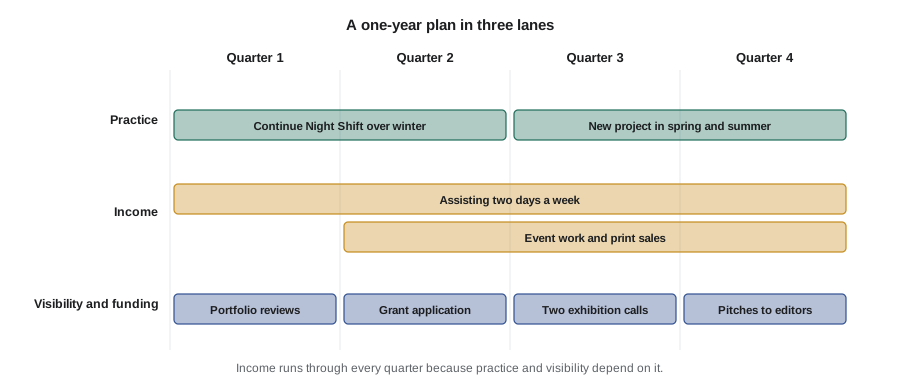
The second final deliverable is a one-year plan: goals for the year after graduation, the actions that lead to them, when each happens, what it costs and how you will know it worked. Keep goals specific and measurable, plan in quarters, and include income, because most plans fail when rent comes due. Limit the plan to what you can actually do alongside paid work; three well-executed goals beat ten neglected ones.
Worked problem
Budgeting time in the first year
Amara plans to work 4 days a week for income (assisting and event work), leaving about 12 hours a week for her own practice over 46 working weeks. Her goals need: continuing Night Shift into winter (80 hours), a new project (150 hours), one grant application (25 hours), two exhibition calls (10 hours each), editor pitches (15 hours), portfolio reviews and networking (30 hours) and website and archive upkeep (40 hours). Does the plan fit?
Show solution
- Available: \( 12 \times 46 = 552 \) hours.
- Planned: \( 80 + 150 + 25 + 20 + 15 + 30 + 40 = 360 \) hours.
- Margin: \( 552 - 360 = 192 \) hours, about 35 per cent of available time.
Answer: It fits with a generous margin, which is realistic: lesson 5 showed her effort factor was about 1.1, and first-year income work is irregular. She keeps the margin rather than adding goals.
Funding the next stage
Many capstone projects continue after graduation, and funding can make that possible. Funding sources include public arts councils, municipal arts programmes, private foundations, residencies, commissions from institutions, crowdfunding (PHOT-430 lesson 8) and sales. Read each programme's eligibility rules carefully; many exclude full-time students, require a minimum period of professional practice or public presentation, or fund only organizations.
In Canada, the Canada Council for the Arts funds individual artists. According to a guide updated in September 2026, its Explore and Create programme's former Research and Creation and Concept to Realization components have been merged into a single Artistic Creation component with rolling intake, up to 75,000 per application and results in about five months; check the Council's current guidelines and your eligibility as an emerging artist before applying. Provincial councils also fund individuals: the Ontario Arts Council's Visual Artists Creation Projects programme, for example, offers 5,000 for emerging, 7,500 for mid-career and 15,000 for established artists, with deadlines in May and November 2026, but excludes full-time students and requires at least three years of professional practice for the emerging category. Municipal councils in larger cities run their own programmes.
Worked problem
Building a grant budget
Amara plans to extend Night Shift over winter and needs funding for: 40 shoot nights of travel at about 18 each, a second light (300), prints for subjects (250), a book dummy revision (120), an artist fee for her own time of 120 hours at 25 per hour, and a 10 per cent contingency on all costs except her fee. What does she request?
Show solution
- Travel: \( 40 \times 18 = 720 \).
- Costs before contingency: \( 720 + 300 + 250 + 120 = 1390 \); contingency \( 0.10 \times 1390 = 139 \).
- Artist fee: \( 120 \times 25 = 3000 \).
- Total: \( 1390 + 139 + 3000 = 4529 \).
Answer: About 4,529. Many arts funders accept or expect artist fees for the applicant's time, but some do not, so the same project may need different budgets for different funders. The budget must match the project description line by line.
Arts grants received by individuals in Canada are generally taxable, and there are rules for deducting project expenses against them; check the Canada Revenue Agency's guidance or an accountant, as PHOT-410 lesson 9 recommends for all tax questions.
Pricing the work as if it were commissioned
A useful exercise is to price your capstone as if a client had commissioned it, using the methods in PHOT-410 lesson 3. It tells you what the work is worth in the market, prepares you for real quotes and helps you judge offers to publish or license the work. For editorial and documentary work the price includes day rates, expenses and a licence for the intended use; for a gallery exhibition, it includes artist fees and print prices.
Worked problem
Pricing Night Shift as a commissioned project
A city magazine asks what it would have cost to commission Night Shift as a 12-image editorial feature. Using illustrative figures, Amara estimates 14 shoot days at a day rate of 450, 4 days of editing and post-production at 300, expenses of 900 and a one-time editorial licence for print and online use valued at 25 per cent of the creative fee. What is the quote?
Show solution
- Creative fee: \( 14 \times 450 + 4 \times 300 = 6300 + 1200 = 7500 \).
- Licence: \( 0.25 \times 7500 = 1875 \).
- Total: \( 7500 + 1875 + 900 = 10275 \).
Answer: About 10,275 at these illustrative rates. A magazine is unlikely to pay that for an existing student project, but the figure is a useful anchor when it offers a licence fee for publishing selected images, and it shows the scale of value the project represents.
Sustainability and the footprint of a project
Photography projects have environmental costs: travel, equipment, energy for computing and storage, printing and framing. Reflecting on them is increasingly expected by funders and venues. Travel usually dominates for projects that involve repeated trips, especially by car or air. Estimates use emission factors, which vary by source, vehicle and grid, so treat the results as rough indications for comparing choices rather than precise accounts.
factors = {'car': 0.17, 'taxi': 0.20, 'bus': 0.10, 'train': 0.04, 'flight': 0.15}  # kg CO2e per passenger-km, illustrative
trips = [('bus', 12, 2 * 9), ('taxi', 12, 11), ('car', 6, 2 * 25), ('train', 2, 2 * 120)]  # mode, trips, km per trip
total = 0
for mode, n, km in trips:
    kg = factors[mode] * n * km
    total += kg
    print(f'{mode:6s} {n:3d} trips x {km:4d} km = {kg:6.1f} kg')
print(f'total about {total:.0f} kg CO2e')
alt = total - factors['car'] * 6 * 50 + factors['bus'] * 6 * 50
print(f'if the car trips were by bus: about {alt:.0f} kg')bus 12 trips x 18 km = 21.6 kg taxi 12 trips x 11 km = 26.4 kg car 6 trips x 50 km = 51.0 kg train 2 trips x 240 km = 19.2 kg total about 118 kg CO2e if the car trips were by bus: about 97 kg
With these illustrative factors, Amara's travel adds up to roughly 120 kg of carbon dioxide equivalent, with the car trips and taxis accounting for about two-thirds of it. Small changes, such as shared rides home and bus or train travel where safe, reduce the total without changing the work. Other choices matter too: reusing frames, choosing printers with responsible paper sources, keeping only the files you need and refreshing rather than multiplying archives.
Keeping relationships and the archive alive
The people in the work and the partners who gave access are part of the project's future. Send them the exhibition documentation, deliver the promised prints and books, thank them in writing, and ask whether they would be willing to continue if the project goes on. Keep their contact details and permissions organized in your archive (lesson 7). Many long-term documentary projects grow from relationships built in a first, short project. If you publish the work later, check that the uses are covered by the original releases and ask again when they are not.
| Within | Action |
|---|---|
| One week | De-install, return equipment, deliver prints and books to subjects and partners |
| Two weeks | Thank-you notes; archive with checksums; portfolio and website updated |
| One month | Reflection and one-year plan submitted; feedback sorted |
| Three months | First grant or call application; first pitch to editors |
| Six months | Review the one-year plan; adjust goals; continue or close the project |
Competitions, calls and fees
Exhibition calls, competitions and festivals can bring visibility, but entry fees add up and some calls exist mainly to collect fees. Before entering, check who runs the call, who judges it, what winners receive, what rights you grant by entering (some terms claim broad usage rights), and how past winners have benefited. Budget a fixed amount for entry fees each year and choose calls that fit your audience from lesson 10. VIS-410 lesson 9 discusses competitions and portfolio reviews in detail.
Worked problem
Is an entry fee worth it?
A competition charges 45 per entry. It receives about 1,500 entries for 3 prizes and 30 shortlist places, with shortlisted work shown in an exhibition and published online. What are the chances of a prize or the shortlist, and what is the expected cost per shortlist place for an entrant?
Show solution
- Chance of a prize, if entries were equally likely: \( 3/1500 = 0.2 \) per cent. Chance of the shortlist or better: \( 33/1500 = 2.2 \) per cent.
- Expected entries per shortlist place: \( 1500/33 \approx 45 \), so the expected cost per place is about \( 45 \times 45 = 2025 \).
- Entries are not equally likely, because strong, well-fitted work has better chances, but the order of magnitude holds.
Answer: About a 2 per cent chance of the shortlist and an expected cost of about 2,000 per shortlist place across many entries. Enter only calls where the fit with your work is strong and the rights terms are fair, and set an annual limit.
Common mistakes
MistakeWriting a reflection that summarizes events without analysing them
InsteadUse what happened, so what, now what, with evidence and specific changes.
MistakeMaking a one-year plan without income
InsteadPlan income in every quarter alongside practice and visibility goals.
MistakeApplying for grants without checking eligibility
InsteadRead eligibility rules, including exclusions for full-time students and minimum professional practice.
MistakeTreating the end of the exhibition as the end of obligations to subjects
InsteadDeliver prints and books, thank partners and check releases before any later use.
MistakeEntering every competition that accepts photographs
InsteadChoose calls that fit your audience, have fair rights terms and fit an annual fee budget.
Summary and key terms
- A reflection analyses what happened, why it matters and what you will do differently.
- Photography careers usually combine several paths; the capstone provides evidence for each.
- A one-year plan sets specific goals in quarters with income in every quarter.
- Public funding for individuals comes mainly from arts councils
- Grant budgets match the project description line by line and follow each funder's rules on artist fees.
- Pricing the capstone as a commission shows its market value and anchors later offers.
- Estimate the project's footprint roughly and keep relationships and archives alive after the show.
- Reflection
- Writing that analyses experience to draw lessons for future practice.
- One-year plan
- A plan of goals, actions, timing and costs for the year after graduation.
- Arts council
- A public body that funds artists and arts organizations.
- Eligibility
- The conditions an applicant must meet to apply for funding.
- Artist fee
- Payment for an artist's time and work, separate from expenses.
- Fiscal sponsorship
- An arrangement in which a nonprofit receives and administers a grant for an individual project.
- Creative fee
- The part of a quote that pays for the photographer's time and skill.
- Licence fee
- Payment for permission to use images in specified ways.
- Emission factor
- An estimate of greenhouse gas emissions per unit of activity.
- Entry fee
- A charge for submitting work to a competition or call.
Practice problems
Work each problem on paper first, then reveal the answer to check.
What are the three questions of the reflection structure?
Show answer
What happened, so what, now what.
10 hours a week for 48 weeks gives how many hours?
Show answer
480 hours.
A grant budget has costs of 2,000 plus 10 per cent contingency and an artist fee of 80 hours at 30. What is the total?
Show answer
\( 2200 + 2400 = 4600 \).
Twelve days at 400 plus a licence of 20 per cent of the fee: what is the quote before expenses?
Show answer
\( 4800 + 960 = 5760 \).
30 trips of 12 km at 0.2 kg per km produce how much CO2e?
Show answer
72 kg.
A competition has 2,000 entries for 40 places. What is the chance per entry, if equal?
Show answer
2 per cent.
Name three things to check before entering a competition.
Show answer
Who runs and judges it, what winners receive, what rights entry grants.
Why include income in a one-year plan?
Show answer
Other goals fail when bills cannot be paid.
What should you do before using images from the capstone in a later publication?
Show answer
Check that the original releases cover the use and ask again if they do not.
Which funders support individual photographers most often?
Show answer
Arts councils at the national, provincial or territorial and municipal levels.
Lesson quiz · 5 questions
Score 60% or more to complete this lesson.
Create a free account to save your progress, take quizzes and earn a certificate.