
PHOT-499 · Lesson 2 of 12 · 29 min
Developing the proposal
The proposal is the first assessed deliverable and the document that every later decision refers back to. A good proposal turns a topic you care about into a specific project that can be made in the time, with the access and money you have, and that has a reason to exist beyond your own interest. It also commits you to outputs and dates, which makes it the baseline against which the mid-term review and defence will measure your progress. PHOT-401 lesson 2 introduced concept, intention and research for fine art projects, and PHOT-230 lesson 9 covered research and access for documentary work; this lesson applies those methods to the specific job of writing a capstone proposal that will be approved in week 2.
From topic to project
Most capstones start with a topic: night work, a neighbourhood changing, a family's farm, a sport, an illness, a landscape. A topic is not yet a project, because it does not tell you what to photograph, how, or why anyone else should look. Moving from topic to project usually takes three steps. First, narrow the topic to a subject you can reach repeatedly within the term. Second, find the question or tension inside it, the thing you want to understand or show. Third, choose an approach, the visual method that will carry that question: portraits, interiors, landscapes, objects, staged tableaux, a typology, a diary, or a combination.
Amara began with "people who work at night". That covers millions of people and suggests nothing specific. She narrowed it to overnight workers in her own city whom she could visit repeatedly: a bakery, a hospital's environmental services team, a transit maintenance yard, a community radio station and a taxi stand. Her question became how people make a working life in hours when most of the city sleeps, and what the night does to the spaces they work in. Her approach combined environmental portraits made with a single portable light and medium-wide interiors without people, shown in pairs.
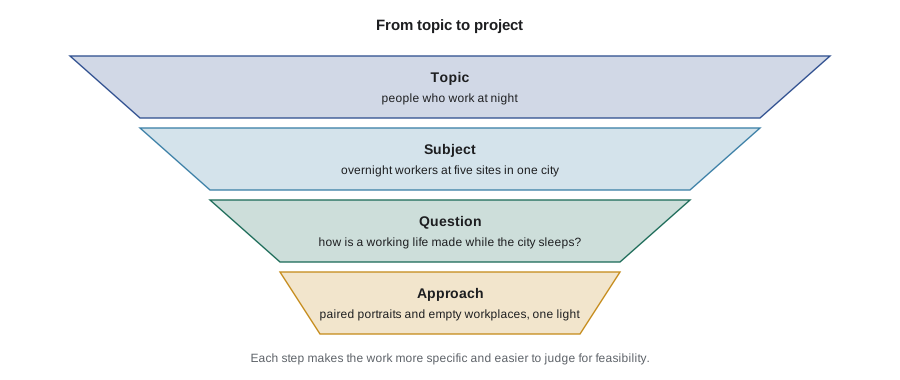
| Stage | Night Shift | A changing street | A grandparent's farm |
|---|---|---|---|
| Topic | Night work | Gentrification | Rural family history |
| Subject | Overnight workers at five sites in one city | One commercial street over a term | One farm and the family who run it |
| Question | How is a working life made while the city sleeps? | What disappears first when a street changes? | What does a farm keep after the people who built it leave? |
| Approach | Paired portraits and empty interiors with one light | Repeated views from fixed points plus shop owner portraits | Objects, landscapes and archive photographs combined |
Research and precedents
Research for a photography project has two strands. Subject research is what you learn about the people, places or issues you will photograph: history, statistics, current debates, and above all the knowledge of people who live or work there. Visual research is what you learn from other photographers and artists who have worked on related subjects or with related methods. Both strands belong in a research file that you keep throughout the term and submit with the proposal.
Precedents are not examples to imitate; they show what has already been done so that you can position your work. For night work, Amara looked at Brassaï's photographs of Paris at night from the early 1930s, which made the city's nocturnal life a subject in its own right; at Bruce Davidson's colour photographs of the New York subway around 1980, which combined portraits and atmosphere in a closed underground world; at August Sander's long typological project of German people photographed by occupation in the early twentieth century, which showed how portraits of workers can form a social survey; and at more recent documentary projects on care workers and the gig economy. From each she wrote a few sentences on what the work does, what she would borrow (a method, a tone, a structure) and what she would do differently.
| Precedent | What it does | What to borrow | What to do differently |
|---|---|---|---|
| Brassaï, Paris at night, early 1930s | Makes the night city its own subject | Respect for darkness; long exposures | Focus on workers rather than nightlife |
| Bruce Davidson, New York subway, about 1980 | Mixes portraits and atmosphere in one closed world | Close engagement with subjects; flash colour | Several sites rather than one system |
| August Sander, portraits by occupation | Builds a social survey from portraits of trades | Consistent framing across subjects | Pair portraits with spaces; collaborative captions |
| Recent care work projects | Show labour that is usually invisible | Workers' own words in captions | Include non-care night work |
Cite precedents accurately, describe them in your own words and avoid reproducing other photographers' images in your proposal beyond what your school's policy on fair dealing or fair use for education allows; a title, date and short description usually serve better than a pasted image. In the defence you may be asked how your work differs from a precedent, so record the differences while the research is fresh.
Defining audience and purpose
A proposal should say who the work is for and what you hope it will do. Audience shapes the output, the tone and the ethics. A gallery audience may spend a minute with each print; a book reader may move back and forth over days; social media viewers decide in a second whether to stop. The people in the work are also an audience, and often the most important one: they will see how you represented them. Purpose can be to document, to question, to celebrate, to inform a policy debate, to build a portfolio for a specific field, or several of these at once, but it should be specific enough to guide choices.
Amara wrote: "The primary audience is the people who use the city by day and rarely think about who keeps it running at night; the secondary audience is the workers themselves, who will receive prints and a copy of the book dummy; the professional audience is documentary editors and arts council juries. The work aims to make night labour visible with dignity rather than pity."
The structure of a capstone proposal
Proposals vary by programme, but most ask for the same components. Keep to word limits; reviewers and later grant juries read many proposals and reward clarity. Write the summary last, after the rest has settled.
| Component | Purpose | Suggested length |
|---|---|---|
| Working title | A memorable handle for the project | A few words |
| Summary | What, where, how and why in one paragraph | 100 words |
| Statement of intent | The question, purpose and audience | 250 words |
| Context and precedents | Where the work sits and how it differs | 300 words |
| Approach and method | Visual strategy, equipment, light, format | 250 words |
| Subjects and access | Who or what, how access is secured, consent | 200 words |
| Outputs | Exhibition, book, screen, portfolio, deliverables | 100 words |
| Schedule and budget summary | Key dates and total cost (details in the plan) | 150 words |
| Risks and ethics | Main risks and how they will be managed | 200 words |
| References and research file | Sources and precedents | List |
Worked problem
Allocating a word limit
Amara's programme sets a 1,500-word limit for the proposal body, excluding references. She wants to give context and precedents 20 per cent, approach 18 per cent, statement of intent 16 per cent, subjects and access 14 per cent, risks and ethics 12 per cent, schedule and budget 10 per cent, outputs 5 per cent and the summary 5 per cent. How many words does each part get, and does it add up?
Show solution
- Multiply each share by 1,500: context 300, approach 270, intent 240, access 210, risks 180, schedule and budget 150, outputs 75, summary 75.
- Check: \( 300 + 270 + 240 + 210 + 180 + 150 + 75 + 75 = 1500 \).
Answer: The allocation fits exactly. Writing to a budget per part prevents the common problem of a long context section and a thin method and access section, which reviewers read as a project that has not yet been planned.
Testing feasibility
Before committing, test each idea against the constraints that most often sink capstones: access, time, cost, skill, safety and ethics. Access means whether you can reach the subject repeatedly and with permission. Time means whether the subject is available when you are, and whether the work can be made in the term; seasonal subjects, events that happen once and slow processes are risky. Cost covers travel, equipment rental, materials, printing and fees. Skill asks whether you can make the images to the required standard now or with a little practice. Safety and ethics ask whether the work puts you or others at risk and whether the people involved can give meaningful consent.
A simple weighted scorecard makes the comparison explicit. Score each idea from 1 to 5 on each criterion, weight the criteria by how much they matter for your circumstances, and compare the totals. Then check whether the ranking changes if the weights change, because weights are judgements and a close result should not be treated as decisive.
Worked problem
Comparing three ideas with a weighted scorecard
Amara compares three ideas. Weights: access 25, time 20, cost 15, skill 15, safety and ethics 15, interest 10. Scores (1 to 5): Night Shift 4, 4, 3, 4, 3, 5; a river's industrial shoreline 5, 3, 4, 3, 4, 3; a hospital's paediatric ward 2, 3, 4, 3, 2, 5. Which scores highest out of 5?
Show solution
- Night Shift: \( (25 \times 4 + 20 \times 4 + 15 \times 3 + 15 \times 4 + 15 \times 3 + 10 \times 5)/100 = (100 + 80 + 45 + 60 + 45 + 50)/100 = 3.80 \).
- Shoreline: \( (125 + 60 + 60 + 45 + 60 + 30)/100 = 3.80 \).
- Paediatric ward: \( (50 + 60 + 60 + 45 + 30 + 50)/100 = 2.95 \).
Answer: Night Shift and the shoreline tie at 3.80; the ward idea is clearly weaker because access and consent are difficult. A tie means the choice comes down to the criterion the scorecard cannot capture well, which is why the next step is a test shoot.
import random
random.seed(499)
ideas = {'Night Shift': [4, 4, 3, 4, 3, 5], 'Shoreline': [5, 3, 4, 3, 4, 3], 'Ward': [2, 3, 4, 3, 2, 5]}
base = [25, 20, 15, 15, 15, 10]
def score(s, w):
    return sum(a * b for a, b in zip(s, w)) / sum(w)
print({k: round(score(v, base), 2) for k, v in ideas.items()})
wins = {k: 0 for k in ideas}
for _ in range(5000):
    w = [max(1, x * random.uniform(0.6, 1.4)) for x in base]
    best = max(ideas, key=lambda k: score(ideas[k], w))
    wins[best] += 1
print({k: f'{v / 50:.1f}%' for k, v in wins.items()}){'Night Shift': 3.8, 'Shoreline': 3.8, 'Ward': 2.95}
{'Night Shift': '50.3%', 'Shoreline': '49.7%', 'Ward': '0.0%'}With weights varied by up to 40 per cent either way, the two leading ideas each win about half the time and the ward idea never wins. The scorecard has done its job: it has removed the weakest option and shown that the remaining decision needs evidence rather than more arithmetic.
Test shoots and proof of concept
A test shoot before the proposal is approved is the strongest feasibility evidence you can offer. It shows that you can get access, that the approach produces images, and what problems will arise. Amara spent one night at the bakery and one evening at the shoreline. The bakery night produced six usable frames and revealed that her single light was too weak for the large ovens room, that bakers had about four minutes between tasks, and that the owner wanted to see images before any publication. The shoreline evening produced handsome landscapes but no sense of a question. She chose Night Shift and added a more powerful battery light to her budget, a portrait time limit of three minutes, and a review step for site partners to her plan.
| Question | Evidence from the test |
|---|---|
| Can I get access, and on what terms? | Who agreed, conditions set, contact details |
| Does the approach produce images that carry the question? | Contact sheet and three strongest frames |
| What technical problems arise? | Light levels, noise, colour, space, sound |
| How long does each image take? | Times recorded in the log |
| What do subjects think of the project? | Notes of their responses and concerns |
Writing the statement of intent
The statement of intent is the heart of the proposal. It should say what the project is about, why it matters, what question or tension drives it and how the images will address it. Write in plain language, in the first person, in the present or future tense, and avoid both inflated claims and vague phrases such as "explores the human condition". Specific nouns and verbs persuade more than abstractions: "I will photograph bakers, cleaners, maintenance crews and drivers at five sites between midnight and six in the morning" is stronger than "I will investigate the hidden labour of the nocturnal city".
Lesson 8 returns to writing about the work for an audience; at proposal stage the statement is a working document, and it will change. Keep each version in your research file so you can show in the defence how your intentions developed.
How proposals are reviewed
Supervisors approve proposals against a short checklist: the question is specific; the approach suits the question; access is secured or has a realistic plan; the scope fits the capacity; outputs are defined; risks and ethics are identified; and the work is new and the student's own. Common outcomes are approval, approval with conditions (for example, "confirm hospital access in writing by week 3 or switch to the alternative site"), or a request to revise and resubmit within days. Conditional approval is normal and is not a criticism; it records the risks you will manage.
| Check | Pass looks like |
|---|---|
| Specific question | One sentence that names a subject and a tension |
| Approach fits question | Visual method explained with test images |
| Access | Named partners, written agreement or a dated plan |
| Scope and schedule | Estimate within capacity, with buffer |
| Outputs | Format, size, number of images and venue named |
| Risks and ethics | Main risks listed with responses |
| Originality | New work; precedents cited and differences stated |
Common mistakes
MistakeProposing a broad topic rather than a project
InsteadNarrow to a reachable subject, a specific question and a chosen approach.
MistakeTreating precedents as styles to copy
InsteadAnalyse what each precedent does and state how your work differs.
MistakeSpending most of the word limit on context
InsteadAllocate words to approach, access and risks, which show the project can be made.
MistakeChoosing the idea with the highest scorecard total without checking sensitivity
InsteadTest whether the ranking holds when weights change, then use a test shoot to decide.
MistakeWriting an abstract statement of intent
InsteadUse plain, specific language about who, what, where and why.
Summary and key terms
- A project needs a reachable subject, a specific question and a visual approach.
- Keep a research file with subject research and precedent analysis.
- Name the audiences, including the people in the work, and the purpose.
- Write each proposal component to a word budget and the summary last.
- Test feasibility for access, time, cost, skill, safety and ethics with a weighted scorecard.
- A test shoot before approval is the strongest evidence of feasibility.
- Conditional approval is normal; it records risks you must manage.
- Proposal
- The document that defines a project's question, approach, outputs and plan.
- Statement of intent
- The part of a proposal explaining what the project is about and why.
- Precedent
- Earlier work related in subject or method, used to position a project.
- Research file
- A collected record of subject and visual research.
- Approach
- The visual method chosen to carry a project's question.
- Feasibility
- Whether a project can be made with the access, time, money and skill available.
- Weighted scorecard
- A comparison that scores options on criteria multiplied by weights.
- Sensitivity check
- Testing whether a decision changes when assumptions change.
- Test shoot
- A trial shoot to check access, approach and practical problems.
- Conditional approval
- Approval that depends on meeting stated conditions by a date.
Practice problems
Work each problem on paper first, then reveal the answer to check.
What three steps turn a topic into a project?
Show answer
Narrow to a reachable subject, find a question, choose an approach.
A 1,200-word proposal gives 20 per cent to approach. How many words is that?
Show answer
240 words.
What two strands does photography research have?
Show answer
Subject research and visual research.
Why describe precedents rather than paste their images?
Show answer
To respect copyright and show your own understanding of what the work does.
Score an idea with weights 50, 30, 20 and scores 4, 3, 5 out of 5.
Show answer
\( (200 + 90 + 100)/100 = 3.9 \).
Name six feasibility criteria.
Show answer
Access, time, cost, skill, safety and ethics.
What did Amara's test shoot change in her plan?
Show answer
A stronger light, a three-minute portrait limit and a partner review step.
Give one sign of a weak statement of intent.
Show answer
Vague abstractions such as "explores the human condition".
What does conditional approval mean?
Show answer
The proposal is approved provided stated conditions are met by a date.
Who are the possible audiences of a documentary capstone?
Show answer
The public, the people photographed and professional reviewers such as editors and juries.
Lesson quiz · 5 questions
Score 60% or more to complete this lesson.
Create a free account to save your progress, take quizzes and earn a certificate.