
PMP-120 · Lesson 4 of 12 · 30 min
Team charters, ground rules and empowerment
Most conflicts on project teams are not really about people disliking each other. They come from unspoken assumptions: one person thinks a reply within a day is fine, another expects an hour; one thinks decisions are made in meetings, another thinks the lead decides; one thinks cameras on is respectful, another thinks it is intrusive. A team charter makes these assumptions visible and agreed before they cause friction. This lesson explains how to create a team charter, how to set and enforce ground rules, and how to empower a team by making decision rights and delegation explicit.
What a team charter is
A team charter (also called a team agreement or working agreement) is a document created by the team that sets out its shared values, agreements and practices. It is different from the project charter. The project charter is issued by the sponsor, authorizes the project and gives the project manager authority to use resources. The team charter is written by the team, for the team, and describes how the members will work together.
| Aspect | Project charter | Team charter |
|---|---|---|
| Who creates it | Sponsor, usually with the project manager | The team, facilitated by the project manager or team facilitator |
| Purpose | Authorizes the project; names the project manager; states objectives and high-level requirements | Agrees values, ground rules, decision making and ways of working |
| Audience | Sponsor, stakeholders, governance bodies | Team members |
| When | Initiation | Team formation, revisited when the team changes |
| Authority | Organizational | Peer agreement |
PMI material lists typical contents of a team charter: team values, communication guidelines, decision-making criteria and process, a conflict resolution process, meeting guidelines and other team agreements, such as core working hours and how to handle absences. Agile teams often add a definition of ready and a definition of done, and working agreements about how work flows on their board.
Creating a team charter
The single most important rule is that the team writes it. A project manager who drafts a team charter alone and asks for signatures produces a document nobody owns. The project manager's job is to facilitate: create the space, ask the right questions, capture the agreements and help the team reach consensus.
Worked problem
Facilitating a team charter workshop
You have a newly formed team of eight: four in Toronto, two in Vancouver and two contractors in Lisbon. Plan a 90-minute workshop to produce a first team charter.
Show solution
- Before the session: share the project vision and a blank charter template; ask each member to note one thing that made a past team great and one thing that made a team difficult.
- Opening (10 minutes): explain the purpose: "We're agreeing how we work together, not what we deliver."
- Values (20 minutes): silent brainstorming of values on a shared board, cluster similar ideas, dot-vote the top four and define what each means in behaviour.
- Working agreements (35 minutes): in small groups, draft agreements for communication (channels, response times, core hours that fit Lisbon and the West Coast), meetings, decision making and conflict. Share and refine.
- Consensus check (15 minutes): use fist-of-five on each section; discuss any score of two or lower until everyone can support it.
- Close (10 minutes): agree where the charter will live, who will update it and when it will be reviewed, for example at every third retrospective.
Answer: Prepare, let the team generate and agree the content, check consensus explicitly, and set a review date. The project manager facilitates rather than authors.
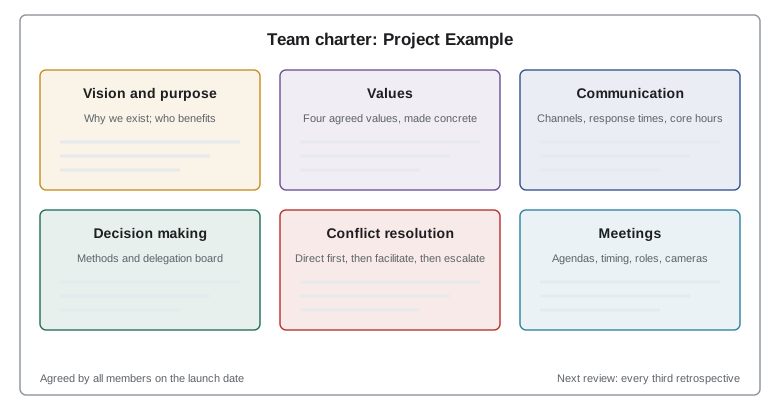
A good charter is specific enough to settle real disagreements. "We communicate respectfully" is a value; "We reply to direct chat messages within four working hours, and anything urgent is a phone call" is an agreement. Both have their place, but only the agreement tells someone what to do on a busy Tuesday.
| Vague | Specific |
|---|---|
| We communicate well | Status questions go in the team channel, not private messages, so everyone sees the answer |
| We respect each other's time | Meetings start on time, have an agenda shared 24 hours ahead and end five minutes early |
| We make decisions together | Design decisions affecting more than one component are made by the leads by consensus; if no consensus in two days, the architect decides |
| We handle conflict maturely | Raise concerns directly with the person first; if unresolved within a week, ask the project manager to facilitate |
| We work flexibly | Core hours are 10:00 to 13:00 Eastern; outside them, no expectation of immediate replies |
Ground rules and how to enforce them
Ground rules are the specific behavioural expectations in a team charter. The ECO's "Manage conflicts" task includes two enablers about them: establishing an environment that fosters adherence to common ground rules, and managing and rectifying ground rule violations. Writing ground rules is easy; living by them is harder.
Several practices help ground rules stick. First, the team owns them: because the team wrote the rules, team members can remind each other, and enforcement does not depend on the project manager alone. Second, they are visible: displayed on the team board, at the top of the team channel or on the first slide of regular meetings. Third, they are reviewed: retrospectives and periodic checks ask whether the rules still serve the team. Fourth, violations are addressed early and proportionately.
Worked problem
Handling a ground rule violation
The team agreed that laptops are closed during the weekly planning meeting except for the note-taker. For three weeks, one senior engineer has worked on email throughout, and others are starting to copy him. What should you do?
Show solution
- Do not call him out in front of the group: public criticism damages trust and may make him defensive.
- Speak to him privately: describe the behaviour and its effect ("In the last three planning meetings you've been on email; others are starting to do the same, and we're missing your input on estimates"), then ask about his perspective.
- Listen for an underlying cause: perhaps he is overloaded by support duties, or he finds the meeting poorly run.
- Agree a solution: for example, he hands off support during the meeting, or the team shortens the meeting.
- If the rule itself no longer works for the team, take it to the retrospective for revision rather than letting it be ignored.
Answer: Address it privately and early, seek the cause, agree a fix, and let the team revise the rule if it no longer serves them.
There is an important distinction between ground rules and organizational policy. Ground rules are team agreements. Behaviour that breaks law or policy, such as harassment, discrimination, safety violations or fraud, is not a ground rule violation to be handled informally; it must be dealt with according to organizational policy and usually involves human resources or other functions. A project manager who treats harassment as a "team norms" issue fails both the person harmed and the organization.
Empowerment and decision rights
Empowerment means giving people the authority, information, resources and support to make decisions and take action within their area of responsibility. The ECO lists "empower the team" as an enabler of leading the team, and PMBOK guidance stresses empowered, self-organizing teams. Empowerment improves speed, because decisions are made close to the work, and motivation, because autonomy is a powerful driver (lesson 6). But empowerment without clarity produces confusion: people do not know which decisions are theirs, decisions get made twice or not at all, and the leader ends up reversing choices, which destroys trust.
The solution is to make decision rights explicit. A decision right specifies who decides, who must be consulted and who must be informed for a particular class of decision. Several tools help.
- RACI and RAPID: A RACI matrix (responsible, accountable, consulted, informed) can be applied to decisions as well as tasks; the accountable person is the decision owner. Bain's RAPID framework names roles specifically for decisions: recommend, agree, perform, input and decide.
- Decision-making methods: unanimity, consensus (everyone can support it even if it is not their first choice), majority, plurality, and autocratic (one person decides). The charter should say which method applies to which kinds of decisions.
- Delegation levels: frameworks such as Jurgen Appelo's seven levels of delegation make explicit how much authority is being handed over.
| Level | Name | What it means |
|---|---|---|
| 1 | Tell | I decide and tell you |
| 2 | Sell | I decide and try to convince you |
| 3 | Consult | I ask for your input, then decide |
| 4 | Agree | We decide together |
| 5 | Advise | I offer advice, but you decide |
| 6 | Inquire | You decide, then tell me |
| 7 | Delegate | You decide; I do not need to know |
In delegation poker, the leader and team each privately choose a level for a decision area, such as choosing development tools, approving annual leave or selecting a vendor, and then reveal their cards. Differences prompt discussion, and the agreed levels are recorded in a delegation board. The exercise turns vague notions of empowerment into explicit agreements and usually reveals that people have very different assumptions.
Worked problem
Building a delegation board
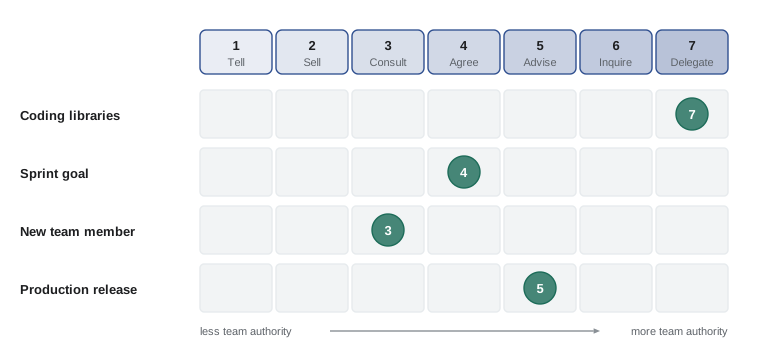
Your team plays delegation poker on four decision areas and agrees: choice of coding libraries: level 7; sprint goal: level 4; adding a new team member: level 3; releasing to production: level 5 (the team decides after hearing the operations manager's advice). Interpret these agreements.
Show solution
- Coding libraries (7): the team chooses without needing to tell the project manager; standards are set by the architecture guidelines.
- Sprint goal (4): the team and the product owner agree together.
- New team member (3): the project manager decides after consulting the team.
- Production release (5): operations advises, but the team makes the call and owns the result.
- Record the board in the team charter and revisit it as the team matures; levels usually rise over time.
Answer: Each area now has an explicit owner and method. Disagreements about "who decides" can be resolved by checking the board.
Boundaries make empowerment work
Empowerment always operates within boundaries: the project's objectives and constraints, organizational policies, the law, budget limits and quality standards. Clear boundaries do not limit empowerment; they make it safe. A team told "do whatever you think best" may hesitate, fearing that its choices will be overturned. A team told "choose any tools that meet the security standard and cost less than five hundred dollars a month per environment" can decide confidently.
Agile teams express boundaries through constructs such as the definition of done, architectural guidelines, the product goal and sprint goal, and escalation thresholds. Predictive projects use tolerances: for example, the team lead may approve schedule changes up to three days within a work package, the project manager up to two weeks, and anything larger goes to the change control board. Either way, the principle is the same: decide as close to the work as is safe, and escalate only what exceeds the agreed limits.
In Canadian public-sector projects, delegation is also constrained by formal financial authorities. Under the Financial Administration Act and Treasury Board policy, only people with delegated spending and payment authority can commit funds or certify payments, whatever the team charter says. Provincial governments and Crown corporations have similar delegation instruments.
Revisiting the charter
A team charter is a living document. Revisit it when new members join, when the team moves into a new phase, after significant conflict, or simply on a regular schedule such as every third retrospective. Ask three questions: which agreements are working, which are being ignored and why, and what new situations need an agreement? A charter that has not been touched in six months has probably stopped guiding behaviour.
Common mistakes
MistakeConfusing the team charter with the project charter.
InsteadThe sponsor issues the project charter; the team writes the team charter about how it will work.
MistakeWriting the team charter yourself and asking the team to sign it.
InsteadFacilitate the team to create it, so members own and enforce it.
MistakeFilling the charter with vague values.
InsteadInclude specific agreements that tell people what to do in real situations.
MistakeCorrecting ground rule violations in front of the team.
InsteadAddress them privately and early, and seek the cause.
MistakeTreating harassment or safety violations as ground rule issues.
InsteadFollow organizational policy and involve human resources or other functions.
MistakeSaying "you're empowered" without defining decision rights.
InsteadMake decision rights, delegation levels and boundaries explicit.
Summary and key terms
- A team charter records the team's values, ground rules, decision making, conflict process and meeting norms.
- The team creates the charter; the project manager facilitates.
- Specific agreements are more useful than vague values.
- Ground rules stick when the team owns them, they are visible and reviewed, and violations are handled early and privately.
- Empowerment requires explicit decision rights, delegation levels and boundaries.
- Delegation poker and delegation boards make authority explicit and usually rise over time.
- Revisit the charter when the team or phase changes and on a regular schedule.
- Team charter
- A document created by the team that sets out its values, agreements and practices.
- Ground rules
- Specific expectations for acceptable behaviour by team members.
- Empowerment
- Giving people authority, information and resources to make decisions within their area.
- Decision rights
- Agreed rules about who decides, who is consulted and who is informed for a class of decisions.
- Consensus
- A decision everyone can support, even if it is not each person's first choice.
- Fist-of-five
- A quick voting technique where people show zero to five fingers to signal their level of support.
- Delegation poker
- An exercise in which leader and team agree delegation levels for decision areas.
- Delegation board
- A visual record of agreed delegation levels for each decision area.
- Definition of done
- A team's shared checklist of criteria an item must meet to be considered complete.
- Tolerance
- A permitted deviation from a plan that a given level of authority can approve without escalation.
Practice problems
Work each problem on paper first, then reveal the answer to check.
Who creates the team charter?
Show answer
The team, facilitated by the project manager or team facilitator.
Name four typical contents of a team charter.
Show answer
Values, communication guidelines, decision-making process, conflict resolution process, meeting guidelines and other agreements.
Rewrite "We value punctuality" as a specific agreement.
Show answer
For example: "Meetings start on the minute; if you will be more than five minutes late, post in the team channel."
A team member keeps breaking a ground rule. First step?
Show answer
Speak to them privately, describe the behaviour and its impact, and ask about their perspective.
What is the difference between consensus and unanimity?
Show answer
Unanimity means everyone agrees it is the best choice; consensus means everyone can support the decision.
In delegation poker, what does level 6 mean?
Show answer
Inquire: the team decides and then tells the leader.
Why do boundaries make empowerment safer?
Show answer
They tell the team the limits within which its decisions will be upheld, so it can decide confidently.
Give two events that should trigger a charter review.
Show answer
For example, a new member joining and a significant conflict.
What should a project manager do about suspected harassment on the team?
Show answer
Act promptly according to organizational policy and involve human resources; it is not a ground rule matter.
What does the RAPID framework's D stand for?
Show answer
Decide: the person with final authority over the decision.
Lesson quiz · 5 questions
Score 60% or more to complete this lesson.
Create a free account to save your progress, take quizzes and earn a certificate.