
PMP-120 · Lesson 6 of 12 · 27 min
Motivation and recognition on projects
Project managers rarely control salaries, promotions or job titles, yet they are expected to keep teams motivated through long, demanding projects. The good news is that the most powerful motivators for knowledge work are within a project manager's reach: meaningful work, autonomy, growth, recognition and a sense of progress. This lesson applies motivation theory to the project setting. The theories themselves are covered in more depth in BUS-130 Organizational Behaviour; here the focus is on what a project manager can do on Monday morning.
Motivation theories at a glance
Several theories appear repeatedly in PMP preparation. You should be able to recognize each and apply it to a scenario.
| Theory | Core idea | Project application |
|---|---|---|
| Maslow's hierarchy of needs | People are motivated by unmet needs, from physiological and safety up to belonging, esteem and self-actualization | Job security worries (safety) crowd out interest in stretch goals; meet basic needs before appealing to growth |
| Herzberg's two-factor theory | Hygiene factors (pay, conditions, policies) prevent dissatisfaction; motivators (achievement, recognition, responsibility, the work itself) create satisfaction | Fix hygiene problems such as broken tools, but motivate through meaningful work and recognition |
| McGregor's Theory X and Theory Y | Theory X assumes people dislike work and need control; Theory Y assumes people seek responsibility and self-direction | Theory Y assumptions underpin empowerment and self-organizing teams |
| McClelland's acquired needs | People differ in their need for achievement, affiliation and power | Give achievers measurable challenges, affiliators collaborative roles and power-motivated people influence through leadership roles |
| Vroom's expectancy theory | Motivation depends on expectancy (effort leads to performance), instrumentality (performance leads to reward) and valence (the reward is valued) | Make goals achievable, rewards reliable and rewards something people actually want |
| Pink's Drive | For complex work, intrinsic motivation from autonomy, mastery and purpose outperforms carrots and sticks | Give the team control over how it works, chances to grow and a clear connection to the vision |
| Self-determination theory | Wellbeing and motivation depend on autonomy, competence and relatedness | Similar to Pink, adding relatedness: belonging and connection to colleagues |
The theories converge. Herzberg's motivators, Pink's autonomy, mastery and purpose, and self-determination theory's autonomy, competence and relatedness all point the same way: once basic needs and fair treatment are in place, people are most motivated by work that matters, control over how they do it, the chance to get better and good relationships with colleagues. A project manager can influence every one of these.
Expectancy theory in practice
Vroom's expectancy theory is the most useful for diagnosing motivation problems because it breaks motivation into three links that can each fail. It is often written as a product:
Here \(E\) (expectancy) is the person's belief, from 0 to 1, that effort will lead to the required performance; \(I\) (instrumentality) is the belief, from 0 to 1, that performance will lead to the outcome; and \(V\) (valence) is how much the person values the outcome, often scored from −1 to +1. Because the terms multiply, a zero in any one of them produces zero motivation, however strong the others are.
Worked problem
Diagnosing low motivation with expectancy theory
The sponsor offers the team an extra paid day off if it delivers the release by 30 June. Motivation remains low. In interviews you find that the team rates the deadline as very unlikely to be met (expectancy 0.2), trusts that the sponsor will keep the promise (instrumentality 0.9) and values a day off moderately (valence 0.6). Calculate the motivational force and suggest improvements.
Show solution
- Motivational force = 0.2 × 0.9 × 0.6 = 0.108, which is low.
- The weakest link is expectancy: the team does not believe the date is achievable.
- Improve expectancy: remove impediments, reduce scope to a minimum viable release, or add capacity, and involve the team in replanning so it believes in the plan. Raising expectancy to 0.7 gives 0.7 × 0.9 × 0.6 = 0.378.
- Improve valence: ask the team what it would value. If a training budget or flexible hours rate 0.9, force becomes 0.7 × 0.9 × 0.9 = 0.567.
Answer: The initial force is about 0.11. Fixing expectancy first (to about 0.38) and then offering a better-valued reward (about 0.57) more than quintuples it.
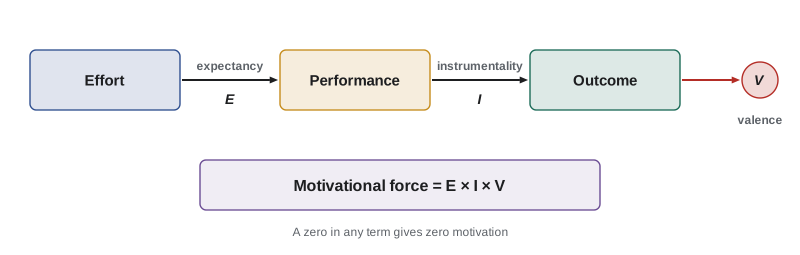
The lesson for project managers is that offering a bigger reward rarely fixes a motivation problem if people do not believe the goal is achievable or do not trust that the reward will materialize. Involving the team in estimating and planning raises expectancy. Keeping promises, and not making promises you cannot keep, protects instrumentality. Asking people what they value improves valence.
What project managers can and cannot control
In a matrix organization, the project manager usually cannot change pay, grant promotions or redesign job descriptions. These belong to functional managers and human resources. But a project manager controls or strongly influences much of what research shows matters most.
| Usually outside project manager control | Within project manager influence |
|---|---|
| Base pay and bonuses | Recognition, praise and visibility to senior leaders |
| Promotions and job titles | Assignments that build skills and careers |
| Organizational policies and benefits | How work is organized and how much autonomy people have |
| Performance ratings (in a matrix) | Input to performance reviews and feedback to functional managers |
| Office facilities | Team tools, removing frustrating obstacles, protecting focus time |
| Corporate strategy | Connecting the team's work to purpose and to the people who benefit |
One of the most powerful factors is a sense of progress. Teresa Amabile and Steven Kramer studied thousands of diary entries from knowledge workers and found that the single most important event in a good workday was making progress in meaningful work, even small progress. Setbacks had an even larger negative effect. Project managers can harness this "progress principle" by breaking work into visible chunks, celebrating milestones, making progress visible on boards and burn-up charts, and, above all, removing the obstacles that cause setbacks.
Recognition and rewards
Recognition acknowledges people's contributions; rewards add something of value, such as a gift card, a day off or a training opportunity. Both are most effective when they are timely, specific, sincere and matched to what the person values. Some people love public praise at an all-hands meeting; others would rather receive a private note or a word to their manager. Ask.
A recurring PMP theme is the danger of win-lose rewards. A "team member of the month" award given to one person can damage collaboration on a team whose success depends on cooperation, because it turns colleagues into competitors. PMI material generally favours win-win rewards that recognize team accomplishments or that everyone can earn by meeting clear criteria. Individual recognition still matters, but it should reward behaviour the team values, such as helping others, rather than pitting people against each other.
| Principle | Weaker practice | Better practice |
|---|---|---|
| Timely | Mentioning good work at the end-of-project party | Thanking someone the day they solved the problem |
| Specific | "Great job, everyone." | "Your test automation cut our regression time from two days to three hours." |
| Valued | A team dinner for people with caregiving duties after hours | Asking the team how it would like to celebrate |
| Fair and win-win | One award for the person with the most completed tasks | Team recognition when the sprint goal is met; peer nominations for helping others |
| Visible to the right people | Praise that stays inside the team | A note to the person's functional manager for their performance review |
Worked problem
Designing a recognition and reward plan
You are writing the recognition section of the resource management plan for a 12-month project with 14 team members, mostly in a matrix arrangement. The budget for rewards is $3,500. Draft a plan.
Show solution
- Ongoing, no cost: specific thanks in stand-ups and the team channel; a "kudos" board where anyone can recognize anyone.
- Each milestone (four planned): a team celebration chosen by the team, budget $500 each, so $2,000 in total.
- Quarterly: peer-nominated recognition for collaboration, shown in the sponsor update; a small token, $50 each for up to three people per quarter, so up to $600.
- Performance input: written feedback to each functional manager twice a year describing each member's contributions.
- Development rewards: $900 reserved for conference or course fees for people who take on stretch roles.
- Total: $2,000 + $600 + $900 = $3,500.
- Review: ask the team at retrospectives whether recognition feels fair and valued, and adjust.
Answer: A plan mixing frequent free recognition, team celebrations, peer recognition, feedback to functional managers and development opportunities, within the $3,500 budget.
Motivation across the project life cycle
Motivation tends to follow a pattern. Energy is often high at the start, when the project is new and full of possibility. It can sag in the long middle, when work is hard, the end is far away and early enthusiasm fades. It may rise again near the end as delivery approaches, or collapse if the team is exhausted or the project is in trouble. Project managers can plan for this: build in visible milestones and celebrations during the middle, rotate challenging assignments, refresh the connection to purpose (for example, by inviting a user to describe how the product will help them), and watch for signs of burnout.
Burnout deserves particular attention. The World Health Organization describes burnout as an occupational phenomenon resulting from chronic workplace stress that has not been successfully managed, characterized by exhaustion, increased mental distance from or cynicism about one's job, and reduced professional efficacy. On projects, burnout is often caused by sustained overtime, unclear priorities, constant change and lack of control. Agile's principle of a sustainable pace, which says sponsors, developers and users should be able to maintain a constant pace indefinitely, exists for this reason. Repeated overtime is a planning problem to be fixed, not a motivation tool.
Workload also has legal limits. Provincial employment standards and, for federally regulated workplaces, the Canada Labour Code set maximum hours, overtime pay and rest periods for employees who are covered, although many managers and some professionals are exempt. Ontario and some other jurisdictions also require certain employers to have a written policy on disconnecting from work. Occupational health and safety laws increasingly treat psychological hazards such as excessive workload as workplace risks.
Motivating different people
Motivation is individual. A useful habit is to have a short conversation with each team member early in the project about what they hope to get from it: new skills, visibility, a particular kind of work, flexibility, or simply a calm project after a stressful one. Record it privately and use it when assigning work, giving recognition and writing feedback. People notice when their manager remembers what matters to them.
Watch also for demotivators, which often matter more than motivators. Common ones on projects include unclear or changing priorities, decisions made without consultation, recognition that goes to the wrong people, broken promises, useless meetings and reporting, poor tools, and unresolved conflict. Removing a demotivator is often cheaper and more effective than adding a reward.
Common mistakes
MistakeAssuming money is the main motivator for knowledge workers.
InsteadOnce pay is fair, autonomy, mastery, purpose and recognition usually matter more.
MistakeOffering a bigger reward when people do not believe the goal is achievable.
InsteadFix expectancy first: replan with the team so the goal is credible.
MistakeUsing win-lose individual awards on a collaborative team.
InsteadPrefer team rewards and recognition for collaborative behaviour.
MistakeGiving generic praise long after the event.
InsteadMake recognition timely, specific and matched to what the person values.
MistakeUsing sustained overtime to meet deadlines.
InsteadTreat repeated overtime as a planning problem and protect a sustainable pace.
MistakeIgnoring demotivators while adding rewards.
InsteadRemove obstacles such as unclear priorities and broken tools first.
Summary and key terms
- Key theories include Maslow, Herzberg, McGregor, McClelland, Vroom, Pink and self-determination theory.
- The theories converge on purpose, autonomy, growth, recognition and relationships.
- Expectancy theory: motivational force = expectancy × instrumentality × valence; any zero kills motivation.
- Project managers influence recognition, assignments, autonomy, tools and purpose even without control of pay.
- Progress on meaningful work is a powerful daily motivator; setbacks are powerful demotivators.
- Effective recognition is timely, specific, valued, fair and visible; prefer win-win rewards.
- Protect a sustainable pace; burnout results from chronic, unmanaged workplace stress.
- Hygiene factor
- In Herzberg's theory, a factor whose absence causes dissatisfaction but whose presence does not motivate.
- Motivator
- In Herzberg's theory, a factor such as achievement or recognition that creates satisfaction.
- Expectancy
- The belief that effort will lead to the required performance.
- Instrumentality
- The belief that performance will lead to a particular outcome.
- Valence
- The value a person places on an outcome.
- Intrinsic motivation
- Motivation that comes from the work itself, such as interest or purpose.
- Extrinsic motivation
- Motivation that comes from outside rewards or pressures.
- Win-lose reward
- A reward that only some can win, potentially at others' expense.
- Progress principle
- The finding that making progress in meaningful work is a strong daily motivator.
- Sustainable pace
- A pace of work that a team can maintain indefinitely without burnout.
Practice problems
Work each problem on paper first, then reveal the answer to check.
In Herzberg's theory, is a fair salary a hygiene factor or a motivator?
Show answer
A hygiene factor.
Calculate motivational force for E = 0.8, I = 0.5, V = 0.5.
Show answer
0.8 × 0.5 × 0.5 = 0.2.
Which expectancy term improves when the team helps set the plan?
Show answer
Expectancy.
Name Pink's three elements of intrinsic motivation.
Show answer
Autonomy, mastery and purpose.
Which McGregor theory supports empowerment?
Show answer
Theory Y.
Why can "employee of the month" harm a project team?
Show answer
It is a win-lose reward that can turn colleagues into competitors and reduce collaboration.
Give an example of specific recognition.
Show answer
For example: "Your workaround for the data feed saved us a week on the integration."
Name three characteristics of burnout as described by the WHO.
Show answer
Exhaustion, mental distance or cynicism about the job, and reduced professional efficacy.
Name two demotivators common on projects.
Show answer
For example, unclear priorities and broken promises.
A reward has valence −0.2 for a person. What does that mean?
Show answer
The person sees the outcome as slightly undesirable, so it reduces motivation.
Lesson quiz · 5 questions
Score 60% or more to complete this lesson.
Create a free account to save your progress, take quizzes and earn a certificate.