
PMP-120 · Lesson 9 of 12 · 28 min
Emotional intelligence
Projects are emotional places. Deadlines create pressure, setbacks create frustration, change creates anxiety and success creates elation. A project manager who cannot recognize and manage emotions, both their own and other people's, will struggle to lead, however strong their technical skills. Emotional intelligence (EI) is the set of abilities that lets people use emotional information well. PMI lists emotional intelligence among the interpersonal skills project managers need, and many PMP scenarios turn on whether the project manager responds to emotion with awareness or reacts without thinking. This lesson explains the main models of emotional intelligence and shows how to apply them on projects.
What emotional intelligence is
Psychologists Peter Salovey and John Mayer introduced the term in 1990, defining emotional intelligence as the ability to monitor one's own and others' feelings and emotions, to discriminate among them and to use this information to guide one's thinking and actions. Their ability model has four branches: perceiving emotions, using emotions to facilitate thought, understanding emotions and managing emotions. Daniel Goleman's 1995 book Emotional Intelligence brought the idea to a mass audience and to the workplace, describing a broader set of competencies.
| Model | Components | Character |
|---|---|---|
| Mayer–Salovey ability model | Perceiving, using, understanding and managing emotions | Treats EI as a form of intelligence measured by ability tests |
| Goleman's original five components | Self-awareness, self-regulation, motivation, empathy, social skills | Broad workplace competencies |
| Goleman and Boyatzis four domains | Self-awareness, self-management, social awareness, relationship management | Competency model widely used in leadership development |
The four-domain model is the one most often seen in PMP preparation, and PMP-110 introduced it briefly. It arranges the domains in a two-by-two grid: whether the focus is on yourself or on others, and whether the skill is about recognizing emotions or regulating them.
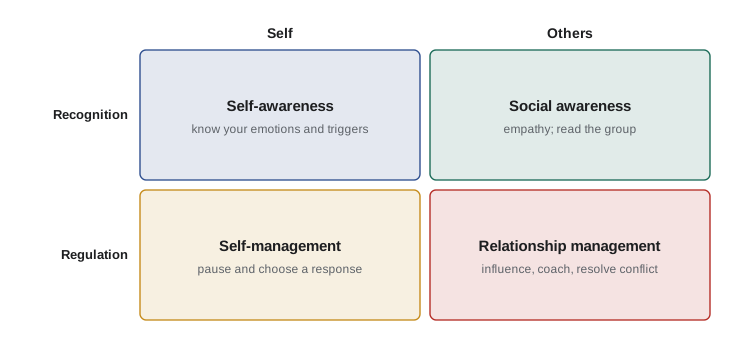
| Domain | What it involves | Project example |
|---|---|---|
| Self-awareness | Recognizing your own emotions, strengths, weaknesses and triggers | Noticing that you become curt when a sponsor questions your estimates |
| Self-management | Controlling impulses, staying calm under pressure, adapting and keeping commitments | Pausing before replying to a provocative email; staying composed in a crisis |
| Social awareness | Empathy, reading the mood of a group, understanding organizational dynamics | Sensing that the team is anxious about possible layoffs before anyone says so |
| Relationship management | Influencing, coaching, managing conflict, building teams and inspiring | Helping two leads move past a clash and rebuild trust |
Why it matters for project managers
Emotional intelligence affects almost every People task in the exam outline. Leading a team requires reading people and adapting your style. Managing conflict requires staying calm and understanding what each party feels. Engaging stakeholders requires empathy for their concerns. Coaching requires listening and noticing. Research on leadership effectiveness consistently finds that emotional and social competencies distinguish outstanding leaders from average ones, especially at senior levels where technical competence is taken for granted, although researchers continue to debate how much EI adds beyond personality and general intelligence.
The practical good news is that, unlike general intelligence, many emotional intelligence competencies can be developed with practice and feedback. The rest of this lesson offers techniques for each domain.
Self-awareness
Self-awareness is the foundation. If you do not notice your own emotional state, you cannot manage it, and you will misread how you come across to others. Practical ways to build self-awareness include:
- Naming emotions precisely: "I'm frustrated and a bit embarrassed" is more useful than "I'm upset". A richer emotional vocabulary helps you choose a response.
- Knowing your triggers: situations that reliably provoke strong reactions, such as being interrupted, surprises in front of senior people, or perceived unfairness.
- Seeking feedback: asking trusted colleagues how you come across, or using 360-degree feedback.
- Reflecting: a few minutes at the end of the day noting what went well, what provoked you and why.
Self-awareness also includes knowing your strengths and limits. A project manager who knows she tends to over-commit can build in checks, such as sleeping on any request before agreeing.
Self-management
Self-management is the ability to choose your response rather than react automatically. Neuroscience popularizers describe an "amygdala hijack", a term Goleman used for moments when a strong emotional reaction overwhelms rational thought, such as snapping at a colleague or firing off an angry email. The details of the neuroscience are debated, but the experience is familiar. The goal is to create a pause between stimulus and response.
| Technique | How it works | When to use it |
|---|---|---|
| Pause and breathe | A few slow breaths before responding | In meetings when provoked |
| Name it to tame it | Silently naming the emotion reduces its intensity | When you notice a strong reaction building |
| Delay the reply | Draft but do not send emotional emails; reread after an hour | Written communication |
| Reframe | Look for another interpretation: "Maybe she's under pressure from her director" | When you feel attacked or slighted |
| Physical reset | A short walk, water, or a change of posture | After a stressful meeting |
| Prepare | Rehearse responses to difficult conversations you can anticipate | Before steering committee meetings or performance discussions |
Self-management also covers adaptability, optimism, initiative and keeping commitments. Team members watch their project manager closely in a crisis. A leader who stays calm, acknowledges the difficulty and focuses on next steps helps the team stay calm too; emotions are contagious, and leaders' emotions are the most contagious of all.
Social awareness and empathy
Social awareness is the ability to read other people and groups accurately. Its core is empathy: understanding another person's feelings and perspective. Psychologists distinguish cognitive empathy (understanding how someone thinks and feels), emotional empathy (feeling with them) and empathic concern (being moved to help). For project managers, cognitive empathy and empathic concern are the most useful; too much emotional empathy without boundaries can lead to exhaustion.
Social awareness also includes organizational awareness: understanding power structures, informal networks and the politics of decisions. A project manager with good organizational awareness knows that the finance director's objection is really about a past project that went over budget, or that the most influential voice on the steering committee is not the chair.
Worked problem
Using an empathy map
A long-serving operations supervisor, Gloria, has been resisting the new scheduling system. In meetings she raises objection after objection. Build a quick empathy map to understand her perspective.
Show solution
- Says: "The old system works fine." "My people won't use this." "Who will fix it at 3 a.m.?"
- Does: arrives late to training, keeps a paper backup of schedules, questions every timeline.
- Thinks (inferred, to be checked): the new system may expose inefficiencies in her area; support may disappear after go-live; her expertise in the old system may no longer be valued.
- Feels (inferred): anxious about losing status and control; worried about being blamed for problems.
- Use the map to plan: meet Gloria one-to-one to check the inferences; involve her as a super-user; confirm the support model in writing; recognize her operational knowledge publicly.
Answer: The map shifts the view from "Gloria is difficult" to "Gloria has understandable concerns about support, status and blame" and suggests actions that address them.
Relationship management
Relationship management is where emotional intelligence becomes visible to others: influencing, inspiring, coaching, managing conflict, building teams and leading change. It draws on the other three domains. You cannot defuse a conflict if you are too angry to think (self-management) or do not understand what the other person cares about (social awareness).
Several practices help. Give recognition and appreciation regularly, building goodwill before you need it. Deliver difficult messages with care: be clear about the facts and kind in manner. Repair relationships after friction: a brief "I was short with you yesterday; I'm sorry" restores trust quickly. And invest in relationships proactively, not only when you need something.
Worked problem
An emotional intelligence scenario
In a steering committee meeting, the sponsor criticizes your team's progress sharply in front of several directors, saying, "Frankly, I'm not sure this team knows what it's doing." You feel your face go hot and want to list everything the team has achieved. What would an emotionally intelligent response look like, during and after the meeting?
Show solution
- Self-awareness: notice the anger and embarrassment and the urge to defend.
- Self-management: pause, breathe, and avoid a defensive reply in front of the directors.
- Social awareness: consider what may lie behind the comment; perhaps the sponsor is under pressure from her own executive or was surprised by a report.
- Respond in the meeting: "I can see you're concerned about progress. I'd like to understand what's worrying you most. Could we take ten minutes after this meeting, and I'll bring the detailed figures?"
- Relationship management afterward: meet privately, listen first, share facts calmly, agree what information she needs and how often, and brief the team constructively without repeating the criticism in a damaging way.
Answer: Recognize and manage your own reaction, seek to understand the sponsor's concern, move the detailed discussion to a private setting and use it to rebuild confidence.
Emotional intelligence in teams
Vanessa Druskat and Steven Wolff argued that teams, not just individuals, can be emotionally intelligent. Group emotional intelligence shows up in norms such as checking in on how people are feeling, acknowledging tension openly rather than ignoring it, caring for members who are struggling, and building relationships with other teams. A project manager can encourage these norms through the team charter, retrospectives that include how people felt as well as what happened, and by modelling them.
Simple practices help: a quick mood check at the start of retrospectives (for example, each person picks a weather symbol for how the sprint felt); acknowledging when the team is tired or frustrated rather than pretending all is well; and noticing individuals who have gone quiet. These practices also support psychological safety (lesson 5).
Psychological health is increasingly recognized in Canadian workplace standards. The voluntary National Standard of Canada for Psychological Health and Safety in the Workplace (CSA Z1003) gives organizations a framework for identifying and managing psychological hazards, such as excessive workload, poor recognition and lack of civility, many of which project managers directly influence.
Limits and cautions
Emotional intelligence is valuable but not magic. It is not the same as being nice: emotionally intelligent leaders deliver hard messages and hold people accountable, and they do so with skill. It is not manipulation: using emotional insight to exploit people is a serious ethical breach and conflicts with the PMI Code of Ethics values of respect and honesty. And measurement is imperfect: self-report EI questionnaires overlap with personality measures, and ability tests are expensive. Treat EI assessments as conversation starters, not verdicts.
Emotional expression also varies across cultures. In some cultures, open displays of frustration in meetings are normal; in others, they would be shocking. Some people show emotion through tone rather than words. Avoid assuming that someone who looks calm is fine, or that someone who speaks loudly is angry. Lesson 10 returns to cultural differences on distributed teams.
Emotional intelligence on the exam
PMP scenarios rarely use the phrase emotional intelligence, but many test it. Watch for stems in which someone is angry, anxious, defensive or withdrawn, or in which the project manager is provoked. The weaker options usually react: they defend, criticize in public, ignore the emotion or escalate at once. The stronger options show the four domains at work: the project manager stays composed, acknowledges the emotion, seeks to understand what lies behind it and then addresses the issue, often privately and with the people involved. When two options both look reasonable, prefer the one that combines empathy with action on the underlying problem, rather than empathy alone or action alone.
Common mistakes
MistakeReacting immediately when provoked.
InsteadPause, name the emotion and choose a response.
MistakeTreating emotional intelligence as being nice and avoiding hard messages.
InsteadDeliver difficult messages clearly, with care and respect.
MistakeLabelling resistant people as difficult.
InsteadUse empathy to understand their concerns and address them.
MistakeDefending yourself publicly when criticized.
InsteadAcknowledge the concern and move detailed discussion to a private setting.
MistakeUsing emotional insight to manipulate people.
InsteadUse it to understand and support people, consistent with ethics.
MistakeAssuming emotional expression means the same across cultures.
InsteadLearn individual and cultural norms and check your interpretations.
Summary and key terms
- Emotional intelligence is the ability to perceive, understand, use and manage emotions in oneself and others.
- The four-domain model covers self-awareness, self-management, social awareness and relationship management.
- Self-awareness is the foundation; self-management creates a pause between stimulus and response.
- Social awareness includes empathy and organizational awareness.
- Relationship management applies EI to influence, coaching, conflict and teamwork.
- Teams can build group emotional intelligence through norms such as check-ins and acknowledging tension.
- EI is not niceness or manipulation, and emotional expression varies across cultures.
- Emotional intelligence
- The ability to perceive, understand, use and manage emotions in oneself and others.
- Self-awareness
- Recognizing one's own emotions, strengths, weaknesses and triggers.
- Self-management
- Controlling impulses and choosing responses, especially under pressure.
- Social awareness
- Accurately reading others' emotions and group and organizational dynamics.
- Relationship management
- Using emotional understanding to influence, coach, resolve conflict and build teams.
- Empathy
- Understanding and sharing another person's feelings and perspective.
- Cognitive empathy
- Understanding how another person thinks and feels.
- Empathy map
- A tool for exploring what a person says, does, thinks and feels.
- Emotional contagion
- The spread of emotions from one person to others in a group.
- Amygdala hijack
- A popular term for a strong emotional reaction that overwhelms rational thought.
Practice problems
Work each problem on paper first, then reveal the answer to check.
Name the four domains of emotional intelligence.
Show answer
Self-awareness, self-management, social awareness and relationship management.
Which domain is the foundation for the others?
Show answer
Self-awareness.
Give two self-management techniques.
Show answer
For example, pausing to breathe and delaying an emotional email reply.
What are the four quadrants of an empathy map?
Show answer
Says, does, thinks and feels.
What is the difference between cognitive and emotional empathy?
Show answer
Cognitive empathy is understanding someone's feelings; emotional empathy is feeling them yourself.
Why are a leader's emotions particularly important?
Show answer
Emotions are contagious, and team members watch leaders closely, especially in a crisis.
Name one group emotional intelligence practice.
Show answer
For example, a mood check at the start of retrospectives.
Who introduced the term emotional intelligence in 1990?
Show answer
Peter Salovey and John Mayer.
What should you do after being short with a colleague?
Show answer
Repair the relationship promptly, for example with a brief, sincere apology.
Why treat EI questionnaire results cautiously?
Show answer
Self-report measures overlap with personality and are imperfect; use them to start conversations, not as verdicts.
Lesson quiz · 5 questions
Score 60% or more to complete this lesson.
Create a free account to save your progress, take quizzes and earn a certificate.