
PMP-120 · Lesson 8 of 12 · 27 min
Managing team conflict
Conflict is inevitable on projects. People with different expertise, priorities and pressures are asked to make many decisions quickly with limited resources, and they will disagree. Handled well, conflict improves decisions: it brings hidden assumptions into the open, tests ideas and prevents groupthink. Handled badly, it damages relationships, slows work and drives good people away. This lesson focuses on conflict within the project team: its sources, how to diagnose its intensity, the five classic approaches and how to choose among them. PMP-121 extends these ideas to stakeholders and negotiation.
Healthy and unhealthy conflict
Researchers distinguish task conflict (disagreements about the work: goals, methods, priorities, technical choices) from relationship conflict (personal friction, dislike, perceived disrespect). Task conflict, kept at a moderate level in a psychologically safe team, tends to improve decisions. Relationship conflict almost always harms performance. The danger is that unmanaged task conflict can turn into relationship conflict when people start to take disagreements personally.
A project manager's job is therefore not to eliminate conflict but to keep it focused on the work, resolve it before it escalates, and make sure decisions get made. Teams with no visible conflict are not necessarily healthy; they may be avoiding difficult issues, a pattern Lencioni calls artificial harmony (lesson 5).
Sources of conflict on projects
Classic research by Thamhain and Wilemon in the 1970s ranked the most common sources of conflict on projects. Their list is still widely cited in PMP preparation, and the top sources remain familiar today.
| Source | Example | Prevention |
|---|---|---|
| Schedules | Disagreement about how long design will take | Involve the team in estimating; make assumptions visible |
| Project priorities | Development wants to build features; operations wants stability work | A clear, agreed priority order owned by the right decision maker |
| Resources | Two work streams need the same specialist in the same week | Resource planning, histograms and early negotiation |
| Technical opinions | Architects disagree on database technology | Agreed decision criteria and decision rights |
| Administrative procedures | Arguments over approval steps or reporting | Clear, lean processes agreed in the team charter |
| Cost | Disputes over budget allocation between teams | Transparent budgets and change control |
| Personality | Two members with clashing working styles | Ground rules, coaching and attention to relationships |
A key insight is that personality is rarely the root cause, even when people describe conflict that way. "He's impossible to work with" often turns out to mean "we disagree about priorities and nobody has clarified them". Before treating a conflict as a personality clash, check whether a schedule, priority, resource or procedural issue lies underneath. Many conflicts are prevented by good planning, clear roles, ground rules and decision rights; the earlier lessons in this course are, in a sense, conflict prevention.
Diagnosing the level of conflict
Speed Leas's five levels of conflict, popularized for agile teams by Lyssa Adkins, help gauge intensity and choose a response. Conflict can move up the levels if unresolved, and the language people use is a good indicator.
| Level | Name | Typical language | Suitable response |
|---|---|---|---|
| 1 | Problem to solve | Open, factual: "We see this differently; let's work it out." | Collaborate; let the team resolve it |
| 2 | Disagreement | Self-protective, more guarded: "I'm just saying what I heard." | Support; build safety; help find common interests |
| 3 | Contest | Win-lose, generalizations: "They always ignore us." | Accommodate, negotiate, find a fair process |
| 4 | Crusade | Ideological, protecting one's group: "They're the problem; we need to get rid of them." | Diplomacy; de-escalate; separate people from positions |
| 5 | World war | Destroy the other side; little rational communication | Do whatever prevents harm; separate parties; involve senior management or HR |
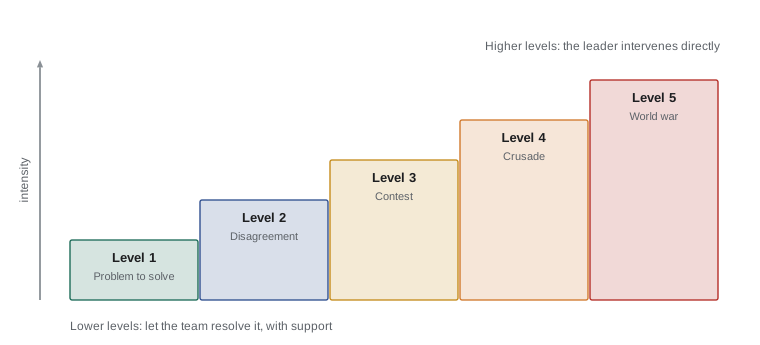
At levels 1 and 2, the best response is usually to let the team work it out, perhaps with some facilitation. Rushing in to resolve every disagreement undermines self-organization and teaches the team to escalate everything. At levels 3 and above, the project manager needs to step in more actively, because positions are hardening and relationships are at risk.
The five conflict approaches
Kenneth Thomas and Ralph Kilmann described five conflict-handling modes based on two dimensions: assertiveness (how much you try to satisfy your own concerns) and cooperativeness (how much you try to satisfy the other party's concerns). PMI material uses similar names, sometimes with alternatives in brackets.
| Mode (PMI term) | Assertive / cooperative | Description | When it fits |
|---|---|---|---|
| Collaborating (problem solving) | High / high | Work together to find a solution that fully meets everyone's concerns | Important issues, time available, need for commitment, complex problems |
| Compromising (reconciling) | Medium / medium | Each side gives something up to reach a mutually acceptable solution | Moderate importance, equal power, time pressure, temporary solutions |
| Accommodating (smoothing) | Low / high | Emphasize agreement and yield to the other party's concerns | The issue matters more to the other side, preserving the relationship, you are wrong |
| Competing (forcing, directing) | High / low | Push one viewpoint at the expense of others | Emergencies, safety, unpopular but necessary decisions, ethical issues |
| Avoiding (withdrawing) | Low / low | Postpone or retreat from the issue | Trivial issues, a cooling-off period is needed, others are better placed to resolve it |
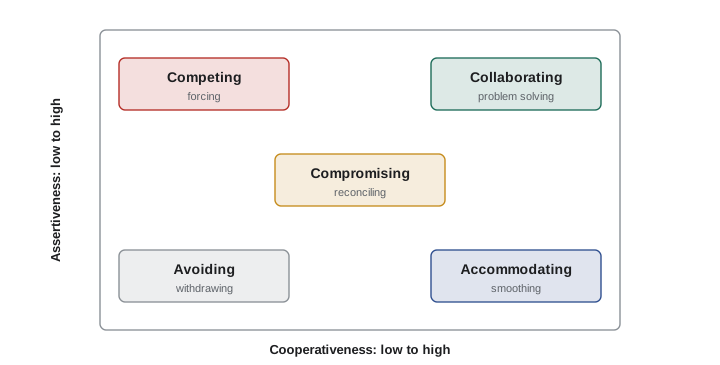
For the exam, remember a general order of preference when time and importance allow: collaborate first, because it addresses root causes and builds commitment; then compromise; and treat forcing and withdrawing as situational tools rather than defaults. Smoothing can preserve relationships but tends to leave the underlying issue unresolved. However, each mode has situations where it is the best choice, and questions often test whether you can spot them: a safety issue calls for forcing; a trivial disagreement over meeting room colours calls for avoiding; a heated exchange may need a short cooling-off break before collaboration is possible.
Worked problem
Choosing a conflict mode
Choose the most suitable mode for each situation. (a) Two senior engineers disagree about the system architecture, which will shape the product for years; the decision is needed in three weeks. (b) A contractor is about to start electrical work without isolating power. (c) Two team members disagree about whether the weekly report should use a table or bullet points. (d) Two team leads both want the single test environment for the same week; neither can wait the full week, and the issue needs resolving today. (e) You realize your proposed design has a flaw a junior developer pointed out.
Show solution
- (a) High importance, time available, commitment needed: collaborate.
- (b) Immediate safety risk: force; stop the work now and discuss afterward.
- (c) Trivial, low impact: avoid, or let the person who owns the report decide.
- (d) Moderate importance, time pressure, equal claims: compromise, for example splitting the week, unless a more creative solution such as a second environment can be found quickly.
- (e) You are wrong and the relationship matters: accommodate gracefully and thank the developer.
Answer: (a) Collaborate; (b) force; (c) avoid; (d) compromise; (e) accommodate.
A process for resolving team conflict
When a team conflict needs active resolution, a simple structured process helps the project manager stay neutral and focused on the problem.
- Prepare: gather facts, identify who is involved, consider the level of conflict and choose a suitable setting. Private conversations are usually better than public confrontation.
- Set the ground rules: remind people of the team charter's conflict agreements; agree to listen without interrupting and focus on the issue, not the person.
- Understand each perspective: ask each person to describe the situation, what matters to them and why. Listen for interests (underlying needs) rather than positions (stated demands).
- Define the problem jointly: restate it in neutral terms that both can accept. "We need a test schedule that lets both releases meet their dates" is better than "Sara wants to take the environment from Tom."
- Generate options: brainstorm without judging; look for solutions that meet both sides' interests.
- Agree a solution: choose an option using agreed criteria, define actions and owners, and record the agreement.
- Follow up: check that the solution is working and that relationships have recovered.
The distinction between positions and interests, made famous by Fisher and Ury in Getting to Yes, is central. A position is what someone says they want ("I need the test environment all next week"); an interest is why they want it ("my release must be tested before the client demo on Thursday"). Positions often conflict; interests frequently do not. Once the interests are clear, creative solutions appear. PMP-121 develops this into a full negotiation method.
Worked problem
From positions to interests
Sara (integration lead) insists that the whole team must attend a daily 30-minute integration meeting. Tom (user interface lead) refuses, saying his team cannot afford the time. Use interests to find a solution.
Show solution
- Ask Sara what the meeting achieves: she needs early warning of interface changes that break integration.
- Ask Tom what concerns him: his designers lose focus with daily meetings that are mostly irrelevant to them.
- Define the joint problem: how can integration get early warning of interface changes without costing the user interface team daily meeting time?
- Options: Tom's team posts interface changes in a shared channel the same day; one rotating representative attends the meeting; the meeting moves to twice a week; automated contract tests flag breaking changes.
- Agree: automated contract tests plus a rotating representative twice a week. Review in two sprints.
Answer: By exploring interests (early warning versus focus time), the leads find a solution better than either original position.
Ground rules and conflict
The ECO's "Manage conflicts" task includes communicating conflict management principles to the team and external stakeholders, establishing an environment that fosters adherence to common ground rules, and managing ground rule violations. In practice this means agreeing a conflict process in the team charter (lesson 4), such as "raise it directly with the person first; if unresolved in a week, involve the project manager; if still unresolved, the sponsor decides", and making sure everyone knows it. When conflict involves people outside the team, such as a vendor or another department, the same principles apply, but the project manager may need to use governance channels and negotiation.
Some conflicts are not ordinary disagreements. Under Canadian occupational health and safety law, harassment and violence, including bullying and repeated humiliating behaviour, must be addressed through the employer's policy and investigation process; for federally regulated employers, the Work Place Harassment and Violence Prevention Regulations under the Canada Labour Code set specific requirements. A project manager who sees such behaviour should act promptly and involve human resources rather than mediating it as a team conflict.
Common pitfalls
Project managers new to conflict often fall into predictable traps. Some avoid conflict altogether, hoping it will go away; it rarely does, and it usually escalates. Some take sides too quickly, often with the person they like or who spoke first. Some resolve every disagreement themselves, which disempowers the team. Some handle conflict in public, embarrassing people and hardening positions. And some treat the symptom, such as a heated email exchange, without looking for the cause, such as unclear priorities. The process above, combined with an understanding of the level of conflict and the five modes, helps avoid these traps.
Common mistakes
MistakeTrying to eliminate all conflict from the team.
InsteadEncourage healthy task conflict and keep it from becoming personal.
MistakeBlaming conflict on personality.
InsteadCheck for underlying schedule, priority, resource or procedural causes first.
MistakeStepping in to resolve every low-level disagreement.
InsteadLet the team resolve level 1 and 2 conflicts; intervene more as conflict escalates.
MistakeDefaulting to forcing because it is fast.
InsteadCollaborate when issues are important and time allows; force only for emergencies, safety or ethics.
MistakeNegotiating over positions.
InsteadExplore the interests behind positions to find better solutions.
MistakeMediating harassment as an ordinary team conflict.
InsteadFollow policy and involve human resources promptly.
Summary and key terms
- Task conflict can improve decisions; relationship conflict usually harms performance.
- Common sources are schedules, priorities, resources, technical opinions, procedures, cost and, least often, personality.
- Leas's five levels run from problem to solve to world war; language signals the level.
- The five modes are collaborating, compromising, accommodating, competing and avoiding.
- Collaborating is generally preferred, but each mode has situations where it fits best.
- A structured process moves from understanding perspectives and interests to joint problem definition, options and agreement.
- Harassment and violence must be handled through policy, not informal mediation.
- Task conflict
- Disagreement about the work, such as goals, methods or priorities.
- Relationship conflict
- Personal friction or perceived disrespect between people.
- Collaborating
- A conflict mode that seeks a solution fully meeting everyone's concerns; also called problem solving.
- Compromising
- A conflict mode in which each party gives up something; also called reconciling.
- Accommodating
- A conflict mode that yields to the other party's concerns; also called smoothing.
- Competing
- A conflict mode that pushes one viewpoint at others' expense; also called forcing or directing.
- Avoiding
- A conflict mode that postpones or withdraws from the issue; also called withdrawing.
- Position
- What a party says it wants.
- Interest
- The underlying need or concern that explains a position.
- Artificial harmony
- The appearance of agreement that hides avoided conflict.
Practice problems
Work each problem on paper first, then reveal the answer to check.
Which source of conflict is usually least frequent on projects?
Show answer
Personality.
Which conflict mode is high in both assertiveness and cooperativeness?
Show answer
Collaborating.
A trivial disagreement about font choice: which mode?
Show answer
Avoiding, or letting the owner decide.
What is the difference between a position and an interest?
Show answer
A position is what someone says they want; an interest is why they want it.
Language such as "they always do this" suggests which Leas level?
Show answer
Level 3, contest.
Why should project managers not resolve every team disagreement?
Show answer
It undermines self-organization and teaches the team to escalate everything.
When is compromising appropriate?
Show answer
For moderately important issues with equal power and time pressure, or as a temporary solution.
What is the risk of smoothing?
Show answer
It may preserve relationships while leaving the underlying issue unresolved.
Name the first step in a structured conflict resolution process.
Show answer
Prepare: gather facts, identify parties, assess the level and choose a setting.
What should happen if conflict involves harassment?
Show answer
Act promptly under organizational policy and involve human resources.
Lesson quiz · 5 questions
Score 60% or more to complete this lesson.
Create a free account to save your progress, take quizzes and earn a certificate.