
PMP-130 · Lesson 4 of 12 · 26 min
Work breakdown structures and the scope baseline
The work breakdown structure (WBS) is the backbone of predictive planning. It decomposes the total scope into smaller, manageable pieces that can be estimated, scheduled, assigned, costed and controlled. Almost every later planning output, from the activity list to the cost baseline to earned value reporting, is organized by the WBS. This lesson covers what a WBS is and is not, the 100 % rule, ways to organize and decompose it, work packages, planning packages and control accounts, the WBS dictionary, coding, and how the scope baseline is assembled.
What a WBS is
A WBS is a hierarchical decomposition of the total scope of work to be carried out by the project team to accomplish the project objectives and create the required deliverables. Three phrases in that definition matter. Hierarchical: each level breaks the level above into smaller pieces. Total scope: everything in scope appears somewhere, including project management. Deliverables: the WBS is oriented toward outcomes, the things produced, rather than actions.
A WBS is not a schedule. It shows what will be produced, not when or in what order. It is also not an organization chart, although an organizational breakdown structure can be mapped to it to show who is responsible for each element. Activities, durations and dependencies come later, in the schedule. Mixing these up is a common exam distractor: if an answer suggests putting dates or sequence into the WBS, it is wrong.
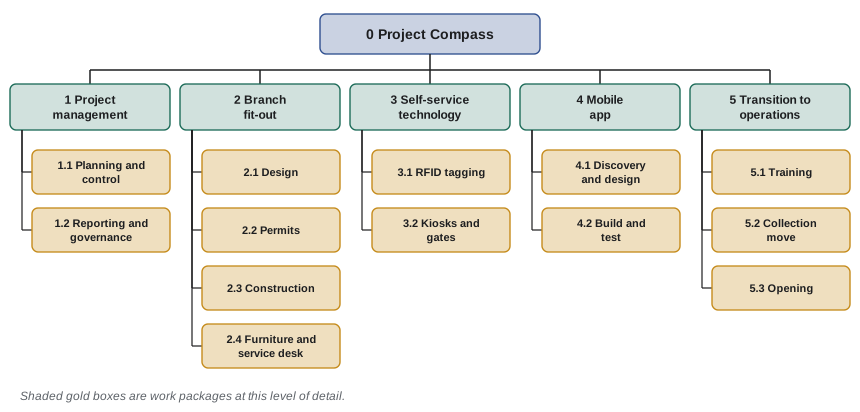
The 100 % rule
The 100 % rule says the WBS includes all of the work defined by the project scope and nothing else, and that at each level the children together represent 100 % of the parent. Nothing outside the scope should appear, and nothing in scope should be missing. The rule applies to work and, by extension, to costs: if work package estimates are rolled up, the total at each level must equal the sum of its children, with no hidden amounts.
The rule has practical consequences. Project management is work and must appear in the WBS, usually as its own element at the second level. Work that is out of scope, such as the excluded exterior signage, must not appear. If someone adds a cost at a summary level that is not in any work package, the rule is broken and the budget can no longer be traced to deliverables.
Organizing and decomposing
There are several ways to organize the second level. By major deliverables, as in Project Compass. By phases of the life cycle, such as design, build, test and deploy. By subprojects, when parts of the work are contracted out. By geography, for multi-site projects. The choice should reflect how the project will be managed and reported. Mixing bases at the same level, such as some elements by phase and others by deliverable, often leads to overlaps and gaps.
Decomposition continues until the lowest elements, the work packages, can be reliably estimated, scheduled, assigned to a single responsible party and monitored. Common heuristics include the 8/80 rule (a work package should take between 8 and 80 hours of effort) and the reporting period rule (a work package should not span more than one or two reporting periods). These are guides, not laws; a construction work package worth hundreds of thousands of dollars may be fine if it has one responsible contractor and a clear deliverable. Over-decomposition creates administrative burden without improving control.
| Test | Question to ask |
|---|---|
| Deliverable | Does the element describe something produced (a noun), not an action? |
| Estimable | Can a competent person estimate its cost and duration with reasonable confidence? |
| Assignable | Can it be assigned to one person or organization accountable for it? |
| Measurable | Can progress and completion be objectively determined? |
| Complete | Do the children add up to 100 % of the parent? |
| Not overlapping | Is each piece of work in exactly one element? |
Decomposition is best done with the team and subject matter experts. The people who will do the work are best placed to identify what is involved, and their involvement builds commitment. A WBS template from a previous similar project, such as the last branch fit-out, is a valuable organizational process asset and can save much time, but it must be checked against this project's scope.
Work packages, planning packages and control accounts
Work packages are the lowest level of the WBS for which cost and duration are estimated and managed. In the schedule, each work package is broken into activities; in the budget, work package estimates are summed into control accounts.
A control account is a management control point where scope, budget, actual cost and schedule are integrated and compared to earned value for performance measurement. Each control account has a control account manager and contains one or more work packages. A control account is placed at a level of the WBS that makes sense for management, often the third level. In Project Compass, the construction contract (2.3) is a control account managed by the facilities lead, and the app (4) is a control account managed by the product lead.
A planning package sits below a control account but above work packages, holding work whose content is known but whose detailed activities are not yet planned. It is the WBS form of rolling wave planning. In Project Compass, transition to operations starts as a planning package; its detailed work packages for training and moving the collection are defined three months before opening, once the staffing plan and collection list are firm.
The WBS dictionary
The WBS dictionary gives detailed information about each WBS element, especially work packages. Typical contents include the code, a description of the work, the responsible organization, schedule milestones, associated activities, resources required, cost estimates, quality requirements, acceptance criteria, technical references and agreement information. The dictionary prevents misunderstandings that a short label in a tree diagram cannot.
| Field | Entry for 3.1 RFID tagging |
|---|---|
| Description | Apply RFID tags to all opening-day collection items and encode them in the library system |
| Responsible | Collections services manager |
| Deliverable | 38,000 tagged and encoded items, verified by a 2 % random sample read test |
| Milestones | Tags received; tagging complete two weeks before move-in |
| Resources | Four temporary staff, two encoding stations, tag supply |
| Cost estimate | $95,000 (tags, temporary staff, equipment rental) |
| Acceptance | Sample read rate of at least 99.5 %; records match the catalogue |
| Assumptions | Opening collection list final by month 3; tag price as quoted |
Coding and rolling up
Each element has a unique identifier, usually a hierarchical number such as 2.3.1. Codes link the WBS to the schedule, cost accounts, the chart of accounts in the finance system and reports. A clear coding scheme makes it possible to roll up costs and progress from work packages to any level. The example below rolls up the Project Compass work package estimates and checks a draft budget memo against them.
# WBS roll-up and 100 % rule check for Project Compass (invented estimates, $000)
wbs = {
    "1":   ("Project management", None),
    "2":   ("Branch fit-out", None),
    "2.1": ("Design", 120), "2.2": ("Permits", 15), "2.3": ("Construction", 690),
    "2.4": ("Furniture and service desk", 180),
    "3":   ("Self-service technology", None),
    "3.1": ("RFID tagging", 95), "3.2": ("Kiosks and gates", 280),
    "4":   ("Mobile app", None),
    "4.1": ("Discovery and design", 70), "4.2": ("Build and test", 410),
    "5":   ("Transition to operations", None),
    "5.1": ("Training", 60), "5.2": ("Collection move", 55), "5.3": ("Opening", 35),
    "1.1": ("Planning and control", 240), "1.2": ("Reporting and governance", 70),
}
children = {}
for code in wbs:
    if "." in code:
        children.setdefault(code.rsplit(".", 1)[0], []).append(code)

def total(code):
    name, own = wbs[code]
    kids = children.get(code, [])
    if kids:
        if own is not None:
            print(f"  check {code}: has its own estimate and children")
        return sum(total(k) for k in kids)
    return own

top = sorted(c for c in wbs if "." not in c)
for c in top:
    print(f"{c:4s} {wbs[c][0]:28s} {total(c):6,d}")
    for k in sorted(children.get(c, [])):
        print(f"  {k:5s} {wbs[k][0]:26s} {total(k):6,d}")
project = sum(total(c) for c in top)
print(f"Project total (work packages only): {project:,d}")

claimed = {"2": 1010, "3": 375, "4": 480}   # figures in a draft budget memo
for c, v in claimed.items():
    status = "ok" if v == total(c) else f"differs by {v - total(c):+,d}"
print(f"Memo figure for {c}: {v:,d} -> {status}")1 Project management 310 1.1 Planning and control 240 1.2 Reporting and governance 70 2 Branch fit-out 1,005 2.1 Design 120 2.2 Permits 15 2.3 Construction 690 2.4 Furniture and service desk 180 3 Self-service technology 375 3.1 RFID tagging 95 3.2 Kiosks and gates 280 4 Mobile app 480 4.1 Discovery and design 70 4.2 Build and test 410 5 Transition to operations 150 5.1 Training 60 5.2 Collection move 55 5.3 Opening 35 Project total (work packages only): 2,320 Memo figure for 2: 1,010 -> differs by +5 Memo figure for 3: 375 -> ok Memo figure for 4: 480 -> ok
The roll-up gives a total of $2.32 million for the work packages. The memo's figure of $1,010,000 for the branch fit-out is $5,000 more than the sum of its work packages, so either the memo includes an amount that belongs to no work package, or a work package estimate is missing. Either way, the 100 % rule is broken until the difference is resolved. In lesson 10, contingency reserve of $80,000 is added to the work package total to form the $2.4 million cost baseline.
The scope baseline
The scope baseline is the approved version of the scope statement, the WBS and the WBS dictionary. It can be changed only through formal change control. It is used as a basis for comparison when controlling scope, when validating deliverables and when assessing change requests. When a change request is approved, all three components are updated and versioned.
Worked problem
Fixing a broken WBS
A draft WBS for Project Compass has these second-level elements: 1 Planning, 2 Design, 3 Construction, 4 Kiosks, 5 App, 6 Opening, 7 Weekly status meetings. Under 3 Construction is a work package "Install kiosks" and under 4 Kiosks another work package "Kiosk installation". What is wrong and how should it be fixed?
Show solution
- Mixed organizing bases: phases (planning, design, construction, opening) are mixed with deliverables (kiosks, app). Choose one basis for level 2, such as deliverables.
- Overlap: kiosk installation appears twice; each piece of work must be in exactly one element.
- Activity at level 2: weekly status meetings are an activity within project management, not a second-level deliverable.
- Missing work: no element for RFID tagging, training or the collection move; the 100 % rule is broken.
Answer: Reorganize level 2 by deliverable (project management, fit-out, technology, app, transition), place each piece of work once, move meetings under project management, and add the missing work packages.
WBS in adaptive and hybrid projects
Adaptive projects do not usually build a detailed WBS for the product, because the backlog plays that role. Some organizations still use a high-level WBS with themes or epics at the upper levels and the backlog beneath. In hybrid projects like Project Compass, the WBS covers everything, but the app element is decomposed into releases or epics rather than detailed work packages; the backlog provides the detail. This keeps a single structure for budgeting and reporting while letting the app team work iteratively.
The WBS also supports other planning. Risks can be identified by walking through each element. Responsibilities can be assigned with a RACI matrix that maps WBS elements to people. Procurement decisions, covered in PMP-131, are made at the work package level: for Project Compass, construction and kiosk supply are bought, while tagging is done in-house with temporary staff.
Common mistakes
MistakePutting activities, dates or sequence into the WBS.
InsteadKeep the WBS deliverable-oriented; activities and timing belong in the schedule.
MistakeLeaving project management out of the WBS.
InsteadInclude project management work so that the WBS covers 100 % of scope.
MistakeMixing organizing bases at the same level.
InsteadUse one basis per level, such as deliverables or phases, to avoid gaps and overlaps.
MistakeDecomposing until every task is a few hours long.
InsteadStop at work packages that can be estimated, assigned and controlled.
MistakeAdding unallocated amounts at summary levels.
InsteadRoll costs up from work packages so totals match the 100 % rule; hold reserves explicitly.
Summary and key terms
- The WBS decomposes total scope into deliverable-oriented elements; it is not a schedule or organization chart.
- The 100 % rule: children equal 100 % of the parent, and the whole WBS equals the project scope.
- Organize each level on one basis, such as deliverables or phases.
- Work packages are the lowest level where cost and duration are estimated and managed.
- Control accounts integrate scope, budget, cost and schedule; planning packages hold later work.
- The WBS dictionary details each element; coding links the WBS to schedules and finance.
- The scope baseline is the approved scope statement, WBS and WBS dictionary.
- Work breakdown structure
- A hierarchical decomposition of the total scope of work to accomplish project objectives and create deliverables.
- 100 % rule
- The principle that the WBS includes all of the work in scope and nothing else, with each level adding up to its parent.
- Decomposition
- Dividing scope and deliverables into smaller, more manageable parts.
- Work package
- The lowest level of the WBS for which cost and duration are estimated and managed.
- Control account
- A management point where scope, budget, actual cost and schedule are integrated and compared with earned value.
- Planning package
- A WBS component below a control account with known work content but no detailed activities yet.
- WBS dictionary
- A document giving detailed deliverable, activity and scheduling information about each WBS element.
- Code of accounts
- A numbering system that uniquely identifies each WBS element.
- Scope baseline
- The approved scope statement, WBS and WBS dictionary.
- 8/80 rule
- A heuristic that a work package should require between 8 and 80 hours of effort.
Practice problems
Work each problem on paper first, then reveal the answer to check.
Does the WBS show the order in which work is done?
Show answer
No; sequence belongs in the schedule.
Why must project management appear in the WBS?
Show answer
It is work in scope, and the 100 % rule requires all scope to be included.
Work packages under 4 Mobile app total 70 and 410 ($000). What is the element's total?
Show answer
$480,000.
Name three things in a WBS dictionary entry.
Show answer
For example, description, responsible party and acceptance criteria.
What is a control account?
Show answer
A management control point integrating scope, budget, actual cost and schedule for earned value measurement.
When should a planning package be broken into work packages?
Show answer
When enough information is available, typically as the work comes closer under rolling wave planning.
A summary element shows $500,000 but its work packages total $470,000. What is wrong?
Show answer
The 100 % rule is broken; $30,000 is unallocated or a work package is missing.
What three components make up the scope baseline?
Show answer
The scope statement, the WBS and the WBS dictionary.
What replaces a detailed WBS in an adaptive project?
Show answer
The product backlog, sometimes beneath a high-level WBS of themes or epics.
Give one reason to involve the team in creating the WBS.
Show answer
They know the work best and are more committed to plans they help create.
Lesson quiz · 5 questions
Score 60% or more to complete this lesson.
Create a free account to save your progress, take quizzes and earn a certificate.